Rule 15 ESOP valuation under the Income-tax Rules, 2026 determines the fair market value of ESOP shares on exercise, and it applies from 1 April 2026. It replaced Rule 3(8) of the Income-tax Rules, 1962, which did the same job for equity shares. The test for unlisted shares is unchanged in substance: a value certified by a Category I merchant banker on a specified date no more than 180 days before exercise. What changed is the rule number, the parent section, the place where the definitions sit and the form that reports the perquisite. This guide maps each change, works through the arithmetic with hypothetical figures, and sets out practical checks before an exercise.
Key takeaways
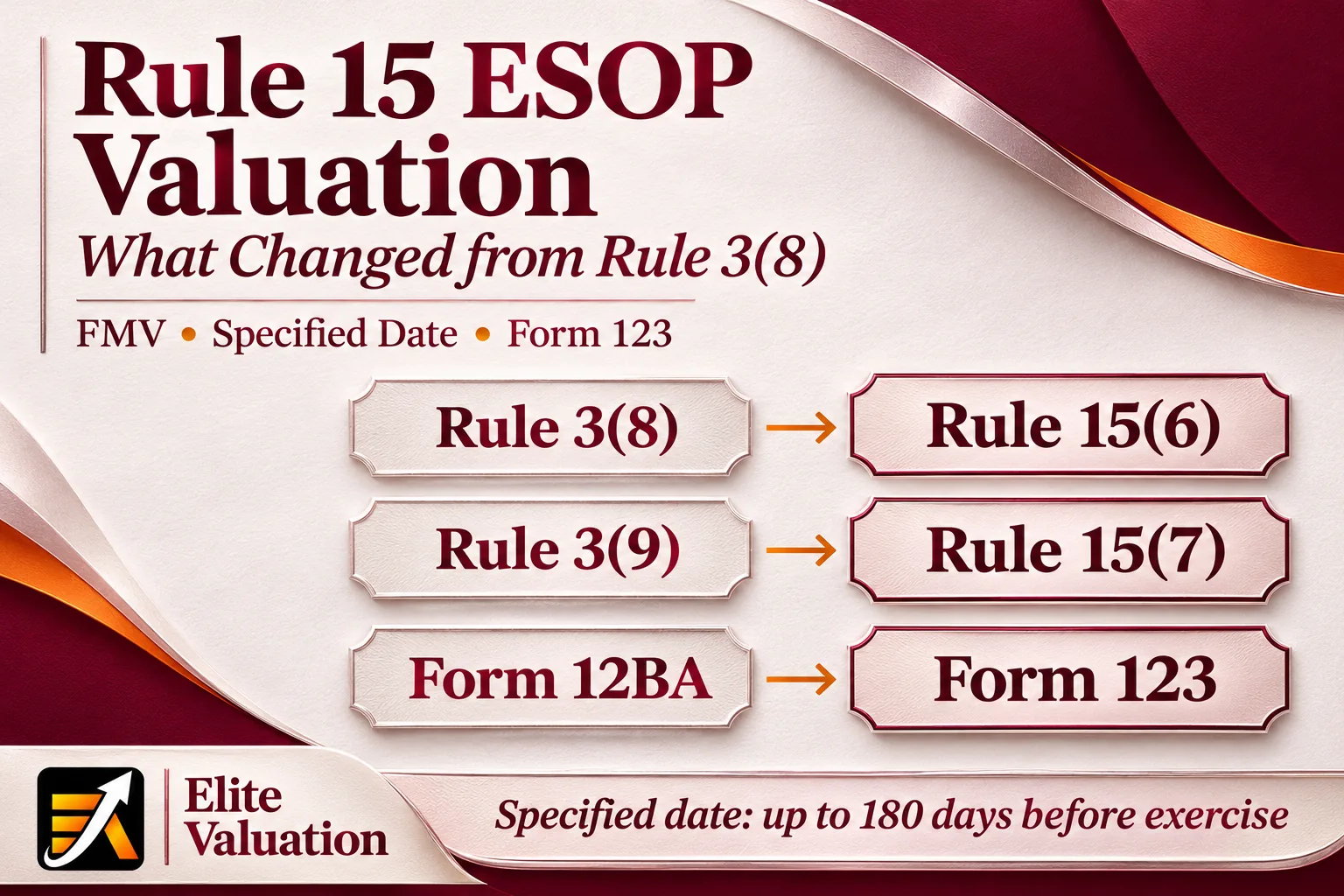
- Rule 15(6) replaces Rule 3(8) for equity shares. Rule 15(7) replaces Rule 3(9) for specified securities that are not equity shares.
- The parent provision is now section 17(1)(d) of the Income-tax Act, 2025, not section 17(2)(vi) of the Income-tax Act, 1961.
- For unlisted equity shares, the fair market value is the value determined by a Category I merchant banker on the specified date.
- The specified date is the exercise date or an earlier date not more than 180 days before exercise.
- Rule 15 does not prescribe a Valuation method for unlisted shares. A well-supported report should state the method, inputs and reasons.
- Listed shares use the average of opening and closing prices on the exercise date, from the exchange with the highest trading volume.
- Form 123 replaces Form 12BA where applicable; Rule 204(2) determines whether the statement is in Form 123 or Form 130.
- SEBI’s 2025 change for listed-company schemes and its 16 November 2026 informal guidance do not amend Rule 15. Confirm the certifier before each exercise.
This guide is for founders who run an ESOP scheme, CFOs who process exercises through payroll, and employees who want to know how their perquisite is computed. It also covers the points where SEBI’s recent valuer changes and the tax rule appear to pull in different directions. Our ESOP work is described in the ESOP consultant services page, and the rules for other share transactions are covered in our share Valuation guide.
What Is Rule 15 of the Income-tax Rules 2026 and Which Rule Did It Replace?
Rule 15 of the Income-tax Rules, 2026 sets out how perquisites are valued for salary tax. Its sub-rules 15(6) and 15(7) fix the fair market value of ESOP shares and other specified securities on the date an employee exercises the option. Rule 15(6) replaced Rule 3(8) of the 1962 Rules for equity shares, and Rule 15(7) replaced Rule 3(9) for other securities.
The perquisite for a stock option is charged under section 17(1)(d) of the Income-tax Act, 2025. The corresponding provision in the Income-tax Act, 1961 was section 17(2)(vi). The rule sets the value that goes into the perquisite, and the Act makes that value taxable as salary. Employers in Bengaluru and Mumbai that cite Rule 3 in option letters, board resolutions or payroll templates should update the citation, because exercises from 1 April 2026 fall under Rule 15. Exercises before that date remain governed by the 1961 Act and the 1962 Rules.
Commentary on the mapping is not consistent. Some sources place the unlisted-share limb under Rule 3(9) of the old rules. The 1962 text does not support that reading. Rule 3(9) covered specified securities that are not equity shares, and the unlisted equity limb sat in Rule 3(8). The new rules keep the same split: equity shares under Rule 15(6), other securities under Rule 15(7).
Old-to-new reference map
| Item | Income-tax Rules, 1962 | Income-tax Rules, 2026 | Status |
|---|---|---|---|
| Equity shares on exercise | Rule 3(8) | Rule 15(6) | Renumbered |
| Specified securities that are not equity shares | Rule 3(9) | Rule 15(7) | Renumbered |
| Definitions of merchant banker and specified date | Set out in Rule 3 | Set out in Rule 15(8) | Moved |
| Parent provision for the ESOP perquisite | Section 17(2)(vi), Income-tax Act, 1961 | Section 17(1)(d), Income-tax Act, 2025 | Renumbered |
| Statement of perquisites | Form 12BA, under Rule 26A | Form 123, under Rule 204(2) | Renumbered |
| Statutory basis for the statement | Section 192 | Section 392(5)(a) | Renumbered |
How Is the Fair Market Value of Listed ESOP Shares Set Under Rule 15(6)?
For a listed company, the fair market value is the average of the opening and closing prices on the exercise date, on a recognised stock exchange. Where the shares are listed on more than one exchange, the exchange with the highest trading volume decides the price. Where there was no trade on the exercise date, the closing price on the nearest earlier trading date applies.
Rule 15(6)(a) to (c) carry forward the three limbs that Rule 3(8) used for listed shares. Take a hypothetical listed employer in Mumbai whose stock opened at ₹300 and closed at ₹320 on the day an employee in Pune exercises. On the exchange with the highest volume, the fair market value is ₹310, and the exercise price is deducted from that figure to arrive at the perquisite per share. The same arithmetic applies in Ahmedabad or Bengaluru for a listed group company, provided the price source is the same.
- Confirm that the share is listed on a recognised stock exchange on the exercise date.
- If it is listed on more than one exchange, select the exchange that records the highest volume of trading in that share.
- Take the opening and closing prices on that exchange for the exercise date, and average them.
- If no trade took place on the exercise date, use the closing price on the nearest earlier date on which the share traded.
Keep the exchange record in the exercise file. A price taken from a news site or a broker’s screen is weaker evidence, and the Form 123 value will be the figure a reviewer traces back to a source. The record should show the exchange, the date, the opening and closing prices and the volume that decided the exchange selection.
How Is the Fair Market Value of Unlisted ESOP Shares Set Under Rule 15(6)(d)?
For an equity share that is not listed on a recognised stock exchange, Rule 15(6)(d) uses the value determined by a merchant banker on the specified date. Rule 15(8) defines the merchant banker as a Category I merchant banker registered with SEBI. The rule does not prescribe a Valuation method.
This is the limb that applies to startups and private companies in Gurugram, Delhi and Bengaluru, whose shares are not listed. The certifier must be a Category I merchant banker. Rule 15(6)(d) does not name an IBBI Registered Valuer for this limb, so a report prepared only under the Companies Act valuer framework does not meet the Category I merchant banker requirement on its own. Confirm the position with the company’s tax adviser before relying on a registered valuer report for an exercise.
The rule also does not say how the merchant banker should value the share. It asks only for the value determined on the specified date. The certifier chooses the method; a well-supported report should state the inputs, the approach and the reason for the choice. A report that gives a per-share figure without that content is hard to defend when a tax officer asks how the number was reached, and it leaves the employer with no answer to give.
Worked unlisted-share example
A Bengaluru company grants 2,000 options at an exercise price of ₹100 a share. An employee exercises on 1 March 2027. A Category I merchant banker’s report with a specified date of 1 February 2027 values the share at ₹400. That date is 28 days before exercise, so it falls inside the 180-day window. The perquisite is (₹400 less ₹100) multiplied by 2,000, which is ₹6,00,000. That amount is salary for the employee, and the employer deducts tax on it under section 392(1) and reports it on Form 123 where applicable.
Not Sure Which Valuer Your Exercise Needs?
Before an employee exercises, we review the valuer requirement, the specified date and the exercise timeline with you, so the perquisite figure is settled before shares are allotted.
Talk to Elite ValuationESOP Advisory | Rule 15 Review | Form 123 Support
What Is the Specified Date and How Long Is a Merchant Banker Report Valid?
The specified date is either the exercise date or any earlier date that is not more than 180 days before the exercise date. A merchant banker report with a specified date inside that window can support the exercise. An exercise outside the window needs a new report.
The specified date is the date at which the merchant banker values the share. Rule 15(8) allows it to be the exercise date itself, or any earlier date that falls no more than 180 days before the exercise. That creates a window that runs backwards from the exercise date. The Valuation date does not have to match the exercise day, but the exercise must fall within 180 days after it. Companies in Ahmedabad, Pune and Delhi that stagger exercises across a quarter should therefore plan the specified valuation date around the exercises they expect to make, rather than rely only on the report issue date.
Check the 180-day boundary
A Gurugram company obtains a merchant banker report with a specified date of 15 January 2027. On a plain count of 180 days, the last exercise date that report can support is 14 July 2027. An employee who exercises on 20 July 2027 needs a specified date no earlier than 21 January 2027, so the 15 January report cannot be used for that exercise, and a fresh report is needed. Companies with staggered exercise windows should record the last permitted exercise date on the report when it is issued.
One report can cover several exercises that fall inside its window, because each exercise is tested against the same specified date. It cannot cover an exercise outside the window, even if the share price has not moved. The reference point is the exercise date, not the grant date or the date of allotment, so a report that was fresh at grant can be stale at exercise.
What Changed From Rule 3(8) to Rule 15(6), Point by Point?
On the points that drive the number, Rule 15(6) matches Rule 3(8). The changes sit in the citation, the parent section, the location of the definitions and the reporting form. Treating the new rule as a new Valuation regime for ESOP perquisites overstates the change.
The table below compares the two rules on the points that decide an ESOP perquisite. The right-hand column states what each change means for an employer or founder preparing an exercise in Mumbai, Bengaluru or Gurugram.
Valuation and reporting comparison
| Point | Rule 3(8) and 3(9), 1962 Rules | Rule 15(6) to 15(8), 2026 Rules | What it means in practice |
|---|---|---|---|
| Date of fair market value | Date on which the option is exercised | Same date, under Rule 15(6) | No change to the reference date |
| Listed shares | Average of opening and closing prices, highest-volume exchange, nearest earlier trading day | Same three limbs in Rule 15(6)(a) to (c) | The price evidence stays the same |
| Unlisted equity shares | Value determined by a merchant banker on the specified date | Same test in Rule 15(6)(d) | The certifier is still a Category I merchant banker |
| Non-equity specified securities | Merchant banker on the specified date (Rule 3(9)) | Merchant banker on the specified date (Rule 15(7)) | Renumbered only |
| Specified date | Exercise date, or an earlier date not more than 180 days before it | Same two limbs and 180 days, defined in Rule 15(8) | The window is unchanged |
| Parent provision | Section 17(2)(vi), Income-tax Act, 1961 | Section 17(1)(d), Income-tax Act, 2025 | Cite the new section in offers, resolutions and forms |
| Perquisite statement | Form 12BA, under Rule 26A | Form 123, under Rule 204(2) | New form under Rule 204(2), where applicable |
Update exercise and payroll templates
The practical change is the citation. Option agreements, board resolutions, employee letters and payroll sheets that cite Rule 3(8) should be updated for exercises from 1 April 2026. The test itself does not need to be rebuilt. A scheme with exercises in Gurugram in 2026-27 and in Mumbai in 2025-26 will therefore carry two citations in its records, one for each exercise year, and both are correct for the year concerned.
The change that needs more care is the reporting form. A perquisite that was reported on Form 12BA in earlier years is reported on Form 123, where applicable under Rule 204(2), for the 2026 framework. Payroll teams should check that the template fields match the new form, because the values carried into the statement must reconcile with the salary TDS records.
Does the Merchant Banker Requirement Still Apply After SEBI’s 2025 and 2026 Changes?
Yes, for the tax limb. SEBI’s December 2025 amendment changed the SBEB Regulations’ definition of “valuer” to refer to Section 247 of the Companies Act, effective 2 January 2026. That applies where those regulations call for a valuer; it does not replace every scheme-related valuation requirement. Rule 15(6)(d) still requires a Category I merchant banker for unlisted equity shares.
Three regimes can touch the same employee option, and each one asks for a different valuer. A listed company in Mumbai and an unlisted start-up in Bengaluru face different valuer rules for their ESOP schemes, because the answer turns on listing status and purpose, not on location. The list below sets the three regimes out so that the right certifier is chosen before the exercise, not after it.
Match the engagement to its purpose
- Listed company under the SBEB Regulations. Where these regulations require a “valuer”, the current definition refers to Section 247 of the Companies Act, 2013. Confirm the particular provision and purpose; it is separate from employee-perquisite valuation under Rule 15.
- Unlisted company, perquisite tax under Rule 15(6)(d). The fair market value on exercise is determined by a Category I merchant banker registered with SEBI, on the specified date.
- Companies Act purposes. Where the Companies Act requires a registered valuer, for example for sweat equity under the share capital rules, that requirement applies in addition to Rule 15. It does not replace it.
How to read the informal guidance
SEBI’s 16 November 2026 letter to Navigant Corporate Advisors addresses merchant-banker valuation activities under Regulation 13A. It discusses registration with the relevant regulator, including Section 247 registration. The letter states the relevant department’s fact-specific enforcement position, not a Board decision. It does not amend Rule 15 or substitute registered-valuer status for Category I merchant banker status. Record the applicable registrations and engagement purpose in the exercise file.
Which Valuer Does Each Use of Your ESOP Need?
Elite Valuation maps each ESOP Valuation to its own valuer requirement, from the Companies Act to the tax rule, so that one engagement does not fail on a different test.
Contact Elite ValuationESOP Valuation | Rule 15 Mapping | Companies Act Valuation
How Is the ESOP Perquisite Reported in Form 123 and Deducted Through TDS?
Form 123 replaces Form 12BA and is issued under Section 392(5)(a), read with Rule 204(2), when annual salary as defined for that rule exceeds ₹1,50,000. Otherwise the prescribed perquisite particulars go in Form 130. Salary TDS generally follows Section 392(1), subject to applicable exceptions.
Form 123 shows the value of each perquisite as computed under the rules, any amount recovered from the employee, the amount chargeable to tax and the tax deducted or paid. For an ESOP, the value entered is the perquisite on exercise: the fair market value under Rule 15 less the exercise price paid, multiplied by the number of shares. Payroll teams in Pune, Gurugram and Bengaluru should reconcile that value with the merchant banker certificate or the exchange record, and with the exercise register, before the financial year closes.
Payroll reconciliation steps
- Fix the exercise date, the number of shares exercised and the exercise price from the signed exercise notice.
- Obtain the certificate for the unlisted limb, or the exchange price record for the listed limb, with the specified date shown.
- Compute the perquisite as the fair market value less the exercise price, multiplied by the number of shares.
- Deduct tax on the perquisite through payroll under section 392(1) of the Income-tax Act, 2025.
- Enter the value on the applicable statement, Form 123 or Form 130, and reconcile it with the salary TDS records for the year.
Eligible startup tax deferral is separate from Rule 15. Its conditions must be tested under Sections 140, 392(3) and 289(3) of the Income-tax Act, 2025; the valuation rule alone does not confer the relief.
Where Do Founders and Employers Go Wrong Under Rule 15? Common Mistakes
Six errors show up most often in ESOP perquisite files, whether the company is in Mumbai, Ahmedabad or Delhi. The first two change the perquisite itself, so they cost the most. Each card shows the consequence and the fix.
Using the grant-date price for the exercise
Founders carry the price from the grant or the last funding round into the exercise, because it is the figure already on file.
Perquisite and TDS are understated, and the shortfall is raised in a later assessmentUse the fair market value on the exercise date or on a specified date within the 180-day window.
Relying on a report after its window has closed
The specified valuation date is months before the exercise, and nobody diarises the 180-day limit.
The report cannot support the perquisite, and a second Valuation is needed at short noticeWrite the last permitted exercise date on the report and obtain a fresh certificate for any later exercise.
Assuming a registered valuer report satisfies the unlisted limb
A report from an IBBI Registered Valuer is accepted for every tax test without checking the certifier category the rule names.
The certifier does not match Rule 15(6)(d), and the perquisite value can be challengedConfirm in writing that the certifier is a Category I merchant banker registered with SEBI before the specified date.
Using one price point for a listed share
The closing price is used alone on a trading exercise date, or a broker-screen price is taken without the exchange record.
The fair market value differs from the rule’s average, and the Form 123 value cannot be traced to a sourceFor a trading exercise date, use the prescribed opening/closing average. If there is no trading that day, apply the preceding closing-price rule, selecting the highest-volume exchange where required. Keep the exchange record.
Citing the 1962 rule and form for exercises after 1 April 2026
Option letters, resolutions and payroll sheets are copied forward from an older scheme without a citation check.
The statement is reported on a form that no longer applies, and it is hard to reconcile with salary TDSUpdate templates to cite Rule 15(6) and 15(7), section 17(1)(d) and the applicable Form 123 or Form 130 statement for the 2026 framework.
Stating a value without the method behind it
The report gives a per-share figure with no method, inputs or reasons, on the view that Rule 15 does not require one.
A tax officer or auditor cannot test the figure, and the report is hard to defendState the method, the key inputs and the reason for the choice, with the source of each input.
How Does Elite Valuation Support ESOP Perquisite Valuations?
Elite Valuation is an independent Valuation firm based in Ahmedabad with pan-India operations. Sagar Shah, the Founder, holds CA, CS and IBBI Registered Valuer credentials and has an Ex-Ernst & Young background. Our ESOP work covers scheme design, grant pricing, Ind AS 102 expense support and the Rule 15 review that sits before an exercise, for clients across India. For a company in Mumbai or Pune with an exercise due, the review starts with the valuer requirement, the specified date and the perquisite workings. Where Rule 15(6)(d) requires a Category I merchant banker to certify the fair market value, that certificate must come from the merchant banker, and that division of work should be agreed in writing.
| Need | What Elite Valuation provides | Where to start |
|---|---|---|
| ESOP scheme design and grant pricing | Scheme structure, pool sizing and grant price support | ESOP consultant services |
| Rule 15 review before exercise | Valuer requirement, specified date planning and perquisite workings | Contact us |
| Ind AS 102 expense support | Fair value inputs for the accounts of the scheme | Contact us |
| Share or company Valuation | Valuation for transfers, fundraises and sweat equity | Share Valuation and Company Valuation |
Related services and guides
- ESOP advisory: scheme design, grant pricing and ESOP compliance support
- Share Valuation: share price support for a fundraise, an ESOP grant or a transfer
- Company Valuation: enterprise and equity value behind a sale, a merger or a round
- When company Valuation is mandatory: the statutory triggers that apply to your company
- Contact us: share the grant, the exercise plan and the listing status to get a scope in writing
What should a founder or employer take from Rule 15?
Rule 15(6) and Rule 15(7) replaced Rule 3(8) and Rule 3(9) for exercises from 1 April 2026. The citation, the parent section and the reporting form have changed. The test for unlisted equity still needs a Category I merchant banker, a specified date no more than 180 days before exercise, and a stated method.
Before each exercise, confirm the certifier, diarise the last permitted exercise date, use the exchange record for listed shares and report on Form 123 where applicable. Treat SEBI’s 2025 change for listed schemes and the Companies Act valuer requirements as separate questions, not as a replacement for Rule 15.
Have an ESOP Exercise Coming Up?
Send us the grant date, the exercise date, the number of options, the exercise price and whether the company is listed. We will confirm the valuer requirement, the specified date and the perquisite workings in writing.
Contact Elite ValuationESOP Advisory | Rule 15 Review | Form 123 Support | Share Valuation
Frequently asked questions about Rule 15 ESOP Valuation
Which rule values ESOP shares for perquisite tax from 1 April 2026?
Rule 15(6) of the Income-tax Rules, 2026 sets the fair market value of equity shares, including sweat equity shares, on the date an employee exercises an option. Rule 15(7) covers specified securities that are not equity shares. Both rules apply to exercises from 1 April 2026 under section 17(1)(d) of the Income-tax Act, 2025. They replaced Rule 3(8) and Rule 3(9) of the Income-tax Rules, 1962, which governed exercises under the 1961 Act.
Did Rule 15 change the Valuation test from Rule 3(8)?
On the points that drive the number, no. The fair market value is still taken on the exercise date, listed shares still use the average of opening and closing prices, and unlisted equity shares still use a value determined by a Category I merchant banker on the specified date. What changed is the rule number, the parent section, the location of the definitions and the form that reports the perquisite. Commentary that reads the new rule as a new Valuation regime overstates the change.
Who must determine the fair market value of unlisted ESOP shares for tax?
Rule 15(6)(d) requires the value to be determined by a merchant banker on the specified date. Rule 15(8) defines that merchant banker as a Category I merchant banker registered with SEBI. The rule does not name an IBBI Registered Valuer for this limb. Before relying on a registered valuer report for an exercise, confirm the position with the company’s tax adviser, because registered valuer status alone does not meet the merchant banker requirement.
What is the specified date for an ESOP exercise?
The specified date is either the exercise date or an earlier date that is not more than 180 days before the exercise date. A merchant banker report with a specified date inside that window can support the exercise. Count the window back from the exercise date, not forward from the grant date or the allotment date. An exercise outside the window needs a fresh report with a later specified date.
Can one merchant banker report cover several exercises?
Yes, provided each exercise falls within 180 days after the specified date of that report. Each exercise is tested separately against the window. If the report is used for an exercise after the window closes, the perquisite cannot be supported by that report. Companies with staggered exercise windows should record the last permitted exercise date on the report when it is issued.
How is the fair market value of listed ESOP shares determined?
Rule 15(6)(a) to (c) use the average of the opening and closing prices on the exercise date on a recognised stock exchange. Where the shares are listed on more than one exchange, the exchange with the highest trading volume decides the price. Where there was no trade on the exercise date, the closing price on the nearest earlier trading date applies. Keep the exchange record with the exercise file.
Does Rule 15 prescribe a Valuation method for unlisted shares?
No. Rule 15(6)(d) asks only for the value determined by the merchant banker on the specified date. The certifier chooses the method, such as a net asset or discounted cash flow approach, and should set out the inputs, the approach and the reason for the choice. Adopting a method from another rule without explaining the choice weakens the report under review by a tax officer or auditor.
Which form reports an ESOP perquisite from 1 April 2026?
Form 123 reports the perquisite. The Ministry of Finance FAQ maps Form 123 to Form 12BA under the 1962 Rules, and states that it is issued under section 392(5)(a) of the Income-tax Act, 2025, read with Rule 204(2) of the Income-tax Rules, 2026. The form shows the value of each perquisite under the rules, any amount recovered from the employee, the amount chargeable to tax and the tax deducted. Under Rule 204(2), Form 123 applies where annual salary, as defined for that rule, exceeds ₹1,50,000; otherwise particulars go in Form 130.
Did SEBI’s Valuer changes amend Rule 15?
No. The December 2025 amendment changed the SBEB Regulations’ definition of “valuer” to refer to Section 247, effective 2 January 2026. Rule 15(6)(d) still requires a Category I merchant banker for unlisted equity shares. SEBI’s 16 November 2026 letter to Navigant discusses applicable registration requirements for merchant-banker valuation work; it is a fact-specific departmental position and does not amend the tax rule.
When is tax payable on an ESOP, and how is the perquisite computed?
The employment perquisite concerns shares allotted or transferred pursuant to exercise; the prescribed FMV is measured by reference to the exercise date, not the grant date. Deduct the amount paid from that FMV and multiply by the shares. Salary TDS generally follows Section 392(1), subject to applicable exceptions. Use Form 123 where Rule 204(2) requires it, otherwise Form 130. Eligible startup deferral is a separate question.
Sources
- Notified Income-tax Rules, 2026: Rule 15 on share FMV and Rule 204 on perquisite statements.
- Income Tax Department: historical Rule 3, including sub-rules (8) and (9).
- Income Tax Department: Form 123 FAQs and its mapping from Form 12BA.
- SEBI consolidated SBEB and Sweat Equity Regulations: current definition of valuer.
- SEBI informal guidance to Navigant Corporate Advisors, 16 November 2026: merchant-banker valuation registrations.
Get the ESOP Perquisite Right the First Time
Whether the shares are listed or unlisted, Elite Valuation checks the certifier, the specified date and the perquisite workings before the exercise, so the Form 123 figure holds up under review.
Book an ESOP ReviewESOP Advisory | Rule 15 Review | Form 123 Support | Share Valuation

Disclaimer. This article is general information only. It is not legal, tax, accounting or investment advice, and it is not a Valuation of any share, company or option. The figures are hypothetical. Treatment depends on the applicable tax year, security, scheme terms and individual circumstances. Obtain advice from a qualified professional for your situation.