Introduction: The Complexity of Tech Asset Valuation in India
Indian IT companies rarely keep their software in one simple place. The code may sit in an Indian operating company, the intellectual property in an overseas holding company, and the customer contracts in a parent company abroad. Revenue may come from subscriptions, long-term services contracts or licences granted to overseas clients. Each structure changes what is being valued, and each one raises a different question for the buyer, the investor, the auditor and the tax officer.
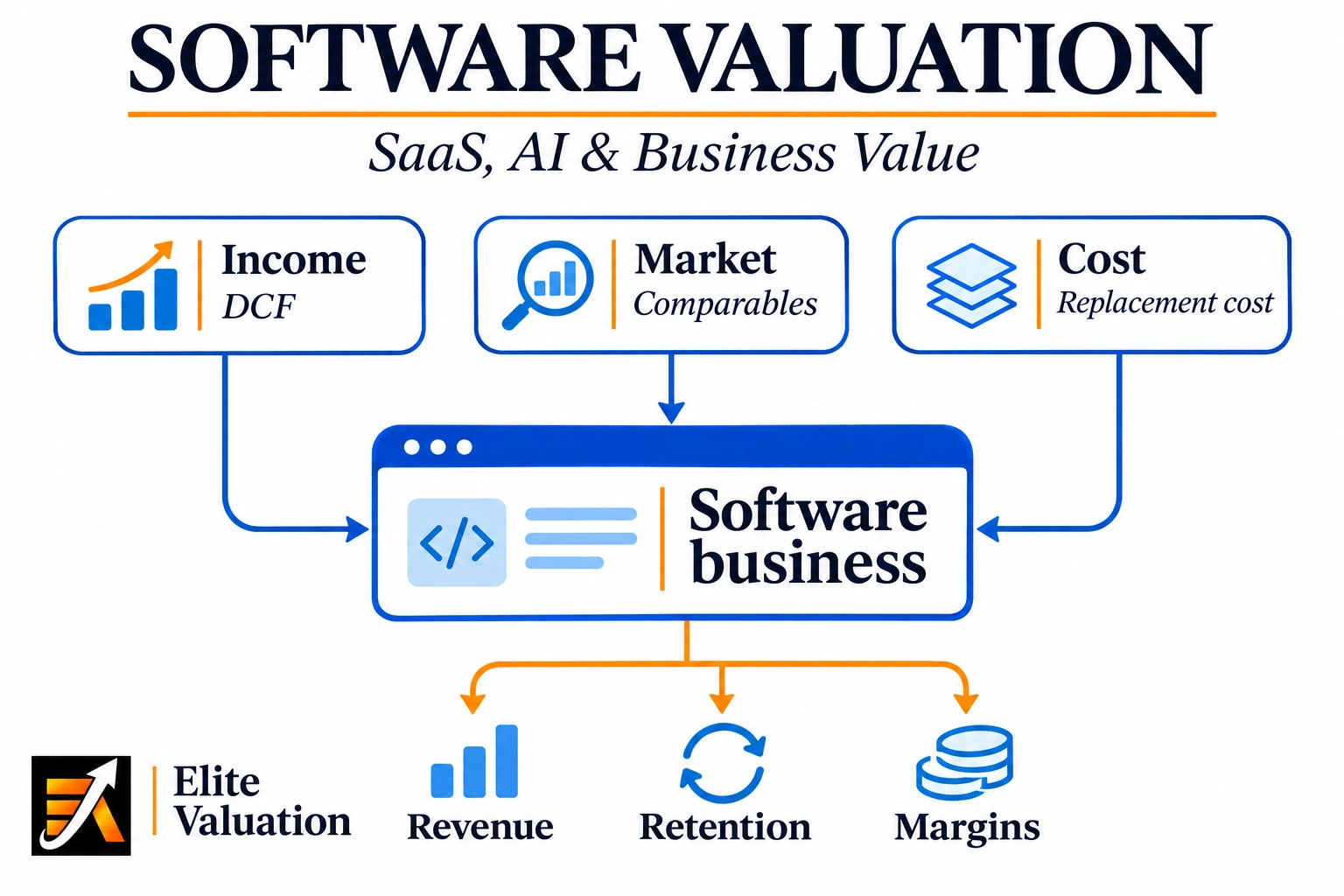
There is no single best approach. For most Indian IT companies, the income approach leads where the software earns identifiable revenue, the cost approach fits internal or pre-revenue software, and the market approach serves as a cross-check. The purpose of the Valuation and the Indian rules that apply then decide the final method.
That is why the first question most CFOs and founders ask is: what is the best approach for software Valuation for an Indian IT company? No single method is best in every case. The approach that works depends on how the software earns money, what records the company keeps and why the Valuation is needed. A method that suits a licensed SaaS platform can mislead for an internal ERP customisation, and a method that suits a pre-revenue product can understate a mature platform with paying customers.
How the purpose shapes the method
Indian IT companies and SaaS businesses need software Valuations for several recurring reasons. Investors and acquirers want a defensible figure for the technology. Post-acquisition accounting requires a purchase price allocation under Ind AS 103. A slump sale or a transfer of IP can trigger tax computations. A non-resident investor brings FEMA pricing rules into play. Impairment testing under Ind AS 36 may depend on the value of a software-heavy cash-generating unit. Each purpose has its own rules, and one number seldom satisfies all of them without a documented reconciliation.
Indian private markets add to the difficulty. Most private software transactions do not disclose price or terms. The Rule 57 commentary we reviewed does not prescribe a method for software intellectual property, so the valuer has to build the answer from the economics of the revenue, the cost of rebuilding the code and the terms on which the IP could be licensed. For the wider framework on when a Valuation is required by law, see our guide on when company Valuation is mandatory in India.
Key takeaways
- There is no single best approach to software Valuation for an Indian IT company. The purpose, the asset and the available data decide the method.
- Lead with the income approach where the software earns identifiable revenue. Use relief-from-royalty for the technology and MPEEM for customer relationships.
- Use the cost approach for internal-use or pre-revenue software, and treat its result as a floor where the software already earns revenue.
- Treat the market approach as a cross-check, because disclosed Indian private software deals are scarce.
- Keep the Ind AS 103 purchase price allocation, the slump sale computation and the tax value separate, since each rule has its own inputs and signatory.
- Confirm that the company owns the code outright before any software figure is shared with an investor or buyer.
The Three Leading Approaches to Software Valuation
Valuation practice recognises three approaches for intangible assets: the cost approach, the income approach and the market approach. The International Valuation Standards set out this framework in IVS 210 on intangible assets, and the ICAI Valuation Standards follow the same logic. Each approach answers a different question. The cost approach asks what it would take to build the software again. The income approach asks what the software will earn. The market approach asks what buyers have paid for similar software.
Four tests help decide which approach should lead:
- Does the software earn revenue that can be traced to it? If yes, lead with the income approach.
- Is the software internal, pre-revenue or easily replaced? If yes, lead with the cost approach.
- Are there disclosed transactions or licence rates for similar software? If yes, use the market approach as a cross-check.
- Does the purpose require a particular basis, such as fair value under Ind AS 113 or a tax value under Rule 57? If yes, the rule overrides the default choice.
| Approach | Best used when | Main input | Main weakness | Anchor standard or rule |
|---|---|---|---|---|
| Cost | Software is pre-revenue, internal-use or easily replaced | Replacement effort, labour rates, obsolescence | Ignores the earnings a platform already produces | IVS 210; Ind AS 38 for the accounting context |
| Income | Software earns identifiable revenue | Attributable revenue, royalty rate or contributory charges, discount rate | Sensitive to revenue attribution and forecast assumptions | Ind AS 103 and Ind AS 113 for purchase price allocation; IVS 210 |
| Market | Comparable deals or licence rates exist | Multiples and royalty benchmarks | Few disclosed Indian private transactions | IVS 210; comparability tests under the ICAI Valuation Standards |
1. The Cost Approach (Reproduction vs. Replacement Cost)
The cost approach estimates what it would cost to create the software today, then deducts any loss in value from age, weak design or lost functionality. It is the easiest approach to explain, and often the only one available for an early-stage product or an internal tool that earns no direct revenue.
Two variants are used. Reproduction cost is the cost of building an exact copy of the existing software, with the same code, design and features. Replacement cost is the cost of building a functionally equivalent system with current architecture and technology. Replacement cost is the more common basis for commercial Valuations, because a buyer rarely wants to pay for code built on an outdated design, and it avoids paying for features the buyer would not use.
A cost estimate usually includes architecture and design effort, developer and tester hours at market rates, quality assurance, infrastructure set-up, project management and a developer margin. It then deducts obsolescence: functional obsolescence where the design is outdated, technical obsolescence where the technology stack is no longer supported, and economic obsolescence where the market no longer needs the product.
When to apply the cost approach
- Pre-revenue startups where revenue forecasts are not yet reliable and the Valuation supports an early funding round.
- Internal-use software such as HR, finance or operations platforms, which has no separate revenue stream.
- Software that a buyer could rebuild within a reasonable time, which sets a practical ceiling on the price.
The cost approach has a limit that deal teams often miss. It gives a floor, or a measure of replacement effort, not the value of software that already earns revenue. A platform generating crores of revenue from a loyal customer base is worth more than the cost of rebuilding its code, and a Valuation that stops at cost will understate it.
Labour rates need care too. If the estimate uses Indian developer salaries for a buyer that would rebuild the software in a higher-cost market, the estimate understates the true replacement effort. The rate should reflect who would actually build the software, and where.
A word on accounting. The capitalised development cost in a company’s books is not a Valuation. Under Ind AS 38, development expenditure is recognised as an intangible asset only when the company demonstrates the criteria in paragraph 57, including technical feasibility and the ability to complete and use the asset. The balance sheet figure therefore reflects those tests and the company’s accounting choices, not the market value of the software. A cost approach Valuation starts afresh from the effort needed to build the software.
2. The Income Approach (MPEEM & Relief-from-Royalty)
The income approach values software by the economic benefit it produces. Two methods are used most often for software in Indian IT companies. Relief-from-royalty works best for a technology asset that could be licensed to others. The multi-period excess earnings method (MPEEM) works best for the primary asset in a business, or for a customer relationship that depends on the software.
Relief-from-royalty
Relief-from-royalty estimates the royalties the owner avoids because it owns the software and does not have to licence it. The analyst forecasts the revenue that depends on the software, applies a royalty rate supported by licence evidence, deducts tax and discounts the resulting cash flows. Where the tax law allows depreciation on the asset, a tax amortisation benefit is added. The result is only as good as two inputs: the revenue attributed to the software and the royalty rate.
Royalty rates should come from documented sources, such as licence agreements the company or its peers have signed, published royalty benchmarks, or a profit-split analysis. A rate picked from a general rule of thumb is hard to defend. The rate should also reflect the exclusivity granted, the territory, the remaining legal life of the rights and the support the licensor provides.
Multi-period excess earnings method (MPEEM)
MPEEM values the software as the excess earnings of the business that remain after paying a fair return on every other asset that contributes to them. Those contributory charges usually cover working capital, fixed assets, the workforce and other intangibles such as the brand. The excess earnings attributable to the software are forecast over its economic life, adjusted for attrition or churn in the customer base where relevant, and discounted to present value.
The method is sensitive to the contributory charges. A low charge on the workforce, for example, can attribute too much profit to the software, because services-led IT companies depend heavily on people. Deal teams should test each charge and show how the result moves when it changes.
When to apply the income approach
- Cash-generating proprietary software, including licensed SaaS platforms and products sold under term licences.
- Mature IP that commands a market premium because customers would find switching costly.
- Customer contracts and relationships tied to a platform, where MPEEM is the usual method.
Discount rates for Indian software assets are usually built from an Indian risk-free rate, an India equity risk premium, a size premium where relevant and an intangible-specific risk premium. The discount rate must match the cash flows. A high-growth platform with uncertain adoption needs a different rate from a mature product with contracted revenue.
3. The Market Approach (Comparable Transactions)
The market approach values software by reference to what buyers have paid for similar businesses, or what licensees have paid for similar technology. Common measures are enterprise value to revenue, enterprise value to EBITDA and royalty rates drawn from licence agreements. Where the data exists, this approach links the Valuation directly to the market.
The difficulty in India is data. Most private software transactions do not disclose their price, terms or earn-outs, and listed Indian software companies are larger and more liquid than most targets. A multiple taken from a listed company must therefore be adjusted for size, liquidity and growth, and a discount for lack of marketability may be needed for a private business. Commercial deal databases can help, but their coverage of Indian private software deals is partial, and the valuer must show why each comparable is genuinely comparable.
Currency adds another layer. Many Indian IT companies earn revenue in US dollars or euros, while comparables may report in a different currency or use a different revenue definition. Convert on a consistent basis, and state the date of each exchange rate.
The market approach is therefore best used as a cross-check, or to source royalty rates for the income approach. Using one headline multiple as the Valuation is the most common error in this area, and the mistakes section below covers it.
Struggling to determine the right Valuation method for your proprietary tech?
Connect with Elite Valuation’s technology asset experts for a defensible Valuation strategy.
Discuss your technology asset with Elite ValuationValuation | Intangible Asset Valuation | Purchase Price Allocation | FEMA and Tax Compliance
Illustrative Scenario: SaaS Startup vs. Legacy IT Firm Valuation
The two scenarios below are hypothetical. They are not drawn from a client file, and their figures are chosen to show how method choice works, not to describe any real company.
Scenario A: Valuing a High-Growth SaaS Startup
Consider a hypothetical Indian SaaS company with annual recurring revenue of ₹40 crore, growing at about 35% a year, with net revenue retention above 110% and an EBITDA margin still below zero. Its platform is sold to customers on annual subscriptions. The founders spent several years building the code, and the development cost sits in the books at a fraction of the value customers place on the product.
A cost approach would value the platform at what it would cost to rebuild. That figure is a floor, and a poor guide to value, because the company earns ₹40 crore a year from the product. A buyer pays for the subscription revenue the platform keeps alive, not for the lines of code.
The income approach should lead. A relief-from-royalty analysis starts by attributing subscription revenue to the software, because the software is what customers buy. Suppose the analyst applies a 15% royalty rate to ₹40 crore of revenue. That gives ₹6 crore a year before tax, or about ₹4.5 crore after an illustrative tax rate of 25%. The forecast then runs over the platform’s economic life, reflecting growth and churn, and is discounted at a rate that reflects the company’s stage and risk.
The market approach serves as a cross-check. Indian private software deals rarely disclose terms, so the analyst would use ranges from published sources, adjust for size and growth, and check whether the implied figure is consistent with the income result. The cost approach stays on file as a floor. The Valuation is the income result, tested against the other two.
Scenario B: Valuing a Legacy IT Services Company
Now consider a hypothetical IT services company, founded two decades ago, that earns most of its revenue from enterprise contracts for software development and maintenance. It also runs internal tools for delivery, finance and human resources. The company built these tools over many years, and no customer pays for them directly.
For the internal tools, the cost approach is usually the right basis. The tools produce no separate revenue, so the analyst estimates the replacement cost of a functionally equivalent system, deducts obsolescence for the older parts and reports the result as the value of the tools to the business. This is a sensible use of the method. The more likely error is overstating the tools by ignoring obsolescence.
For the enterprise contracts, MPEEM is the usual choice. The analyst forecasts the earnings from each contract over its remaining life, deducts contributory charges for the workforce, working capital, fixed assets and the internal tools that support delivery, and discounts the remaining excess earnings. Attrition is built into the forecast, because enterprise contracts renew with varying probability.
In an acquisition, the buyer records these customer relationships separately from goodwill under Ind AS 103, and the same MPEEM analysis supports the purchase price allocation. The internal tools may be recorded at replacement cost less obsolescence, while the contracts carry the value of the earnings they produce. The two methods work together, and the valuer should explain why each asset is valued the way it is.
Purpose-Driven Valuation: Why Do You Need a Software Valuation?
The purpose of a Valuation sets the standard it must meet. Investors judge a figure prepared for a funding round on commercial grounds. Auditors judge a purchase price allocation against Ind AS. A tax computation is judged against a specific rule. Software Valuations prepared for one purpose often fail when they are reused for another, so the first step is to write the purpose down and identify the rule that governs it.
Mergers and Acquisitions (M&A) and Fundraising
Investors and strategic acquirers want to know what the technology is worth, and how much of the price depends on it. In a fundraising, the software Valuation supports the ask. In an acquisition, it supports the price, the deal structure and the representations. Buyers test the figure against the data room, so the valuer should expect questions on ARR definitions, retention, unit economics and the margin behind any EBITDA figure.
Ownership is the first test buyers apply. A software Valuation is worth little if the company does not own the code outright. Diligence teams check employee and contractor assignment agreements, founder contributions made before incorporation, open-source licence obligations and the ownership of trademarks and domain names. A gap found late in a deal usually leads to a price adjustment, a holdback or a specific indemnity, so these checks should come before the Valuation is shared.
Fundraising also has a tax boundary. For unquoted equity shares, Rule 57 of the Income-tax Rules, 2026 (previously Rule 11UA) sets a net asset value basis for tax purposes. A commercial round price is a separate question. The two figures can differ widely for a software company whose value lies in contracts and capitalised development that the balance sheet does not fully carry. The commentary we reviewed also places compulsorily convertible preference shares outside the equity row of Rule 57, which points to a different Valuation route for CCPS. Keep the tax value and the commercial price apart, document the reason for any difference, and confirm the CCPS treatment against the notified text. For how share Valuation works in practice, see our share Valuation guide for India.
Purchase Price Allocation (PPA) under Ind AS 103
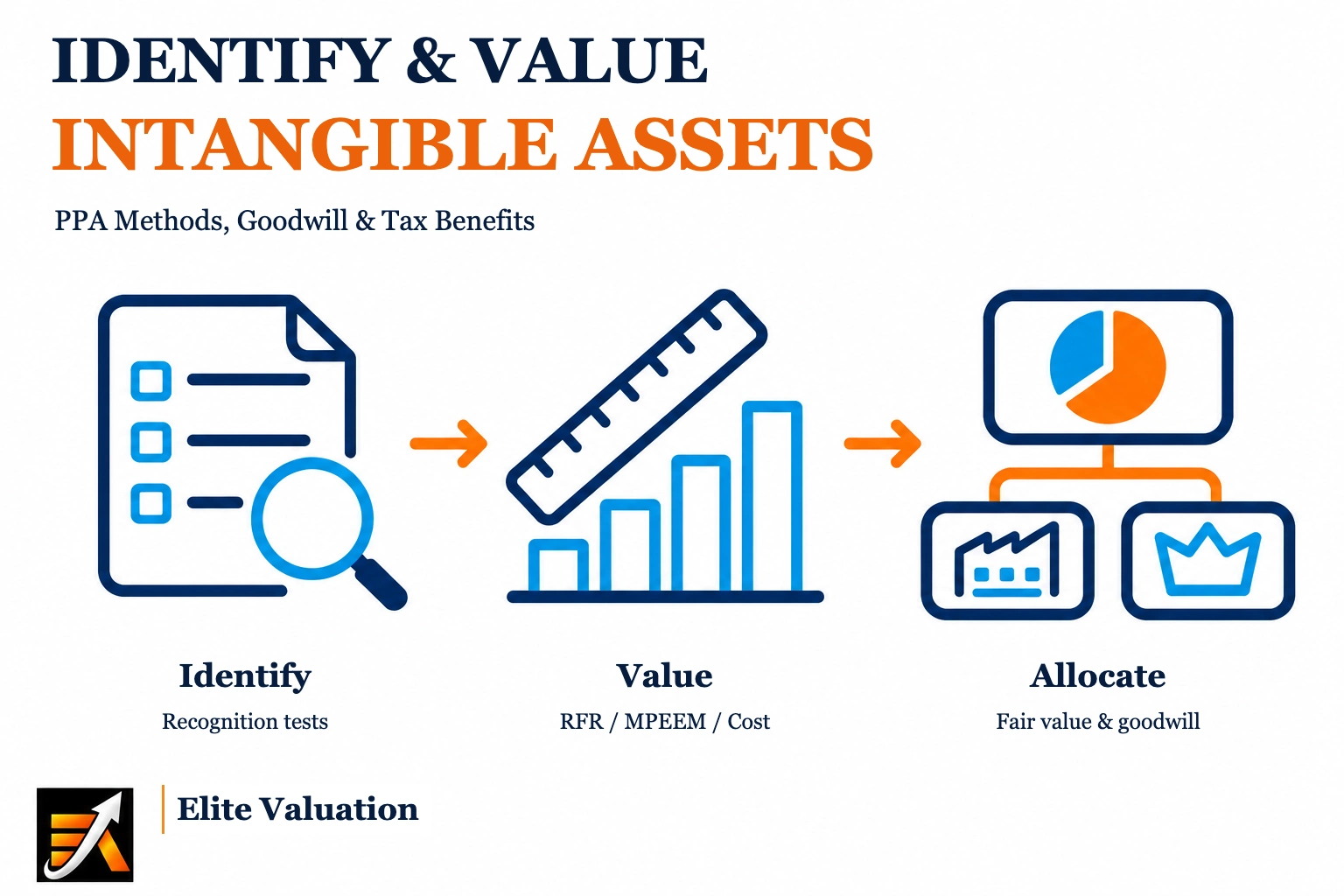
When one company acquires another, Ind AS 103 requires the acquirer to measure the identifiable assets acquired and liabilities assumed at fair value. Any excess of the price over the net identifiable assets is goodwill. Software sits at the centre of this exercise for most Indian IT and SaaS targets, because the technology, the customer relationships and the trademarks are often the most valuable identifiable intangibles.
A point that surprises many finance teams is that the acquirer recognises identifiable intangible assets even when the target never recognised them. A target that expensed all its development costs can still hold a valuable acquired technology. The acquirer must identify and value that technology separately from goodwill, provided it meets the identifiability test under Ind AS 103, which is met where the asset is separable or arises from contractual or other legal rights.
Three consequences follow for software. First, the valuer must separate the technology from goodwill, and value the customer relationships and trademarks on their own bases. Second, the acquired software is amortised over its useful life, which depends on the product roadmap as well as the legal term. Third, a deferred tax liability usually arises under Ind AS 12 where the fair value of an acquired intangible exceeds its tax base. Goodwill is not amortised, but it is tested for impairment under Ind AS 36 at least annually.
The measurement period allows provisional amounts to be revised for up to one year from the acquisition date, where new information about facts that existed at that date comes to light. Plan the software Valuation so that it can be updated within that window.
Slump Sales and Tax Compliance under the Income-tax Act, 2025
A slump sale transfers an undertaking as a going concern for a single lump sum, without assigning values to the individual assets and liabilities. From 1 April 2026 the Income-tax Act, 2025 governs these transfers, and the capital gains computation sits in Section 77 of the Act. Section 77 replaces Section 50B of the Income-tax Act, 1961, which covered the same ground for transfers up to 31 March 2026.
The computation measures the gain against the net worth of the undertaking, which the section treats as the cost of acquisition. Net worth is computed under the section’s own rules, and it is normally not a software Valuation. Commentary on the new section indicates that the consideration is also measured against a prescribed fair value where that figure is higher, so a price below that value does not reduce the gain. This is where a credible software Valuation becomes important. Confirm this against the notified text before a transaction is structured on it.
Two practical points follow. The Act has historically required an accountant’s certificate that the net worth has been correctly computed, and the draft rules include a prescribed form of accountant’s report for slump sales. A separate software Valuation is not automatically needed for the net worth computation. It becomes necessary where the price is challenged against the prescribed fair value, or where the buyer needs a purchase price allocation or a transfer price to support the deal.
Tax value versus a separate IP valuation
A transfer of software IP on its own, outside a slump sale, is a different transaction, and Rule 57 is not the answer for it. Rule 57 sets the fair market value method for unquoted equity shares, securities and the other property it lists. The commentary we reviewed does not show it prescribing a method for software IP. A transfer of IP between group companies should be checked against the capital gains and deemed-income provisions of the Act, the transfer pricing rules where a non-resident is involved, and the FEMA pricing rules where shares are issued to or by a non-resident. A move of IP to an overseas entity raises further questions on price, tax on the transfer and FEMA reporting, and should be planned before the transfer date.
Who Can Sign Off a Software Valuation Report in India?
The answer depends on the statute, and it changes from one purpose to the next. There is no single signatory for every software Valuation in India. Identify the purpose first, then check the signatory that the rule for that purpose names.
Signatories by purpose
- Companies Act, 2013: where the Act requires a Valuation, Section 247 requires a registered valuer. Registration is by asset class under the Companies (Registered Valuers and Valuation) Rules, 2017, and a valuer may value only the class in which they are registered. IBBI currently recognises three asset classes: land and building, plant and machinery, and securities or financial assets.
- Intangible assets: no separate asset class for software appears in that list. In a disciplinary matter, IBBI treated brands and trademarks as within the scope of a securities or financial assets registered valuer. Confirm the registration class for each intangible assignment before you engage a valuer.
- Income-tax: commentary we reviewed indicates that Rule 57 relies on a merchant banker or an accountant where a report is needed for securities other than equity shares. Confirm the rule for the specific property involved.
- FEMA pricing: the NDI Rules require a pricing certificate for non-resident transactions. Commentary we reviewed names a chartered accountant, a SEBI-registered merchant banker or a practising cost accountant. Confirm the current list before a round closes.
- ESOP perquisite: commentary we reviewed indicates that the fair market value for an unlisted ESOP perquisite is determined by a merchant banker. Confirm against the current rule before relying on it.
PPA expertise and engagement scope
Ind AS 103 does not name a signatory for purchase price allocation. The auditor will, however, expect a qualified and independent expert, and a registered valuer in the right asset class is the usual choice. A Valuation that may be tested in litigation or a tax appeal will be examined closely on the signatory’s independence and competence, so the valuer’s file should record the qualifications, the standards applied and the sources used.
Elite Valuation’s founder is an IBBI Registered Valuer, and the firm’s IBBI registration is in the securities or financial assets class. For each intangible assignment, we confirm the scope of that registration against the purpose-specific rule before accepting the work.
Transferring IP or executing a slump sale?
Ensure the software Valuation supports the Section 77 computation, the pricing rules and the other Indian rules that apply, with an IBBI Registered Valuer from Elite Valuation.
Plan your IP transfer with Elite ValuationValuation | Slump Sale and Tax Compliance | FEMA Pricing | Purchase Price Allocation
Where Do Software Valuations Go Wrong? Common Mistakes and Fixes
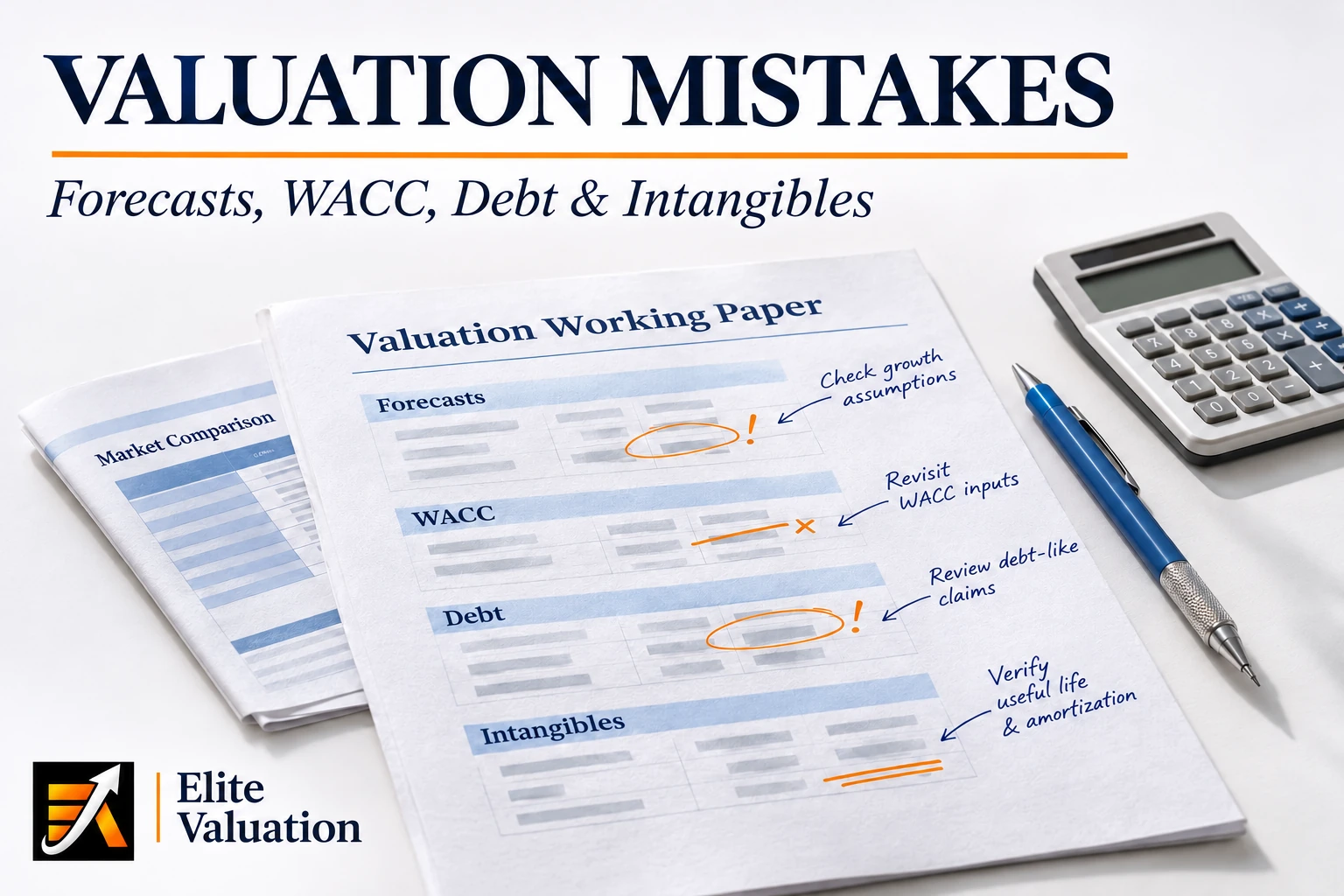
These six errors appear most often in software Valuations reviewed by investors, auditors and tax officers. Each card shows what goes wrong, what it costs and the fix that closes the gap before a reviewer finds it.
Treating the rebuild cost as the value of revenue-generating software
The replacement cost is used as the Valuation for a platform that already earns subscription revenue from customers.
Value understated, and the price an acquirer pays cannot be explainedUse the cost approach as a floor, and lead with the income approach where the software earns identifiable revenue.
Attributing all product revenue to the software
The full revenue of a product is used as the software’s revenue base, although services, people and brand also earn part of it.
Software value overstated, and the figure fails the first diligence questionAttribute revenue on a documented basis, supported by customer and product evidence, and show how the result changes with that choice.
Leaving out contributory asset charges in MPEEM
The excess earnings are calculated without a fair return on the workforce, working capital, fixed assets and other intangibles.
Software absorbs profit that belongs to other assets, and the purchase price allocation is challengedCalculate a charge for every contributing asset, and test how the result moves when each charge changes.
Valuing code the company does not clearly own
The Valuation assumes ownership of the code without checking employee, contractor and founder assignments or open-source obligations.
Investors reprice the deal or require a holdback after the figure has been sharedObtain assignment agreements from every contributor and an open-source review before any figure leaves the company.
Using capitalised development cost as the Valuation
The book value of capitalised development is taken as the software’s value, although it reflects accounting tests rather than market value.
Asset and earnings both misstated, because capitalisation moves cost out of the profit and loss accountBuild a separate fair value on the cost or income basis, and reconcile it to the book figure in a written note.
Using one rule for every purpose
The Rule 57 tax value, the commercial price and the purchase price allocation figure are treated as interchangeable, and one rule is used to support all three.
A tax file, an audit file and a deal price disagree, and the gap is hard to explainMap each purpose to its own rule and signatory, then record the reasons for every difference in one reconciliation note.
Ensure your tech assets are valued accurately and stand up to scrutiny.
Ensure your tech assets are valued accurately and stand up to rigorous auditor and regulatory scrutiny. Schedule your software Valuation consultation with Elite Valuation today.
Schedule your software Valuation consultationValuation | Due Diligence | Transaction Structuring | FEMA and Regulatory Compliance
Frequently Asked Questions (FAQs)
What is the best approach for software Valuation for an Indian IT company?
No single approach is best in every case. For an Indian IT company, the income approach usually leads where the software earns identifiable revenue, using relief-from-royalty for the technology and MPEEM for customer relationships. The cost approach suits internal-use, pre-revenue or easily replaced software, and it works as a floor for revenue-generating platforms. The market approach is a cross-check, because disclosed Indian private software deals are scarce. The final choice depends on the purpose, such as M&A, purchase price allocation, a slump sale or tax.
When should a tech startup use the cost approach instead of the income approach?
A tech startup should lead with the cost approach when it has no reliable revenue forecast, when the software is still pre-revenue, or when the software is an internal tool that earns no direct income. In those cases the replacement cost of a functionally equivalent system, less obsolescence, gives a defensible starting point. Once the software produces identifiable revenue from paying customers, the income approach should lead and the cost figure should be kept as a floor. Using the cost approach alone for a platform with paying customers usually understates its value.
How does the Relief-from-Royalty method work for SaaS Valuation?
Relief-from-royalty estimates the royalties a company avoids by owning its software rather than licensing it. The analyst attributes subscription revenue to the software, applies a royalty rate supported by licence evidence, deducts tax and adds a tax amortisation benefit where the tax law allows depreciation on the asset. The resulting cash flows are discounted at a rate that reflects the company’s stage and risk. The revenue attributed to the software and the royalty rate are the two inputs that most affect the result, so both must be documented.
Is software Valuation mandatory during a slump sale under the Income-tax Act, 2025?
Not always. A slump sale is computed under Section 77 of the Income-tax Act, 2025, which measures the gain against the net worth of the undertaking, and an accountant’s report on that net worth is part of the process. A separate software Valuation is not automatically needed for the net worth computation. It becomes necessary where the price is tested against a prescribed fair value, or where the buyer needs a purchase price allocation or a transfer price to support the deal. Confirm the notified text and the rules before the transaction is structured.
What is the difference between reproduction cost and replacement cost in software Valuation?
Reproduction cost is the cost of building an exact copy of existing software, with the same code, design and features. Replacement cost is the cost of building a functionally equivalent system using current architecture and technology. Replacement cost is usually the more relevant basis, because buyers rarely pay for outdated design. Either figure must then be reduced for functional, technical and economic obsolescence. The labour rates used should reflect the party that would actually rebuild the software, and where that party is located.
How are internally generated software assets treated during Ind AS 103 Purchase Price Allocation?
The acquirer recognises identifiable intangible assets at fair value even if the target never recognised them on its own balance sheet. Acquired software, customer relationships and trademarks are therefore valued separately from goodwill, provided they are separable or arise from contractual or legal rights. Development costs the target expensed earlier do not carry over as an asset. The acquired software is then amortised over its useful life, and a deferred tax liability usually arises where fair value exceeds the tax base. Goodwill is not amortised but is tested for impairment under Ind AS 36.
Can you use the market approach if your software is a highly unique B2B platform?
In most cases only as a limited cross-check. A highly unique platform has few truly comparable transactions, and private deal terms in India are rarely disclosed. The valuer can still use licence royalty rates, sector multiples and listed peers, provided each is adjusted for size, growth, margin and liquidity, and the reasons for choosing each comparable are written down. For a unique platform the income approach usually carries more weight, and the market evidence shows whether the result sits within a credible range.
Who is legally qualified to sign off on a statutory software Valuation report in India?
There is no single signatory. Where the Companies Act, 2013 requires a Valuation, a registered valuer must sign, and a valuer may act only in the asset class in which the valuer is registered with IBBI: land and building, plant and machinery, or securities or financial assets. IBBI has treated intangible assets such as brands and trademarks as within the scope of a securities or financial assets valuer. Income-tax and FEMA pricing rules name their own professionals, such as merchant bankers, chartered accountants and cost accountants. Check the rule for each purpose before appointing the signatory.
Sources and Regulatory References
- Income-tax Act, 2025, including Section 77 on the computation of capital gains in slump sales, in force from 1 April 2026.
- Income-tax Rules, 2026, Rule 57 (determination of fair market value), which replaced Rule 11UA of the Income-tax Rules, 1962 from 1 April 2026.
- Companies Act, 2013, Section 247, and the Companies (Registered Valuers and Valuation) Rules, 2017, with IBBI registration by asset class.
- Insolvency and Bankruptcy Board of India, disciplinary orders of 2025 on the scope of securities or financial assets registered valuers.
- Indian Accounting Standards (Ind AS) 12, 36, 38, 103 and 113, Ministry of Corporate Affairs, India.
- Foreign Exchange Management (Non-debt Instruments) Rules, 2019, as amended, Reserve Bank of India.
- IVS 210 Intangible Assets, International Valuation Standards Council.
- ICAI Valuation Standards, 2018, Institute of Chartered Accountants of India.

Disclaimer. This article is general information only. It is not legal, tax or Valuation advice for any particular transaction. Rules and rule numbers are stated as at 15 November 2026, and must be checked against the notified text before reliance. Where this article relies on secondary commentary, the point is described as commentary and should be confirmed with a qualified professional before it is relied upon. Research date: 15 November 2026.