SaaS Valuation Services in India
Independent Valuation of Subscription and Recurring-Revenue Software Businesses
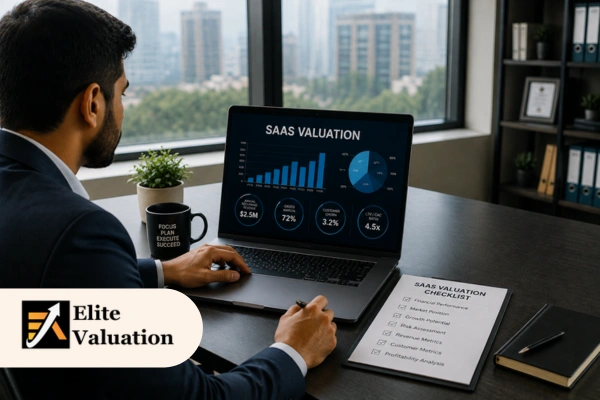
For SaaS businesses, value is driven by the quality and durability of recurring revenue, not simply trailing profit or book value. Elite Valuation provides independent SaaS company Valuation for fundraising, M&A, ESOPs, secondary transactions and financial reporting, combining DCF and market benchmarking with ARR, growth, retention, churn and margin metrics to deliver a defensible view of value for investors, boards, auditors and regulators.

SaaS Valuation Experts in India
Elite Valuation is a specialist financial advisory firm providing Valuation services to SaaS founders, CFOs, boards, and investors across India, including Mumbai, Delhi, Bengaluru, Hyderabad, Pune, and Chennai, from our Ahmedabad base.
A SaaS business rarely looks like a traditional company on paper. Revenue is recurring rather than transactional, growth often comes with negative near-term margins, and the balance sheet carries little in the way of tangible assets. A Valuation that relies only on trailing profit or book value will understate or misstate what the business is actually worth.
Led by CA Sagar Shah (Ex-EY, IBBI Registered Valuer), our team combines DCF and comparable company analysis with SaaS-specific metrics, annual recurring revenue, net revenue retention, the CAC to LTV ratio, and gross margin, to produce a Valuation that reflects how the sector is actually priced.
Our Specialized SaaS Valuation Solutions
We provide end-to-end SaaS Valuation services tailored to your specific needs:
SaaS Valuation Metrics and Multiple Bands
SaaS Valuation multiples are driven by the quality, growth and predictability of recurring revenue. ARR alone is not enough. The applicable SaaS ARR multiple depends on key operating metrics:
- ARR Growth Rate: Higher and sustainable recurring revenue growth generally supports stronger SaaS Valuation multiples.
- Net Revenue Retention (NRR): Strong NRR indicates customer retention, expansion revenue and recurring revenue quality.
- Gross Margin: Higher margins demonstrate scalability and improve the quality of SaaS economics.
- CAC to LTV Ratio: Measures customer acquisition efficiency and the long-term value generated from sales and marketing spend.
- Churn Rate: Lower customer and revenue churn improves predictability and supports higher Valuation multiples.
- Rule of 40: Combines revenue growth and profitability to assess the balance between SaaS growth and operating efficiency.
Key Factors That Influence a SaaS Valuation
- Revenue quality and retention: The rate at which existing customers expand, downgrade, or churn, and the resulting predictability of future revenue.
- Market size and penetration: Total addressable market size and the company's realistic share of it over the projection period.
- Customer acquisition efficiency: Sales and marketing spend required to acquire a customer relative to the revenue that customer generates over its lifetime.
- Customer concentration: Whether the product depends on a small number of large customers or is diversified across a broad customer base.
- Capital efficiency: Cash burn relative to growth achieved, and the runway remaining before the next funding requirement.
- Product defensibility: The extent to which the platform, integrations, and data create switching costs that competitors cannot easily replicate.
- Team and execution track record: Depth and stability of the founding and leadership team, particularly relevant at pre-revenue and early-revenue stages.
- Pricing and monetisation model: Whether monetisation is per-seat, usage-based, or a hybrid model, which affects how predictably revenue scales with customer growth.
SaaS Valuation vs Traditional Software or IT Services Valuation
| Parameter | SaaS Company Valuation | Traditional Software or IT Services Valuation |
|---|---|---|
| Primary revenue base | Annual or monthly recurring revenue (ARR/MRR) | Billed revenue, project fees, or licence sales |
| Key value driver | Growth rate, net revenue retention, and gross margin | Order book, client contracts, and historical profitability |
| Typical method emphasis | ARR multiple and DCF, cross-checked against SaaS metrics | EBITDA multiple, DCF based on historical earnings |
| Margin profile | Often negative or thin near-term margin funded by growth | Generally profitable with stable operating margins |
| Retention measure | Net revenue retention and logo churn | Client renewal rates and contract tenure |
| Typical use case | Fundraising, ESOP, M&A for subscription businesses | M&A and succession planning for services or licence businesses |
What Is SaaS Valuation?
SaaS Valuation is the process of determining the fair value of a Software as a Service company, one that delivers software through a subscription model rather than a one-time licence sale. Because revenue is recurring, Valuation typically weighs metrics such as annual recurring revenue, growth rate, and retention more heavily than trailing profit.
Unlike valuing a software asset for licensing or purchase price allocation, SaaS Valuation values the operating business as a going concern: its customer base, recurring revenue stream, growth trajectory, and cost structure together. It is used for fundraising, M&A, ESOP planning, secondary transactions, and investor and financial reporting.

Get Expert SaaS Valuation Support
When Do You Need a SaaS Valuation?
Specific funding, transaction and regulatory events trigger the need for an independent SaaS Valuation:
Free Patent Valuation Guide for Founders, CFOs & Investors (2026)
Learn patent portfolio Valuation, technology transfer pricing, R&D pipeline rNPV models, and patent infringement damages used by professionals.
Includes real-world case studies, royalty benchmarks, and frameworks covering Ind AS 103 PPA, FEMA ODI Rules, Section 35A income tax, Patents Act Section 108, and Ind AS 36 impairment - for technology, pharma, and biotech companies.
Who Needs SaaS Valuation Services
Our SaaS Valuation services are designed for key decision-makers across the startup, investment and transaction ecosystem:

SaaS founders and CEOs

CFOs and Finance Heads

VC and PE investors

HR and ESOP administrators

Corporate development teams

Family offices and HNI investors
Benefits of an Independent SaaS Valuation
Valuation Methodologies Used
We apply the Valuation approach best suited to your SaaS company's stage, revenue profile, and growth trajectory:
Income Approach (DCF)
Venture Capital Method
Market Approach
Scorecard & Berkus Methods
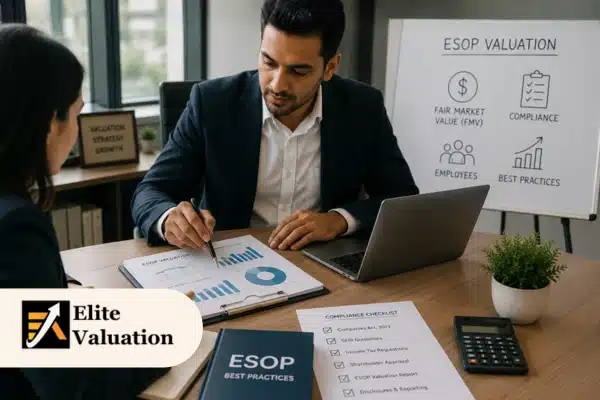
Regulatory Compliance for SaaS Valuation (Companies Act, Tax & FEMA)
We navigate the applicable regulatory and accounting frameworks to keep your SaaS Valuation compliant:
- Companies Act, 2013
Governing statutory Valuation requirements for preferential allotments, share issuances and other prescribed transactions. - Income-tax Act, 2025
Determining the Fair Market Value of unquoted shares for applicable tax transactions under the prescribed Valuation rules. - FEMA Regulations
Ensuring cross-border share issues and transfers comply with applicable RBI pricing and Valuation requirements. - Ind AS 102
Governing fair value measurement and accounting for ESOPs and other share-based payment arrangements. - Ind AS 113
Providing the fair value framework for financial reporting, portfolio Valuations and investor reporting. - SEBI & AIF Regulations
Supporting portfolio Valuation and fair value reporting where SaaS businesses are held by SEBI-regulated funds.
Our SaaS Valuation Process
We follow a structured five-step workflow to deliver defensible, metrics-driven SaaS Valuations that align with your transaction timeline:
Engagement Scoping
We confirm the Valuation purpose, along with the applicable Valuation date and reporting requirements.
Discovery & Data Collection
We gather financial statements, ARR and cohort data, and verify the revenue base before any modelling begins.
Modelling & Benchmarking
We reconcile key SaaS metrics and build DCF, comparable company, and transaction benchmarks.
Review & Discussion
We test valuation outputs against company metrics and discuss key assumptions with management.
Final Reporting & Certification
Once validated, we issue a signed Valuation report documenting the methodology, workings, and key assumptions.
What You Receive: SaaS Valuation Deliverables
Our deliverables are comprehensive documents designed for external scrutiny. Every report includes:
Why Choose Elite Valuation?
We are uniquely positioned to handle high-stakes Valuations in PAN India:
- Ex-Big 4 Pedigree
Founder CA Sagar Shah’s background at Ernst & Young ensures global best practices in ethics and documentation. - Tripartite Qualification
Combining CA, CS, and Registered Valuer expertise to address tax, legal, and financial angles simultaneously.
- Speed & Agility
We offer the quickest response times without compromising analysis depth and providing quality of Big 4 firms. - Defensive Reporting
Reports written to withstand regulatory scrutiny, minimizing queries from the government authorities.
Our Clients









































































































Where Our Expertise Is Applied
Our SaaS Valuation expertise spans across funding stages, business models, and transaction types:






Trusted by Leaders.
Proven by Results.
What founders, CFOs, and investors say about working with Elite Valuation.
"The team at Elite Valuation was very helpful in our multiple Valuations. CA Sagar Shah personally ensured the Valuation was objective and clearly explained to us, which helped fix the gap during negotiations. They are responsive, professional, and truly understand the complexities of M&A. Highly recommend their expertise for any deal."

"We've been working with Elite Valuation for our ESOPs for a few years now, and they've been great. They handle the complex regulatory side of things very smoothly, making sure our reports are always audit-ready and easy to understand. The team is professional and always help us meet a deadline, and they really know how to manage equity Valuations for larger companies. Highly recommended if you need a reliable partner for compliance."

"Elite Valuation has been our go-to firm for our all type of Valuations be ie Merger, ESOP, Preferential Valuation of listed companies. They understand the nuances of different regulations, complex Valuation modelling and always ensure the assumptions are well-supported and defensible during audits. Their consistency and reliability make them a trusted partner for all of our Valuation requirements ."

"We engaged Elite Valuation for a merger Valuation involving more than 12 group companies, and the experience was seamless. Mr Sagar Shah and his team built a robust model that satisfied all stakeholders. Their understanding of regulatory requirements and Valuation complexities made them an invaluable partner throughout the process."

"Sagar and his team understand ESOP and Business Valuation and compliance very well. What we like most is that they take the time to explain the numbers and the logic behind them, which has been very useful for us internally. It feels like working with a team that genuinely knows the space well."

"We issued compulsorily convertible debentures as part of a funding round, and Elite Valuation provided a robust Valuation that addressed all regulatory and stakeholder requirements. Their familiarity with instrument-specific Valuation methodologies and SEBI requirements was very evident."
"As a first-time fundraiser, we had no idea where to begin. Elite Valuation built an investor-grade financial model and a detailed Investor Memorandum for us, while guiding us on exactly what institutional investors look for. Mr. was patient, responsive, and made the entire process approachable. We walked into every investor meeting fully confident. Truly a reliable partner for anyone navigating fundraising for the first time."

"We have engaged Elite Valuation across a range of assignments, including share issuances, transfers, ESOPs, preferential allotments, rights issues, and merger Valuations. Their execution has consistently reflected strong technical depth and a clear understanding of regulatory frameworks. The team delivers well-structured, defensible Valuation reports with a high level of precision and professionalism. Their ability to manage complex mandates within tight timelines, without compromising on analytical rigor, is particularly noteworthy. Elite Valuation combines technical expertise with commercial insight, making them a dependable partner for Valuation engagements. We highly recommend their services.""

"Over the last few years, we've engaged Elite Valuation for multiple Valuation projects for multiple of our clients. Their reports are always comprehensive, well-documented, and fully aligned with regulatory requirements under Income-tax and FEMA. CA Sagar Shah's insights were instrumental in ensuring a smooth process and his expertise added tremendous value throughout. Highly recommended for multinational enterprises and large firms."
Published Insights
Read Our Latest Blogs





















Speak to a SaaS Valuation Specialist
15+ years
500+ clients
Frequently Asked Questions (FAQs)
Related Services
- Technology Valuation Services