ESOP
Strategy to liquidity, one coordinated engagement
ESOP Services in India
End-to-End ESOP Strategy, Structuring, Implementation, Valuation, Accounting and Administration
An ESOP involves more than issuing employee stock options. It brings together pool sizing, scheme design, corporate approvals, grant terms, valuation, accounting, employee tax, administration and eventual liquidity. Each workstream needs to remain aligned so the ESOP works effectively for employees, founders, finance teams and investors.
Elite Valuation provides comprehensive ESOP Services for startups, private companies, listed companies, PE/VC-backed businesses and corporate groups across India. We support companies from initial ESOP strategy and pool planning through scheme drafting, implementation, valuation, Ind AS 102 support, employee communication, ongoing administration and liquidity planning based on the company's stage and requirements.
- Startups to listed companies
- Ind AS 102 & exercise-stage FMV
- Pan-India support
Where is your ESOP today?
Pick the statement closest to your situation to see where to start.
Who we are
ESOP Advisory & Valuation Experts in India
Elite Valuation provides end-to-end ESOP support covering strategy, pool sizing, scheme design, implementation, valuation, accounting, taxation and administration for startups, private companies and growing businesses across India.
Our ESOP engagements are led by CA Sagar Shah — CA, CS and IBBI Registered Valuer (SFA), bringing together valuation, accounting, regulatory and transaction experience.
This integrated approach helps companies structure ESOPs that are commercially practical, financially sound and compliant.
Who we are
Our Specialized ESOP Services
End-to-end ESOP advisory, implementation and valuation support for companies across India.
Definition
What Are ESOP Services?
IN SHORT
ESOP services cover the strategy, design, implementation, valuation, accounting, taxation and ongoing administration
required to establish and manage an Employee Stock Option Plan effectively.
An ESOP involves much more than drafting a scheme or issuing options. Decisions around pool size, eligibility, grant structure, vesting, exercise terms and valuation can affect shareholder dilution, employee incentives and the overall effectiveness of the plan.
The support required also changes over time. A company setting up its first ESOP may need assistance with pool sizing, scheme design, documentation and approvals, while an existing plan may require support for new grants, valuation, Ind AS 102 accounting, employee exercises, administration, restructuring or liquidity events.
Typical ESOP support may therefore span:
Strategy & Pool Planning
Scheme Design
Implementation
Valuation
Accounting
Taxation
Administration
The ESOP lifecycle
How an ESOP Works:
From Grant to Liquidity
ESOP Pool &
Grant Planning
The company defines the ESOP pool, eligible employees, grant size, exercise price and key terms before options are issued.
Option Grant
Employees receive options under the approved ESOP scheme, supported by the required grant documentation and corporate approvals.
Vesting Period
Options vest over the agreed schedule based on continued service, performance conditions or other applicable terms.
Employee Exercise
Once vested, employees may exercise eligible options by paying the exercise price, subject to applicable tax, valuation and process requirements.
Shareholding &
Administration
After exercise, the employee may become a shareholder. The company must keep grant, vesting, exercise, cap-table and accounting records properly reconciled.
Liquidity or Exit
Employees may eventually realise value through a buyback, secondary sale, acquisition, IPO or another liquidity event, depending on the company and transaction structure.
Requirements by lifecycle stage
One ESOP Can Create Different Service Requirements
An ESOP is not a one-time exercise. Different stages of the same employee equity plan can require different strategic, documentation, valuation, accounting, tax, administration and transaction support.
| ESOP Requirement | What It Covers | Typical Timing | Primary Purpose |
|---|---|---|---|
| ESOP Strategy & Pool Sizing | ESOP objective, employee universe, pool size, grant philosophy and dilution scenarios | Before creating the ESOP or increasing the pool | Align employee equity with hiring, retention and shareholder dilution objectives |
| Scheme Design & Documentation | Eligibility, vesting, exercise, leaver, performance, exit and other scheme terms | Before scheme approval and employee grants | Create a clear, implementation-ready ESOP framework |
| ESOP Valuation | Underlying share value, option fair value and other purpose-specific valuation requirements | Grant, reporting, exercise, modification or transaction stages | Support accounting, tax, audit and transaction requirements |
| Accounting & Tax Support | Share-based payment accounting, compensation expense, employee tax and payroll coordination | During financial reporting and employee exercise | Maintain appropriate accounting treatment and employee tax workflows |
| ESOP Administration | Grants, vesting, exercises, lapses, employee balances and option-pool tracking | Throughout the life of the ESOP | Keep ESOP records accurate, current and ready for audit or diligence |
| Liquidity & Transaction Support | Buyback, secondary sale, M&A, IPO, settlement and outstanding-option analysis | During liquidity or transaction events | Help management assess employee, shareholder and transaction-level outcomes |
Get Expert ESOP Services Support
Avoid gaps between ESOP strategy, scheme design, implementation, valuation, accounting, tax coordination and administration. Partner with Elite Valuation for practical, end-to-end ESOP support aligned with your company stage, employee equity objectives and ongoing requirements.
Start with your situation
Your ESOP Needs Change
with Your Company Stage
Before the scheme
Three Decisions to Make Before Designing an ESOP
Decision 01
Why Are You Giving Employees Equity?
Different objectives require different grant philosophies. An ESOP created to retain senior leadership may require a different allocation framework from one designed for broad employee ownership, performance incentives or startup hiring.
Decision 02
How Much Dilution Can the Business Absorb?
A 10% ESOP pool does not necessarily mean founders will experience only 10% dilution over time. Future fundraising, pool top-ups, refresh grants and unallocated reserves can materially
change ownership.
Decision 03
How Will Employees Eventually Realise Value?
Employees value an ESOP more when they understand how their options may become economically meaningful. Exercise mechanics, tax cost, buybacks, secondary sales, acquisitions and IPOs all affect the employee experience.
See why a 10% pool is rarely 10% dilution
Adjust the pool, the dilution from each funding round and whether the pool is topped up after each round.
A 10% pool implies 90% for existing holders on day one. After 2 rounds with pool top-ups, this illustration leaves them with 55.1%.
Illustration only. Top-ups are modelled as post-round issuances that dilute all holders proportionally. Actual pool mechanics, pre-money or post-money pool creation and dilution depend on the agreed capital structure and transaction terms.
Our Specialized ESOP Services
The Full Scope of Our ESOP Services
ESOP Strategy & Pool Sizing
Advisory on ESOP objectives, employee eligibility, pool size, grant philosophy and dilution scenarios to align employee equity with hiring, retention and ownership goals.
Strategy & DesignESOP Scheme Design
Structuring of vesting schedules, cliff periods, exercise terms, leaver provisions, performance conditions, acceleration and transaction-related treatment based on the company's objectives.
Strategy & DesignESOP Scheme Drafting & Documentation
Preparation and coordination of ESOP scheme documents, grant letters, approval materials and supporting documentation required to implement the agreed employee equity structure.
Strategy & DesignESOP Implementation Support
Structured support for corporate approvals, grant rollout, employee documentation and coordination between management, finance, HR, legal and company secretarial teams.
Rollout & PeopleESOP Valuation & Accounting Support
Underlying share valuation, option fair-value analysis and share-based payment support, including Ind AS 102-related valuation, expense schedules and audit workings where applicable.
Valuation, Accounting & TaxEmployee Tax & Exercise Support
Support in identifying exercise-stage FMV requirements, employee perquisite implications, payroll inputs and the documentation required to coordinate employee exercises.
Valuation, Accounting & TaxESOP Administration & Record Management
Ongoing tracking of grants, vesting, exercises, lapses, cancellations, employee balances, pool utilisation and related records to keep the ESOP organised and diligence-ready.
Operate & TransactEmployee Communication & Education
Clear employee-facing explanations of grant terms, vesting, exercise price, tax implications, leaver treatment and potential liquidity so employees better understand how their ESOP works.
Rollout & PeopleBuyback, M&A & Liquidity Support
Assessment of outstanding employee awards during buybacks, secondary transactions, acquisitions, restructurings, IPO preparation and other liquidity events, including settlement, rollover and employee impact.
Operate & TransactESOP Restructuring & Scheme Review
Review of existing ESOP schemes, unutilised pools, vesting and exercise terms, underwater options, grant practices and employee participation to identify where restructuring or amendments may be required.
Operate & TransactWhy end-to-end matters
Why Coordination Matters Across ESOP Services
An ESOP brings together commercial, legal, valuation, accounting, tax and administrative requirements. When these are handled independently, different assumptions or records can create inconsistencies across the scheme, cap table, grants and financial reporting.
A coordinated approach helps ensure that key ESOP decisions remain aligned throughout the plan lifecycle.
| Area | Fragmented Approach | Coordinated Approach |
|---|---|---|
| Strategy & Dilution | Pool and grants considered separately | Pool size, dilution and grant strategy considered together |
| Scheme & Approvals | Commercial terms and documentation handled separately | Scheme terms, approvals and implementation remain aligned |
| Valuation & Accounting | Valuation and accounting addressed independently | Grant terms, valuation and accounting implications considered together |
| Tax & Administration | Exercise, tax and records addressed only when required | Grants, vesting, exercises and tax requirements tracked systematically |
| Funding, M&A & IPO | Outstanding options reviewed late in the transaction | ESOP implications assessed before the transaction becomes time-sensitive |
Award structures
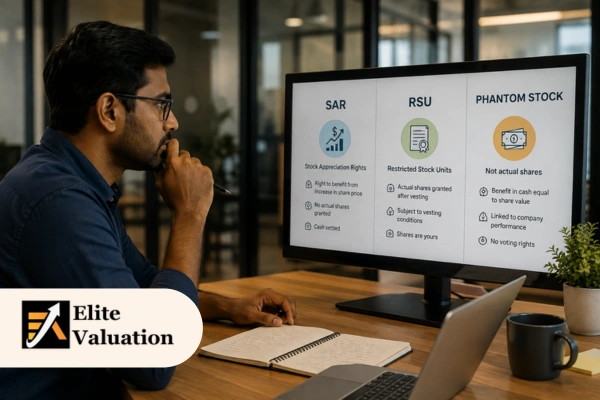
Types of Employee Equity and Share-Based Awards We Support
Employee equity and equity-linked incentive awards can take different forms, and each structure may require a different approach to scheme design, valuation, accounting, administration and settlement.
Accounting
ESOP Accounting Support Under Ind AS 102
Equity-Settled Employee Awards
Equity-settled employee awards are generally measured at grant-date fair value and recognised over the applicable vesting or service period. The accounting treatment should remain aligned with the grant terms, vesting conditions and employee records.
Cash-Settled Employee Awards
For cash-settled arrangements such as certain SARs, the company recognises a liability that is remeasured at fair value at each reporting date and again at settlement, with resulting changes recognised in profit or loss.
ESOP Modifications
Changes such as repricing, accelerated vesting, replacement awards or revised exercise terms may create additional accounting consequences and should be reviewed before the modification is implemented.
Companies Outside Ind AS
For applicable companies following Accounting Standards rather than Ind AS, ICAI's Guidance Note on Accounting for Share-based Payments (Revised 2020) provides relevant recognition, measurement and disclosure guidance.
Tax & exercise
ESOP Tax & Exercise Support
Unlisted Equity Shares
For unlisted equity shares, the prescribed exercise-stage FMV is determined by a SEBI-registered Category I Merchant Banker on the specified date, being the exercise date or an earlier date not more than 180 days before exercise.
Listed Equity Shares
For listed equity shares, FMV is generally determined using the prescribed market-price mechanism on the exercise date, with specific rules where shares trade on multiple recognised exchanges or do not trade on that date.
Tax, Payroll & Employee Coordination
Exercise-stage FMV is different from the option value used for accounting. Finance, payroll and HR teams should confirm the applicable rule, valuation date, prescribed professional and employee tax inputs before processing an exercise.
Select your role
Different Stakeholders Have Different ESOP Priorities
Checklist
Documents Required for ESOP Services
- Existing ESOP Scheme & Amendments: Current approved ESOP scheme together with all amendments, addenda and changes made since the original adoption.
- Grant Letters & Employee Records: Employee-level grant documentation, acceptance records, vesting status, exercises, lapses, cancellations and details of any subsequent modifications.
- Historical Financial Statements:Recent audited financial statements and relevant management accounts required for ESOP planning, valuation, accounting or transaction analysis.
- Recent Funding Documents:Relevant term sheets, subscription agreements, shareholders' agreements and closing documents from recent or ongoing financing rounds.
- Corporate Approvals & Registers:Relevant board and shareholder approvals, option registers and other corporate records relating to the ESOP.
- Grant Details & Terms: Grant dates, number of options, exercise price, vesting schedule, exercise period and other material terms applicable to employee awards.
- Current Cap Table:Details of equity shares, preference shares, convertibles, warrants, ESOP pool and other outstanding or potentially dilutive securities.
- Hiring Plans & Employee Structure:Current and projected employee requirements, seniority levels, proposed participants and hiring plans relevant to pool sizing and grant architecture.
- Previous Valuation & Accounting Records:Prior company, share or ESOP valuation reports together with accounting schedules and supporting financial reporting records.
- Transaction & Liquidity Details:Information on proposed fundraising, buyback, secondary sale, acquisition, IPO or other events that may affect ESOP structure, outstanding awards or employee liquidity.
Additional information may be required for complex capital structures, market-linked awards, cross-border ESOPs, cash-settled plans or significant modifications.
Regulatory touchpoints
Regulatory Framework for ESOP Services in India
Companies Act, 2013 & Rule 12
Section 62(1)(b) and Rule 12 govern key ESOP requirements for unlisted companies, including approvals, eligibility, vesting and exercise terms.
Relevant for: unlisted companies
SEBI (Share Based Employee Benefits and Sweat Equity) Regulations, 2021
For listed companies, SEBI regulations govern employee benefit schemes, including approvals, administration and disclosures.
Relevant for: listed companies
Ind AS 102: Share-Based Payment
Governs the recognition and measurement of equity-settled and cash-settled share-based employee awards.
Relevant for: Ind AS entities
ICAI Guidance Note on Share-Based Payments
Provides accounting guidance on recognition, measurement and disclosure of employee share-based payments.
Relevant for: applicable non-Ind AS entities
Income-tax Act, 2025 & Rules, 2026
ESOP exercise may trigger employee perquisite taxation, valuation, payroll and withholding requirements.
Relevant for: employee exercises and payroll
FEMA / NDI
Framework
Cross-border ESOPs involving non-resident participants require consideration of eligibility, sectoral limits and other FEMA requirements.
Relevant for: non-resident participants
How we work
Our ESOP Services Process
- 01
Scope the ESOP Requirement
We confirm the company's ESOP objectives, current stage, employee population, proposed structure and the specific workstreams required.
- 02
Review ESOP & Company Data
We review the cap table, existing or proposed scheme, employee structure, financial information, funding history and other relevant company documents.
- 03
Design the ESOP Framework
We define the pool size, grant architecture, vesting, exercise, leaver, approval and other key terms based on the company's objectives and ownership structure.
- 04
Coordinate Implementation & Supporting Workstreams
We align documentation, approvals, valuation, accounting, tax coordination, employee communication and administration requirements before rollout.
- 05
Deliver, Implement & Support
We provide the agreed ESOP work products and ongoing support for grants, administration, employee queries, financial reporting and future transaction or liquidity events.
Deliverables
What You Receive from Our ESOP Services
ESOP Strategy & Pool Model
ESOP objectives, eligibility, pool sizing, grant philosophy and dilution scenarios aligned with the company’s growth and hiring plans.
Scheme Design & Documentation
ESOP scheme, grant terms, vesting, exercise, leaver and transaction provisions, along with supporting implementation documentation.
ESOP Valuation Support
Underlying share and option valuation analysis, methodology workings and valuation reports based on the applicable purpose.
Accounting & Tax Support
Share-based payment expense workings, vesting schedules, exercise-stage FMV and relevant employee tax inputs.
Employee Communication & Administration
Employee FAQs and grant communication, together with structured tracking of grants, vesting, exercises, lapses and pool utilisation.
Ongoing & Transaction Support
Support for ESOP amendments, restructuring, buybacks, funding rounds, M&A, IPOs and employee liquidity events.
Avoid these
Common ESOP Mistakes to Avoid
No Dilution Modelling
Creating or expanding an ESOP pool without modelling future grants and funding rounds can result in unexpected shareholder dilution.
Generic Scheme Terms
Standard vesting, exercise and leaver terms may not align with the company’s retention goals or future transaction plans.
Weak Employee Communication
Employees may undervalue their ESOP when vesting, exercise, taxation and liquidity terms are not clearly explained.
Poor ESOP Records & Administration
Mismatch between the scheme, grants, cap table, vesting and employee records can create issues during administration, audit and diligence.
Treating Valuation as a One-Time Exercise
Different ESOP stages may require separate valuations for grant accounting, exercise-stage taxation or transaction purposes.
Ignoring Modifications & Transaction Events
Repricing, accelerated vesting, funding, M&A or IPO events can create additional valuation, accounting, approval and documentation requirements.
Why Elite Valuation
Why Choose Elite Valuation for ESOP Services?

Founder - Elite Valuation
CA Sagar Shah
IBBI Registered Valuer & Business Valuation Expert in India
Chartered Accountant (All India Rank) · Company Secretary · Ex-Ernst & Young.
15+ years advising Promoters, Investors, and MNCs on Valuation, ESOP, M&A, FEMA, AIF, Transfer Pricing, and Cross-Border Transactions across India.
- CA — All India Rank
- Company Secretary
- IBBI Registered Valuer
- Ex-Ernst & Young
- 500+ Clients
Our Clients














































































































































Industries
Industries We Support for ESOP Services






Pan-India coverage
ESOP Services Across India
We support companies across India with ESOP advisory, valuation, accounting, taxation and ongoing administration, through a structured and senior-led delivery model.
Our remote-first approach ensures the same quality of advice and execution, irrespective of your location.
Major cities we serve
Ahmedabad
Mumbai
Pune
Delhi
Gurugram
Bangalore
Chennai
Hyderabad
Trusted by Leaders.
Proven by Results.
What founders, CFOs, and investors say about working with Elite Valuation.
"The team at Elite Valuation was very helpful in our multiple Valuations. CA Sagar Shah personally ensured the Valuation was objective and clearly explained to us, which helped fix the gap during negotiations. They are responsive, professional, and truly understand the complexities of M&A. Highly recommend their expertise for any deal."

"We've been working with Elite Valuation for our ESOPs for a few years now, and they've been great. They handle the complex regulatory side of things very smoothly, making sure our reports are always audit-ready and easy to understand. The team is professional and always help us meet a deadline, and they really know how to manage equity Valuations for larger companies. Highly recommended if you need a reliable partner for compliance."

"Elite Valuation has been our go-to firm for our all type of Valuations be ie Merger, ESOP, Preferential Valuation of listed companies. They understand the nuances of different regulations, complex Valuation modelling and always ensure the assumptions are well-supported and defensible during audits. Their consistency and reliability make them a trusted partner for all of our Valuation requirements ."

"We engaged Elite Valuation for a merger Valuation involving more than 12 group companies, and the experience was seamless. Mr Sagar Shah and his team built a robust model that satisfied all stakeholders. Their understanding of regulatory requirements and Valuation complexities made them an invaluable partner throughout the process."

"Sagar and his team understand ESOP and Business Valuation and compliance very well. What we like most is that they take the time to explain the numbers and the logic behind them, which has been very useful for us internally. It feels like working with a team that genuinely knows the space well."

"We issued compulsorily convertible debentures as part of a funding round, and Elite Valuation provided a robust Valuation that addressed all regulatory and stakeholder requirements. Their familiarity with instrument-specific Valuation methodologies and SEBI requirements was very evident."
"As a first-time fundraiser, we had no idea where to begin. Elite Valuation built an investor-grade financial model and a detailed Investor Memorandum for us, while guiding us on exactly what institutional investors look for. Mr. was patient, responsive, and made the entire process approachable. We walked into every investor meeting fully confident. Truly a reliable partner for anyone navigating fundraising for the first time."

"We have engaged Elite Valuation across a range of assignments, including share issuances, transfers, ESOPs, preferential allotments, rights issues, and merger Valuations. Their execution has consistently reflected strong technical depth and a clear understanding of regulatory frameworks. The team delivers well-structured, defensible Valuation reports with a high level of precision and professionalism. Their ability to manage complex mandates within tight timelines, without compromising on analytical rigor, is particularly noteworthy. Elite Valuation combines technical expertise with commercial insight, making them a dependable partner for Valuation engagements. We highly recommend their services.""

"Over the last few years, we've engaged Elite Valuation for multiple Valuation projects for multiple of our clients. Their reports are always comprehensive, well-documented, and fully aligned with regulatory requirements under Income-tax and FEMA. CA Sagar Shah's insights were instrumental in ensuring a smooth process and his expertise added tremendous value throughout. Highly recommended for multinational enterprises and large firms."
Case studies
ESOP Case Studies
Explore practical ESOP case studies covering pool dilution, first-time ESOP setup,
scheme design, due-diligence clean-up, valuation and alternative employee equity structures.
Published Insights
Read Our Latest Blogs





Frequently Asked Questions (FAQs)
Related Services
START WITH A 15-MINUTE CALL
Discuss Your ESOP Services Requirement
15+ years
500+ clients
- +91 98795 57558
- sagarrvshah@elitevaluation.in
- 405, Interstellar, Sindhubhavan Road, Thaltej, Ahmedabad 380059