📌 For Founders, CFOs & HR Heads — What You Must Know
A traditional ESOP is not the only way to reward employees with upside. Stock Appreciation Rights (SARs) and Phantom Stock let you pay employees the same economic value as equity growth — entirely in cash, with zero cap table dilution. Restricted Stock Units (RSUs) deliver real shares and real dilution, but carry stronger retention psychology and investor familiarity.
- RSU = real shares transferred on vesting → dilutive → taxed as perquisite + capital gains
- SAR = cash (or equity) equal to the appreciation in share value → usually non-dilutive → taxed fully as salary income
- Phantom Stock = cash equal to the full hypothetical share value at payout → non-dilutive → taxed fully as salary income
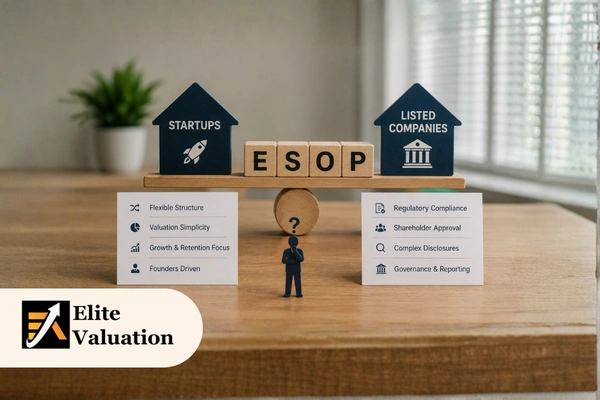
The right choice depends on your dilution appetite, cash position, promoter control preferences, and your timeline to a liquidity event — not on which instrument sounds most "standard."
Every founder eventually asks the same question at their board meeting: "we've almost used up the ESOP pool — what do we do next?" The instinctive answer is to expand the pool and dilute further. But an expanded ESOP pool is not always the right tool. A promoter-controlled family business may refuse to issue a single additional share to a professional CFO, however deserving. A profitable, cash-generative company nearing an IPO may prefer to keep its pre-listing cap table clean rather than explain a fresh round of option grants to underwriters. A founder three years from a strategic exit may want to reward a key sales leader with real upside — without creating a minority shareholder who has to be bought out or carried through the transaction.
This is where Stock Appreciation Rights (SARs) and Phantom Stock plans — collectively often called "synthetic equity" — become genuinely useful alternatives to a conventional Restricted Stock Unit (RSU) or ESOP grant. Each of the three instruments achieves a similar commercial objective (aligning an employee's reward with the company's value creation) through structurally different legal, tax, and accounting routes under Indian law.
At Elite Valuation, we design and value ESOP and synthetic equity plans for founders, HR heads, and CFOs across India — including the independent Valuations that every SAR, RSU, and Phantom Stock scheme depends on to set a defensible base price and compute payouts. This guide walks through the mechanics, tax treatment, dilution impact, and Companies Act/FEMA compliance for all three instruments, and tells you which one typically fits which stage of company.
Key Takeaways:
- RSUs transfer real shares on vesting under Section 62(1)(b) of the Companies Act, 2013 and Rule 12 — they dilute the cap table and carry shareholder-approval requirements
- SARs pay the employee the appreciation in share value in cash (occasionally equity); Phantom Stock pays the full hypothetical share value in cash — both are usually non-
- RSU income is taxed in two stages for the employee — perquisite tax at vesting under Section 17 of the Income-tax Act, 2025, then capital gains at sale
- SAR and Phantom Stock payouts are taxed entirely as salary income in the year of receipt — no capital gains treatment, no DPIIT startup deferral benefit
- Under Ind AS 102, RSUs are expensed once at grant-date fair value; SAR/Phantom Stock liabilities are re-measured every reporting period, creating P&L volatility tied to Valuation movement
- Cash-settled plans generally require only board approval for unlisted companies; RSUs require a shareholder special resolution and a Form SH-6 register
- Cross-border grants from a foreign parent are governed by the FEM (Overseas Investment) Rules, 2022 for equity-settled instruments
- Early-stage startups usually default to RSU/ESOP; mature, cash-rich, and family-controlled companies gravitate toward SAR or Phantom Stock to avoid dilution
- All three instruments depend on a defensible, independent Valuation to set the base price and compute payouts — this is where disputes most often arise
What Are SARs, RSUs, and Phantom Stock? The Fundamental Differences
All three instruments are designed to give an employee an economic stake in the company's growth in value. The difference lies in what is ultimately delivered — real shares, cash pegged to share price movement, or cash pegged to the full share value — and that single design choice cascades into completely different tax, accounting, and compliance outcomes.
Restricted Stock Unit (RSU) — Real Equity, Delivered on Vesting
Dilutive
Equity-Settled
An RSU is a promise by the company to transfer a specified number of actual shares to the employee once vesting conditions are satisfied — typically at nil or nominal cost, unlike a conventional stock option which requires the employee to pay an exercise price. On vesting, real shares are allotted and the employee becomes a shareholder with full ownership, voting, and dividend rights.
- No exercise price in most Indian RSU structures — vesting itself triggers share transfer
- Employee becomes a registered shareholder with voting and dividend rights
- Increases the company's outstanding share capital — dilutes every existing shareholder
- Legally treated in substance as an employee stock option scheme for Companies Act purposes
Stock Appreciation Right (SAR) — Paid on the Growth in Value Only
Usually Non-Dilutive
Typically Cash-Settled
A SAR gives the employee the right to receive a payout equal to the increase in the company's share value between the grant date (the "base price") and the exercise or trigger date, multiplied by the number of SAR units held. No shares change hands and no purchase price is ever paid by the employee — the employee simply receives the appreciation in cash. SARs can occasionally be structured as equity-settled (rare for unlisted companies), but the overwhelming majority of Indian private-company SAR plans are cash-settled.
- Payout = (FMV per share at trigger date − Base price per share) × number of SAR units
- No shares issued in a cash-settled SAR — the cap table is unaffected
- Employee never pays anything to "exercise" a SAR — it settles automatically on trigger
- Purely contractual for unlisted companies; a formal statutory instrument only for listed companies under SEBI's SBEB & SE Regulations, 2021
Phantom Stock — Paid on the Full Hypothetical Share Value
Non-Dilutive
Always Cash-Settled
Phantom Stock ("shadow stock" or "synthetic equity") mirrors the entire value of a hypothetical share — not just its appreciation — at the date of payout, usually reduced by nothing (unlike SARs, there is typically no base price netted off, though some plans do use one). It is structured as a deferred cash bonus plan tied to a Valuation formula, most commonly used for retention and succession-linked rewards in closely held or family businesses.
- Payout is typically = FMV per phantom unit at payout date × number of units held (base-price variants also exist)
- Entirely a contractual arrangement — no securities law or Companies Act share-issuance framework applies
- Most flexible instrument for defining trigger events: time, performance, exit, or a fixed future date
- Common in family businesses, professional service firms, and mature companies with no near-term listing or exit plan
Not Sure Which Instrument Fits Your Retention Goals?
We assess your dilution appetite, cash position, promoter control preferences, and exit timeline to recommend the right instrument — RSU, SAR, Phantom Stock, or a blend — before you draft a single document.
SAR vs RSU vs Phantom Stock: Side-by-Side Comparison Table
The table below summarises the practical differences that matter most to a board deciding between the three instruments for an unlisted Indian company.
| Parameter | RSU | SAR | Phantom Stock |
|---|---|---|---|
| What employee receives | Actual shares | Cash equal to appreciation | Cash equal to full share value |
| Cap table dilution | Yes — new shares allotted | No (if cash-settled) | No |
| Shareholder/voting rights | Yes, on vesting | None | None |
| Governing framework (unlisted co.) | Companies Act §62(1)(b) + Rule 12 | Contractual (board-approved) | Contractual (board-approved) |
| Approval required | Shareholder special resolution | Board resolution (typically) | Board resolution (typically) |
| Employee tax treatment | Perquisite + capital gains (2 stages) | Fully salary income (1 stage) | Fully salary income (1 stage) |
| DPIIT startup TDS deferral | Available | Not available | Not available |
| Employer accounting (Ind AS 102) | Equity-settled — one-time grant-date expense | Cash-settled — liability re-measured each period | Cash-settled — liability re-measured each period |
| Cash outflow to company | None (only dilution) | Yes, at trigger/payout | Yes, at payout |
| Best suited for | Early-stage, VC-backed startups | Growth/pre-IPO, dilution-sensitive boards | Family businesses, mature cash-rich companies |
How Are RSUs, SARs, and Phantom Stock Taxed for Employees in India?
Employee Taxation
The single biggest practical difference between RSUs and the two cash-settled instruments is how many taxable events occur, and under what head. This is often the deciding factor for senior employees comparing offers, and it is a compliance area where employer TDS defaults are common.
📌 RSU — Two Taxable Events
- At vesting/allotment: The fair market value of the shares allotted (less any amount paid by the employee, usually nil) is taxed as a salary perquisite under Section 17 of the Income-tax Act, 2025 — the successor provision to Section 17(2)(vi) of the erstwhile Income Tax Act, 1961. The employer deducts TDS on this notional gain.
- At sale of shares: Capital gains apply on the difference between the sale price and the FMV already taxed as perquisite at vesting. Long-term gains (holding beyond 24 months for unlisted shares, 12 months for listed shares) are taxed at 12.5%; short-term gains at the employee's applicable slab rate.
- DPIIT-recognised eligible startups can allow employees to defer the TDS payment on the vesting-stage perquisite — to the earliest of a fixed number of years from allotment, sale of the shares, or cessation of employment — easing the "dry income" cash-flow problem of paying tax on shares that cannot yet be sold.
📌 SAR & Phantom Stock — One Taxable Event
- Because no share or capital asset is ever transferred to the employee, the entire cash payout under a SAR or Phantom Stock scheme is taxed as salary income (profits in lieu of salary) in the year it is received — in full, at the employee's marginal slab rate.
- There is no capital gains component, because the employee never held a capital asset — only a contractual entitlement to a cash sum.
- The DPIIT eligible-startup TDS deferral is not available, because it is expressly linked to "specified securities" — actual shares — not cash payouts. This is frequently misunderstood by HR teams porting an ESOP-style deferral clause into a SAR or phantom stock letter.
- Employer TDS under the salary withholding provisions of the Income-tax Act, 2025 applies at the time of payment, exactly as it would for a cash bonus.
⚠️ Every SAR, RSU, and Phantom Stock document drafted or last reviewed before 1 April 2026 should be re-checked. The Income-tax Act, 2025 replaced the Income Tax Act, 1961 with effect from that date, and while the substantive taxation of perquisites and salary income is unchanged in principle, section references have been renumbered. Grant letters, scheme rules, and board resolutions that cite the old section numbers should be updated so that TDS computation and employee disclosures rest on the correct current statutory reference.
Need Your ESOP, SAR, or Phantom Stock Documents Reviewed for the Income-tax Act, 2025?
We audit grant letters, scheme rules, and board resolutions for outdated statutory references and TDS computation errors, and correct them before your next vesting or payout event.
Employer Tax Deductibility and Accounting Treatment Under Ind AS 102
Before filing with SEBI, the AIF must be established as a legal entity. SEBI permits three structures: Trust, LLP, and Body Corporate (company). The choice of structure affects tax treatment, governance flexibility, speed of SEBI approval, and investor perception.
Employer Taxation & Accounting
| Aspect | RSU (Equity-Settled) | SAR / Phantom Stock (Cash-Settled) |
|---|---|---|
| Tax deductibility | The discount between FMV and exercise price is generally deductible as business expenditure under Section 37 (successor to the erstwhile Section 37(1)), spread over the vesting period, consistent with the accounting expense | The cash payout is deductible in the year of payment as ordinary employee remuneration — no Valuation dispute at the deduction stage since the amount paid is a fact, not an estimate |
| Ind AS 102 measurement | Fair value measured once, at grant date; expensed over the vesting period; no subsequent remeasurement even if the share price moves | Fair value of the liability is remeasured at every reporting date until settlement, with the change routed through the P&L |
| Balance sheet impact | Credited to equity (share-based payment reserve) — no liability created | Recognised as a liability, growing or shrinking with company Valuation until paid |
| P&L volatility | Predictable, front-loaded, one-time estimate | Can swing significantly period to period if the company's Valuation is volatile — a real planning consideration for boards |
| Cash flow impact | None — settled in shares | Real cash outflow at trigger/payout, which must be budgeted for |
⚠️ The Ind AS 102 remeasurement requirement is the most commonly overlooked feature of SAR and Phantom Stock plans. Unlike an RSU's one-time grant-date charge, a cash-settled plan's liability must be revalued every quarter or year against the company's current fair value — meaning a strong Valuation year can materially increase the reported liability and expense, even before a single rupee is paid out. CFOs should model this volatility before recommending a cash-settled plan to the board, not discover it at the first audit.
Impact on Cap Table Dilution, Accounting, and Company Cash Flow
Beyond tax, the three instruments sit at genuinely different points on the trade-off between dilution today and cash tomorrow. There is no free option — a company either gives up a slice of ownership (RSU) or commits to a future cash liability (SAR/Phantom Stock), and the right answer depends on which constraint binds harder for your business.
Step 2: Appoint the Sponsor, Investment Manager, and Trustee
Key Persons Setup
RSU — Trades Ownership for Zero Cash Outflow
Dilutes Every Shareholder
Preserves Cash
- No cash ever leaves the company to fund an RSU grant — the "cost" is borne entirely by existing shareholders through dilution
- Dilution is permanent and compounding — each subsequent funding round dilutes the RSU pool further unless anti-dilution or top-up provisions are built in
- Attractive when the company is cash-constrained (early-stage) and the per-share dilution cost is low relative to the retention value delivered
SAR / Phantom Stock — Trades Future Cash for Zero Dilution
No Dilution
Creates a Future Cash Liability
- The company must have — or be confident it will have — cash available at the trigger/payout date, whether that is an exit, an IPO, or a fixed future date
- Best funded by tying the trigger event to a liquidity event itself (an acquisition or IPO), so the payout is made from transaction proceeds rather than operating cash
- Where the trigger is a fixed date rather than an exit, the company should provision for the liability on its balance sheet from day one, using the Ind AS 102 remeasurement, to avoid a cash-flow surprise
Need Help Setting Up Your AIF Entity Structure?
Trust deed drafting, Investment Manager incorporation, trustee appointment, and sponsor declarations — we handle the entire entity formation before you file with SEBI.
Legal and Regulatory Compliance: Companies Act, 2013 and FEMA Requirements
Regulatory Compliance Phase
Because an RSU results in the allotment of real shares, it sits inside the Companies Act's employee stock option framework. Because SARs and Phantom Stock (when cash-settled) do not, they largely sit outside it — which is precisely their appeal to promoters who want speed and confidentiality, but also means the protections that framework provides (minimum vesting, disclosure, a maintained register) must be voluntarily built into the contract instead.
RSU Compliance — Companies Act, 2013
📋 What an RSU Scheme Must Satisfy (Unlisted Company)
- Section 62(1)(b), Companies Act, 2013: Authorises issuance of shares to employees under an approved scheme — RSUs, being culminate-in-equity instruments, fall within this framework alongside conventional ESOPs
- Rule 12, Companies (Share Capital and Debentures) Rules, 2014: Prescribes eligibility (permanent employees and directors of the company or its holding/subsidiary; promoters and directors holding >10% equity are generally excluded, other than at DPIIT-recognised eligible startups), a minimum one-year gap between grant and vesting, and detailed disclosure in the explanatory statement to shareholders
- Shareholder approval: Special resolution required (private companies may rely on an ordinary resolution under MCA exemption notifications, though Rule 12 itself has not been correspondingly amended — best practice remains a special resolution)
- Form SH-6: A register of the RSU/option grants, vesting, and exercise must be maintained
- Board's report disclosure: Details of the scheme, options granted, vested, and exercised must be disclosed annually
SAR & Phantom Stock Compliance — Contractual, Not Statutory
📋 What a Cash-Settled SAR/Phantom Stock Scheme Requires (Unlisted Company)
- No Section 62(1)(b)/Rule 12 requirement ,— because no shares are allotted, the Companies Act's share-issuance framework simply does not apply
- Board resolution approving the scheme rules, base Valuation methodology, and delegated authority to grant units is standard practice, even though not statutorily mandated for the scheme itself
- Section 197-198 interaction: If payouts to whole-time directors or KMP would push their total remuneration beyond the managerial remuneration limits under Sections 197-198, shareholder approval is separately required — this is a frequently missed trigger when SARs are used to reward the CEO or CFO
- A written scheme document and individual grant letter are essential even though the law does not mandate a specific format — this is the only document that will govern a payout dispute, since no statutory register exists to fall back on
- Independent Valuation policy: The base price and periodic FMV used to compute payouts should be set by a defensible, documented Valuation methodology — ideally from an independent, IBBI Registered Valuer — to withstand scrutiny from both the employee and the tax authorities
Listed Companies — SEBI's SBEB & SE Regulations, 2021
For listed companies, the picture changes. SEBI's (Share Based Employee Benefits and Sweat Equity) Regulations, 2021 formally recognise ESOS, ESPS, SAR, and GEBS as distinct, regulated scheme categories requiring compensation committee oversight, shareholder approval, and detailed disclosure — including equity-settled SAR schemes. SEBI does not recognise "RSU" as a separately named category; listed companies typically implement RSU-equivalent grants as an ESOS with a nil or nominal exercise price. Phantom Stock, being purely a contractual cash bonus with no reference to "shares" as such, generally sits outside the SBEB Regulations even for listed companies, though disclosure obligations under the listing regulations and related-party transaction norms may still apply for senior management grants.
FEMA — When a Foreign Parent Grants the Plan
⚠️ Cross-Border Grants Need Careful Structuring. Where an Indian subsidiary's employees receive RSUs or ESOPs of a foreign parent company's shares, the acquisition of foreign securities by a resident individual is governed by the Foreign Exchange Management (Overseas Investment) Rules, 2022. A specific carve-out permits resident employees and directors of an Indian office, branch, or subsidiary of a foreign entity to acquire that foreign entity's shares under an ESOP/RSU scheme without the general overseas investment value cap — but the acquisition must still be reported to the Reserve Bank of India through the employee's Authorised Dealer bank within the prescribed timeline. A cash-settled SAR or Phantom Stock payout from the same foreign parent, by contrast, involves no acquisition of foreign securities at all — it is simply a cross-border remittance of compensation, subject to ordinary withholding tax and remittance documentation, not the Overseas Investment Rules.
Structuring a Cross-Border RSU or SAR Plan from a Foreign Parent?
We help Indian subsidiaries of foreign parents structure FEMA-compliant equity and synthetic equity plans, coordinate AD bank reporting, and set the Valuation methodology both jurisdictions will accept.
Which Plan Should Your Company Choose? Matching the Instrument to Your Stage
Plan Selection Framework
1. Early-Stage, Venture-Backed Startup (Pre-Series A/B)
RSU / ESOP — Typically Preferred
Investors expect a functioning ESOP pool as a term-sheet standard, and at a low Valuation the dilution cost of granting real equity is small relative to the retention value it delivers. Real ownership also carries stronger psychological pull for early employees betting on a multi-year growth story. Cash is scarce at this stage, so avoiding a future cash liability matters more than avoiding dilution.
- Standard ESOP/RSU pool sized at 8-15% of fully diluted capital, per typical VC expectations
- SAR/Phantom Stock occasionally layered in for senior lateral hires once the core pool is largely allocated
2. Growth-Stage Company, 2-4 Years from IPO or Strategic Exit
SAR — Often the Best Fit
Boards approaching a listing or sale want a clean, predictable pre-transaction cap table — every additional RSU grant is another line item to explain to underwriters or an acquirer's counsel. A SAR plan tied to the eventual IPO price or acquisition consideration gives leadership genuine, exit-linked upside without touching the share register before the transaction closes.
- Base price set at the last independent or funding-round Valuation
- Trigger and payout tied directly to the IPO listing price or acquisition consideration
3. Mature, Profitable, Cash-Rich Company (No Near-Term Exit)
Phantom Stock — Well Suited
Established, cash-generative companies with no imminent listing or sale can comfortably fund periodic cash payouts, and typically have no interest in further diluting a stable shareholder base for a plan with no near-term "final settlement" moment. Phantom Stock, valued periodically against an internal or independent Valuation, gives senior management a bonus pool that behaves like equity without ever becoming equity.
- Annual or milestone-based independent Valuation sets the reference price
- Payout structured in instalments or on a rolling multi-year vesting cycle to manage cash flow
4. Closely-Held Family Business (Control-Sensitive)
Phantom Stock or SAR — Rarely RSU
Promoter families are frequently unwilling to issue even a single share to a non-family professional executive, regardless of merit — governance, succession, and control concerns override the retention benefit of real equity. SAR or Phantom Stock lets the family reward a trusted CFO, COO, or plant head with genuine financial upside tied to the business they helped build, without ever admitting them to the shareholder register or exposing the family to a minority-shareholder dispute down the line.
- No impact whatsoever on promoter shareholding, voting control, or board composition
- Valuation methodology should be agreed and documented upfront to avoid disputes at succession or a future ownership transition
How to Structure Vesting Schedules and Payout Triggers
Scheme Design Phase
Whichever instrument you choose, the design choices below determine whether the plan actually retains and motivates employees — or becomes a source of confusion and dispute at payout.
1. Define the Vesting Trigger — Time, Cliff, or Performance
Most Indian plans use a standard 4-year time-based vesting schedule with a 1-year cliff (nothing vests until year one, then either monthly or annual vesting thereafter). Performance-linked variants tie vesting to revenue, EBITDA, or individual KPI milestones — common for senior leadership SAR and Phantom Stock grants where the board wants payout to track demonstrable value creation, not just tenure.
2. Set a Defensible Base Price
The base price (for SARs) or reference Valuation (for Phantom Stock and RSU FMV computations) should come from a documented, independent Valuation — typically Rule 11UA methodology for unlisted shares, or a DCF/comparable-multiples approach for the internal Valuation underlying a phantom stock formula. An arbitrary or undocumented base price is the single most common source of later disputes and tax scrutiny.
3. Tie the Payout to a Liquidity Event Where Possible
For SAR and Phantom Stock plans, the cleanest design links the crystallisation date to an actual liquidity event — an IPO listing, an acquisition, or a promoter-led buyback — so the company funds the payout from transaction proceeds rather than operating cash. Where no exit is anticipated, a fallback fixed-date or periodic Valuation window (e.g., an annual liquidity window valued by an independent valuer) avoids the plan becoming an indefinite, unfunded liability.
4. Determine the Settlement Mechanism and Timeline
Decide whether payout is a lump sum or staged instalments, the number of days from trigger to payment, and how TDS is withheld and remitted. For RSUs, this includes deciding whether the company nets shares to cover the perquisite tax (a "sell-to-cover" mechanism) or requires the employee to fund the tax separately.
📁 Case Study — Cash-Settled SAR Plan for a Pre-IPO Leadership Team
Sector: B2B SaaS
Structure: Cash-Settled SAR
12 Senior Leaders Covered
A Bengaluru-headquartered B2B SaaS company, roughly two years from an anticipated IPO window, approached Elite Valuation after its existing ESOP pool was nearly fully allocated. The board wanted to reward twelve senior leaders below CXO level for the final push to listing, but did not want to further dilute the pre-IPO cap table or add complexity to the DRHP shareholding disclosures.
We designed a cash-settled SAR plan referencing the company's most recent priced-round Valuation as the base price, vesting over three years, with payout crystallising on the earlier of a qualifying IPO or a change-of-control transaction. A fallback annual Valuation window, conducted by an independent IBBI Registered Valuer, was built in as a safety net should the IPO timeline slip beyond five years. The plan added zero dilution to the pre-listing cap table, was fully and correctly reflected in the financial statements under Ind AS 102, and gave the board a documented, auditable Valuation trail supporting TDS computation at eventual payout.
Designing a SAR or Phantom Stock Plan? Get the Valuation Right First.
Every payout under a SAR or Phantom Stock scheme is only as defensible as the Valuation behind it. Our IBBI Registered Valuer credential lets us both design the scheme and independently sign the Valuation that funds it.
Where Companies Go Wrong — Common Mistakes in SAR, RSU, and Phantom Stock Plans
❌ Structuring an RSU as if it were a simple cash bonus and skipping Section 62(1)(b) compliance
Because RSUs are not literally named in the Companies Act, HR teams sometimes assume they fall outside the ESOP framework. They don't — any instrument culminating in share allotment triggers Section 62(1)(b) and Rule 12, including shareholder approval and the Form SH-6 register.
Fix: Treat every share-settled instrument, regardless of what it is called internally, as subject to the same Companies Act compliance as a conventional ESOP.
❌Promising a SAR or Phantom Stock payout without a documented Valuation methodology
When the base price or payout FMV is set informally ("we'll figure out the value when it's time to pay"), disputes are almost guaranteed — the employee's expectations and the company's numbers rarely match years later.
Fix: Fix the Valuation methodology (Rule 11UA, DCF, or independent valuer sign-off) in the scheme document at inception, not at payout.
❌Missing FEMA reporting on cross-border RSU/ESOP grants from a foreign parent
Indian employees receiving actual shares of a foreign parent under an RSU/ESOP scheme must have the acquisition reported to the RBI through their Authorised Dealer bank — a step frequently missed when the HR team assumes the foreign parent's own equity plan administrator handles Indian compliance.
Fix: Build AD bank reporting into the onboarding checklist for every employee receiving foreign parent equity, not just at scheme launch.
❌ Not budgeting for Ind AS 102 liability remeasurement on cash-settled plans
CFOs sometimes model only the eventual cash payout, missing that the SAR/Phantom Stock liability must be revalued every reporting period — a strong Valuation year can spike the reported liability and P&L charge well before any cash actually leaves the company.
Fix: Model the quarterly/annual remeasurement impact under a range of Valuation scenarios before recommending the plan to the board.
❌ Designing a Phantom Stock plan with no defined trigger event and no near-term exit
Without a clear payout date or liquidity trigger, a Phantom Stock plan can become an indefinite, unfunded promise — employees grow disillusioned when "someday" never arrives, and the liability sits unresolved on the books indefinitely.
Fix: Always define a fallback fixed-date or periodic liquidity window, even in plans primarily designed around an eventual exit.
❌ Assuming the DPIIT startup ESOP tax deferral applies to SAR or Phantom Stock income
Because the deferral is expressly limited to specified securities, applying it (or promising it) to a cash-settled plan creates an incorrect TDS position that surfaces at the employee's return-filing stage or an employer TDS audit.
Fix: Clearly distinguish, in every employee communication, which instruments qualify for the deferral and which do not — never assume parity across plan types.
Closing Summary: Choosing Between SAR, RSU, and Phantom Stock Is a Board-Level Decision
There is no single "correct" employee equity instrument in India — only the instrument that correctly matches your company's dilution tolerance, cash position, control preferences, and timeline to a liquidity event. RSUs remain the natural default for early-stage, VC-backed companies where dilution is cheap and investors expect a conventional pool. SARs suit growth-stage companies within reach of an IPO or acquisition, where the board wants exit-linked upside without touching the pre-transaction cap table. Phantom Stock is often the best-fitting instrument for mature, cash-generative businesses and closely-held family companies that want to reward senior talent without ever admitting them as shareholders. Whichever route you choose, the plan's credibility — with employees, auditors, and tax authorities alike — rests entirely on a defensible, independently documented Valuation methodology. At Elite Valuation, we design the scheme, draft the underlying documentation, and independently sign the Valuations that fund every payout — bringing together the advisory and the IBBI Registered Valuer sign-off that most software-only platforms cannot provide.
Design the Right Equity Plan for Your Company — End to End
Instrument selection → Scheme design and vesting structure → Board and shareholder documentation → Independent Valuation → Ongoing FMV updates for tax and accounting → Companies Act/FEMA compliance. One advisory partner, from design through every payout.
Frequently Asked Questions —SAR vs RSU vs Phantom Stock in India

CA Sagar Shah, Founder
Mr Sagar Shah is the Founder of Elite Valuation and leads the firm’s Valuation and Advisory practice. With over 15+ years of professional experience.