ESOP Scheme Drafting Services in India
Clear, compliant ESOP documents built around your people strategy, cap table, and future transaction plans.
A strong Employee Stock Option Scheme should remove ambiguity before the first grant. It defines eligibility, vesting, exercise, employee exits, and treatment during fundraising, buyback, acquisition, or listing events.
Elite Valuation drafts ESOP schemes for startups, private companies, listed companies, and promoter-led businesses. Our ESOP policy drafting India services ensure clauses are coordinated with dilution, Valuation, tax, accounting, approvals, and implementation so the documents are practical to administer.

ESOP Scheme Drafting Experts in India
Elite Valuation is a specialist advisory firm headquartered in Ahmedabad, supporting companies across Mumbai, Bengaluru, Delhi, Hyderabad, Pune, Chennai, and other Indian business centres.
ESOP drafting is not a standard policy exercise. Clauses affect dilution, employee expectations, accounting expense, tax cash flow, board control, and investor diligence. Ambiguous exercise or leaver terms often surface during funding or exit events.
Led by CA Sagar Shah, Ex-EY and IBBI Registered Valuer for Securities or Financial Assets, the engagement integrates financial, Valuation, corporate, and implementation considerations. Legal counsel and the Company Secretary are coordinated where transaction-specific legal review or certification is required.
Our Specialized ESOP Scheme Drafting Services
The drafting scope is tailored to the company’s stage, ownership structure, employee profile, and intended mode of implementation, ensuring full compliance with the Companies Act, 2013, and applicable FEMA guidelines.

Speak to Our Valuation Experts
When Do You Need ESOP Scheme Drafting Services?
Who Needs ESOP Scheme Drafting Services?

Startup Founders

CFOs and Finance Heads

CHROs and People Teams

Boards and Compensation Committees

Promoter-Led Private Companies

Listed and IPO-Bound Companies:
What Is ESOP Scheme Drafting?
Employee Stock Option Plan (ESOP) scheme drafting is the process of converting a company’s employee equity strategy into an approved set of rules and supporting documents for Indian startups and corporate entities. The scheme creates the contractual and governance framework under which options are granted, vested, exercised, lapsed, cancelled, or settled.
Also called an ESOP plan or policy, it is separate from an individual grant letter. The scheme contains common rules, while each grant letter records employee-specific options, vesting, exercise price, and grant date.
A complete scheme also anticipates employee exits, capital changes, restructuring, investor consents, grant modifications, and liquidity events (such as M&A or IPOs) so it can be administered consistently throughout its life while minimizing tax liabilities and future legal disputes.
Get Your ESOP Scheme Right Before the First Grant
Essential Clauses in an ESOP Scheme
Clause wording depends on the company’s listed status, source of shares, shareholder agreement, and approved commercial terms. A complete scheme should address these eight groups.
- Purpose, Definitions, and Scheme Pool: State the incentive objective, key definitions, maximum option pool, and adjustments for bonus issues, splits, consolidation, rights issues, mergers, and similar corporate actions.
- Eligibility and Grant Authority: Define eligible employees and the board, committee (such as the Compensation or NRC Committee), or trust authority responsible for selection, grants, interpretation, and administration.
- Vesting Schedule and Conditions: Specify the vesting start, cliff, instalments, service requirement, performance conditions, measurement period, and authority certifying achievement.
- Exercise Price, Period, and Procedure: Set the price or formula, exercise window, payment method, notice process, allotment conditions, and any permitted cashless or sale-assisted mechanism.
- Leaver and Special Event Treatment: Distinguish resignation, no-fault termination, misconduct, retirement, death, and permanent incapacity, with clear treatment of vested and unvested options (establishing clear Good Leaver vs. Bad Leaver frameworks).
- Change of Control and Liquidity Events: State whether options accelerate, continue, substitute, settle, or lapse during an acquisition, merger, demerger, IPO, buyback, or secondary sale.
- Lapse, Cancellation, Amendment, and Disputes: Define lapse events, cancellation powers, amendment authority, option-holder protection, and the process for resolving interpretation or administration disputes.
- Lock-In, Transfer, and Nomination: Address non-transferability of options, any post-exercise share lock-in, and nomination or legal-heir procedures for death-related claims.
Free Ultimate ESOP Guide for Founders, CFOs & HR Leaders (2026)
Learn ESOP scheme design, Black-Scholes Valuation, tax structuring, and Ind AS 102 compliance — used by founders, CFOs, HR leaders, and company secretaries.
Includes real-world ESOP frameworks, Valuation models, tax structuring guidance, and practical tools for scheme design, Ind AS 102 compliance, SEBI filings, and cross-border ESOP structuring.
Benefits of Professional ESOP Scheme Drafting
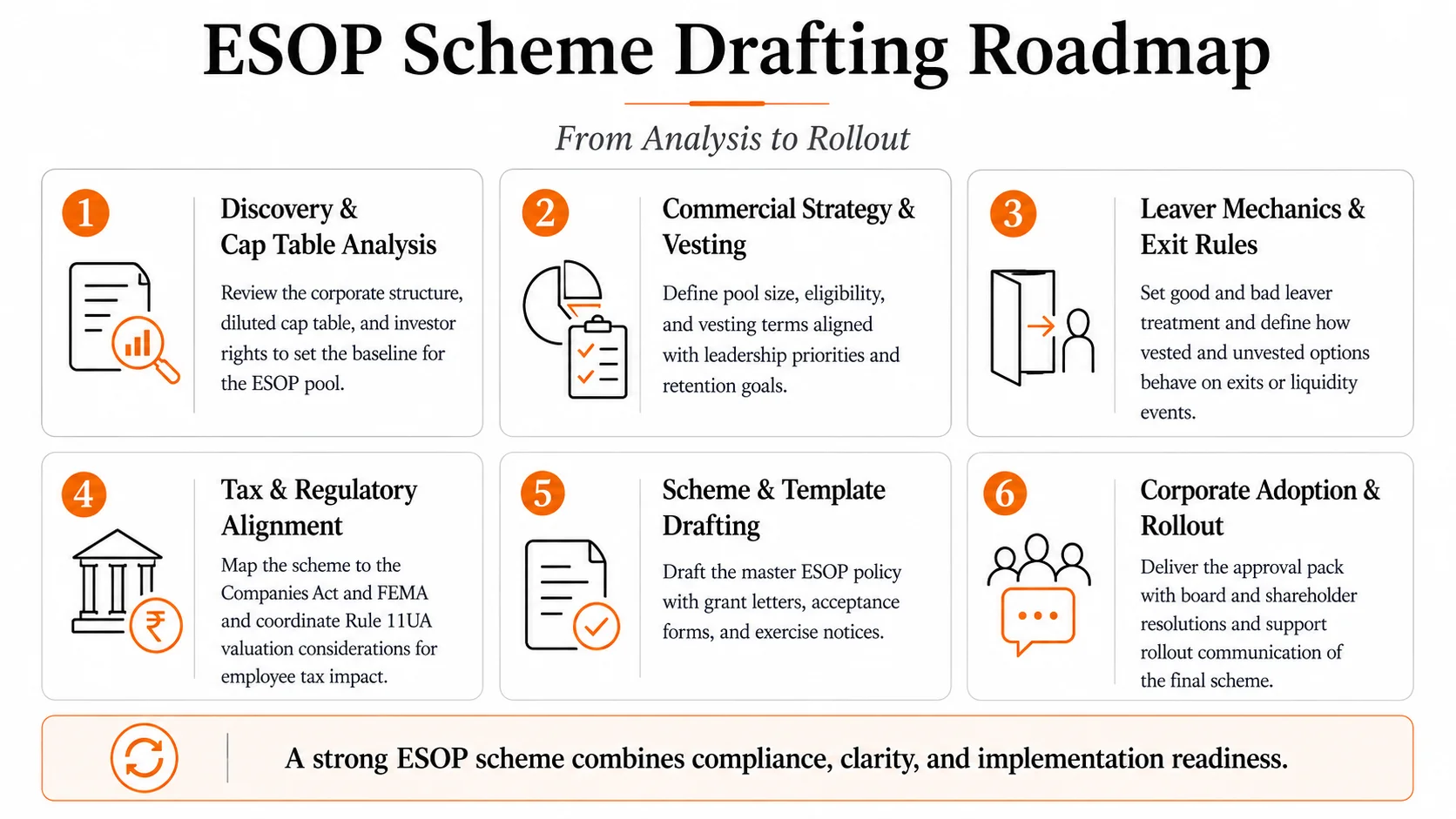
ESOP Scheme Drafting Roadmap (From Analysis to Rollout)
A well-drafted ESOP scheme moves through a structured process, from cap table analysis and commercial planning to documentation, approvals, and employee rollout. Each stage helps align employee incentives with business goals while addressing vesting, exit, tax, regulatory, and implementation requirements.
Regulatory, Tax & Accounting Framework
We align your ESOP scheme with applicable corporate, tax, accounting and cross-border requirements:
- Unlisted Companies
Compliance with Section 62(1)(b) and Rule 12 covering approvals, vesting, disclosures, exits and statutory registers. - Listed Companies
Alignment with SEBI SBEB Regulations governing committee oversight, shareholder approval, implementation and disclosures. - Approvals & Filings
Preparation of resolutions, explanatory statements, MGT-14, PAS-3, Form SH-6 and annual disclosures, as applicable. - Tax & Accounting
Coordination of exercise-stage perquisite tax, FMV certification and accounting under Ind AS 102 or applicable ICAI guidance.
ESOP Clause Decision Matrix for Employment and Exit Events
A single lapse clause rarely covers every exit event. The scheme should state the treatment below, subject to statutory rules for death, permanent incapacity, and listed-company plans.
| Event | Unvested Options | Vested Options | Decision to Draft |
|---|---|---|---|
| Resignation | Usually lapse unless otherwise provided. | Exercise within a defined post-exit window. | Fix the window, notice process, and non-exercise consequence. |
| Termination without cause | Lapse, continue, or partially accelerate. | Remain exercisable for a stated period. | Separate no-fault termination from misconduct. |
| Misconduct or bad leaver | Commonly lapse immediately. | Lapse or remain exercisable only as approved. | Define misconduct and related trigger events precisely. |
| Retirement | Continue, accelerate, or lapse as permitted. | Exercise within the retirement window. | State service conditions and approval authority. |
| Death or permanent incapacity | Apply the statutory vesting treatment. | Exercise by the employee, nominee, or legal heir. | Specify evidence, nomination, and exercise procedures. |
| Change of control or liquidity event | Accelerate, continue, substitute, settle, or lapse. | Exercise, substitute, settle, or participate. | Align treatment with transaction documents and tax funding. |
Key ESOP Drafting Decisions That Affect Dilution and Employee Value
- Pool Denominator: Confirm whether the pool is measured on issued capital, fully diluted capital, or another agreed basis and ensure consistency with investor documents.
- Grant Size Authority: Set maximum grant limits, approval thresholds, and separate approval triggers for large grants or group-company employees..
- AuVesting Design: Choose time-based, performance-based, or hybrid vesting and avoid conditions that cannot be measured or independently verified.
- Exercise Economics: Balance a manageable exercise price and window against tax cash flow, accounting expense, cap table impact, and employee affordability.
- Exit Protection: Decide whether employees receive acceleration, substitution, cash settlement, or participation rights during a corporate transaction.
- Amendment Governance: Define which changes the board can administer and which changes require employee, shareholder, stock-exchange, or regulatory approval.
Direct Route vs ESOP Trust Structure
The route should be selected before drafting because it changes approvals, documents, administration, and the source of employee shares.
| Parameter | Direct Route | Trust Route |
|---|---|---|
| Share delivery | Company allots shares on exercise. | Trust acquires or receives shares and transfers them. |
| Documents | Scheme, approvals, grant, exercise, allotment, and registers. | Direct-route documents plus trust deed, trustee, funding, custody, and administration records, including comprehensive ESOP trust deed drafting. |
| Cap table impact | Dilution usually occurs when fresh shares are allotted. | Impact depends on fresh issue, gift, or permitted secondary acquisition. |
| Administration | Simpler for limited grants and infrequent exercise. | Supports centralised custody and liquidity but adds governance. |
| Listed-company point | Available for direct issue under the SEBI framework. | Mandatory where a listed scheme uses secondary acquisition or gift. |
The comparison is indicative. Trust structures require transaction-specific corporate, tax, accounting, and regulatory advice.
Documents and Information Required for ESOP Drafting
- Corporate Records: Certificate of incorporation, memorandum, articles, share capital, and relevant board authorities
- Cap Table and Securities: Issued and fully diluted ownership, existing options, convertibles, warrants, and investor rights.
- Shareholder Agreements: Consent rights, reserved matters, transfer restrictions, liquidation terms, and existing ESOP provisions.
- Pool and Eligibility Plan: Retention objective, proposed pool, employee categories, group entities, grant limits, and exclusions in compliance with applicable corporate laws.
- Commercial Terms: Vesting, cliff, price, exercise period, lock-in, performance conditions, and post-exit windows.
- Leaver and Liquidity Policy: Intended treatment for resignation, misconduct, retirement, death, disability, acquisition, buyback, and IPO.
- Existing Commitments: Offer letters, employment terms, side letters, board minutes, and prior employee promises.
- Financial and Implementation Inputs: Financials, recent Valuations, accounting policy, applicable tax treatment, direct or trust route, administrator, and rollout workflow.
Our ESOP Scheme Drafting Process
We follow a rigorous five-step workflow to deliver defensible ESOP scheme:
Discovery & Regulatory Mapping
Map your corporate structure, cap table, and investor rights against the Companies Act and SEBI (SBEB) Regulations.
Commercial Strategy Workshop
Define the ESOP pool, vesting rules, and leaver clauses with your leadership to align with your retention goals.
Scheme & Template Drafting
Draft the master ESOP policy and all legally compliant templates for grants, acceptances, and exercises.
Tax, Accounting & Valuation Alignment
Align the scheme with Ind AS 102 and coordinate Rule 11UA valuations to optimize employee tax impact.
Final Review & Adoption Pack
Incorporate stakeholder feedback and deliver a final board-approved, MCA compliance-ready rollout pack.
What You Receive
Generic ESOP Template vs Professionally Drafted Scheme
| Criteria | Generic Template | Professionally Drafted Scheme |
|---|---|---|
| Business alignment | Standard clauses with limited context. | Reflects retention goals, cap table, investor rights, and exit plans. |
| Leaver treatment | One broad lapse rule. | Separates resignation, termination, misconduct, retirement, death, and incapacity. |
| Vesting | Vague milestones or inconsistent schedules | Measurable conditions, authority, and dates. |
| Liquidity events | Often silent on deal events. | Covers acceleration, substitution, exercise, settlement, and participation. |
| Implementation | Approvals and forms created later. | Includes grant, exercise, approval, filing, and communication documents. |
Why Choose Elite Valuation?
We are uniquely positioned to handle high-stakes ESOP scheme drafting in India, offering technical rigor and operational speed:
- Ex-Big 4 Pedigree
Our founder’s background at Ernst & Young (EY) ensures global best practices in documentation, ethics, and corporate structuring. - Tripartite Qualification
We uniquely combine CA, CS, and Registered Valuer expertise, allowing us to simultaneously solve the tax, legal, and financial puzzles of ESOPs.
- End-to-End Accountability
We do not just hand over a template; we guide you from the initial cap table math to the final ROC filing and employee rollout. - Defensive Engineering
Our schemes and reports are explicitly written to withstand rigorous regulatory scrutiny, minimizing queries from tax officers and auditors.
Our Clients











































































































































Industries We Serve





Trusted by Leaders.
Proven by Results.
What founders, CFOs, and investors say about working with Elite Valuation.
"The team at Elite Valuation was very helpful in our multiple Valuations. CA Sagar Shah personally ensured the Valuation was objective and clearly explained to us, which helped fix the gap during negotiations. They are responsive, professional, and truly understand the complexities of M&A. Highly recommend their expertise for any deal."

"We've been working with Elite Valuation for our ESOPs for a few years now, and they've been great. They handle the complex regulatory side of things very smoothly, making sure our reports are always audit-ready and easy to understand. The team is professional and always help us meet a deadline, and they really know how to manage equity Valuations for larger companies. Highly recommended if you need a reliable partner for compliance."

"Elite Valuation has been our go-to firm for our all type of Valuations be ie Merger, ESOP, Preferential Valuation of listed companies. They understand the nuances of different regulations, complex Valuation modelling and always ensure the assumptions are well-supported and defensible during audits. Their consistency and reliability make them a trusted partner for all of our Valuation requirements ."

"We engaged Elite Valuation for a merger Valuation involving more than 12 group companies, and the experience was seamless. Mr Sagar Shah and his team built a robust model that satisfied all stakeholders. Their understanding of regulatory requirements and Valuation complexities made them an invaluable partner throughout the process."

"Sagar and his team understand ESOP and Business Valuation and compliance very well. What we like most is that they take the time to explain the numbers and the logic behind them, which has been very useful for us internally. It feels like working with a team that genuinely knows the space well."

"We issued compulsorily convertible debentures as part of a funding round, and Elite Valuation provided a robust Valuation that addressed all regulatory and stakeholder requirements. Their familiarity with instrument-specific Valuation methodologies and SEBI requirements was very evident."
"As a first-time fundraiser, we had no idea where to begin. Elite Valuation built an investor-grade financial model and a detailed Investor Memorandum for us, while guiding us on exactly what institutional investors look for. Mr. was patient, responsive, and made the entire process approachable. We walked into every investor meeting fully confident. Truly a reliable partner for anyone navigating fundraising for the first time."

"We have engaged Elite Valuation across a range of assignments, including share issuances, transfers, ESOPs, preferential allotments, rights issues, and merger Valuations. Their execution has consistently reflected strong technical depth and a clear understanding of regulatory frameworks. The team delivers well-structured, defensible Valuation reports with a high level of precision and professionalism. Their ability to manage complex mandates within tight timelines, without compromising on analytical rigor, is particularly noteworthy. Elite Valuation combines technical expertise with commercial insight, making them a dependable partner for Valuation engagements. We highly recommend their services.""

"Over the last few years, we've engaged Elite Valuation for multiple Valuation projects for multiple of our clients. Their reports are always comprehensive, well-documented, and fully aligned with regulatory requirements under Income-tax and FEMA. CA Sagar Shah's insights were instrumental in ensuring a smooth process and his expertise added tremendous value throughout. Highly recommended for multinational enterprises and large firms."
Published Insights
Read Our Latest Blogs

































Request a Call Back
15+ years
500+ clients

Draft an ESOP Scheme Your Company Can Actually Operate
An ESOP scheme should remain clear when an employee leaves, a grant is modified, a funding round changes the cap table, or an acquisition creates a liquidity event. Build those answers into the documents before the first grant is made.
Partner with Elite Valuation for ESOP scheme drafting that connects commercial decisions with approvals, Valuation, tax, accounting, and implementation.