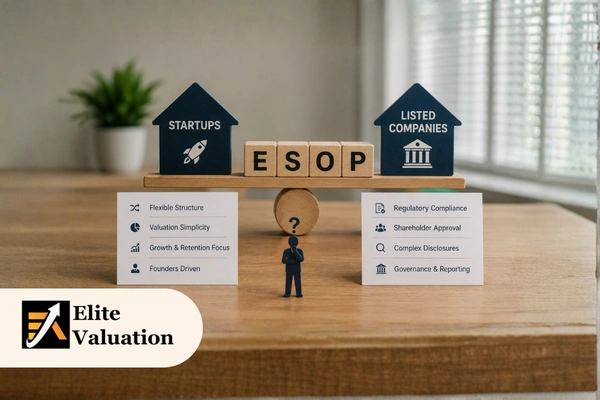
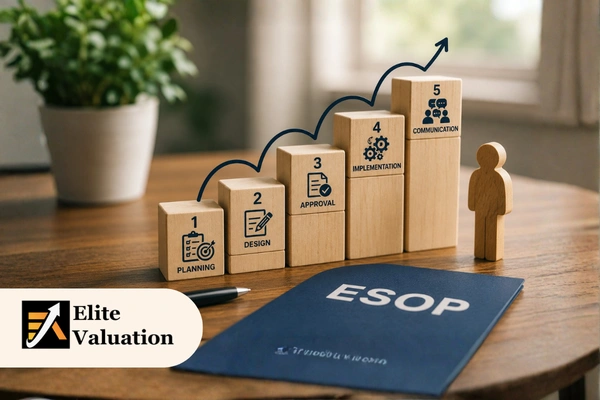
ESOP Advisory
ESOP Consultant in India: Complete ESOP Advisory, Drafting, Valuation and Implementation Services (2026)


Table of contents
- Key Takeaways:
- What Does an ESOP Consultant in India Do?
- When Should You Engage an ESOP Consultant?
- What ESOP Consulting Services Are Covered?
- ESOP Consultant vs CA, CS, Law Firm and ESOP Software — Who Does What?
- How to Choose an ESOP Consultant in India — Seven Things to Check
- What Does an ESOP Consultant Cost in India?
- Which ESOP Rules Apply to Your Company?
- ESOP Consultant Services Across India
- Case Study: Cleaning Up an ESOP Before a Funding Round
- Common Mistakes When Choosing an ESOP Consultant
- Closing Summary
- Frequently Asked Questions —ESOP Consultant in India
📌 In Short — What an ESOP Consultant in India Does
An ESOP consultant takes a company from the intention of giving employees equity to a fully implemented, compliant plan — and then keeps it compliant.
- Advises on whether an ESOP is right, how large the pool should be, and who is eligible
- Drafts the scheme, resolutions, grant letters and registers
- Values the shares for the exercise price, the options for accounting, and again at every exercise for tax
- Implements the board and shareholder process and files with the Registrar of Companies
- Supports the finance team on accounting and the payroll team on TDS
- Explains the plan to employees, and maintains it every year afterwards
The drafting is roughly 20% of the work. The other 80% is what determines whether the plan survives a funding round or a due diligence exercise.
Almost every ESOP problem we are asked to fix has the same origin: the work was split across four functions and nobody owned the whole of it. The founder decided the intent. The company secretary handled the resolutions. The auditor booked the expense. The payroll team deducted the tax. And the employee — the entire reason for the exercise — was handed a grant letter and never given an explanation.
None of those people did anything wrong. The gaps between them are where the problems form. A vesting clause is drafted without anyone modelling the tax the employee will owe on exercise. A pool is fixed at 10% because that is what someone read, not because it was tested against a hiring plan. A valuation is obtained once and reused for four years. A grant is made to a director who is not eligible under Rule 12. Each is individually small and each surfaces at the worst possible time, usually when an investor's diligence team asks for the option register.
An ESOP consultant in India exists to own that whole picture. At Elite Valuation, we run the complete engagement — advisory, drafting, valuation, secretarial process, finance and tax support, employee workshops and annual administration — under one roof, drawing on CA, CS and IBBI Registered Valuer credentials rather than coordinating three firms who each see one part. This page explains what that involves, when you need it, what it costs, and how to judge whether a consultant is any good.
Key Takeaways:
- ESOP work spans
four disciplines — advisory, drafting, valuation and compliance. Most providers cover one or two - A full engagement runs through ten phases, from the first discussion to annual maintenance
- Valuation is required more than once — at grant, for accounting, and again at every exercise for perquisite tax
- The secretarial process — board meeting, special resolution, MGT-14, Form SH-6, PAS-3 — is where in-house attempts most often fail
- An ESOP software platform administers a plan; it cannot design, value, approve or file one
- Typical implementation timeline is 6–10 weeks for a private limited company with clean records
- Regularising a broken ESOP costs morethan implementing one correctly the first time
- ESOP law is central, not state-specific — but stamp duty, the jurisdictional RoC and trust registration do vary by state
What Does an ESOP Consultant in India Do?
An Employee Stock Option Plan gives selected employees the right to buy shares in the company at a fixed price, after completing a defined period or achieving defined goals. It is governed principally by Section 62(1)(b) of the Companies Act, 2013 read with Rule 12 of the Companies (Share Capital and Debentures) Rules, 2014, and for listed companies by the SEBI (Share Based Employee Benefits and Sweat Equity) Regulations, 2021.
An ESOP consultant converts that framework into a plan that fits your specific company. The work falls into four distinct kinds, and understanding the split is the fastest way to judge whether a provider can actually serve you.
📌 The Four Kinds of Work Inside Every ESOP Engagement
- Advisory — is an ESOP the right instrument, how large should the pool be, who should receive options, on what vesting and exercise terms, and what does it cost in dilution
- Drafting — the scheme document, board and shareholder resolutions, explanatory statement, grant letters, acceptance and exercise forms, the Form SH-6 register, and a trust deed where the trust route is used
- Valuation — the share value supporting the exercise price, the option fair value for the accounting charge, and the fair market value at each exercise for the perquisite computation
- Compliance — the board and general meeting process, MCA filings, accounting entries, tax withholding, annual Board's Report disclosure and register maintenance
A company secretary typically covers drafting and compliance. An audit firm covers valuation and accounting. A law firm covers drafting. The advisory layer — the decisions that determine whether the plan works commercially — is the one most often left unowned.
The practical test of a consultant is simple. If the first deliverable offered is a scheme document, you are buying documentation. If the first request is to see your hiring plan, your cap table and your last valuation, you are buying advisory.
When Should You Engage an ESOP Consultant?
Trigger Points
Companies come to us at three broadly different moments, and the engagement looks quite different in each.
1. You Are Setting Up an ESOP for the First Time
Cleanest and Cheapest Path
6–10 Weeks
The most common triggers are a funding round where the investor expects a pool, a senior hire who will not join without equity, or a founder deciding to formalise what has so far been verbal promises.
- Nothing has been granted yet, so the design is unconstrained
- Pool sizing can be modelled properly against the hiring plan before anything is committed
- Verbal promises already made to early employees can be reconciled into the framework rather than around it
2. You Have an ESOP That Needs Cleaning Up
Most Common Engagement
Costs More Than Doing It Right
The most common triggers are a funding round where the investor expects a pool, a senior hire who will not join without equity, or a founder deciding to formalise what has so far been verbal promises.
- Nothing has been granted yet, so the design is unconstrained
- Pool sizing can be modelled properly against the hiring plan before anything is committed
- Verbal promises already made to early employees can be reconciled into the framework rather than around it
3. You Are Preparing for a Transaction
Funding, Sale or IPO
Timeline-Critical
An ESOP that is not in order becomes a price adjustment, an indemnity or a condition precedent. Preparing the file before diligence begins is materially cheaper than defending it during.
- Fully diluted cap table reconciled and agreed, including unallocated pool and unvested options
- Complete ESOP file assembled and gap-closed before the data room opens
- Pool top-up sized and justified before it is negotiated inside a term sheet
- For IPO-bound companies, founder grant sequencing and the SEBI position reviewed well ahead of the draft offer document
What ESOP Consulting Services Are Covered?
Full Scope
Our engagement runs through ten phases. Each is set out in detail on our ESOP services page; the summary below shows the full scope in sequence.
📋 The Ten Phases of an ESOP Engagement
- 1. ESOP management discussion — establishing the objective, dilution appetite and whether an ESOP is the right instrument at all
- 2. Helping you understand the ESOP — a plain-language session for founders and management on grant, vesting, cliff, exercise, dilution and tax
- 3. Employee identification — checking eligibility under Rule 12 and building a grant plan by role and seniority
- 4. Pool sizing and structure design — sizing the pool from the hiring plan, fixing vesting, exercise price policy and leaver terms
- 5. ESOP drafting services — scheme, resolutions, explanatory statement, grant letters, acceptance and exercise forms, Form SH-6, trust deed if applicable
- 6. ESOP valuation — share value at grant, option fair value for accounting, and fair market value at each exercise
- 7. Company secretarial process — board meeting, general meeting, special resolution, MGT-14, SH-6 register, allotment and PAS-3
- 8. Finance and tax team support — amortisation schedule and journal entries for finance; perquisite and TDS computation and Form 12BA/16 reporting for payroll
- 9. Employee workshop — a live session plus written FAQ so employees actually understand what they hold
- 10. Ongoing ESOP administration — register upkeep, vesting tracking, exercise processing, leaver handling and annual disclosures
⚠️ Phases 8 and 9 are the ones most often dropped. They are also the two that determine whether the plan produces any benefit. If the finance team cannot support the charge in the audit and the employees cannot explain what they hold, the company has taken the full dilution and received almost none of the retention value it was paying for.
Not Sure Whether You Need a New ESOP or a Cleanup?
Send us what you have — scheme, resolutions, register, grant letters, or nothing at all. We will tell you where you stand and what the engagement would actually involve, before you commit to anything.
ESOP Consultant vs CA, CS, Law Firm and ESOP Software — Who Does What?
This is the question most companies are actually weighing, and it deserves a straight answer rather than a sales one. Each of these providers is genuinely good at part of the work. The table below sets out honestly where each is strong and where the gaps sit.
| Activity | Practising CS | CA / Audit Firm | Law Firm | ESOP Software | ESOP Consultant |
|---|---|---|---|---|---|
| Pool sizing & dilution modelling | Rarely | Sometimes | No | Tools only | Yes |
| Vesting & exercise price design | Partly | Partly | Yes | No | Yes |
| Scheme & document drafting | Yes | Partly | Yes | Templates | Yes |
| Share & option valuation | No | Yes | No | No | Yes |
| Board, EGM & MCA filings | Yes | Partly | Partly | No | Yes |
| Accounting charge & audit support | No | Yes | No | No | Yes |
| Perquisite tax & TDS working | No | Yes | No | No | Yes |
| Employee workshop | Rarely | Rarely | No | Dashboard only | Yes |
| Day-to-day tracking & dashboards | Manual | Manual | No | Best in class | Manual or via platform |
📌 The Honest Version
A software platform is genuinely better than any consultant at ongoing tracking. If you have an implemented, compliant plan and many grantees, a platform will administer it more reliably than a spreadsheet. What it cannot do is decide your pool size, sign a valuation report, pass your special resolution, file with the Registrar, or answer an employee asking what tax they will pay. Most companies are best served by both — a consultant to design and implement, a platform to administer afterwards.
Equally, if your plan is small and your records are clean, a good practising company secretary may be sufficient. The case for a consultant strengthens as the pool grows, as senior hires start negotiating equity individually, as an audit or a transaction approaches, or when nobody internally owns the picture end to end.
How to Choose an ESOP Consultant in India — Seven Things to Check
- Do they ask for your hiring plan before offering a document? The order of questions reveals whether you are buying advisory or templates.
- Can they sign the valuation, or will they subcontract it? Valuation is needed repeatedly across the plan's life. A provider who outsources it adds a handoff at every exercise.
- Do they handle the MCA filings themselves? Drafting a resolution and filing MGT-14 are different services. Confirm which you are getting.
- Will they brief your finance and payroll teams directly? Ask specifically whether the deliverable includes an amortisation schedule and a perquisite computation format — not a note explaining that these are required.
- Do they run employee workshops? Most do not. It is the cheapest part of the engagement and the one employees remember.
- What does year two look like? An ESOP creates permanent annual obligations. A provider with no ongoing service model is handing you a maintenance problem at the end of the project.
- Have they prepared an ESOP file for due diligence before? Designing a plan and defending one are different skills. Ask for the experience specifically.
⚠️ The single clearest warning sign is a fixed-price quote given before anyone has seen your cap table, your hiring plan or your existing corporate records. It means the provider intends to deliver a template. Any honest scope for an ESOP engagement depends on whether records are clean, whether grants have already been made, whether a trust is involved, and how many people will be granted options.
Put Us Against That Checklist
CA, CS and IBBI Registered Valuer credentials in one team — so the advisory, the drafting, the valuation, the filings and the tax working come from the same place, with no handoffs between firms.
What Does an ESOP Consultant Cost in India?
Engagement Models
Most firms avoid this question. The honest answer is that cost is driven by scope rather than by headcount, and the largest single variable is whether you are building a plan from scratch or repairing one.
| Engagement Model | What It Covers | Basis |
|---|---|---|
| Full ESOP implementation | All ten phases — advisory, design, drafting, valuation, secretarial process and filings, finance and tax support, employee workshop | One-time fee, scoped after reviewing records |
| ESOP valuation only | Share valuation, option valuation, or exercise-date fair market value | Per report |
| ESOP drafting only | Scheme, resolutions and document set, where the company runs its own secretarial process | One-time fee |
| ESOP cleanup / regularisation | Reconstructing the historical position, closing gaps, regularising past grants and filings | Scoped after a diagnostic review |
| Annual administration retainer | Register upkeep, vesting tracking, exercise processing, leaver handling, annual disclosures and audit support | Annual retainer |
What Actually Drives the Cost
| Factor | Lower Cost | Higher Cost |
|---|---|---|
| Starting position | No grants made yet; clean records | Existing grants, missing documents, unfiled forms |
| Company type | Unlisted private limited | Listed company under SEBI SBEB Regulations |
| Structure | Direct grant route | ESOP trust route with trust deed and trustee |
| Grantees | Small, single-location team | Large team, multiple entities, or employees outside India |
| Valuation complexity | Recent priced round available | No recent round; projections required; multiple exercise dates |
⚠️Cleanup consistently costs more than implementation. Repairing an ESOP means first reconstructing what was actually done — from board minutes, grant letters and filings that may be incomplete — before anything can be corrected. That reconstruction is chargeable work that would never have existed had the plan been implemented properly. If you are weighing whether to engage a consultant now or manage in-house for a year, this is the number to weigh it against.
Which ESOP Rules Apply to Your Company?
The framework that governs your plan depends on what kind of company you are. This determines the approval process, the valuation requirements and the disclosure obligations.
| Company Type | Governing Framework | Key Points |
|---|---|---|
| Unlisted private limited | Section 62(1)(b), Companies Act, 2013 + Rule 12 | Special resolution required; minimum one year between grant and vesting; Form SH-6 register; Board's Report disclosure under Rule 12(9) |
| Listed company | SEBI (Share Based Employee Benefits and Sweat Equity) Regulations, 2021 | Nomination and Remuneration Committee administers; additional disclosure and certification; specific limits on the trust route |
| DPIIT-recognized startup | Companies Act + Rule 12, with exemption | Exempt from the promoter and 10%-plus director exclusions for ten years from incorporation; perquisite tax deferral available only where the Section 80-IAC certificate is held |
| GIFT City / IFSC entity | Companies Act + applicable IFSCA framework | Additional regulatory layer; cross-border employee grants require FEMA reporting |
| Company with employees abroad | Companies Act + FEMA Non-Debt Instruments Rules, 2019 | Grants to non-residents require reporting to the Reserve Bank in Form ESOP within 30 days; see our FEMA compliance guide |
⚠️ Eligibility must be tested at every grant date, not once at scheme adoption. Rule 12(1) excludes promoters, the promoter group, and directors holding more than 10% of the outstanding equity shares, alone or with relatives and body corporates. A director who was eligible at the first grant may cross the threshold before the second. For DPIIT-recognised startups, the exemption runs for ten years from incorporation — after which the exclusions apply normally.
ESOP Consultant Services Across India
Where We Work
ESOP law is central. The Companies Act, the SEBI regulations for listed issuers and the income tax provisions apply identically nationwide, so ESOP consulting is delivered across India. What genuinely varies by state is stamp duty on share certificates and share transfers, the jurisdictional Registrar of Companies for MGT-14 and PAS-3 filings, and trust registration where the ESOP trust route is used.
Our Home Office
RoC Ahmedabad
Beyond Ahmedabad, we work with manufacturing and textile groups across Surat, Vadodara and Rajkot, and with entities operating from GIFT City IFSC — where the ESOP framework sits alongside an additional regulatory layer and, frequently, employees located outside India.
Surat | Vadodara | Rajkot
GIFT City IFSC
Our base. Ahmedabad's client mix runs from family-owned manufacturing groups formalising employee ownership for the first time, to a growing set of technology and services businesses. First-generation ESOPs in promoter-led businesses raise a particular question — how to reward a long-serving management team without disturbing family shareholding — and that is a large part of what we do here.
Listed Companies
BFSI
Mumbai's mix skews toward listed companies and financial services, which means the SEBI SBEB Regulations rather than Rule 12 alone — Nomination and Remuneration Committee administration, additional disclosure, and stricter conditions around the trust route and secondary acquisition.
Gurugram | Noida | New Delhi
The NCR client base is weighted toward fintech, e-commerce and B2B services, often with group structures spanning multiple entities. Grants to employees of holding, subsidiary or associate companies require a separate special resolution — a condition frequently missed in multi-entity groups.
VC-Backed SaaS
Pool Top-Ups
Bengaluru is where ESOPs are most standard and most contested. Venture-backed companies granting through successive priced rounds face pool top-ups negotiated inside term sheets, refresh grants for early employees, and secondary liquidity windows — questions of design and negotiation more than of compliance.
Elsewhere in India
Pune | Hyderabad | Chennai | Jaipur
We work with companies across India. Because the framework is central, the engagement runs the same way regardless of location — with the state-specific elements of stamp duty, RoC jurisdiction and trust registration handled as part of the implementation phase.
Case Study: Cleaning Up an ESOP Before a Funding Round
Elite Valuation — Anonymised Client Engagement
Technology Services
140 Employees
Existing ESOP, 3 Years Old
Closed With No Adverse Findings
The situation. A company approached us seven weeks before a data room was due to open. An ESOP had been implemented three years earlier by a firm engaged only to draft the scheme and pass the resolutions. Since then, 46 grants had been made and tracked in a spreadsheet by the HR team. The Form SH-6 register had not been updated after the first year. Two grants had been made to employees of a subsidiary without the separate special resolution required for group-company grantees. The same valuation report had been used for three separate exercises across two financial years, meaning the perquisite computations and the tax withheld were unsupported.
What we did. We reconstructed the option position from grant letters, board minutes and bank records, and reconciled it to the register of members and every PAS-3 filing. The subsidiary grants were regularised through fresh approvals with counsel. We prepared exercise-date valuations for each of the three historical exercise events, recomputed the perquisite for the affected employees, and worked with the payroll team on the corrective withholding and reporting position. The register was rebuilt and brought current, and a compliance calendar was handed to the company secretary.
The outcome. The ESOP file was complete before the data room opened. The equity compensation section of diligence closed with no adverse findings, no indemnity and no holdback. The company has since retained us on an annual administration basis — which, as the founder observed, would have cost a fraction of the cleanup had it been in place from the start.
Common Mistakes When Choosing an ESOP Consultant
❌Buying drafting and calling it advisory
A scheme document delivered without anyone examining your hiring plan, cap table or dilution appetite is a template with your name on it. The design decisions — pool size, vesting, exercise price — are where the value sits, and they are made before drafting begins.
Ask instead: "What will you need from us before you start drafting?" The answer tells you everything.
❌Splitting the work across three providers to save cost
A law firm drafts, an audit firm values, a company secretary files. Each does its part correctly, and nobody owns the joins. The exercise price is set without reference to the perquisite tax; the accounting charge does not match the scheme terms; the register drifts from the ledger.
Consequence: The coordination cost lands on your CFO, and the gaps surface in an audit or a diligence exercise.
❌ Assuming a software platform replaces a consultant
Platforms administer well. They do not size pools, sign valuations, pass resolutions or file with the Registrar. Companies that adopt a platform without implementing the plan properly end up with an accurate dashboard on top of a non-compliant scheme.
Better approach: Consultant to design and implement, platform to administer. They are complements, not alternatives.
❌ Accepting a fixed quote before anyone has seen your records
Scope for an ESOP engagement genuinely depends on whether grants have already been made, whether records are complete, whether a trust is involved and how many grantees there will be. A price quoted without that information assumes the simplest possible case.
Consequence: Either a scope variation later, or a deliverable narrower than what you thought you were buying.
❌ Treating the engagement as finished at implementation
The plan is approved, grant letters go out, the file is closed. Then vesting is not tracked, leavers are not processed, exercises happen against a stale valuation, and the annual Board's Report disclosure is assembled from memory.
Fix: Agree the year-two service model at the outset — whether with your consultant, a platform, or an internal owner with a written calendar.
Closing Summary
An ESOP looks like a document and behaves like a project. It needs an advisory conversation before anything is drafted, a valuation before an exercise price can be set, a proper board and shareholder process before any option is granted, working papers so the numbers land correctly in the accounts and the payroll, a workshop so employees understand what they have been given, and steady annual upkeep so the file still stands up when an investor or an acquirer asks for it. The value of an ESOP consultant is not any single one of those steps — most of them can be bought separately. It is that one team owns the joins between them. At Elite Valuation, our ESOP practice brings CA, CS and IBBI Registered Valuer capability together in a single engagement, covering advisory and structuring, scheme drafting, share and option valuation, the complete secretarial process, finance and tax support, employee workshops and ongoing administration — for companies in Ahmedabad, across Gujarat, and in Mumbai, Delhi NCR, Bengaluru and elsewhere in India.
Frequently Asked Questions —ESOP Consultant in India
One Team for Your Entire ESOP — Start to Finish
Advisory discussion → Management education → Employee identification → Pool sizing → Scheme drafting → Valuation → Board and shareholder process → MCA filings → Finance and tax support → Employee workshop → Annual administration. You make the decisions. We handle everything else.

CA Sagar Shah, Founder
Mr Sagar Shah is the Founder of Elite Valuation and leads the firm’s Valuation and Advisory practice. With over 15+ years of professional experience.
Published Insights