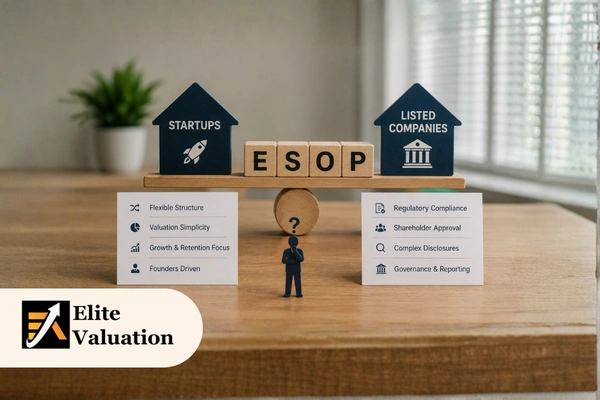
📖 Part of our resource hub: ESOP Advisory and Valuation Services at Elite Valuation. This guide focuses specifically on how to evaluate, vet and select the right ESOP advisor for your company's stage, structure and listing status.
📌 For Founders, CFOs & HR Leaders: What You Must Know
Most founders shop for an ESOP advisor the way they shop for a logo designer: lowest quote, fastest turnaround, done. That approach works until the ESOP scheme is challenged in a funding round due diligence, a tax officer questions the perquisite value at exercise, or a listed company's Regulation 14 disclosure gets flagged by the exchange.
An ESOP program in India can trigger up to three distinct valuations across its life, each requiring a different regulatory standard and, in most cases, a different category of professional. Getting the professional category wrong is the single most common and most expensive mistake founders make when hiring an ESOP advisor.
Employee stock option schemes look simple from a distance: grant options, employees vest, employees exercise, employees own shares. In practice, an ESOP program sits at the intersection of three separate legal frameworks that do not talk to each other. The Companies Act 2013 governs how the scheme is structured and how the exercise price is set. The Income Tax Act governs how the perquisite is taxed when an employee actually exercises. SEBI governs the same activity all over again the moment the company lists its shares. Each framework has its own valuation date, its own prescribed methodology and, critically, its own list of who is even allowed to sign the report.
This is exactly the gap most ESOP advisors do not fill. Many providers are strong on scheme documentation and cap table mechanics but treat the valuation itself as a commodity, farmed out to whichever merchant banker or registered valuer answers the phone first. Others are strong valuers but have no view on the December 2025 SEBI amendment that just changed who is legally allowed to sign an ESOP valuation for a listed company. At Elite Valuation, our team combines IBBI registered valuer credentials with practical ESOP scheme design, and we have built this guide specifically to help founders ask the right questions before signing an engagement letter, whether they use our team or someone else's.
Key Takeaways:
- An unlisted company's ESOP can trigger up to three separate valuations: grant date, exercise date and, if the company later lists, an ongoing SEBI compliant valuation, each needing a different professional
- Grant date valuation under Section 62(1)(b) and Section 54 of the Companies Act 2013 must be done by an IBBI registered valuer holding the Securities or Financial Assets asset class
- Exercise date perquisite valuation for unlisted company shares, under Rule 3(8) of the Income Tax Rules, still requires a Category I merchant banker, not a CA certificate and not an IBBI registered valuer
- The SEBI Second Amendment Regulations 2025, effective 2 January 2026, replaced merchant bankers with IBBI registered valuers for listed company ESOP and sweat equity valuation under Regulation 34
- Price is the least reliable signal of ESOP advisor quality. The cheapest quote is frequently the one missing the correct professional category for the trigger involved
- Eligible DPIIT recognised startups can defer TDS on the ESOP perquisite up to five years under Section 192(1C), and an advisor who overlooks this creates avoidable cash flow pain for employees
- A written independence declaration and a verifiable IBBI registration number are non negotiable checks before signing any ESOP valuation engagement
- The right advisor changes by company stage: early stage, growth stage with recurring pool refreshes, and pre-IPO or listed each need a different depth of SEBI and Companies Act expertise
What Does an ESOP Advisor in India Actually Do?
Scope Definition Phase
Before evaluating advisors, it helps to unbundle what "ESOP advisory" actually covers, because most firms only do part of it well. A complete ESOP engagement in India spans four distinct workstreams, and a founder should know which of these a prospective advisor is actually quoting for.
Scheme Design and Documentation
Legal Drafting
Board and Shareholder Resolutions
- Drafting theESOP scheme rules, pool size, vesting schedule and cliff structure
- Preparing special resolution wording and explanatory statements for shareholder approval under Section 62(1)(b)
- Structuring the ESOP trust deed where secondary acquisition of shares is involved
- Advising on cross-border grants where employees or the parent entity sit outside India, which brings FEMA into scope alongside the Companies Act
Valuation
IBBI Registered Valuer (Grant Date)
Merchant Banker (Exercise Date, Unlisted)
- Grant date fair value determination to set the exercise price, using DCF or a market multiple approach depending on the company's stage
- Exercise date fair market value certification for perquisite tax computation under Rule 3(8) of the Income Tax Rules
- Periodic 409A-style refresh valuations ahead of new grant tranches or pool top-ups
Tax and Payroll Compliance
Section 17(2)(vi)
Section 192(1C)
- Computing the taxable perquisite at exercise and coordinating TDS deduction under Section 192
- Assessing eligibility for the Section 80-IAC startup TDS deferral and tracking the five year, sale, or exit trigger under Section 192(1C)
- Advising on capital gains treatment when shares are eventually sold
Ongoing Governance and Disclosure
Regulation 14 (Listed Companies)
Annual ROC Filings
- Annual accounting disclosures per the ICAI guidance note on share-based payments
- Regulation 14 disclosures under the SEBI SBEB and Sweat Equity Regulations 2021 for listed companies
- Form PAS-3 filing within 30 days of allotment on exercise, along with the registered valuer's certificate
Very few firms are genuinely strong across all four workstreams. A founder's first task is not finding "the best ESOP advisor" in the abstract, but identifying which of these four areas actually needs outside help, and then checking that the shortlisted advisor's core strength lines up with that need.
Why the December 2025 SEBI Amendment Changes Who You Should Hire
Regulatory Landscape Phase
Until recently, the professional category question was relatively settled: IBBI registered valuers for Companies Act triggers, merchant bankers for income tax and SEBI triggers. That changed with the Securities and Exchange Board of India (Share Based Employee Benefits and Sweat Equity) (Second Amendment) Regulations, 2025, notified on 3 December 2025 and effective 2 January 2026.
The amendment redefined "valuer" under Regulation 2 to align exactly with Section 247 of the Companies Act 2013, and amended Regulation 34 to require that all fresh ESOP and sweat equity valuations for listed companies be carried out exclusively by an independent IBBI registered valuer. Merchant bankers, who previously held this role, are now permitted only to complete assignments they had already started before the amendment, within a nine month transition window ending in late September 2026. This is the same directional shift SEBI has been making across its other valuation-linked regulations, including the parallel replacement of merchant bankers with registered valuers for open offer pricing of infrequently traded shares under the Takeover Regulations.
✅ What the December 2025 Amendment Means for Your Advisor Selection
- If your company is listed, or is close to an IPO, any ESOP or sweat equity advisor you engage from January 2026 onward must be an IBBI registered valuer, not a merchant banker, for the Regulation 34 valuation
- If you engaged a merchant banker before the amendment for an assignment already in progress, that engagement can lawfully continue only within the nine month transition window
- The change does not touch Rule 3(8) of the Income Tax Rules, so unlisted company exercise date perquisite valuations still require a Category I merchant banker
- An advisor unaware of this amendment is a meaningful red flag if your company is listed or actively preparing for listing
| Valuation Trigger | Governing Law | Required Professional Valuation | Date |
|---|---|---|---|
| Grant date, exercise price setting | Section 62(1)(b) & Section 54, Companies Act 2013 | IBBI Registered Valuer | Date of grant / board approval |
| Exercise date, perquisite tax (unlisted co.) | Rule 3(8), Income Tax Rules 1962 | Category I Merchant Banker | Within 180 days of exercise |
| Exercise date, perquisite tax (listed co.) | Rule 3(8), Income Tax Rules 1962 | Average of exchange open/close price | Date of exercise |
| ESOP / sweat equity valuation (listed co.) | Regulation 34, SEBI SBEB & Sweat Equity Regulations 2021 (as amended 2025) | IBBI Registered Valuer (from 2 Jan 2026) | As specified in the scheme resolution |
| Sweat equity for know-how / IP | Section 54, Companies Act 2013 | IBBI Registered Valuer | Date of board resolution |
Not Sure Which Valuation Your ESOP Program Actually Needs?
We map your ESOP lifecycle against the Companies Act, Income Tax and, where relevant, SEBI triggers, and tell you exactly which report you need, dated correctly, before you engage anyone.
The 12-Point Checklist for Choosing an ESOP Advisor in India
Selection Phase
Once you understand what an ESOP advisor should actually cover, the selection process becomes a matter of verification rather than guesswork. Work through the following twelve checks with every advisor on your shortlist, in this order.
1. Verify the IBBI Registration Directly, Not From the Advisor's Website
Ask for the IBBI registration number and asset class, then check it yourself on the IBBI website rather than trusting a logo or a claimed credential on a proposal document. Confirm the registration covers the Securities or Financial Assets asset class, since a valuer registered only under Land and Building or Plant and Machinery cannot lawfully sign an ESOP valuation.
2. Ask Which Specific Valuation Is Being Quoted
A quote for "ESOP valuation" is meaningless until you know whether it covers grant date fair value, exercise date perquisite valuation, or both. Ask the advisor to state, in writing, which Section or Rule the deliverable satisfies, and get the valuation date they intend to use.
3. Confirm They Know the December 2025 SEBI Amendment
If your company is listed, close to listing, or has any sweat equity component, ask the advisor directly what changed under the SEBI Second Amendment Regulations 2025. An advisor still quoting a merchant banker for a fresh Regulation 34 valuation after 2 January 2026 is working from outdated knowledge.
4. Ask for a Sample Report With Assumptions Visible
A credible valuer will show a redacted sample report with the discount rate, growth assumptions, comparable set and DLOM (discount for lack of marketability) clearly documented. A valuer unwilling to show methodology, only a final number, is a sign the underlying analysis may not withstand scrutiny in a later funding round or tax assessment.
5. Check Trust Route Experience if Secondary Acquisition Is Involved
Where the ESOP scheme buys back existing shares through a trust rather than issuing fresh shares, the annual acquisition is capped at 2 percent of paid-up equity under the SEBI SBEB Regulations for listed companies, and the trust deed itself carries specific drafting requirements. Ask for a specific example of a trust structure the advisor has actually set up, not a general assurance.
6. Test Their Understanding of the Section 192(1C) TDS Deferral
Ask directly whether your company qualifies as an eligible startup under Section 80-IAC, and if so, whether the advisor will flag the TDS deferral option to your payroll team. Missing this is not a valuation error, but it is a compliance and employee experience failure that a genuinely full-service advisor should catch.
7. Get a Written Independence Declaration
The advisor should confirm in writing that they hold no equity, board seat, advisory fee tied to outcome, or other interest that could bias the valuation. This is not a formality. Independence is exactly what a tax officer, an investor's diligence team, or the NCLT will test first if the valuation is ever challenged.
8. Ask Who Actually Signs the Report
At larger firms, a partner's name and registration number appear on the final report, but the underlying analysis is sometimes performed entirely by a junior team the partner has never spoken with the founder about. Ask specifically who will sign, and whether that person will be available to answer questions from your auditors or investors later.
9. Clarify the Fee Structure and What It Excludes
Confirm whether the quoted fee is fixed or scope-based, and what triggers an additional charge, a second grant tranche, a scheme amendment, a follow-up query from your auditors. A fixed fee that excludes basic follow-up support is often more expensive in practice than a slightly higher fee that includes it.
10. Ask for Two References at a Similar Company Stage
An advisor who has only valued mature, profitable companies may not have current judgment on how to value a pre-revenue company's ESOP pool, and vice versa. Ask for references specifically from companies at your funding stage, and actually call them.
11. Confirm Turnaround Time Against Your Grant Timeline
Grant date valuations need to be ready before the board resolution approving the grant, and exercise date valuations need to be dated within 180 days of exercise for unlisted companies. Ask for a specific turnaround commitment in business days, not "a couple of weeks", and confirm what happens if a co-founder or board member is unavailable for a signature during that window.
12. Check Coordination With Your Company Secretary and Auditors
ESOP compliance touches board resolutions, ROC filings, statutory audit disclosures and, for listed companies, exchange filings. Ask whether the advisor has previously coordinated directly with a company secretary and statutory auditor on an ESOP matter, or whether you will be the one relaying information between three disconnected advisors.
Companies Act vs Income Tax vs SEBI: Which Valuation Does Your Advisor Need to Deliver?
The most persistent confusion founders have is assuming "ESOP valuation" is one report. It is not. Below is the practical distinction between the three standards of value your advisor may be asked to apply, and why using the wrong one is not a minor technicality./p>
| Standard | Purpose | Typical Method | Consequence if Wrong |
|---|---|---|---|
| Fair Value (Companies Act) | Sets the exercise price at grant, protects shareholders from underpriced dilution | DCF for growth-stage, market multiple where peers exist | ROC filing rejection, minority shareholder objection |
| Fair Market Value (Income Tax) | Computes the taxable perquisite at exercise under Section 17(2)(vi) | Merchant banker certified FMV, internationally accepted methodology | Employee under or over taxed, TDS demand on the company, penalty exposure |
| SEBI Compliant Value (Listed Companies) | Governs valuation for listed company ESOP and sweat equity under Regulation 34 | IBBI registered valuer, methodology consistent with Section 247 standards | Regulation 14 disclosure mismatch, exchange query, possible unwinding |
⚠️ One Report Cannot Serve All Three Purposes. A founder who asks an advisor for "one ESOP valuation report to cover everything" is asking for something that does not exist under Indian law. Grant date fair value, exercise date fair market value and, where applicable, the SEBI compliant valuation are three distinct exercises with three distinct dates and, in most cases, three distinct signatories. An advisor who offers a single combined report without addressing this distinction is either simplifying past a compliance gap or has not thought through the requirement.
How Does Customer Attrition Rate Determine the Remaining Useful Life?
Stage-Specific Selection Phase
Early-Stage Startups (Pre-Seed to Series A)
Speed and Simplicity Matter Most
At this stage, the priority is a fast, defensible grant date valuation and a clean, simple ESOP scheme document, not elaborate infrastructure. Look for an advisor comfortable working from limited financial history, willing to use reasonable, well-documented assumptions rather than an overbuilt model, and able to turn around the valuation and scheme document within one to two weeks. Cost sensitivity is legitimate here, but not at the expense of IBBI registration or a written independence declaration.
Growth-Stage Companies (Series A to Series D)
Recurring Grants, Pool Refreshes
Growth-stage companies typically issue multiple grant tranches a year, refresh the pool ahead of new hiring, and increasingly deal with the Section 192(1C) TDS deferral question as early employees approach the five-year or exit trigger. The advisor selection priority shifts toward continuity, the same team handling successive valuations so grant-to-grant assumptions stay consistent, and toward proactive compliance tracking rather than reactive, request-only service.
Pre-IPO and Listed Companies
SEBI Regulation 34 Now Applies
Once a company lists, or is actively preparing to, the advisor must be current on the December 2025 SEBI amendment, comfortable with Regulation 14 disclosure formatting, and able to coordinate directly with the company's SEBI-registered merchant banker on the broader listing or open offer workstream even though the merchant banker no longer signs the ESOP valuation itself. This is the stage where advisor continuity failures are most expensive, since a valuation gap or inconsistency becomes visible to public shareholders and the exchange, not just to the company's own board.
Planning ESOP Pool Refreshes Across Multiple Funding Rounds?
We provide continuity across grant tranches so every valuation uses consistent, defensible assumptions, from your first ESOP pool through to a SEBI-compliant listed company structure.
What Should an ESOP Advisory Engagement Cost in India?
Cost Benchmarking Phase
Pricing varies with complexity, but founders benefit from having a reference range so an unusually low quote raises the right question rather than looking like a good deal.
📌 Illustrative Fee Ranges for ESOP Advisory Engagements in India
- Standalone grant date valuation, early stage: Rs.75,000 to Rs.2,00,000, depending on financial complexity and time pressure
- Full scheme design plus valuation plus trust deed: Rs.2,50,000 to Rs.8,00,000, depending on trust structure and cross-border elements
- Annual compliance retainer, growth stage: Rs.1,50,000 to Rs.5,00,000 per year, covering recurring grant valuations and disclosure support
- Listed company Regulation 34 valuation and Regulation 14 disclosure support: Priced higher given documentation depth and IBBI registered valuer requirement
A Rs.1 to Rs.3 Lakh advisory fee protecting a Rs.5 to Rs.50 Crore ESOP pool from a mispriced exercise price, a rejected ROC filing, or an incorrect perquisite tax computation is not a discretionary cost. It is closer to insurance against a much larger correction later.
⚠️ The Cost of Getting the Perquisite Value Wrong. If the exercise date fair market value is understated, employees are undertaxed and the company faces a TDS shortfall demand from the Income Tax Department, typically accompanied by interest and, where the shortfall is treated as deliberate, a penalty under Section 270A that can reach 200 percent of the tax evaded in cases of underreporting arising from misreporting of income. An overstated FMV, by contrast, simply overtaxes employees unnecessarily, which is a retention and morale cost rather than a compliance one, but is equally avoidable with a correctly scoped advisor.
Questions to Ask an ESOP Advisor Before You Sign
📋 A Practical Pre-Engagement Question List Selection
- What is your IBBI registration number and asset class, and can I verify it independently?
- Which specific Section or Rule does this valuation satisfy, and what valuation date will you use?
- Will you provide a written independence declaration before the engagement begins?
- What is your turnaround commitment, in business days, and what happens if it slips?
- Who signs the final report, and will that person be reachable if my auditors or investors have questions?
- What is your turnaround commitment, in business days, and what happens if it slips?
- Does your fee include a follow-up round of questions from auditors, investors, or tax authorities, or is that billed separately?
- Can you share two references from companies at a similar stage to mine?
- If my company is DPIIT recognised, will you flag the Section 192(1C) TDS deferral option to my payroll team?
Red Flags That Signal You Have Hired the Wrong ESOP Advisor
Risk Screening Phase
⚠️ "We can do the valuation and the audit sign-off together." A valuer or firm offering to also handle your statutory audit, or offering a package deal that blurs the two roles, creates an independence conflict that auditors and later investors will flag. Valuation and audit sign-off should always sit with separate, unconnected professionals.
⚠️ The quote is dramatically below every other quote you received. A price 50 percent or more below the rest of your shortlist, for the identical scope, is far more often explained by a missing deliverable, an unregistered valuer, or a template report than by genuine efficiency.
⚠️ They cannot explain the difference between grant date and exercise date valuation. This distinction is fundamental to ESOP work in India. An advisor who conflates the two, or treats them as interchangeable, does not have the regulatory grounding the engagement requires.
⚠️ No written engagement letter, only a verbal quote and a WhatsApp confirmation. A defensible valuation engagement needs a documented scope, valuation date, fee and deliverable. Verbal arrangements create no accountability if the report is later challenged.
📁 A Recent Engagement
B2B Software Company
Series B, 45 Employees on ESOP
Pre-IPO Compliance Cleanup
A Series B software company approached us after its previous ESOP advisor, a single independent consultant working without a registered firm, had priced three consecutive grant tranches using a merchant banker for the grant date valuation instead of an IBBI registered valuer, a mismatch with Section 62(1)(b) that had gone unnoticed for two years. The company was now preparing for a pre-IPO funding round, and the investor's legal counsel flagged the professional category mismatch during due diligence.
We reconstructed the ESOP grant history, obtained corrected IBBI registered valuer certifications for all three prior grant dates on a retrospective, documented basis, and set up a going-forward process with a single continuity valuer for future tranches. We also identified that six employees qualified for the Section 192(1C) TDS deferral that had never been applied, which the company's payroll provider corrected before the next exercise cycle. The pre-IPO round closed with the ESOP documentation fully reconciled, and the fix cost the company a fraction of what a delayed or renegotiated funding round would have cost.
Common Mistakes Founders Make When Hiring an ESOP Advisor
❌ Choosing the advisor based only on the lowest quotee
Price comparisons only make sense when the scope, professional category and valuation date are identical across quotes. A lower price quoting a CA certificate where an IBBI registered valuer is required is not actually a cheaper version of the same service.
Fix: Standardise the scope you request from every advisor in writing before comparing fees.
❌Assuming one advisor and one report covers the entire ESOP lifecycle
Grant date, exercise date and, for listed companies, the SEBI compliant valuation are separate exercises. Founders who assume a single report from a single engagement covers all three frequently discover the gap only when a tax officer or investor's counsel raises it.
Fix:Map out every valuation trigger your ESOP program will face across its lifecycle before engaging anyone.
❌ Not verifying IBBI registration independently
A certificate shown on a proposal document is not the same as a registration verified directly against the IBBI database. Founders rarely check, and this is precisely the gap that later surfaces in due diligence.
Fix: Verify every valuer's registration number and asset class directly on the IBBI website before engagement.
❌Ignoring the December 2025 SEBI amendment for a company nearing listing
Companies preparing for an IPO sometimes continue using a merchant banker for ESOP valuation out of habit, unaware that Regulation 34 now requires an IBBI registered valuer, creating a compliance gap right when regulatory scrutiny is highest.
Fix: Confirm your advisor's familiarity with the current Regulation 34 requirement well before your IPO readiness review begins.
❌Overlooking the Section 192(1C) TDS deferral for eligible startups
Employees at DPIIT recognised startups are frequently taxed immediately at exercise when the company was eligible to defer TDS for up to five years, creating unnecessary cash flow strain for employees who have not yet sold any shares.
Fix: Ask explicitly whether your advisor will assess Section 80-IAC eligibility and flag the deferral option to payroll.
❌ Changing advisors every grant cycle without a handover
Switching advisors for a marginally lower fee each year, without ensuring the new advisor reviews prior valuations for consistency, can produce a grant history where successive valuations use incompatible assumptions, which is exactly what a due diligence team notices first.
Fix: If you do change advisors, require a documented review of prior valuation assumptions as part of the handover.
Closing Summary: Choose for Regulatory Fit, Not Just Price
The right ESOP advisor in India is not simply the most affordable or the fastest to respond. It is the advisor who can correctly identify which of the three regulatory standards, Companies Act fair value, Income Tax fair market value, or SEBI compliant value, applies to each stage of your ESOP lifecycle, and who holds the specific professional credential each one requires. The December 2025 SEBI amendment has made this distinction sharper, not softer, for any company that is listed or approaching listing. A twelve-point checklist cannot replace judgment, but it can prevent the most common and most expensive mistake founders make: hiring on price alone and discovering the professional category gap only when an investor's counsel, a tax officer, or an exchange reviewer finds it first.
Get an ESOP Advisor Who Gets the Regulatory Category Right the First Time
IBBI registered valuer credentials → Scheme design and trust structuring → Grant and exercise date valuation → SEBI and Income Tax compliant reporting. One coordinated engagement, built for founders who do not want to relearn this the hard way.
Frequently Asked Questions: Choosing an ESOP Advisor in India

CA Sagar Shah, Founder
Mr Sagar Shah is the Founder of Elite Valuation and leads the firm’s Valuation and Advisory practice. With over 15+ years of professional experience.