ESOP Advisory
ESOP Pool Dilution: How a 10% Pool Before Funding Changed Founder Ownership
ESOP Pool Size
Pre-Money Dilution
Cap Table Modelling
Funding Round
Founder Dilution
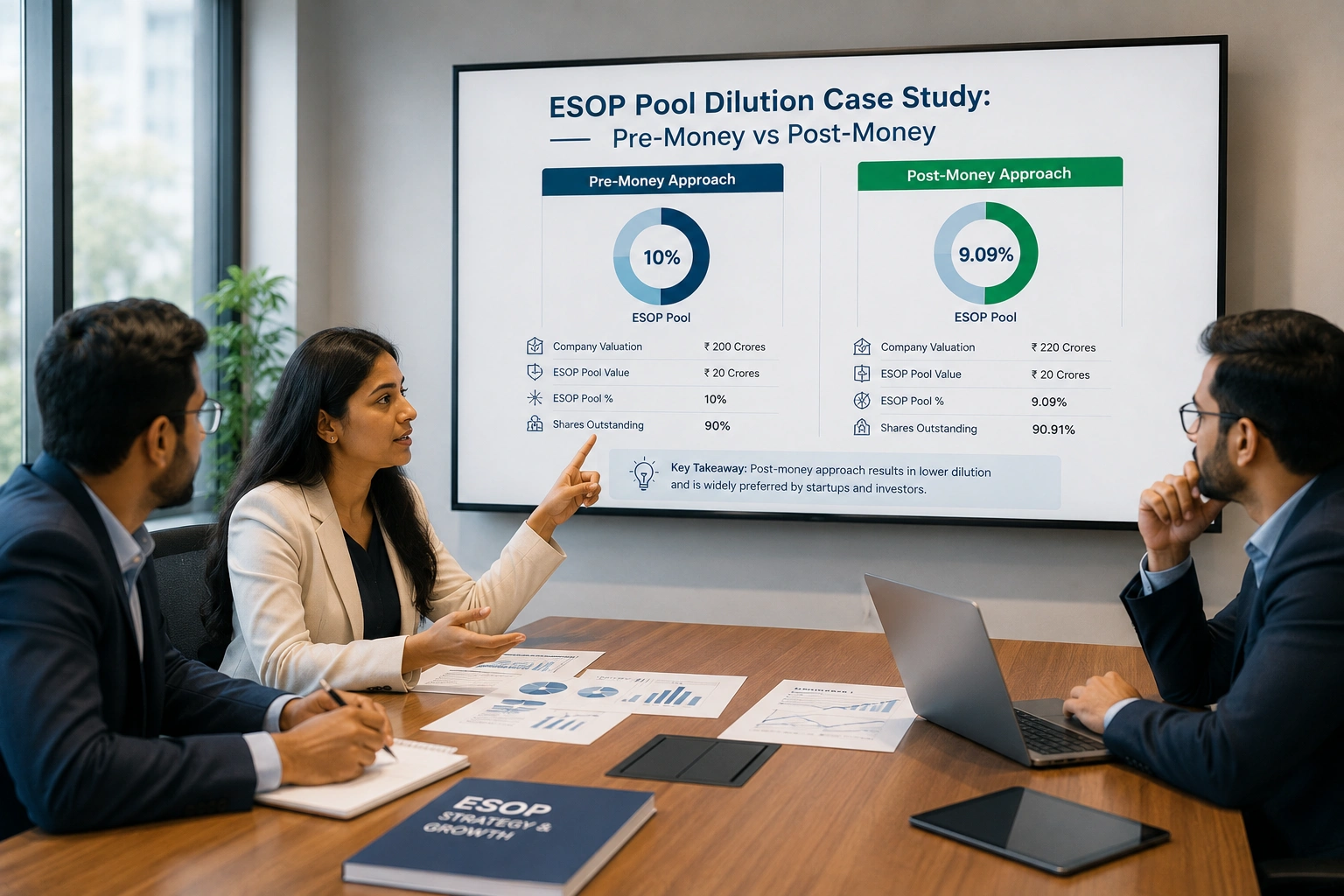
A venture-backed Indian startup entering a Series A round believed that creating a 10% ESOP pool before funding would leave a 10% employee pool after closing. It would not. A 20% new investor would dilute that pool to 8%. Elite Valuation modelled the cap table backwards and showed that a 12.50% pre-money pool was required to preserve a 10.00% post-money pool—taking founder ownership from 80% initially to 56% after the round.
12.50%
10.00%
20.00%
56.00%
01. The Cap Table Before the “10% Pool” Conversation
The client was a fast-scaling Indian B2B technology company preparing for a Series A round. Before any ESOP reservation, the fully diluted cap table contained 90,00,000 equity shares: the founders held 72,00,000 shares (80.00%) and an early angel investor held 18,00,000 shares (20.00%).
The incoming institutional investor proposed to invest ₹15.00 crore at a ₹60.00 crore pre-money Valuation, implying a ₹75.00 crore post-money Valuation and 20.00% ownership for the new investor. As part of the term sheet, the company was also expected to maintain an employee option pool equal to 10.00% of the post-financing fully diluted capital.
Management's first instinct was to reserve 10% immediately before the round. On 90,00,000 existing shares, that meant adding 10,00,000 pool shares, taking the pre-money fully diluted base to 1,00,00,000 shares. But once the new investor received 20% of the post-money company, that 10% pre-money pool would fall to only 8.00% post-money.
Elite Valuation was engaged to model the pool mathematically, quantify the dilution by stakeholder, explain the pre-money versus post-money economics, and translate the agreed structure into a practical ESOP and funding-round implementation roadmap.
"A 10% ESOP pool is not a single number. The real question is 10% of which cap table—and at what point in the financing sequence?"
02. Six Dilution Issues Hidden Inside One Term-Sheet Clause
The transaction looked simple until the denominator, timing and economic burden of the pool were modelled together.
| Challenge Area | Description & Valuation Impact |
|---|---|
| 10% Pre-Money Is Not 10% Post-Money Denominator Risk | A 10,00,000-share pool over a 1,00,00,000-share pre-money base represented 10.00%, but after a 20% investor came in the same pool represented only 8.00% of the enlarged capital. |
| Who Bears the Pool Dilution? Negotiation Economics | If the pool is created or topped up pre-money, founders and existing investors absorb the dilution. If it is created post-money, the incoming investor shares part of that dilution—an outcome institutional investors commonly resist. |
| Pool Size Had to Be Solved Backwards Cap Table Algebra | To retain 10.00% after a 20.00% financing, the pool needed to represent 12.50% of the pre-money fully diluted base. That required 12,85,714 reserved shares, not 10,00,000. |
| Top-Up Changed the Round Price Per Share Pricing Mechanics | With the larger pre-money fully diluted denominator, the ₹60.00 crore pre-money Valuation translated into approximately ₹58.33 per share rather than ₹60.00 per share under the original 10% pool assumption. |
| Reserved Pool Is Not Issued Capital Legal Structure | An ungranted ESOP pool is a fully diluted cap-table reservation, not shares already issued to employees. The scheme, grants, vesting and later issue of shares on exercise must be distinguished from the investor-model denominator. |
| Headroom Had to Match Hiring Reality Pool Adequacy | The company needed enough capacity for senior technology, sales and leadership hires without returning to shareholders for an immediate second top-up, while avoiding unnecessary pre-money dilution. |
03. How the 10% Post-Money Pool Was Built
The advisory work started with the cap-table denominator and worked backwards from the investor's post-closing ownership requirement.

Phase A: Freeze the undiluted ownership base
The opening cap table was fixed at 90,00,000 shares: 72,00,000 founders and 18,00,000 angel shares. This established the ownership that would bear any pre-money pool expansion.
Phase B: Demonstrate why a simple 10% pool fails
Adding 10,00,000 pool shares created a 1,00,00,000-share pre-money base. A 20% investor then required 25,00,000 new shares, taking post-money capital to 1,25,00,000 shares and reducing the pool to 8.00%.
Phase C: Solve the pool backwards from 10% post-money
Because the Series A investor would hold 20%, all pre-money holders together would represent 80% post-money. A 10% post-money pool therefore had to equal 10% / 80% = 12.50% of the pre-money fully diluted base.
Phase D: Compute the top-up and revised issue price
A 12.50% pre-money pool required 12,85,714 reserved shares on top of the 90,00,000 existing shares. The pre-money fully diluted base became 1,02,85,714 shares, giving an indicative funding price of approximately ₹58.33 per share.
Phase E: Issue the Series A shares and re-run ownership
At ₹58.33 per share, a ₹15.00 crore investment translated into approximately 25,71,429 new shares. Post-money capital became approximately 1,28,57,143 shares: founders 56.00%, angel 14.00%, ESOP pool 10.00% and new investor 20.00%.
Phase F: Align the cap-table model with ESOP documentation
The final step separated the investor's fully diluted pool assumption from actual grants and exercises. The ESOP scheme and shareholder approvals would operate under Section 62(1)(b) and Rule 12, while grants would be made against the approved pool over time.





6 ESOP dilution components applied:
Ownership progression:
| Stakeholder | Before Pool | 10% Pre-Money Pool | Final: 10% Post-Money Pool |
|---|---|---|---|
| Founders | 80.00% | 72.00% | 56.00% |
| Angel Investor | 20.00% | 18.00% | 14.00% |
| ESOP Pool | — | 10.00% | 10.00% |
| Series A Investor | — | — | 20.00% |
Indian legal framework
Section 62(1)(b), Companies Act, 2013: permits further issue of shares to employees under a scheme of employees' stock option, subject to shareholder approval and prescribed conditions.
Rule 12, Companies (Share Capital and Debentures) Rules, 2014: governs ESOP schemes for relevant unlisted companies, including special-resolution approval, scheme disclosures, vesting mechanics, registers and ongoing disclosures.
Practical distinction: reserving an ESOP pool in a financing cap table does not itself issue shares. The formal scheme, individual grants, vesting and issue of equity shares on exercise are separate corporate actions.
04. Result: The “10% Pool” Cost the Founders 24 Percentage Points
Once the pool and financing were modelled on the same fully diluted basis, the economics became transparent for every stakeholder.
12.50%
10.00%
20.00%
56.00%
- The model showed that a nominal 10.00% pre-money pool would shrink to 8.00% after a 20.00% financing, avoiding a late-stage cap-table surprise during documentation.
- A 12.50% pre-money pool was established as the correct denominator to deliver exactly 10.00% employee capacity after the round.
- The ₹15.00 crore investment at ₹60.00 crore pre-money still gave the Series A investor its negotiated 20.00% ownership because the pool top-up was absorbed before closing.
- Founder ownership moved from 80.00% to 56.00%, quantifying the combined 24 percentage-point dilution from employee capacity plus new capital.
- The final post-money cap table reconciled to 56% founders + 14% angel + 10% ESOP + 20% investor = 100%, giving legal and finance teams a clean closing model.
Five Lessons for Founders Negotiating an ESOP Pool
The case illustrates why ESOP pool sizing is a financing negotiation as much as an HR decision.
Always define whether the pool percentage is pre-money or post-money
A 10% pool created before a round does not remain 10% after new shares are issued. In this case it fell to 8%, which is why the term-sheet language had to be modelled backwards.
Pre-money pool top-ups are borne by existing shareholders
The investor preserved its 20% post-money stake. The economic cost of enlarging the pool therefore sat with the founders and angel investor, not with the incoming capital provider.
A pool affects the funding price even before options are granted
Expanding the fully diluted pre-money base reduced the indicative issue price from the simpler ₹60.00-per-share case to approximately ₹58.33, even though the reserved options were not yet issued shares.
Do not oversize the pool simply because an investor asks for headroom
The right pool should be tied to a hiring plan. Every unnecessary percentage point reserved pre-money dilutes existing holders immediately in the financing model.
Keep financing mechanics separate from ESOP legal implementation
The cap table may reserve 12,85,714 shares for the pool, but actual employee rights arise only through the approved scheme and grants. Corporate-law documentation must follow the negotiated economics.
Why Choose Elite Valuation
Elite Valuation supports startups, founders and investors with integrated ESOP advisory, Valuation and cap-table modelling across fundraising and employee-equity transactions.
For ESOP pool creation and top-ups, the work goes beyond selecting a percentage. We model pre-money and post-money ownership, funding-price effects, founder dilution, hiring requirements, scheme capacity and the interaction between commercial term-sheet language and implementation documentation.
As an IBBI Registered Valuer, the firm combines Valuation discipline with practical transaction advisory so that the cap table used in negotiations remains consistent with the Valuation, ESOP documentation and closing mechanics.
IBBI Registered Valuer
CA & CS Led Advisory
Startup Cap Tables
Funding-Round Support
ESOP Pool Sizing
ESOP Scheme Advisory
Dilution Modelling
ESOP Valuation
Fundraising Valuation

Sagar Shah — CA | CS | IBBI Registered Valuer | Founder, Elite Valuation
Sagar Shah is the founder of Elite Valuation and a qualified Chartered Accountant, Company Secretary, and IBBI Registered Valuer with prior experience at Ernst & Young. He specialises in business Valuation, M&A advisory, ESOP Valuation, FEMA compliance, and regulatory Valuation across the Companies Act, SEBI, and RBI frameworks. Elite Valuation operates pan-India from Ahmedabad, advising companies of all stages and sizes.