Closing an acquisition is where the accounting work starts. The buyer must report the combined group, the auditor will ask how the price was divided, and the tax team may need the same split for a different purpose. A PPA answers all three questions from one set of numbers. When it is built late, or in pieces by different advisers, the result is a goodwill figure that nobody can defend.
Key takeaways
- Ind AS 103 requires the acquirer to measure the identifiable assets acquired and the liabilities assumed at fair value on the acquisition date. The PPA is the working that supports those figures.
- Consideration includes contingent earn-outs at their acquisition-date fair value, not only the cash paid at completion.
- An intangible asset is recognised apart from goodwill if it meets the contractual-legal criterion or the separability criterion, even when the target never recorded it.
- Goodwill is a residual: consideration, plus any non-controlling interest and previously held stake, less net identifiable assets at fair value.
- The measurement period runs for up to one year from the acquisition date. Changes after it are recognised in profit or loss, not in goodwill.
- Goodwill is not amortised. It is tested for impairment at least annually under Ind AS 36, and an impairment loss on goodwill is never reversed.
- Amortisation of finite-life intangibles reduces reported profit each year, although the unwinding deferred tax liability softens the effect.
- The standard does not name a signatory, so an IBBI Registered Valuer in the right asset category is the most verifiable choice for the Valuation.
Using this guide
Most Indian acquisitions are agreed on a price in a term sheet, and the accounting question arrives only after completion. Ind AS 103 then requires the buyer to recognise what it actually acquired, measure each item at fair value and show whatever remains as goodwill. The same figures feed the business combination note, the auditor’s file, the deferred tax computation and the profit forecast that the board reviews for as long as the intangibles stay on the books.
This guide is for CFOs, finance controllers, Company Secretaries, board members and auditors who face a PPA for the first time or review one prepared by someone else. It follows the order in which the work is done, explains the recognition tests for intangibles, works through a hypothetical deal and lists the mistakes that force a PPA to be reopened. Every figure in the illustrations is hypothetical.
What Is Purchase Price Allocation in M&A?
Purchase price allocation is the process of assigning the total consideration paid for a business to the identifiable assets acquired and the liabilities assumed, each measured at fair value on the acquisition date. The excess over the net identifiable assets is recorded as goodwill, and a shortfall is recognised as a gain on a bargain purchase.
Defining PPA: Bridging the Gap Between Purchase Price and Book Value
A target’s balance sheet records what it paid for its assets, less depreciation and amortisation. It seldom shows what those assets are worth to a buyer. Customer relationships, proprietary technology and an established trademark are often missing altogether, because a company does not usually capitalise the cost of building them internally. The purchase price therefore sits above book value, and the difference has to be explained item by item.
A PPA does that explaining. It lifts tangible assets to fair value where the difference is material, adds the identifiable intangibles the target never recorded, recognises deferred tax on those adjustments and records the residual as goodwill. Each step has its own schedule, and each schedule ties to the next. If a schedule does not tie, the goodwill figure is wrong even when every individual number looks reasonable.
The logic is the same for a manufacturer, a software company or a services firm. What changes is the mix of intangibles and the method used to value each of them.
The Mandatory Nature of PPA under Ind AS 103 and IFRS 3
Ind AS 103 is India’s converged version of IFRS 3, Business Combinations. Both require the acquisition method for every business combination within their scope. Under Ind AS, the scope depends on the entity’s reporting framework, and Ind AS applies to companies that fall within the thresholds set by listing status and net worth under the Companies (Indian Accounting Standards) Rules, 2015.
What the standard makes mandatory is the measurement outcome: identifiable assets and liabilities recognised at acquisition-date fair value, with goodwill as the residual. It does not require a document called a PPA report. Companies still prepare one, because the auditor needs evidence for every number, and the disclosures required by the standard are difficult to support without it.
Two points are often missed. The initial accounting must be completed within the measurement period, discussed below. A company outside Ind AS follows a different framework, under which amalgamations are treated differently and goodwill may be amortised. The reporting framework should therefore be confirmed before the work begins.
The Core Components of a PPA Exercise
A PPA has two sides. The first measures what the buyer paid, which is the consideration. The second measures what the buyer received, which is the identifiable net assets. Goodwill is the difference between the two, after the deferred tax effects are included.
Determining the Total Purchase Consideration (including Contingent Earn-outs)
Consideration transferred is measured at fair value on the acquisition date (paragraph 37 of Ind AS 103). It includes cash, the fair value of shares issued, the fair value of any asset handed over to the seller and the fair value of contingent consideration.
A contingent earn-out is an obligation to pay more if the business meets stated targets. It is recognised at its acquisition-date fair value, which is usually estimated with probability-weighted scenarios discounted at a rate that reflects the risk of payment. The classification then decides what happens later. An earn-out classified as equity is not remeasured. One classified as a financial liability is remeasured at each reporting date, with changes recognised in profit or loss under Ind AS 109, except where the change is a measurement period adjustment (paragraph 58).
Replacement share-based awards issued to the target’s employees need their own split. The part of their fair value attributable to service before the acquisition date forms part of the consideration, and the balance is recognised as remuneration after the combination. The ESOP team should be involved early, because the award terms drive the split.
Acquisition-related costs, such as advisers’ fees and stamp duty, are not part of the consideration. They are expensed as incurred (paragraph 53).
Valuing Net Tangible Assets at Fair Value
Net tangible assets are the target’s tangible assets and working capital, less the liabilities assumed, each measured at fair value. Ind AS 113 defines fair value by reference to an orderly transaction between market participants at the measurement date, and it is an exit price. The phrase fair market value, which appears in some tax rules, is not the accounting measure. A PPA should use fair value under Ind AS 113 and keep the tax Valuation separate.
Working capital is often close to book value, because receivables and payables settle quickly. Inventory is different. Finished goods are usually restated to estimated selling price less costs to complete, costs to sell and a reasonable margin for the selling effort. That step-up flows through cost of sales as the stock is sold, so reported gross margin is lower for the first few months after completion.
Property, plant and equipment is valued by an approach suited to each asset. Land and buildings are often valued by Registered Valuers in the land and building category, and plant and machinery by the plant and machinery category. Liabilities include contingent liabilities assumed, which are recognised at fair value where that fair value can be measured reliably (paragraph 23), together with any deferred tax, which is covered later in this guide.
Closing an M&A transaction?
Ensure seamless Ind AS 103 compliance with a comprehensive Purchase Price Allocation report from Elite Valuation.
Discuss Your PPA ScopePurchase Price Allocation | Ind AS 103 Valuation | Intangible Asset Valuation | Goodwill Computation
The Challenge of Identifiable Intangible Assets
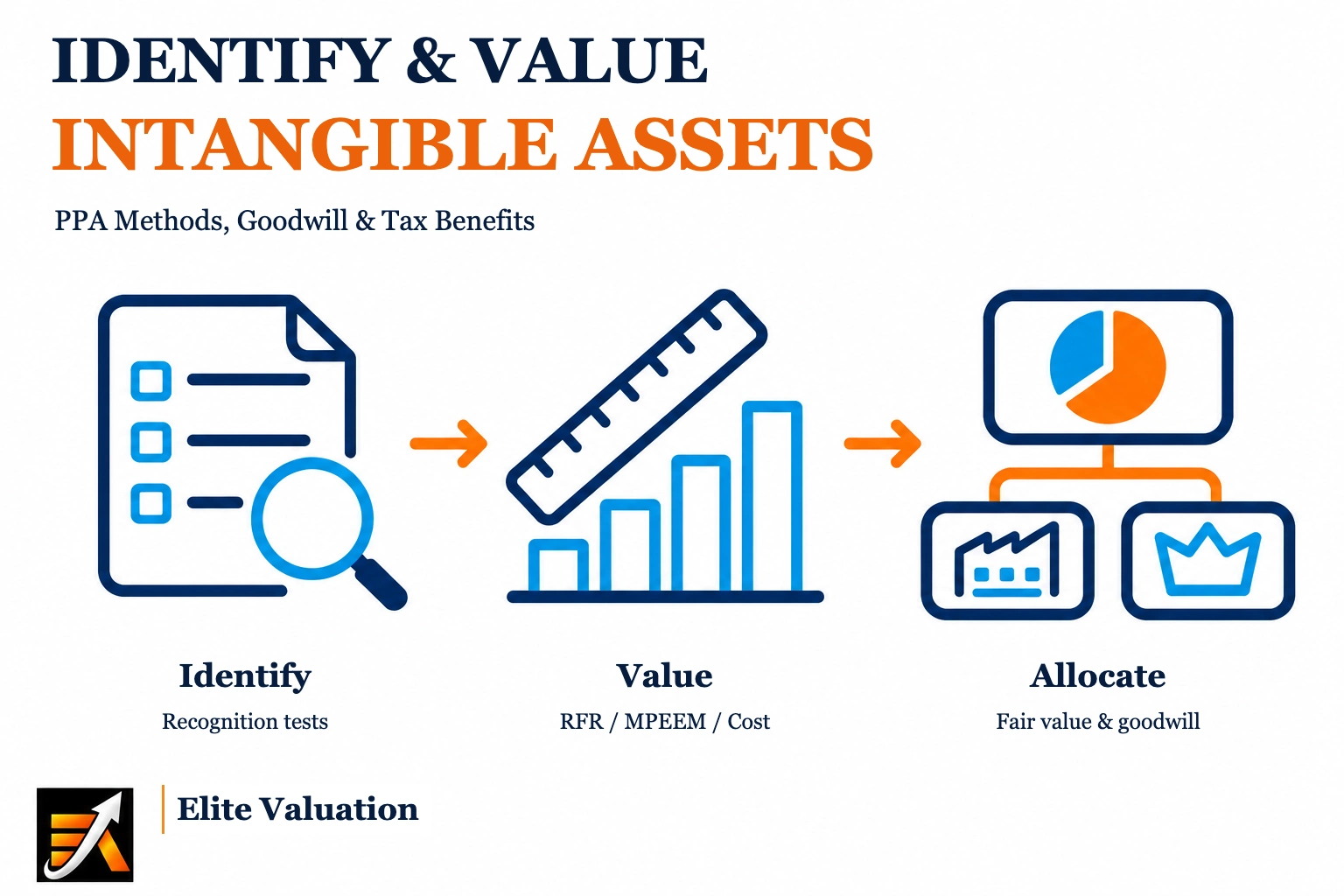
Intangible assets are where most PPA disputes begin. They rarely appear on the target’s balance sheet, the Valuation methods depend heavily on assumptions, and each choice moves the goodwill line by a material amount. Every intangible must be identified, tested against the recognition criteria, valued at fair value and given a useful life, or an indefinite life supported by evidence.
The search should start from source documents: the target’s contracts, its customer data, its licence and IP registers, and the list of dependencies that the operating team keeps. The trial balance is the last place to look for intangibles, not the first.
The Legal-Contractual and Separability Criteria for Recognition
Under Ind AS 103, an acquired intangible is recognised separately from goodwill if it meets either of two criteria, both set out in Appendix B of the standard. The contractual-legal criterion is met where the asset arises from contractual or other legal rights, whether or not those rights can be transferred or separated from the business. The separability criterion is met where the asset can be sold, transferred, licensed, rented or exchanged, either alone or together with a related contract, asset or liability.
The contractual-legal test reaches further than many buyers expect. A non-compete agreement signed with the founder, a long-term supply contract with a major customer or a licence granted to the target can all qualify, even though none of them is ever sold on its own. The separability test picks up items such as a patent portfolio that could be licensed to a third party.
Some items fail both tests. The assembled workforce is the usual example. A trained team is valuable, and its contribution is reflected in the cash flows used to value other assets, but the team is not an identifiable asset. Its value falls into goodwill.
Recognition criteria by intangible asset
| Intangible | Recognition basis | Common Valuation approach |
|---|---|---|
| Customer relationships | Contractual, or separable where customer data can be transferred; needs evidence of customer retention | Multi-period excess earnings method (MPEEM) |
| Technology and software | Separable if it can be licensed or sold; in-house tools can qualify | Relief from royalty, or cost approach where it is the only reliable basis |
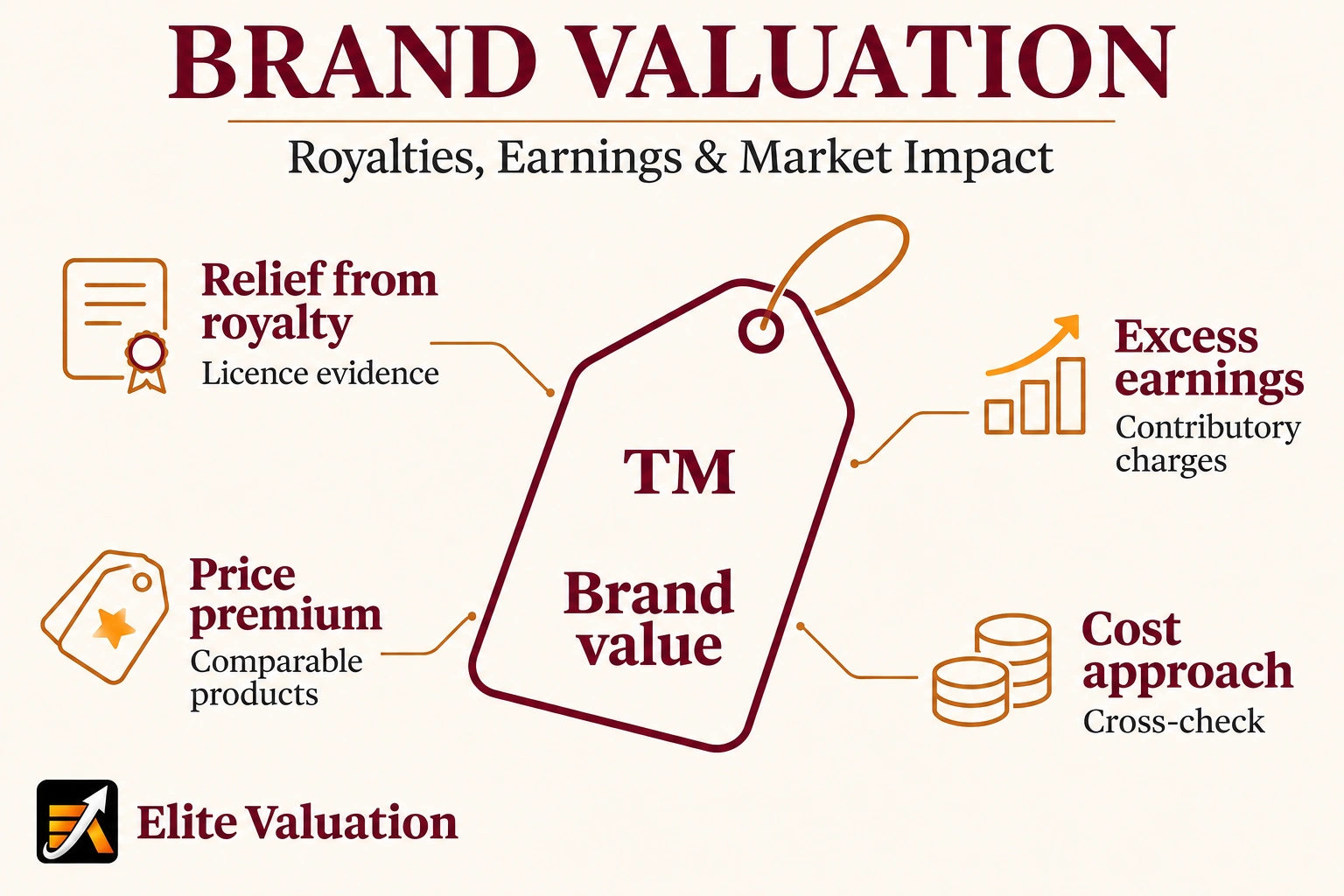
| Trademarks and brands | Legal rights, such as a registration, or separable through a licence | Relief from royalty |
| Non-compete agreements | Contractual or legal right | With-and-without method, measuring the value of the competition avoided |
| Order backlog | Contractual, usually with a short life | Excess earnings on the contracted revenue |
| Assembled workforce | Not identifiable; included in goodwill | Not valued separately |
The method chosen for each asset should be recorded with the reason it suits that asset. MPEEM, relief from royalty and the with-and-without method all depend on forecasts. The forecasts used in the PPA must match those used for the impairment test and the board’s plan, or the auditor will ask why they differ.
Calculating the Residual: How Goodwill Is Derived
Goodwill is the residual. Under paragraph 32 of Ind AS 103, it equals the consideration transferred, plus any non-controlling interest, plus the fair value of any interest the acquirer already held, less the identifiable assets acquired and liabilities assumed, all measured at acquisition-date fair values. Because goodwill is a residual, every change in an intangible flows into it, reduced by the deferred tax on that change.
The hypothetical deal below shows the mechanics. A buyer acquires 100% of a target with no non-controlling interest. It pays ₹250 crore in cash on completion and agrees an earn-out with an acquisition-date fair value of ₹30 crore, so total consideration is ₹280 crore. The target’s net tangible assets, after the liabilities it assumes, are fair valued at ₹90 crore. The team identifies three intangibles: customer relationships at ₹45 crore, technology at ₹20 crore and a trademark at ₹15 crore, a total of ₹80 crore. In this structure those intangibles have a nil tax base, so the deferred tax liability at an assumed 25% rate is ₹20 crore.
Net identifiable assets are therefore ₹90 crore plus ₹80 crore less ₹20 crore, which is ₹150 crore. Goodwill is ₹280 crore less ₹150 crore, which is ₹130 crore. The deferred tax rate must be the rate that is enacted or substantively enacted for the entity and the period, so the 25% figure is an assumption for this illustration only.
Figure 1 shows how the price is divided. About 32.1% sits in net tangible assets, 21.4% in intangibles after deferred tax and 46.4% in goodwill. A high goodwill share is common where value rests on people, relationships and future growth, and it is the number a reviewer will test first, which is why the intangibles schedule behind it must be complete.
Illustrated purchase price allocation
The Strategic Impact of PPA on Future Earnings
The PPA does not end at completion. The allocation sets the amortisation charge for each intangible, the deferred tax credit that offsets it and the goodwill balance that must be tested every year. A PPA that ignores these consequences leaves the board surprised by the first set of post-deal results.
How Amortization of Intangibles Impacts Post-Merger EPS
Finite-life intangibles are amortised as an expense in profit or loss every year. That charge reduces profit after tax and, through it, basic earnings per share under Ind AS 33, which divides profit attributable to equity holders by the weighted average number of shares. The deferred tax liability created in the PPA unwinds as the intangibles are amortised, which produces a tax credit that partly offsets the charge.
Continue the hypothetical deal. The customer relationships are amortised over nine years, which is ₹5.0 crore a year. Technology is amortised over five years, which is ₹4.0 crore a year, and the trademark over ten years, which is ₹1.5 crore a year. The annual charge is ₹10.5 crore. At the assumed 25% rate, the deferred tax credit is about ₹2.6 crore, so profit after tax falls by about ₹7.9 crore a year rather than ₹10.5 crore. Figure 2 shows the effect.
Two practical consequences follow. The first is that EPS in the first year after a deal can look weaker than the operating business, and the board should be told in advance that much of the reduction is non-cash. The second is that a change in a useful life moves the charge for every remaining year. Lives must be supported by contract terms, technology cycles and customer attrition data, not chosen to suit an earnings target.
Annual Impairment Testing for Goodwill (Ind AS 36)
Goodwill is not amortised. Ind AS 36 requires it to be tested for impairment at least once a year, and sooner if events suggest its value may have fallen (paragraph 90). For testing, goodwill is allocated to the cash-generating units expected to benefit from the combination. The recoverable amount of each unit is compared with its carrying amount, including the goodwill.
Suppose the unit that holds the goodwill in the illustration has a carrying amount that exceeds its recoverable amount by ₹18 crore. The impairment loss is charged to profit or loss and first reduces the goodwill allocated to that unit (paragraph 104). Under paragraph 124, an impairment loss recognised for goodwill is not reversed in a later period, even if the unit’s recoverable amount recovers.
The impairment test also checks the PPA. The forecasts behind the customer and technology Valuations are the same forecasts that drive the recoverable amount. If the PPA assumed strong growth while the impairment test assumes a sharp slowdown, both cannot be right, and the auditor will want the reconciliation.
Don’t let PPA amortization unexpectedly erode your post-deal earnings.
Let Elite Valuation stress-test your acquisition economics.
Stress-Test Your Deal EconomicsAcquisition Economics | PPA Amortisation Modelling | Goodwill Impairment Support
Why Acquirers Should Appoint an Independent Registered Valuer
Ind AS 103 does not name the person who must prepare or sign a PPA, so the accounting standard does not itself require a registered valuer. The legal position is narrower. Under section 247 of the Companies Act, 2013 and the Companies (Registered Valuers and Valuation) Rules, 2017, a registered valuer must sign a Valuation that the Act itself requires. Other laws set their own requirements. The Insolvency and Bankruptcy Code, 2016 and the SEBI rules for real estate and infrastructure investment trusts, for example, call for registered valuers in the cases they cover. Where a Valuation of the same transaction falls under one of those laws, the signatory must be registered.
For a PPA that no statute requires a registered valuer to sign, the acquirer chooses the expert, and that choice is where the auditor’s review begins. Under the auditing standard on using the work of an auditor’s expert (SA 620), the auditor must evaluate the competence, capabilities and objectivity of any expert whose work it relies on. An IBBI registration gives that evaluation something to test. The registration can be checked on the IBBI register, and the registered asset categories can be matched to the assets in the PPA.
Matching expertise to asset categories
The asset category matters. The IBBI registers valuers by category, and the categories include intangible assets and securities or financial assets, as well as land and building and plant and machinery. A single PPA often needs more than one. Customer relationships and technology call for intangible asset expertise, an earn-out calls for securities or financial assets expertise, and fixed assets fall under their own categories. The signatory should be registered in the category that covers each asset it values.
Documenting a defensible allocation
Defensibility is the practical reason. A registered valuer’s report should set out the method, the inputs, the sources and the sensitivity of each figure. That is what the auditor, the tax team and any later reviewer need to test a goodwill number. Elite Valuation is an independent Valuation firm founded in 2020. Sagar Shah is a Chartered Accountant, Company Secretary and IBBI Registered Valuer, and he spent a decade at Ernst & Young, focused on cross-border structuring and transfer pricing. The firm’s practice covers purchase price allocation, business Valuation, ESOP Valuation and advisory, FEMA and SEBI Valuations, and fund advisory. The schedules for intangibles, deferred tax and goodwill should be built from one set of assumptions, so that the accounts and the auditor’s file agree. That is the structure Elite Valuation applies to PPA engagements.
What to ask a Valuation provider before appointing it
- Registration. Confirm the IBBI registration number and the asset categories it covers on the IBBI register.
- Category match. Check that the signatory is registered for intangible assets and, where an earn-out is involved, for securities or financial assets.
- Documentation. Ask whether the report gives the method, inputs, sources and sensitivity for each intangible.
- Consistency. Ask how the forecasts are tied to the board plan and to the impairment test.
- Review. Ask who reviews the deferred tax and goodwill reconciliation before it is issued.
Where Acquirers Go Wrong in a PPA: Common Mistakes
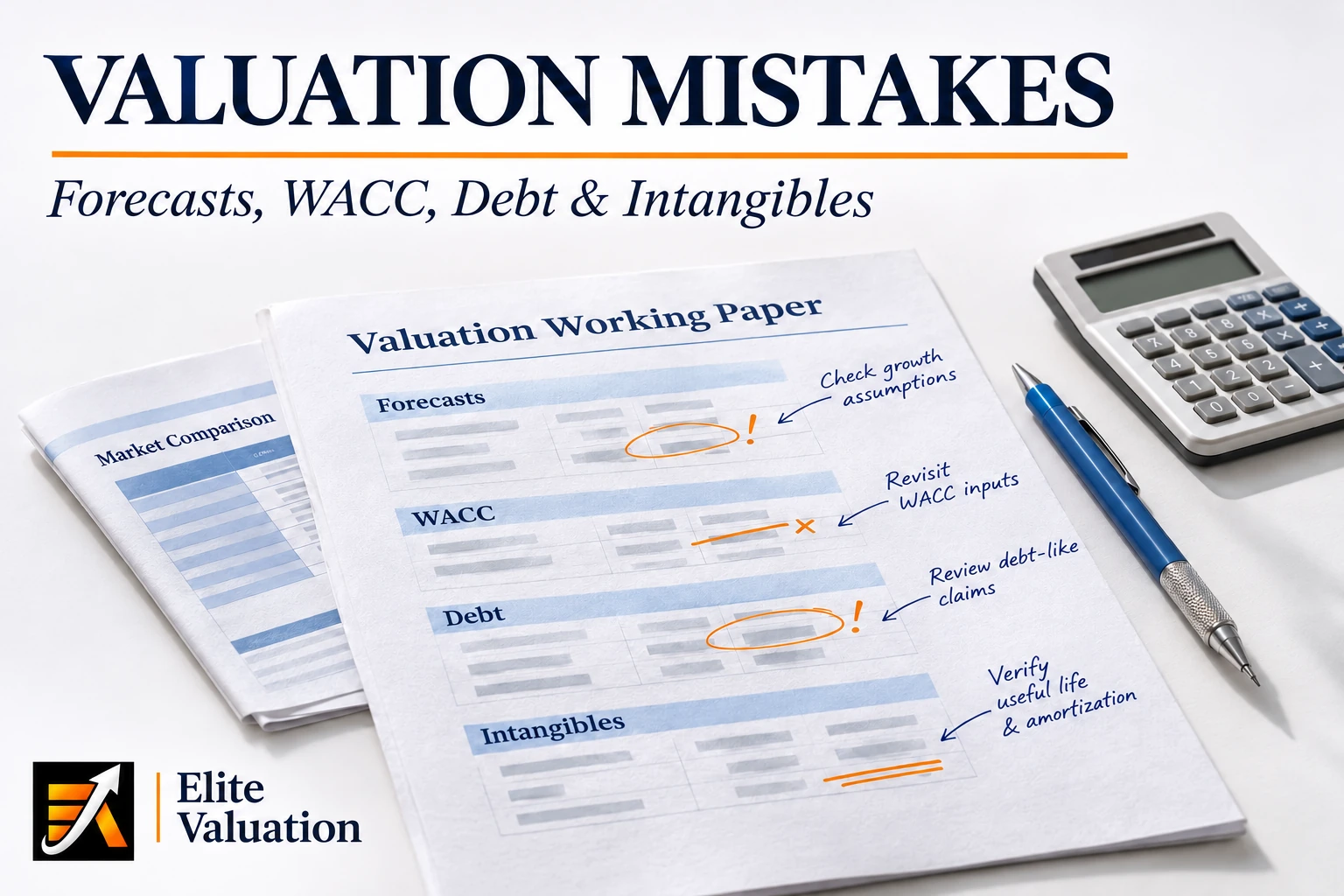
These six errors appear most often when acquisition accounts are reviewed. They are listed in order of the damage they cause, the most serious first.
Leaving the contingent earn-out out of the consideration
The cash paid at completion is recorded as the full price, and the earn-out is treated as a future expense or ignored altogether.
Goodwill understated and earn-out charges hit profit without warningMeasure the earn-out at its acquisition-date fair value under paragraph 39 and document the scenarios and discount rate used.
Listing only the intangibles that appear in the books
The team works from the trial balance and misses customer contracts, technology, licences and trademarks that the target built internally.
Goodwill overstated and amortisation understated, which the auditor will challengeBuild the intangibles list from contracts, customer data, IP registers and interviews before the Valuation starts.
Using book value as fair value
Carrying amounts are copied across for property, plant and equipment, inventory and other items to save time.
Net assets misstated, so both goodwill and deferred tax are wrongRe-measure property, plant and equipment and inventory at fair value under Ind AS 113, and record the method used for each class.
Building the deferred tax schedule after goodwill is set
The deferred tax schedule is added at the end and does not tie to the intangibles schedule at the acquisition date.
The goodwill reconciliation fails at audit and the numbers are reopenedBuild the deferred tax schedule from the same intangibles schedule and reconcile it to goodwill before the PPA is issued.
Letting provisional amounts run past the measurement period
Provisional amounts stay open, with no owner or deadline, until the one-year window has already closed.
Later corrections go through profit or loss instead of goodwill, changing reported earningsKeep a log of open items with an owner and a date, and close each provisional amount before the measurement period ends, which is no later than one year from the acquisition date.
Recording the assembled workforce as a separate intangible
A trained team is shown as an identifiable asset to lift the intangibles total.
The reviewer rejects the entry and the intangibles schedule loses credibilityInclude the workforce in goodwill, and record why it does not meet the contractual-legal or separability criterion.
What Should Acquirers Take Away From a PPA Under Ind AS 103?
A purchase price allocation turns a headline price into recognised assets, liabilities and goodwill. Its quality depends on three things: a complete list of what was acquired, fair values with a stated method for each item, and a deferred tax and goodwill reconciliation that ties back to the intangibles schedule.
The decisions that matter most come early. Settle the acquisition date, include the earn-out at fair value, build the intangibles list from source documents and appoint a valuer whose registration matches the assets. Those steps keep goodwill defensible, make the amortisation charge predictable and give the auditor what it needs inside the measurement period.
The work continues after completion, through amortisation, impairment testing and any change in the earn-out. A PPA prepared with those later years in mind is far cheaper to maintain than one rebuilt at each audit.
Frequently Asked Questions About Purchase Price Allocation Under Ind AS 103
Is Purchase Price Allocation mandatory for all acquisitions in India?
No. Purchase price allocation is required as part of the acquisition method for business combinations accounted for under Ind AS 103, which applies to companies that report under Ind AS. Whether a company is within Ind AS depends on its listing status and net worth under the Companies (Indian Accounting Standards) Rules, 2015. Companies outside Ind AS follow other accounting standards, where amalgamations are treated differently and goodwill may be amortised. Tax and FEMA Valuations are separate requirements that a PPA does not replace.
What is the deadline to complete a PPA under Ind AS 103?
The measurement period ends no later than one year from the acquisition date, which is the date the acquirer obtains control. Within that period, the acquirer can adjust the provisional amounts it reported where new information about facts that existed at the acquisition date comes to light. Changes after the period ends are recognised in profit or loss, not goodwill. Companies should aim to close the allocation well before the anniversary, because the first annual audit relies on it.
How does PPA impact a company’s Profit and Loss statement post-acquisition?
Finite-life intangibles are amortised every year, which reduces profit, and the deferred tax liability unwinds to give a partial tax credit. Goodwill is not amortised but is tested for impairment at least annually under Ind AS 36, and an impairment charge is never reversed. Acquisition costs are expensed when incurred, and changes in a liability for contingent consideration go through profit or loss. In the hypothetical deal, 10.5 crore of annual amortisation reduces profit by about 7.9 crore after deferred tax.
Can contingent consideration (earn-outs) change the PPA calculation later?
Yes, in two ways. If new information about facts that existed at the acquisition date comes to light within the measurement period, the initial fair value of the earn-out is adjusted and goodwill changes. After the measurement period, or where the change arises from later events, a liability for an earn-out is remeasured at fair value under Ind AS 109 and the change goes to profit or loss. An earn-out classified as equity is not remeasured at all. In the hypothetical deal, an earn-out revised from 30 crore to 35 crore within the period would increase goodwill by 5 crore.
What is the difference between a bargain purchase and goodwill in PPA?
Goodwill arises when the consideration, plus any non-controlling interest and previously held stake, exceeds the fair value of the net identifiable assets acquired. It is recorded as an asset and tested for impairment each year. A bargain purchase arises when the net identifiable assets exceed that total. The acquirer must first reassess whether every asset and liability has been identified and measured correctly, and then recognise the excess as a gain in profit or loss on the acquisition date. A bargain purchase is unusual and draws close scrutiny.
Does the Income-tax Act, 2025 allow tax deductions on PPA-derived goodwill?
No depreciation is allowed on goodwill of a business or profession. The Income-tax Act, 2025, which took effect on 1 April 2026, excludes goodwill of a business or profession from the intangible assets that form part of a block of assets. Accounting goodwill created by a PPA therefore does not give rise to a tax deduction. Other acquired intangibles, such as know-how, patents, trademarks and licences, can be depreciable, subject to the Act’s conditions and to the tax base that the transaction structure produces. Confirm the tax treatment with a tax adviser before the deal is structured.
Who is legally qualified to sign off on a PPA Valuation report?
Ind AS 103 does not name a signatory, so no single professional is legally required to sign a PPA report. Where a Valuation of the same transaction is required under the Companies Act, 2013, section 247 and the Companies (Registered Valuers and Valuation) Rules, 2017 require a registered valuer. Other laws, such as the Insolvency and Bankruptcy Code, 2016, set their own requirements. For other PPAs, the auditor evaluates the competence of the expert it relies on. An IBBI Registered Valuer, registered in the asset category that covers the assets, is the most verifiable choice.
Can internally generated intangibles of the acquirer be recognised in a PPA?
No. A PPA measures the identifiable assets and liabilities of the acquiree. The acquirer’s own assets sit outside the business combination and continue to be accounted for under their existing standards. Ind AS 38 does not allow an internally generated brand, customer list or similar item to be recognised, so the acquirer’s own brand or customer base stays off the balance sheet. The acquiree’s internally generated intangibles are different. They can be recognised in the PPA if they meet the identifiability criteria, even though the target never recorded them.
Sources
- Ind AS 103, Business Combinations, as notified under the Companies (Indian Accounting Standards) Rules, 2015, including paragraphs 18, 23, 32, 37, 39, 45, 53 and 58 and Appendix B, from the Ministry of Corporate Affairs at https://www.mca.gov.in
- Ind AS 12, Income Taxes; Ind AS 33, Earnings per Share; Ind AS 36, Impairment of Assets, including paragraphs 90, 104 and 124; Ind AS 38, Intangible Assets, including paragraph 63; Ind AS 109, Financial Instruments; and Ind AS 113, Fair Value Measurement, as notified: https://www.mca.gov.in
- Companies Act, 2013, section 247; Companies (Registered Valuers and Valuation) Rules, 2017; and the register of registered valuers maintained by the Insolvency and Bankruptcy Board of India: https://ibbi.gov.in
- Income-tax Act, 2025, which took effect on 1 April 2026, including its definition of block of assets, which excludes goodwill of a business or profession: https://incometaxindia.gov.in
- Standard on Auditing 620, Using the Work of an Auditor’s Expert, issued by the Institute of Chartered Accountants of India: https://www.icai.org
The illustrations are hypothetical and describe no company. Paragraph numbers and section references must be checked against the current notified text before reliance. Commentary on the numbering of the Income-tax Act, 2025 differs, so this article does not cite a section number for depreciation.
Secure a defensible, audit-ready Purchase Price Allocation report for your next business combination.
Contact the experts at Elite Valuation today.
Contact Elite ValuationPurchase Price Allocation | Ind AS 103 Valuation | Goodwill and Impairment | Registered Valuer Services

Disclaimer. This article is general information only. It is not legal, tax, accounting or investment advice, and it is not a Valuation of any company, business or asset. The figures in the illustrations are hypothetical and describe no company. Ind AS, the Income-tax Act, 2025 and the registered valuer rules change, so every reference must be checked against the current text before reliance. Research date: 14 November 2026. Confirm each point with a qualified professional before relying on it.