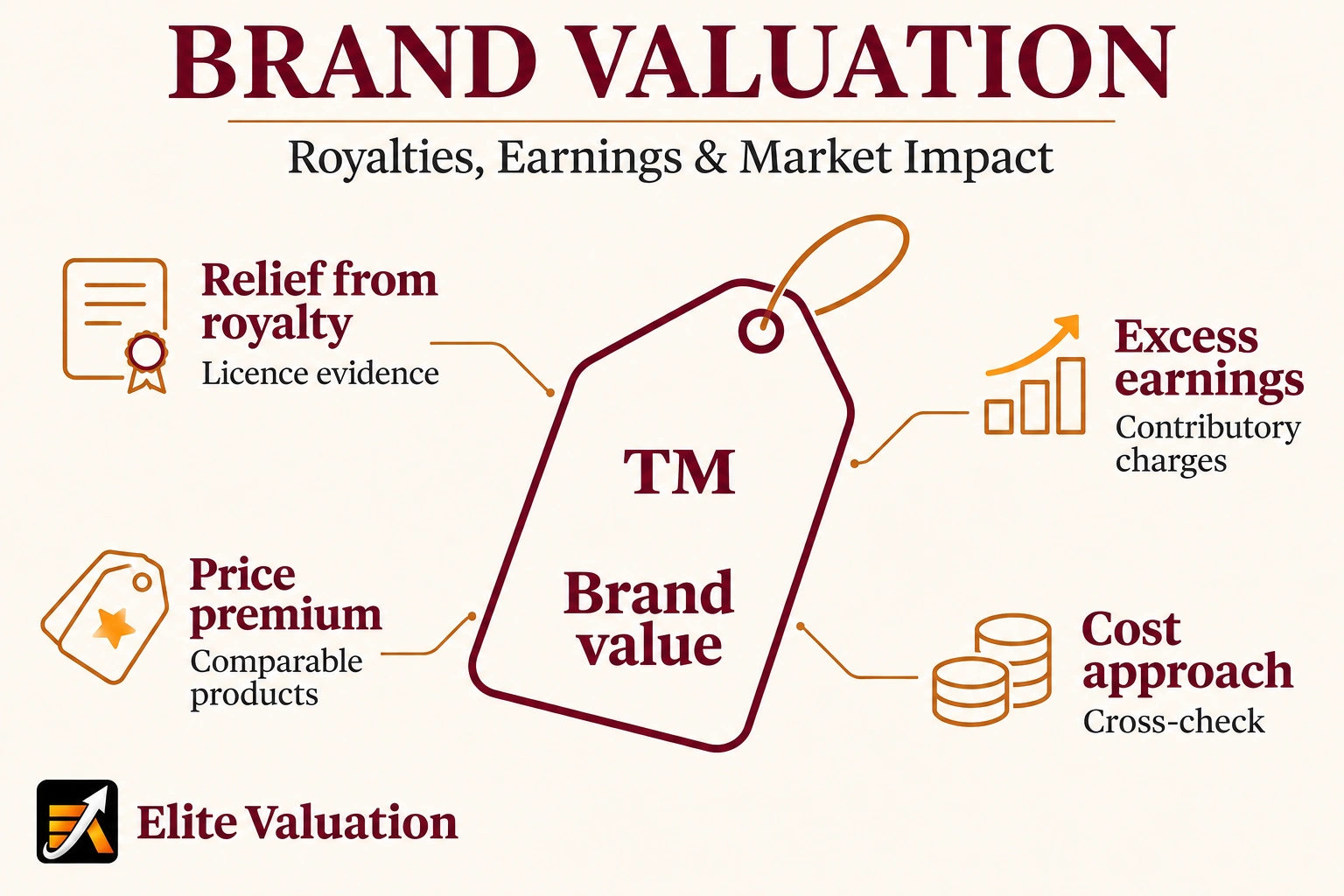
Brand valuation in India estimates what a brand is worth as a commercial asset at a stated date and for a stated purpose. It links customer demand, pricing power and loyalty to cash flows, while distinguishing the brand from its legal trademark rights and the business as a whole. This guide explains the methods, supporting evidence and accounting and tax considerations for acquisitions, impairment reviews, licensing and other transactions.
Key takeaways
- Brand equity is the extra value a brand earns through customer demand, pricing and repeat purchase. It is measured through the earnings and cash flows the brand creates, not through awareness scores alone.
- An internally generated brand is not recognised under Ind AS 38. A separately purchased brand is initially measured at cost; an identifiable brand acquired in a business combination is measured at acquisition-date fair value.
- Relief from royalty and price premium are income-based methods. Select the method for the purpose, rights and evidence; do not treat one method as mandatory or average different answers mechanically.
- Royalty rates, price premiums, growth, useful life and discount rates can materially affect value. Support each significant input and show sensitivities.
- An acquired brand with an indefinite useful life is not amortised. It is tested for impairment every year under Ind AS 36.
- The trademark register supports checks of registered ownership and status. Reconcile it with assignments, licences, renewals and disputes; the register alone is not a complete legal-title review.
This guide is for CFOs, finance controllers and company secretaries preparing a transaction or an audit, promoters and deal teams valuing a brand for a sale or an acquisition, tax advisers preparing a transfer or royalty position, and lenders taking brands as security. It builds on our guide to purchase price allocation under Ind AS 103. For engagement support, see our brand valuation service.
Fix the Purpose Before Scoping the Brand Valuation
Send us the purpose, the acquisition or transaction date, the brand revenue by product line and the trademark record. We confirm the scope, the method and the evidence list before any fee is agreed.
Discuss Your Brand Valuation ScopeBrand Valuation | Purchase Price Allocation | Impairment Support | Tax File Support
What Is Brand Equity, and How Does a Brand Valuation Differ From a Trademark Valuation?
Brand equity is the additional value a product or business earns because customers know the name, trust it and will pay for it. A brand can earn that value through a higher price, a larger share of volume, a lower marketing cost per customer or more loyal repeat purchase. A valuation measures that extra earning power as a rupee amount at a stated date.
A brand valuation is not the same as a trademark valuation. A trademark valuation starts from the registered mark, its term, its classes and its transfer rules. A brand valuation starts from the commercial position the brand holds in its market. The two overlap in practice, and a purchase price allocation or a tax split needs the legal and the commercial view to agree.
A brand strength score from a survey or an index describes the brand’s position. It does not, by itself, give a rupee value. The valuer converts the position into earnings, and the earnings into value, and records each step.
When Is a Brand Valuation Needed in India?
This guide covers five common reasons to commission a brand valuation. The purpose determines the basis, report and evidence required; not every purpose requires a statutory valuation or the same signatory.
Five Purposes and the Evidence They Need
| Purpose | Standard or rule | What the valuation must show | Typical user |
|---|---|---|---|
| Purchase price allocation | Ind AS 103 and fair value under Ind AS 113 | Fair value of the acquired brand at the acquisition date, from market participant assumptions | Acquirer and auditor |
| Impairment review | Ind AS 36 | Recoverable amount: the higher of value in use and fair value less costs of disposal, at asset or CGU level as appropriate | Management and auditor |
| Tax position | Income-tax Act provisions on transfer and depreciation, and transfer pricing for group brands | A split of consideration or a royalty supported in writing | Tax team and tax officer |
| Licence or royalty | Licence terms; transfer-pricing requirements where the transaction is within scope | An arm’s length royalty for the brand’s use | Licensor and licensee |
| Loan or security | The lender’s collateral policy | A value with clear assumptions and a sensitivity range | Lender |
Ind AS 38 prohibits recognising internally generated brands. A brand acquired separately is initially measured at cost, while an identifiable brand acquired in a business combination is recognised at acquisition-date fair value. A management or licensing valuation does not, by itself, permit an internally developed brand to be recognised.
Which Drivers Build Brand Equity, and How Should Each Be Measured?
Brand equity is built from a small set of drivers. A valuer does not need a separate score for each. The aim is to link each driver to a number in the earnings model.
- Awareness and consideration. How often the brand is recalled and chosen. Measured through survey data, search volume and conversion from enquiry to sale.
- Price premium. The gap between the brand’s realised price and the price of an unbranded equivalent. Measured from price lists, distributor data and shelf prices.
- Repeat purchase and retention. The share of customers who buy again. Measured from sales ledgers and customer cohort data.
- Channel reach. The share of distribution the brand holds, across modern trade, online and export. Measured from channel sales data.
- Legal protection. The registration status, the classes covered and any opposition or dispute. Measured from the trademark register and the legal file.
A driver that cannot be tied to revenue, price, margin or cost should not be used as a valuation input. It can support the narrative, but the number in the model must come from the business’s own data or from a documented external source.
Which Brand Valuation Method Fits: Relief From Royalty, Price Premium, Excess Earnings or Cost?
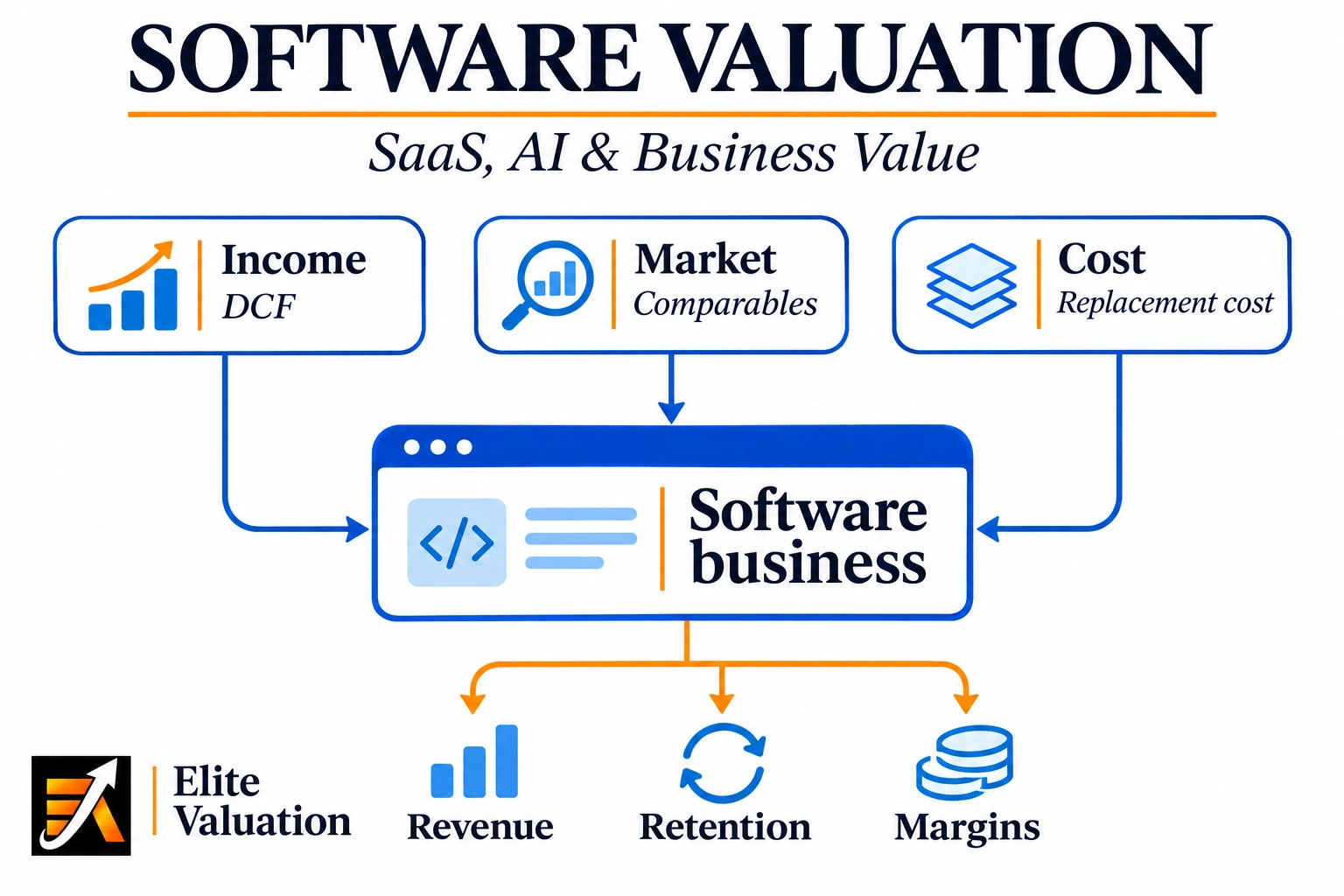
Three broad valuation approaches are income, market and cost. The four methods below include three income methods and the cost approach. Comparable transactions and licences can supply market evidence. ICAI Valuation Standard 103 addresses approaches and methods, and Standard 302 addresses intangible assets; distinguish these from Ind AS accounting standards and identify the framework applicable to the engagement.
Compare the Four Methods
| Method | Core idea | Main inputs | Best used when |
|---|---|---|---|
| Relief from royalty | The value is the royalty the owner avoids by owning the brand, after tax and discounted | Brand revenue, royalty rate, tax rate, discount rate, life | Comparable royalty evidence exists, as in most acquisition accounts |
| Price premium | The value is the extra after-tax profit from the price the brand commands, discounted | Branded and unbranded prices, volumes, margins, sustaining spend | The brand sells beside an unbranded equivalent that can be observed |
| Multi-period excess earnings | The value is the brand’s cash flow after charges for the other assets that help earn it | Brand revenue, margins, contributory asset charges, growth | The brand is the main earnings driver and royalty evidence is thin |
| Cost approach | Supported replacement or reproduction cost, adjusted for functional and economic obsolescence | Launch, advertising and registration spend | Where replacement cost and obsolescence can be supported; often a limited cross-check for brands, not an automatic value floor |
Select the appropriate method or methods rather than requiring two in every case. Explain the leading method, any cross-check and material differences. A cost indication is not an automatic floor, and accounting recognition does not follow merely because a valuation has been prepared.
Choosing a Method From the Evidence
- Comparable licence economics: consider relief from royalty.
- Defensible unbranded comparator: consider price premium and incremental cash flows.
- Brand is a primary earnings driver: consider excess earnings with contributory-asset charges.
- Supported replacement cost: consider cost with obsolescence; it is not an automatic floor.
Watch: How Brand Valuation Works in India
Before you read the detail on the price premium and royalty methods, the video below walks through the approaches in this guide and the evidence each one needs. It is a quick way to see how a brand’s share of earnings is tested.
What the video covers
The four methods shown in the guide, the evidence behind royalties and price premiums, and the accounting questions that arise for acquired brands.
How Does the Price Premium Method Isolate the Brand’s Share of Earnings?
The price premium method measures the extra price the brand commands. It works when the brand is sold next to a generic or unbranded equivalent, which is common in packaged food, consumer goods, pharmaceuticals and retail. The premium is the difference between the price the brand achieves and the price the same product would achieve without the brand, applied to the volume sold under the brand.
Three checks matter. The unbranded comparator must be genuinely the same product in size, quality and channel. The premium must be net of the extra marketing spend needed to sustain it. And the premium must be taxed, because the brand’s contribution is an after-tax cash flow, not a pre-tax figure.
Where the Price Premium Sits
Illustrative branded revenue: ₹200 crore a year.
₹184 crore at the comparator price + ₹16 crore brand premium.
The premium is 8% of branded revenue, or about 8.70% of comparator revenue. Allow for incremental sustaining costs, tax and cash-flow conversion before discounting.
Price Premium: Cash-Flow Assumptions
Example 1 (illustrative)Assume flat annual branded revenue of ₹200 crore, with an 8% premium measured as a share of branded revenue. That is ₹16 crore before tax each year, and implies ₹184 crore at the comparator price. For this simplified example, assume incremental sustaining costs have already been allowed for and the premium fully converts to cash flow. At a hypothetical 25.168% tax rate, annual after-tax cash flow is ₹11.97312 crore. Five year-end receipts discounted at 16% give an annuity factor of 3.2743 and a present value of ₹39.20 crore.
The example assumes a five-year economic life with no residual value, growth, working-capital or capital-expenditure changes, or tax-amortisation benefit. It does not value an indefinite-life brand. An 8% share of branded revenue is about 8.70% of the comparator revenue; do not confuse these denominators. Actual forecasts must separately support sustaining costs and cash-flow conversion.
How Should a Brand Royalty Rate Be Set, Sourced and Tested?
Relief from royalty values the after-tax royalty payments avoided through ownership, discounted over the relevant life. Value moves proportionately with the royalty rate when other assumptions are fixed, but growth, economic life and discounting can also be important. General articles and rules of thumb alone do not establish a supported rate; document the comparable evidence and adjustments.
Support the rate with comparable licence agreements, disclosed royalty terms and relevant benchmarking data. Test product scope, territory, exclusivity, term, date and bundled rights. A profit-split analysis is a separate method where appropriate, not a third-tier source of royalty observations. For in-scope controlled transactions in tax year 2026–27 onward, Sections 161 and 165 of the Income-tax Act, 2025 address arm’s-length computation and method selection; earlier periods retain the applicable former framework.
Royalty Sensitivity: Hold Other Inputs Fixed
Year-one revenue ₹120 crore; 10% growth for five years; 15% discount rate; hypothetical tax rate 25.168%.
Relief From Royalty: Base Case and Sensitivities
Example 2 (illustrative)Assume year-one revenue of ₹120 crore, 10% annual growth through year five, a hypothetical 3% royalty, a hypothetical 25.168% tax rate and year-end cash flows. At 15% discounting, the five-year present value is ₹10.74 crore. At 2% and 4% royalties it is ₹7.16 crore and ₹14.32 crore respectively. Each percentage point changes value by ₹3.58 crore with other inputs fixed. At a 17% discount rate, the 3% case is ₹10.22 crore. These scenarios exclude terminal value and tax-amortisation benefit.
All inputs and licence assumptions are hypothetical; no real comparables or concluded arm’s-length range are asserted. The example illustrates sensitivity, not the value of an actual brand.
The sensitivity table in the report should show royalty, growth and discount rate together, so the reader can see the range of outcomes rather than a single figure. For a brand valuation to support a transaction, that range is part of the answer, not an optional extra. Where the royalty benchmark is the weakest input, our patent valuation service applies the same sourcing discipline to licence and royalty evidence.
Is a Brand’s Useful Life Finite or Indefinite Under Ind AS 38?
Ind AS 38 requires an entity to assess whether an intangible asset has a finite or indefinite useful life. A brand has an indefinite life when there is no foreseeable limit to the period over which it is expected to generate cash flows. Many established brands fit that description, provided they are maintained and the company has the means to keep them. A brand tied to a product being discontinued has a finite life and is amortised over that life.
An indefinite-life brand is not amortised. Test it annually for impairment and also when indicators arise, and review its life classification each reporting period. A finite-life brand is amortised and assessed for impairment indicators at each reporting date. An intangible not yet available for use also requires annual impairment testing. Test at CGU level where independent cash flows cannot be identified.
Impairment: Individual-Asset Illustration
Example 3 (illustrative)Assume an indefinite-life brand can be tested individually and carries at ₹60 crore. Its recoverable amount—the higher of value in use and fair value less costs of disposal—is ₹52 crore. The impairment is ₹8 crore, or 13.3% of carrying amount. Assume the cost model applies, so the loss is recognised in profit or loss. If the brand does not generate independent cash flows, test the appropriate cash-generating unit instead of assigning a standalone loss mechanically.
The figures are hypothetical.
How Does Ind AS Treat a Brand in a Purchase Price Allocation and Impairment?
In an Ind AS 103 business combination, recognise an identifiable acquired brand at acquisition-date fair value. Ind AS 113 uses market-participant assumptions. Assess deferred tax under Ind AS 12 using the relevant tax base and exceptions. Goodwill is the residual after the full acquisition accounting, including the consideration and any non-controlling or previously held interests—not simply the consideration less the brand alone.
- At acquisition. The brand is valued at fair value, and its royalty or premium inputs are supported by market evidence.
- After acquisition. A finite-life brand is amortised. An indefinite-life brand is tested for impairment every year.
- On impairment. A loss arises where carrying amount exceeds recoverable amount at the relevant asset or CGU level. Under the cost model it goes to profit or loss; a revalued asset can require different treatment. Goodwill impairment is not reversed.
Internally generated brand expenditure is not recognised as a brand asset under Ind AS 38. Acquisition is a different route: a separately purchased brand starts at cost, while an identifiable brand acquired in a business combination starts at acquisition-date fair value. Distinguish these treatments from a management estimate of a brand developed in-house.
For the purchase price allocation itself, our purchase price allocation service values the brand alongside the other intangibles in the Ind AS 103 workings, with the deferred tax and the impairment inputs documented.
Need the Brand Valued for an Acquisition or an Impairment Test?
We value the brand at fair value under Ind AS 113 for the purchase price allocation, prepare the annual impairment inputs under Ind AS 36 and document the life assessment, so the auditor can trace each figure.
See Our PPA and Impairment ServiceInd AS 103 Fair Value | Ind AS 36 Impairment | Life Assessment | Audit Support
What Tax Points Arise for a Brand Valuation in India?
Tax treatment depends on the actual rights, transaction and tax year. For tax year 2026–27 onward, use the Income-tax Act, 2025 and applicable Income-tax Rules, 2026. Earlier periods can remain subject to the former Act and transition provisions. A commercial brand valuation does not itself establish tax depreciation or a deductible royalty.
- Depreciation on acquired rights. Section 33(1)(b) of the 2025 Act covers qualifying acquired trademarks and similar rights used for business, subject to its conditions; goodwill is excluded. Identify the actual rights, cost, use and applicable prescribed block/rate rather than assuming every amount labelled “brand” qualifies.
- Transaction structure. A supported asset allocation can matter in an itemised transfer. A slump sale or another statutory deemed-value mechanism may follow different rules; do not assume a negotiated brand split determines taxable gain in every business transfer.
- Group brand royalties. Apply the relevant arm’s-length analysis under Sections 161 and 165 where transfer pricing is in scope. Document the rights and benefits, comparables and method; valuation is separate from deduction, withholding and reporting compliance.
- Model tax consistently. Check the applicable period, regime and tax-amortisation assumptions. The 25.168% rate in the examples is hypothetical, not a universal current rate.
What Evidence Will the Auditor, Tax Officer or Lender Test?
A brand valuation is judged by its evidence. The report should be supported by a file that lets a reviewer trace every number to a source, and it should be ready before the first audit query arrives.
- Brand revenue by product line and channel, reconciled to the accounts for the period.
- The source for each royalty rate or price premium, with the date, the product scope and the territory.
- The contributory assets considered, and the charge applied to each.
- The forecast, its reconciliation to the deal model, and any difference explained.
- The life assessment in writing, with the reason for a finite or an indefinite life.
- The discount rate build-up, with each component sourced.
- Sensitivity of the result to royalty, premium, growth and discount rate, with a range.
- An extract from the trademark register showing registration, classes covered and status.
Ind AS recognition, impairment and tax valuation answer different questions. Confirm the measurement date, asset or CGU, legal rights, professional eligibility and applicable framework before relying on a report.
Where Do Brand Valuations Go Wrong? Six Common Mistakes and Their Fixes
These errors appear most often in brand valuations prepared for acquisitions, impairment reviews and tax files. Each one can be closed before the auditor, the tax officer or the lender raises it.
Brand carried as an internally generated asset
A brand built in-house is shown on the balance sheet at an estimated value, outside any business combination.
This conflicts with the recognition prohibition in Ind AS 38. Assess materiality and the required correction under the applicable accounting framework.Recognise a brand only when it is acquired. Keep the internal brand valuation for management and licensing, outside the accounts.
Royalty rate with no source
The royalty is a rule of thumb from an article, or a general view of the sector, with no comparable agreement behind it.
The value moves almost in line with the rate, so an unsupported rate makes the whole answer unreliable.Source each rate from comparable agreements or benchmarks, record the scope and date, and show the sensitivity range.
Price premium measured against the wrong product
The unbranded comparator is a different product, size, quality or channel from the branded one.
The premium is overstated, and the brand contribution is inflated in the model.Use a like-for-like comparator, and net the premium for the marketing spend needed to sustain it.
Indefinite life assumed without a written reason
The brand is treated as indefinite-life with no assessment of the forecast period or the plan to maintain it.
The annual impairment test is skipped or weakly supported, and the auditor raises it in every audit.Write down the life assessment, and link it to the maintenance plan, the forecast period and the evidence of demand.
Trademark register not reconciled to the Valuation
The valuation assumes ownership, classes and term without checking the register or the renewal status.
A defect in title or a gap in the classes covered can reduce the value or defeat a transfer.Attach a current register extract, check the classes covered and the owner name, and reconcile them to the valuation.
Tax split decided before the Valuation
The price is split between the brand and goodwill to suit a tax outcome, without a supporting valuation.
The tax officer challenges the split, and the position weakens across the file.Value the brand first on its own evidence, then apply the split, and record the reasoning in the tax file.
How Elite Valuation Supports Brand Valuation Engagements
Elite Valuation’s brand and intangible-asset work covers purchase price allocation, impairment support, royalty evidence and transaction analysis. Sagar Shah is a CA, CS and IBBI-Registered Valuer with 9 years at Ernst & Young and 17 years of total experience. Agree the purpose-specific professional requirements, scope, information and review support before engagement.
Match the Service to Your Requirement
| Need | What Elite Valuation provides | Where it sits in this guide |
|---|---|---|
| Brand fair value for an acquisition | Brand fair value under Ind AS 113, inside the purchase price allocation, with a source register | Accounting section |
| Impairment support | Life assessment, annual impairment workings and recoverable amount | Useful life section |
| Royalty and premium support | Royalty benchmark or price premium analysis, with a sensitivity range | Royalty and price premium sections |
| Tax file support | Consideration split and brand valuation evidence for the tax file | Tax section |
If you need a brand valued for a transaction, an audit or a tax position, contact us with the purpose, the date, the brand’s revenue by product line and the trademark record. We confirm the scope and the method before any fee is agreed. Where the brand sits alongside patents or technology in the same deal, our Patent valuation service covers those assets on the same evidence standard.
Related services: Company valuation for the enterprise value behind the deal or the report, ESOP advisory for employee equity and Ind AS 102 expense, and Share valuation for share issues, transfers and exchange ratios.
Value the brand on its earnings, and support every input
A brand valuation in India starts with its purpose and evidence. Link the conclusion to supported revenue, pricing, costs and cash flows. Keep internally developed brand estimates separate from accounting recognition; distinguish separately purchased brands from brands identified in business combinations.
Test the life assessment every year, reconcile the trademark register to the valuation, and keep the file that lets the auditor, the tax officer or the lender trace each figure. A brand valuation built that way answers their questions in writing, in one pass.
Frequently asked questions about brand Valuation in India
What is brand Valuation in India?
Brand valuation is the estimate of the value of a brand as a commercial asset for a stated purpose and date. It converts the brand’s effect on prices, volumes, margins and customer retention into a cash flow, and discounts that cash flow to present value. The purpose, such as an acquisition, an impairment test, a tax position or a licence, decides the standard of value and the method. The report must state its assumptions and the evidence behind each one.
What is the difference between brand Valuation and trademark Valuation?
Trademark valuation focuses on the defined legal rights, while brand valuation examines the commercial asset and its earning power. Scope can overlap. Check the register alongside assignments, licences, renewal status and disputes, and reconcile the rights valued to the commercial cash flows. Registration alone is not a complete title review.
Can a brand built in-house be shown as an asset in India?
An internally generated brand cannot be recognised under Ind AS 38. A brand acquired separately is initially measured at cost, while an identifiable brand acquired in a business combination is recognised at acquisition-date fair value. A valuation for management or licensing does not itself permit an internally generated brand to appear on the balance sheet.
Which brand Valuation method is most common in India?
Relief from royalty can fit brands with supported licence economics; price premium needs a defensible comparator and incremental cash-flow analysis. Excess earnings may fit a primary earnings driver after contributory-asset charges. Cost needs supported replacement cost and obsolescence and is not an automatic floor. Select the method for the evidence and purpose rather than assuming a mandatory default.
How is the royalty rate for a brand chosen?
Use comparable licence agreements and relevant disclosed or benchmarked rates, documenting rights, territory, exclusivity, term and date. Test bundled assets and adjustments. Show sensitivities for material assumptions. A general article or rule of thumb alone does not establish an appropriate royalty.
Is a brand’s useful life finite or indefinite?
A brand has an indefinite useful life under Ind AS 38 when there is no foreseeable limit to the period over which it will generate cash flows, and the company can maintain it. An indefinite-life brand is not amortised and is tested for impairment every year. A brand tied to a product being discontinued has a finite life and is amortised over that life. The classification and its reason must be documented, because the auditor tests it in each year.
How is an acquired brand treated under Ind AS 103?
An identifiable brand acquired in a business combination is recognised at acquisition-date fair value using market-participant assumptions. Consider deferred tax on temporary differences under Ind AS 12 and its exceptions. Goodwill is the residual after the full acquisition accounting, not just consideration less the brand. A separate brand purchase initially uses cost under Ind AS 38.
Does a brand need an impairment test every year?
An indefinite-life brand, or an intangible not yet available for use, needs annual impairment testing and a further test when indicators arise. Finite-life assets are assessed for indicators at each reporting date. Recoverable amount is the higher of value in use and fair value less costs of disposal; use the relevant CGU where the brand lacks independent cash flows. Apply the relevant recognition rules for any loss.
What tax issues arise when a brand is transferred or licensed?
For tax year 2026–27 onward, Section 33 of the Income-tax Act, 2025 addresses depreciation on qualifying acquired rights, excluding goodwill. Sections 161 and 165 address in-scope arm’s-length pricing. Check the transaction structure, prescribed rates, deductions, withholding and documentation separately. Earlier periods can retain the former law; a brand valuation alone does not settle tax treatment.
What does an auditor check in a brand Valuation?
An auditor checks whether the brand is recognised correctly under Ind AS 38 and Ind AS 103, whether the fair value uses market participant assumptions, whether royalty rates and premiums have sources, whether the life classification is supported, and whether the impairment test is current. The auditor also checks that the brand figures reconcile to the deal model and the accounts. A complete evidence file answers these questions in one pass.
Sources
Selected primary references. Apply the current notified text and transaction-specific requirements; the examples are hypothetical.

Get the Brand Valued on Evidence Your Auditor Can Test
Share the purpose, the brand revenue by product line, the trademark record and the acquisition or transaction date. Elite Valuation confirms the scope, the method, the royalty or premium evidence and the sensitivity range before any fee is agreed.
Discuss a Brand ValuationBrand Valuation | Purchase Price Allocation | Impairment Support | Tax File Support
Disclaimer. This article is general information only. It is not accounting, legal, tax or investment advice, and it is not a valuation of any brand, business or security. The examples are hypothetical and illustrate the arithmetic only; they do not describe any transaction. Accounting standards, tax sections and the Income-tax Act, 2025 must be confirmed against the notified text before reliance. Confirm each point with a qualified professional before relying on it.