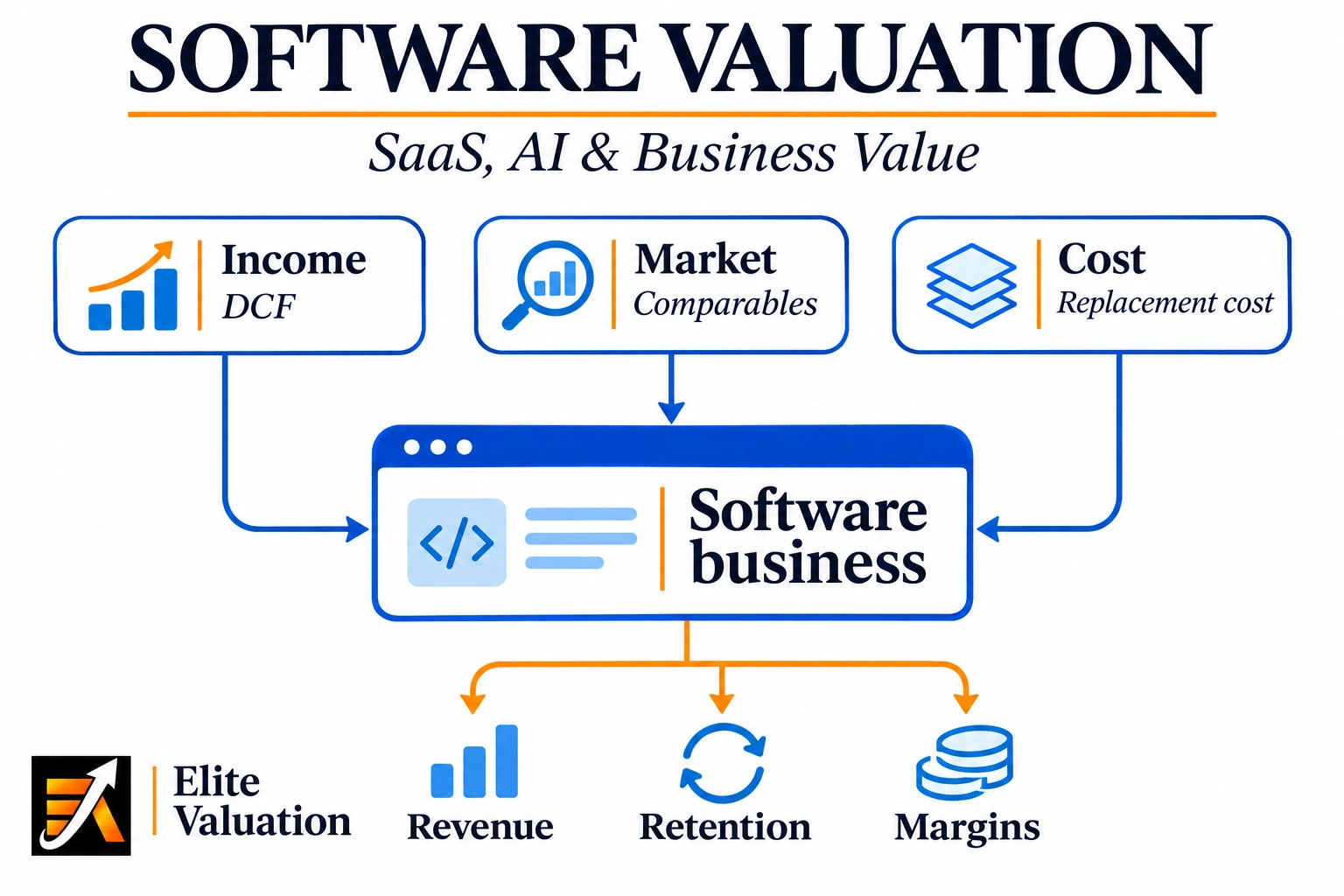
A software company is worth what its recurring revenue, retention and margins can support, discounted for the risk that they will not last. The right method depends on why the Valuation is needed, whether that is a funding round, an ESOP grant, an acquisition, a tax filing or a FEMA pricing exercise.
Key takeaways
- Software is valued on cash flow, growth, retention and margin. The method should match the purpose of the Valuation.
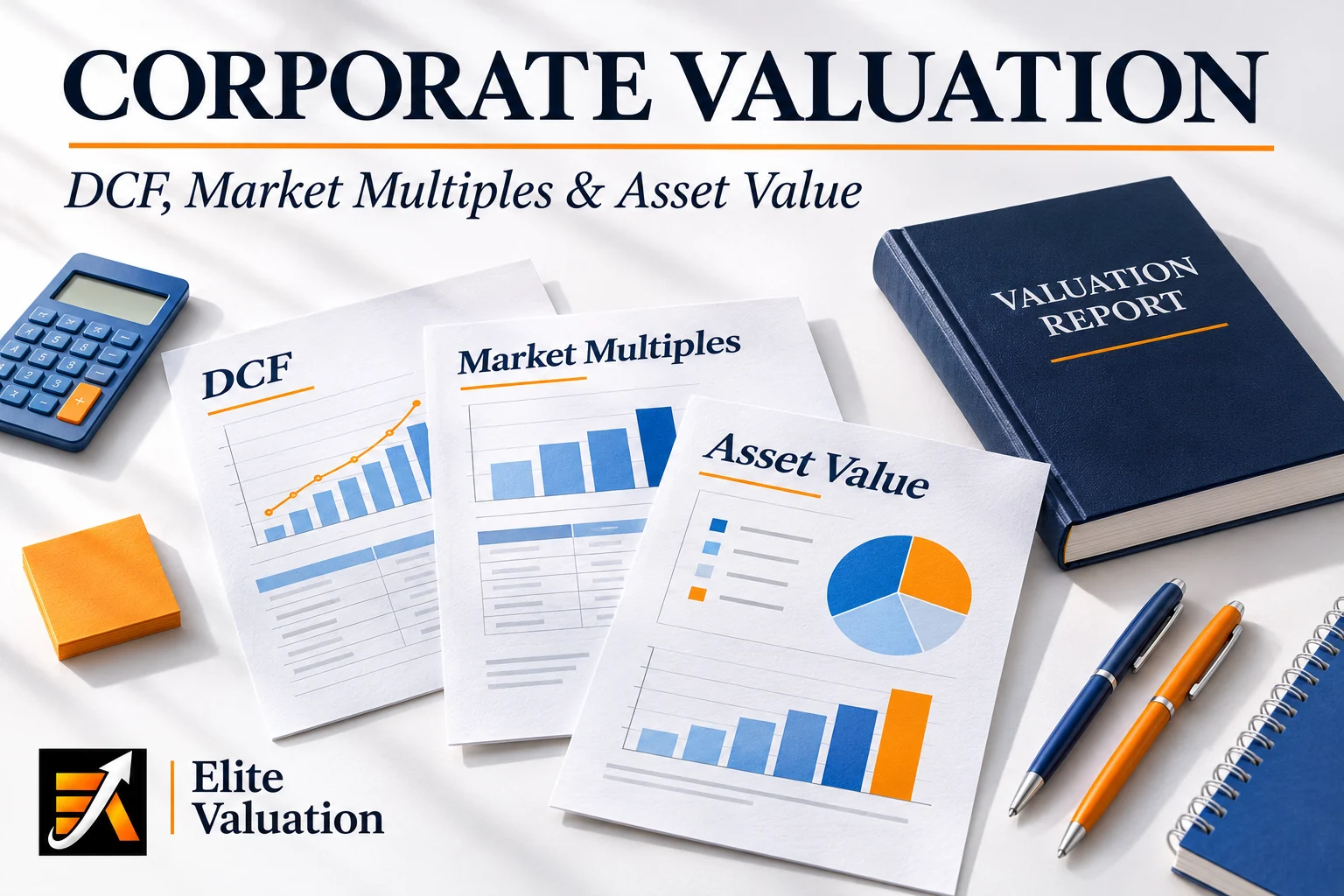
- ICAI Valuation Standard 103 recognises three approaches: income (DCF), market (comparable companies and multiples) and cost (replacement cost). Most reports use at least two.
- Reported private SaaS multiples cluster well below the 3x to 12x range often quoted online. That range blends small private companies with mid-size and AI-native businesses.
- For AI companies, value depends on revenue evidence, margins, compute costs and the defensibility of the technology, not on the AI label.
- A sound report states its purpose, Valuation date, method, sources, sensitivities and the registration of the valuer who signs it.
This guide is for founders, CFOs, investors and small business owners in India who need a Valuation of a software or SaaS business. It covers the methods, the factors that move value, the standards that apply, and how to choose a provider. It uses illustrative figures throughout, labelled as such, so you can follow the arithmetic without treating any number as a conclusion about a real company.
How Do You Calculate Software Valuation for Investment Purposes?
An investor values a software business by estimating the cash it will generate, or the recurring revenue it can keep, and then adjusting for risk. Growth rate, net revenue retention, gross margin and the path to profitability move the answer more than any other inputs.
In practice, an investor in Mumbai or Bengaluru starts with a few operating facts before choosing a method. These facts show whether the company is a steady subscription business, a fast-growing product with uncertain retention, or a platform whose revenue depends on a few large customers. The Valuation then follows from those facts.
The bridge from business value to equity value is also mechanical. Enterprise value is the value of the operating business. Equity value is enterprise value less net debt, adjusted for cash and other claims. For a funding round, the price per share depends on the rights attached to each class of shares, which is a separate analysis from the business Valuation itself.
| Metric | What it tells the investor | Question it answers |
|---|---|---|
| ARR (annual recurring revenue) | Size of the contracted or subscription base | How much revenue repeats without new sales? |
| Net revenue retention (NRR) | Whether existing customers spend more or less over time | Does the base grow on its own? |
| Gross margin | Cost to serve each unit of revenue, including hosting and support | Does growth improve or erode profit? |
| Customer acquisition payback | Months of gross profit needed to recover the cost of a new customer | Is growth bought at a sustainable price? |
| Rule of 40 | Growth rate plus profit margin, as a shorthand for efficiency | Is the company balancing growth and cash? |
Bengaluru and Pune investors often weight these metrics differently by sector. A vertical SaaS product for logistics or healthcare may show lower growth but stronger retention than a horizontal tool, and the Valuation should reflect that trade-off rather than rank the two by growth alone.
Preparing a software Valuation for a funding round or an acquisition? Contact Elite Valuation with your purpose, your date and your latest ARR, churn and cap table, and we will confirm the scope in writing.
Which Software Valuation Methods Do Financial Analysts Use?
Analysts use the three approaches described in ICAI Valuation Standard 103: the income approach (discounted cash flow), the market approach (comparable companies and transactions) and the cost approach (replacement or reproduction cost). Each answers a different question, and the choice depends on the company’s stage, data and purpose.
The standard does not require one method. It asks the valuer to select the approaches that produce a reliable value for the asset, to explain the choice, and to reconcile the results where more than one is used. For a software company in Gurugram, Delhi or Pune, that usually means an income approach supported by a market check, with the cost approach used as a floor or as a cross-check on early-stage assets.
The Income Approach (DCF)
A discounted cash flow model projects free cash flow over a forecast period, discounts each year at a rate that reflects risk (the weighted average cost of capital, or WACC), and adds a terminal value for the period after the forecast. The method captures what the business is expected to earn, which is why it is central to most software Valuations. Its weakness is that the answer depends heavily on assumptions about the distant future.
Example 1 (illustrative)
A hypothetical Ahmedabad SaaS company forecasts free cash flow of Rs 2 crore, Rs 4 crore, Rs 6 crore, Rs 8 crore and Rs 10 crore over five years. A WACC of 16 percent and long-term growth of 5 percent after year five are assumed. The five annual cash flows have a present value of about Rs 17.7 crore. The terminal value at year five is Rs 10 crore multiplied by 1.05 and divided by 11 percentage points, about Rs 95.5 crore, with a present value of about Rs 45.5 crore. The enterprise value is about Rs 63 crore, and about 72 percent of it comes from the terminal value. That share is why sensitivity testing on the discount rate and the terminal growth rate is essential.
The Market Approach (Multiples)
The market approach values the company by reference to prices paid for similar businesses. Comparable company analysis uses listed peers. For private software companies, the valuer relies more on private transactions, funding rounds and multiples drawn from data sets, adjusted for size, growth, retention, margin and liquidity. Common multiples are enterprise value to revenue or ARR, enterprise value to EBITDA for profitable businesses, and price to revenue for equity.
The most quoted metric for SaaS is the ARR multiple. The figures below are reported ranges from advisers and data publishers. They are not audited deal data, and they should be used as cross-checks rather than as Valuation inputs in their own right.
| Company profile | Reported ARR multiple | Basis of the figure |
|---|---|---|
| Private SaaS, lower middle market | 3x to 7x ARR, median around 4.5x | Livmo, SaaS Valuation Multiples 2026; FE International |
| Private SaaS, up to $5 million ARR | Median around 3.3x | Fungies compilation of Aventis Advisors and SaaS Capital data |
| Mid to large SaaS with consistent growth | 7x to 12x | Axial, quoting an M&A adviser’s view |
| AI-native SaaS | Median around 12.5x EV to revenue | Vendor and data-publisher reports; wide dispersion |
The 3x to 12x range often quoted online is a blend of two bands. One adviser describes 3x to 5x for smaller SaaS companies and 7x to 12x for mid to large companies showing consistent growth. Applying the full span to any single company overstates the precision of the market evidence.
Multiples also need adjustment for the company being valued. A private Indian company with concentrated customers, founder dependence or limited audit history will typically sit at the lower end of the band for its size. A company with strong net retention and a clear path to profitability can justify a position at the upper end.
Need a market check on your ARR multiple, or a DCF that holds up to investor questions? Read about Elite Valuation’s company Valuation services or contact us with your figures.
The Cost Approach (Replacement Cost)
The cost approach estimates what it would cost to recreate the software’s functionality today. Replacement cost asks for an equivalent system built with current technology. Reproduction cost asks for an identical copy. For most commercial software, replacement cost is the relevant basis. The estimate combines developer time, architecture and testing effort, data migration, and an allowance for the time and risk of building it.
The cost approach rarely produces the full Valuation for a growing software business, because cost does not measure what customers will pay. Its value lies in two places. It sets a floor for early-stage companies in Bengaluru, Pune or Ahmedabad that have not yet proven revenue, and it provides a check on an income approach that implies a value far above what the product could realistically be rebuilt for.
What Factors Influence Software Valuation in the Tech Industry?
Five factors move software value most: the quality of recurring revenue, retention and expansion, the defensibility of the technology, the scalability of the stack and the cost of running it, and the company’s ownership and governance. Accounting questions, including Ind AS 36 impairment, follow from these factors.
- Revenue quality. Contracted subscriptions are worth more than usage-based revenue that can fall away. Customer concentration, where a few clients produce most of the ARR, lowers the multiple a buyer will pay.
- Retention and expansion. Net revenue retention above 100 percent means existing customers spend more over time. Churn that is high or rising reduces the expected life of the revenue.
- Intellectual property. Granted patents, trade secrets, clean source code ownership and the open-source licences in the stack all affect what the company can lawfully charge for and defend.
- Tech stack scalability. Architecture debt, cloud cost per customer and dependence on a single third-party platform change the margin the business can earn at scale.
- Ownership and governance. Assignment deeds from founders, employees and contractors, the cap table, and dependence on one or two key people all need to be settled before a buyer or investor relies on the number.
Regulatory exposure is a further factor. A payments or lending software company in Mumbai or Gurugram carries licensing and data obligations that a horizontal tool does not, and a buyer will discount for uncertainty in those obligations. Data protection under the Digital Personal Data Protection Act, 2023 is a relevant consideration for any company that processes personal data of Indian users.
Ind AS 36 and impairment of software
Ind AS 36 applies when a company holds software or other intangible assets, including goodwill from an acquisition. The company must test for impairment when there are indicators that the carrying amount may not be recoverable, and goodwill and certain intangibles must be tested at least annually. The recoverable amount is the higher of value in use and fair value less costs of disposal. Software Valuation often supports this test directly, because the fair value leg requires a market-participant view of the asset and the value in use leg requires a cash flow forecast for the asset or the cash-generating unit.
A common error is to use a management forecast for value in use that assumes growth the company has not yet shown. The valuer should test that forecast against the same evidence used for the income approach, so that the impairment analysis and the Valuation tell the same story.
How Are AI Software Companies Valued in India?
AI companies are valued on evidence of revenue, margin and defensibility. Valuers test whether AI features drive paid usage, what the inference and compute cost per customer is, how much the business depends on third-party models, and whether the data, workflow or model is hard to replicate.
AI-native companies trade at higher multiples in vendor and data-publisher reports, and the median quoted is well above that for traditional SaaS. The dispersion is also wide, and the premium is not automatic. A company in Bengaluru or Delhi that markets itself as AI-driven still has to show that customers pay for the AI and that the business earns a margin after compute and model costs.
Three questions shape the Valuation. First, how much revenue depends on the AI feature, and can that revenue be separated from the rest of the product. Second, how much of the cost base is compute, and whether gross margin improves or worsens as usage grows. Third, whether the company owns or controls the model, the training data and the customer data rights, or depends on a provider that can change its pricing or terms.
Example 2 (illustrative)
A hypothetical Mumbai AI company has an ARR of Rs 12 crore, of which about Rs 4.8 crore comes from customers who use its AI features. Applying a 12.5 times AI-native median to the whole Rs 12 crore gives about Rs 150 crore. Applying a 4.5 times private SaaS median gives about Rs 54 crore. The Rs 96 crore gap is the Valuation question, and it cannot be closed by assertion. The valuer needs evidence on how much of the revenue is attributable to AI, how durable it is, and what margin it earns after compute cost.
For funding rounds, AI companies often have short revenue histories and long development horizons. Scenario analysis with explicit probabilities for different adoption paths gives investors a clearer picture than a single forecast. Sensitivity tables on gross margin and on retention are usually more informative than a precise point estimate.
What Standards and Regulatory Rules Apply to Software Valuation in India?
ICAI Valuation Standard 103 governs the approaches and methods. ICAI Valuation Standards 201 and 202 cover scope, analysis and reporting. Ind AS 36, 38, 103 and 113 govern accounting. Section 247 of the Companies Act, 2013 requires a registered valuer for specified Valuations, and the Income-tax and FEMA rules set their own pricing requirements for particular transactions.
ICAI Valuation Standard 103, Valuation Approaches and Methods.
Defines the income, market and cost approaches and gives guidance on their use. ICAI has issued a revised exposure draft of this standard (ED/ICAI VS-103/2026-2027/03), so the version in force on the report date should be confirmed before the report is signed.ICAI Valuation Standards 201 and 202.
Cover the scope of work, analysis and evaluation, and reporting and documentation. A report that follows the approaches in VS 103 but omits the scope and documentation requirements will still be incomplete.Ind AS 36, 38, 103 and 113.
Ind AS 36 governs impairment. Ind AS 38 sets the criteria for capitalising internally developed software. Ind AS 103 governs purchase price allocation in business combinations. Ind AS 113 defines fair value and the market-participant assumptions to be used.Section 247, Companies Act, 2013, and the IBBI Registered Valuers Regulations, 2017.
Specified Valuations must be carried out by a registered valuer. The valuer’s registration asset class must match the assignment, so a securities or financial assets registration does not automatically cover every type of intangible asset.Rule 57, Income-tax Rules, 2026 (previously Rule 11UA).
Governs the fair market value of unquoted shares for specified tax purposes. The net asset value method is the principal method for unquoted equity shares. Commentary is not consistent on whether a discounted cash flow method remains an alternative, so the notified text should be read before relying on it.FEMA, NDI Rules, 2019.
Set pricing floors and ceilings for share issues and transfers involving non-residents, with a certification requirement that depends on the transaction. A software company issuing shares to a foreign investor in Mumbai, Bengaluru or Ahmedabad should confirm the pricing basis before the transaction closes.
Two points deserve emphasis. The first is that the rules attach to the purpose, not to the company. The same software business may need one report for a funding round, a different one for an ESOP grant under Ind AS 102, and a third for a tax or FEMA filing. The second is that rules and their section numbers change. The Income-tax Act, 2025 renumbered many provisions, so any reference in a report should be checked against the current text on the date of signing.
Software Valuation Tools or a Registered Valuer: Which Do Small Businesses Need?
Online calculators and tools are useful for early estimates and scenario planning. A report used for a funding round, an ESOP grant, a tax filing, a FEMA pricing exercise or an acquisition needs a registered valuer’s judgment, accountability and documentation.
Small business owners in Ahmedabad, Vadodara and Pune often compare a free calculator with a professional report and ask whether the difference matters. For internal planning, it often does not. For any decision that a third party will rely on, it does. A tool produces a number from the inputs you give it. A registered valuer tests the inputs, chooses the method, explains the judgments, and signs the result.
| Need | Online tool or calculator | Registered valuer report |
|---|---|---|
| Early estimate for internal planning | Suitable | Usually more than the decision requires |
| Funding round or term sheet | Not sufficient on its own | Often requested by investors |
| ESOP grant fair value (Ind AS 102) | Partial support only | Needed with a documented method. See ESOP consulting |
| Share Valuation for tax or FEMA | Not sufficient | Required under the applicable rules. See share Valuation |
| Acquisition or purchase price allocation | Not sufficient | Required with supporting documentation |
| Accountability and sign-off | None | A named registered valuer signs the report |
The practical test is who relies on the number and what happens if it is wrong. If only you will read the estimate, a tool is fine. If an investor, auditor, tax officer, the Registrar of Companies or an employee will rely on it, a registered valuer’s report is the defensible choice.
Steps to Get a Professional Software Valuation Report
A professional report follows six stages: define the purpose and the Valuation date, collect the data, select the methods, build and stress-test the model, review the draft for factual accuracy, and issue a signed report with its sources and limitations. Each stage affects the final number.
A founder in Mumbai, a CFO in Delhi and an investor in Ahmedabad will each go through the same stages, but the time each one takes depends on how quickly the data arrives. The steps below describe the usual sequence.
Define the purpose and date
State why the Valuation is needed, the Valuation date and the standard of value. A funding round, an ESOP grant and a FEMA filing can each require a different basis.
Collect the data
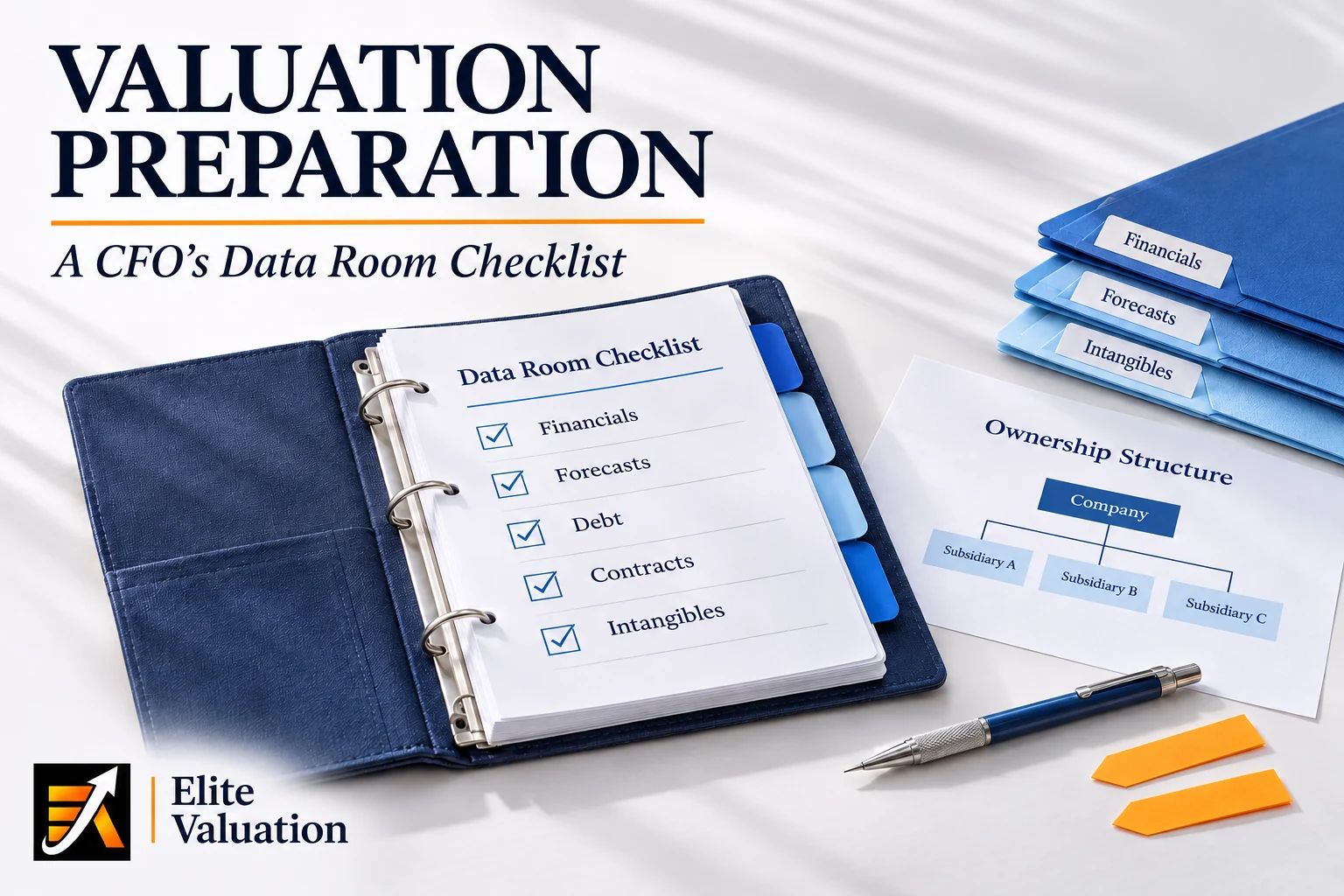
Audited accounts, management accounts, ARR and churn data by customer, the cap table, the product roadmap, key contracts and any earlier Valuations.
Select the approaches
Choose the income, market and cost approaches that fit the stage and data, and record why any approach was set aside.
Build and stress-test
Build the model, then run sensitivities on discount rate, growth, margin, retention and terminal assumptions. Reconcile the approaches.
Review the draft
Management checks the factual inputs. The valuer keeps responsibility for the judgments and does not change the result to fit a preferred outcome.
Issue the signed report
The report sets out the scope, sources, methods, assumptions, sensitivities, limitations and the registration of the signing valuer.
Clients in Mumbai and Gurugram often ask how long the process takes. The honest answer is that it depends on the data. Clean, complete records shorten the timeline considerably. Missing customer data, unreconciled accounts or an unsettled cap table are the most common reasons a report is delayed, and they are better identified in the scoping stage than at the end.
Ready to start? Check whether a registered valuer’s report is mandatory for your purpose, then contact Elite Valuation with the scope.
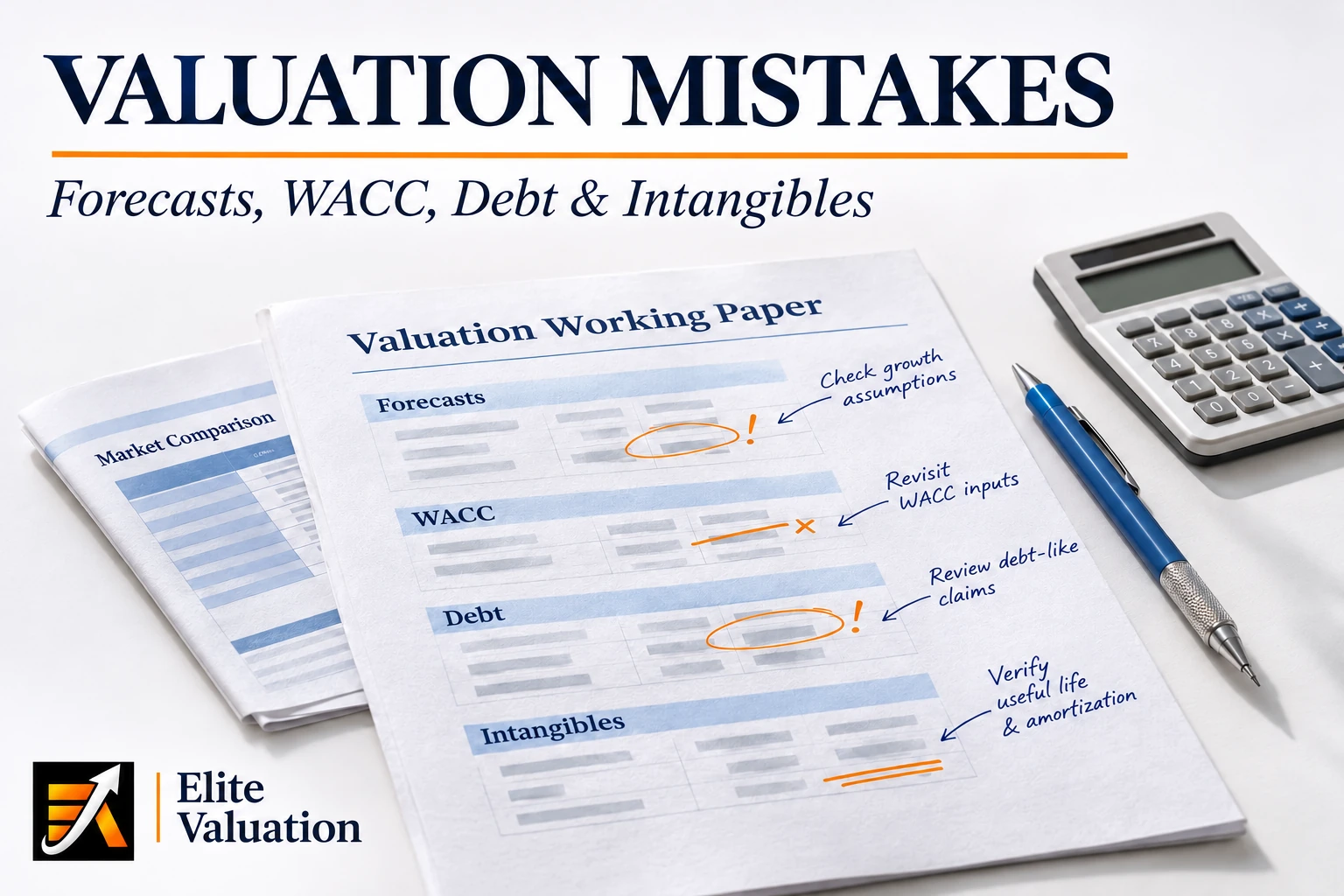
Common Mistakes in Software Valuation and How to Fix Them
These six errors appear most often in software reports reviewed by investors, auditors and tax officers across Bengaluru, Gurugram and Vadodara. Each card shows the error, what it costs and the fix.
Applying a headline multiple without adjustment
A market multiple from a large or AI-native peer is applied to a small private company with no adjustment for size, growth or retention.
The Valuation is overstated, and a buyer’s diligence team rejects itSelect peers or transactions in the same size band, adjust for growth, retention and margin, and show the adjustment.
Mixing ARR with recognised revenue
ARR is annualised contracted value, while revenue is what was recognised in the period. The two can differ sharply in a growing company.
The multiple is applied to the wrong base, and the answer shifts by a large marginDefine ARR in writing, reconcile it to recognised revenue, and state which base each multiple uses.
Stopping at enterprise value
The report gives a business value but ignores debt, cash, preference rights and the cap table when the purpose is an equity transaction.
The price per share is wrong, and the round or the ESOP grant is mispricedBridge enterprise value to equity value, and analyse the rights attached to each class of shares for equity purposes.
Relying on one method
A single DCF or a single multiple is presented as the Valuation with no cross-check, even when the inputs are weak.
The result cannot be defended when a reviewer changes one assumptionUse at least two approaches where the data allows, and explain how the results were reconciled.
Assuming the company owns its technology
Assignment deeds from founders, early employees or contractors are missing, and open-source licence obligations have not been reviewed.
Ownership or licence questions surface during due diligence, at the worst momentObtain assignment deeds and a licence scan before the Valuation is relied on, and disclose any gaps.
Treating AI capability as value
An AI feature is valued as a premium asset with no evidence that customers pay for it or that its compute cost leaves a margin.
The premium is challenged, and the forecast falls apart on the first margin reviewAttribute revenue to the AI feature with usage and pricing data, and show gross margin after compute cost in each scenario.
Each of these errors is avoidable with a documented file that sets out the purpose, the data, the methods, the assumptions and the limits. A Valuation that can be traced from the input to the conclusion is far easier to defend in front of an investor or an auditor.
How to Choose a Software Valuation Provider in India
Choose a provider on registration, relevant experience, method discipline and documentation, not on advertised price. Check the valuer’s registration and asset class, the scope letter, the method explanation and the name of the person who signs the report.
Investors and founders in Mumbai, Delhi and Bengaluru often compare several firms for the same engagement. The comparison is easier when it is built on a short list of verifiable points rather than on marketing claims. The list below is a practical starting point.
Questions to ask before you engage a provider
- Registration. Is the signing valuer a registered valuer, and is the registration in the asset class that matches the assignment?
- Scope in writing. Does the scope letter state the purpose, the Valuation date, the standard of value, the approaches and the deliverables?
- Method. Does the provider explain which approaches it will use, how they will be reconciled, and how the report follows ICAI Valuation Standard 103?
- Sensitivity. Will the report show how the result moves when the discount rate, growth, margin and retention change?
- Named responsibility. Who signs the report, and who answers questions on the assumptions after it is issued?
- Conflicts and independence. Has the provider checked whether it has a conflicting relationship with the company, its investors or its acquirer?
- Fees. Are fees set out in writing for the defined scope, with a clear basis for any change in scope?
A provider that answers these questions clearly is easier to rely on than one that leads with a low headline price. Ask for a redacted sample of prior work, or a description of the method used for a similar company, before you decide.
If you have searched for top companies offering software Valuation services in India or affordable software Valuation service providers near me, the checklist above applies to both searches. A list of firms cannot show whether a firm suits your purpose, so the better test is a written scope, a named signatory and a documented method for a business like yours.
On cost, compare the fee for a defined scope rather than a headline figure. Elite Valuation is based in Ahmedabad and sets out fees in writing before work starts, so the scope and the price can be compared directly. The metro cities where the firm provides these services are listed in the next section.
Elite Valuation’s Software Valuation Services in India
Elite Valuation is a Valuation firm founded in 2020 by Sagar Shah, a Chartered Accountant, Company Secretary and IBBI Registered Valuer. Before founding the firm, he spent a decade at Ernst & Young focused on cross-border structuring and transfer pricing. The firm is based in Ahmedabad and works with founders, investors, CFOs and advisers in Mumbai, Pune and across India, including on cross-border structures and matters involving GIFT City.
The firm’s work on software and technology assets combines business Valuation, intangible asset Valuation and regulatory reporting. The table below shows how these services map to the needs in this guide.
Metro cities where Elite Valuation provides software Valuation services
- Ahmedabad (head office)
- Mumbai
- Delhi NCR
- Bengaluru
- Pune
- Hyderabad
- Chennai
- Kolkata
Clients outside these cities are also served, subject to the scope agreed in writing.
| Need | What Elite Valuation delivers | Related service |
|---|---|---|
| Software or SaaS business Valuation | Income, market and cost approaches under ICAI Valuation Standard 103, reconciled and stress-tested | Company Valuation |
| ESOP grant and Ind AS 102 support | Share Valuation and fair value support for grants and option pricing | ESOP consulting |
| Acquisition and purchase price allocation | Identification and Valuation of software and technology intangibles under Ind AS 103 | Share Valuation |
| Impairment support under Ind AS 36 | Recoverable amount analysis, including value in use and fair value less costs of disposal | Contact us |
| Tax and FEMA pricing | Valuation reports for specified tax and FEMA purposes, with the method and sources documented | When a Valuation is mandatory |
Talk to Elite Valuation about your software Valuation
- Company Valuation: enterprise and equity Valuation for software and SaaS businesses
- Share Valuation: price per share for a funding round, an ESOP grant or a share transfer
- ESOP consulting: option pool design, grant Valuation and Ind AS 102 support
- About Elite Valuation: the firm, its founder and its credentials
- Contact us: send your purpose, date and latest figures to start the scoping
Need a Software Valuation You Can Defend?
Tell us the company, the purpose, the Valuation date and the decision the Valuation has to support. We will confirm the scope, the method and the documents needed, in writing, before work begins.
Contact Elite ValuationSoftware Valuation | Company Valuation | Share Valuation | ESOP Consulting | Purchase Price Allocation
What should a founder, investor or buyer take from a software Valuation?
A software Valuation is only as good as its purpose, its data and its method. The purpose decides which standard and which rules apply. The data decides how far the forecast can be trusted. The method decides how the evidence becomes a number, and the sensitivities show how much that number depends on judgment. The same discipline applies to a founder in Ahmedabad, a CFO in Mumbai or an investor in Bengaluru.
Before the figure is used in a term sheet, a board paper, an impairment file or a tax computation, settle the purpose, the Valuation date, the ARR definition, the cap table, the open-source position and the registration of the valuer in writing.
Frequently asked questions about software Valuation in India
How much is a software company worth in India?
There is no single figure. Private SaaS businesses are often priced at a multiple of annual recurring revenue, and reported medians for private companies sit in the low single digits to mid-single digits. The result depends on growth, retention, margins and the purpose of the Valuation, so a valuer sets the figure for a specific purpose and date.
Which method should a startup use for a funding round?
Most funding-round work combines a market approach using recent comparable rounds or ARR multiples with a scenario-weighted income approach. The cost approach sets a floor for early-stage businesses. The investor’s terms, including preference rights, also affect the price per share and need separate analysis.
Is a registered valuer required for software Valuation in India?
Not for every purpose, but specified Valuations under Section 247 of the Companies Act, 2013 require a registered valuer, and tax and FEMA pricing rules also call for a qualified professional in certain cases. Confirm the requirement for each purpose before relying on an estimate.
What does ICAI Valuation Standard 103 cover?
ICAI Valuation Standard 103 defines the income, market and cost approaches and the methods within them, and gives guidance on choosing and applying them. It is read with ICAI Valuation Standards 201 and 202, which cover scope of work, analysis, reporting and documentation.
What is an ARR multiple?
An ARR multiple is enterprise value divided by annual recurring revenue. A business with a Rs 20 crore ARR valued at Rs 80 crore has a 4x ARR multiple. Multiples depend on growth, retention, margins and business size, so a single multiple should not be applied to every software company.
How does Ind AS 36 apply to software?
Ind AS 36 requires impairment testing for intangible assets, including software and goodwill, when indicators of impairment exist. The recoverable amount is the higher of value in use and fair value less costs of disposal, so software Valuation often supports the impairment test directly.
Can an AI company be valued with a DCF?
Yes, but early AI businesses have uncertain long-range cash flows, so a DCF needs scenario analysis and evidence from revenue, margins and compute costs. Market evidence and sensitivity testing usually carry more weight than a single forecast.
How long does a software Valuation take?
The timeline depends on the quality of the data, the purpose and the number of approaches. Elite Valuation confirms the scope, the documents required and the timeline in writing before work starts.
In which metro cities do you provide software Valuation services?
Elite Valuation is based in Ahmedabad and provides software Valuation services in Mumbai, Delhi NCR, Bengaluru, Pune, Hyderabad, Chennai and Kolkata, as well as clients across India, including cross-border structures. Engagements are scoped in writing, and the report is prepared for the purpose the client needs.
What documents are needed for a software Valuation?
Usually the audited financial statements and management accounts, ARR, churn and customer data, the cap table, the product roadmap, key customer contracts, and any earlier Valuations. For patents or acquired technology, the assignment deeds and technical documents are also needed.
Sources
The positions below are taken from the standards, statutes and publications named. Market multiples are reported by third parties and are not audited. Figures in the examples are hypothetical. Section numbers, Ind AS paragraph references and rule numbers should be confirmed against the notified text before reliance.
- ICAI, Educational Material for ICAI Valuation Standard 103, Valuation Approaches and Methods (2021): https://publication.icai.org/publication/1002
- ICAI, Exposure Draft of ICAI Valuation Standard 103, ED/ICAI VS-103/2026-2027/03: https://caalley.com/exp_drafts/94996ibvsb-aps6678-vs103.pdf
- Livmo, SaaS Valuation Multiples in 2026: https://livmo.com/blog/saas-valuation-multiples-2026/
- FE International, SaaS Valuation Multiples: https://www.feinternational.com/blog/saas-valuation-multiples
- Fungies, SaaS Valuation Statistics 2026: https://fungies.io/saas-valuations-statistics-2026
- Axial, SaaS Multiples: A Guide for Business Owners (2026): https://www.axial.net/?p=70241
- Companies Act, 2013, Section 247, and the Insolvency and Bankruptcy Board of India, Registered Valuers Regulations, 2017: https://www.ibbi.gov.in/
- Indian Accounting Standards Ind AS 36, 38, 103 and 113, as notified by the Ministry of Corporate Affairs: https://www.mca.gov.in/
- Foreign Exchange Management (Non-debt Instruments) Rules, 2019, Reserve Bank of India: https://www.rbi.org.in/
- Elite Valuation, Company Valuation and Share Valuation guides on this website, for the practice positions summarised above.

Disclaimer. This article is general information only. It is not legal, tax, accounting or investment advice, and it is not a Valuation of any company or security. The figures in the examples are hypothetical. The Companies Act, the Income-tax Act, the Indian Accounting Standards, the ICAI Valuation Standards and the FEMA rules change, and the points flagged in this article must be checked against the current text before reliance. Research date: 10 November 2026. Confirm each point with a qualified professional before relying on it.