Registering an AIF in India is a sequence of SEBI filings, not a single form. Each step depends on the one before it, and most delays come from a document drafted before the category, the sponsor commitment or the PPM was settled.
To register an AIF in India, the sponsor files Form A and the PPM of the first scheme with SEBI, pays a non-refundable application fee, and pays the registration fee only after SEBI approves. SEBI’s benchmark lists 21 days for a fresh registration, but the real timeline depends on how quickly queries are answered.
Key takeaways
- Pick the category first. Category I, II or III is fixed at registration.
- Continuing interest is the lower of 2.5% of corpus or ₹5 crore (Category I and II), held in cash.
- Form A, the CA-certified net worth certificate, the declarations and the PPM are filed together.
- A merchant banker certifies the PPM for a regular scheme, and every AIF must appoint a custodian.
- For a regular scheme, first close is generally due within 12 months of launch eligibility, with the applicable minimum corpus.
This guide is for first-time sponsors, family offices and fund managers who want to launch a SEBI registered fund and need the sequence before committing money. It covers the seven steps from category choice to the first close, and it flags where the rules changed in 2026.
Plan for two to four months from a complete filing to registration. That is our planning estimate, not a SEBI commitment. The 12-month first-close limit then runs from the scheme’s launch-eligibility date, so the full runway is longer than the registration step alone.
Quick Overview of the AIF Registration Process
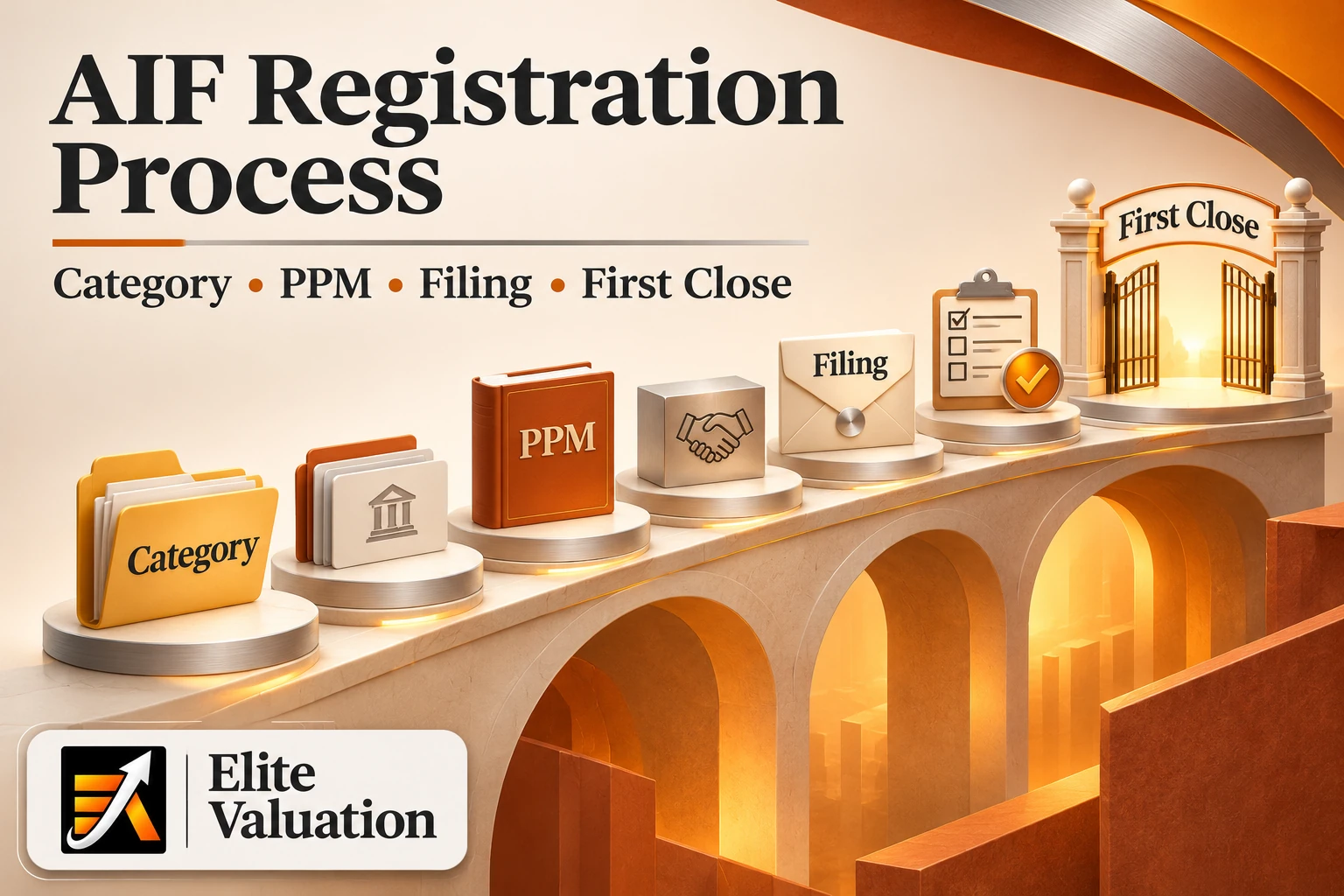
Registration runs in seven steps, and the same sequence applies whether the sponsor is in Mumbai, Ahmedabad or Gurugram. Steps two and three can overlap, but the SEBI filing waits for a final PPM, signed declarations and the sponsor’s net worth evidence.
- Decide the category and legal vehicle.
- Appoint the key intermediaries: trustee, merchant banker, custodian, legal counsel and valuer.
- Prepare the PPM to the SEBI template.
- Prove the sponsor’s continuing interest and net worth.
- File Form A and the first scheme’s PPM on the SEBI intermediary portal.
- Clear SEBI’s queries, pay the registration fee and receive the certificate.
- Meet the post-registration requirements: launch, first close and ongoing reporting.
Step 1: Decide Category and Structure
Category I covers venture capital, SME, social impact and infrastructure funds. Category II covers funds outside Categories I and III that do not borrow beyond day-to-day needs, such as private equity and real estate funds. Category III covers complex or leveraged strategies, such as hedge funds and PIPE funds. Category I and II funds are closed-ended with a three-year minimum tenure.
The category is fixed at registration. Once registered, the AIF cannot change category without SEBI’s prior approval, so settle it before drafting the PPM. Our guide on how to choose between Category I, II and III AIFs sets out the decision tests.
An AIF must be set up as a trust, LLP or company in India, raise funds only through private placement, and generally keep a minimum corpus of ₹20 crore per scheme, subject to special-category rules. Most sponsors choose a trust, because the trust deed, trustee and investment manager structure is the form investors already know. A company or LLP is allowed and suits some sponsors, but each brings its own governance.
A Pune sponsor plans a five-year private equity fund that invests in mid-market manufacturers, uses no borrowing and earns carried interest. That profile points to Category II. An Ahmedabad sponsor running leveraged long and short equity positions would look at Category III instead.
Settle the Category Before You Draft
Send us the strategy, target corpus and investor base. We will map the category, the vehicle and the intermediaries before any filing starts.
Talk to Elite ValuationAIF Registration | Structuring | Category Selection
Step 2: Appoint Key Intermediaries
Each party named in the filing brings its own documents. Sponsors in Mumbai, Delhi or Gurugram should choose the trustee and merchant banker before the PPM is drafted, because the PPM discloses the merchant banker.
- Sponsor and investment manager. The sponsor provides the continuing interest and net worth evidence, and the manager runs the fund. Both are named in Form A.
- Trustee. For a trust, the trustee is a named party with its own identity and PAN documents.
- Merchant banker. A SEBI registered merchant banker certifies the PPM for a regular scheme. Accredited-investor-only funds (including large value funds) and angel funds follow the exempt merchant-banker filing route, with the prescribed manager undertakings. The merchant banker must be independent of the AIF, sponsor, manager and trustee.
- Custodian. A January 2024 SEBI circular extended the custodian requirement to every AIF, regardless of corpus. Investment holdings must follow the applicable dematerialisation requirements and exceptions.
- Legal counsel and valuer. Counsel drafts the trust deed and PPM terms. The Valuation policy belongs in the fund documents from the start, because portfolio Valuation is an ongoing obligation. See our AIF Valuation requirements guide.
Step 3: Prepare the Private Placement Memorandum (PPM)
The PPM is the offer document investors read, and the merchant banker’s due diligence checks it before filing. It must contain the information the regulations require and follow SEBI’s template unless an applicable template exemption applies. The template is set by SEBI, so a fund in Ahmedabad, Mumbai or Pune faces the same disclosure list.
Annexure 1 of SEBI’s Master Circular covers the PPM template for Category I and II AIFs, and Annexure 2 covers Category III. The eligible investor-waiver route uses Annexure 3; separate exemptions also apply. Two disclosures need particular care: the manager’s and sponsor’s own investments in the fund, and the disclaimer that names the merchant banker. The first scheme’s PPM is filed with the application, together with the merchant banker’s certificate in Annexure 6. Our AIF PPM checklist sets out the essential disclosures.
Step 4: Sponsor Commitment and Net Worth
The sponsor or manager must hold a continuing interest in the fund. For Category I and II, it is the lower of 2.5% of corpus or ₹5 crore. For Category III, it is the lower of 5% of corpus or ₹10 crore. The interest must be an investment in the fund, not a waiver of management fees. A sponsor in Gurugram or Delhi meets the same test, so the figure depends on fund size and category, not on location.
| Hypothetical fund corpus | Category II: lower of 2.5% or ₹5 crore | Category III: lower of 5% or ₹10 crore |
|---|---|---|
| ₹50 crore | ₹1.25 crore | ₹2.5 crore |
| ₹300 crore | ₹5 crore | ₹10 crore |
| ₹400 crore | ₹5 crore | ₹10 crore |
Hypothetical corpus sizes. The table shows how the cap applies, not what any real fund must hold.
Demonstrate the commitment with a CA-certified net worth certificate for the sponsor or investment manager, or their promoters or partners, plus the previous year’s financial statements. The evidence must support capacity to maintain continuing interest; the continuing-interest caps are not separate blanket minimum-manager-net-worth requirements.
Check Your Continuing Interest Before You File
Share the target corpus and the sponsor structure. We will confirm the continuing interest required and the evidence SEBI will expect.
Talk to Elite ValuationAIF Registration | Continuing Interest | Net Worth Evidence
Step 5: File Application with SEBI (Form A and PPM)
Filing is online, through SEBI’s intermediary portal at siportal.sebi.gov.in. The applicant selects its category and completes Form A from the First Schedule of the AIF Regulations, including the compliance declarations. Sponsors in Pune, Delhi or Mumbai file through the same portal.
A non-refundable application fee of ₹1 lakh plus GST is paid at filing, and the registration fee follows only after approval. Before filing, reconcile the corpus in the PPM, the continuing interest in the net worth certificate and the investment amounts in the fund documents. Mismatches invite queries.
Step 6: SEBI Queries and Approval
SEBI’s 2012 process note said applicants would normally hear back within 21 working days, and that the total time depends on how quickly requirements are met. SEBI’s service benchmark still lists 21 days for a fresh registration. Expect queries in the areas the filing asks you to prove: net worth, declarations, PPM disclosures and the identity of each party. Answer each query in writing and keep a log of every document revised. The same SEBI process applies to a sponsor in Delhi or Pune as to one in Mumbai.
Once SEBI is satisfied, it asks for the registration fee. The certificate of registration in Form B follows, and it remains valid until the AIF is wound up.
Answer SEBI Queries Without Restarting the Clock
If SEBI has raised queries, send us the observations. We will draft the responses, reconcile the revised documents and confirm what changed.
Talk to Elite ValuationAIF Registration | SEBI Queries | Document Reconciliation
Step 7: Post-Registration Compliances
Registration starts the compliance cycle. A fund run from Mumbai, Ahmedabad or Pune needs the same calendar, with an owner and a date for each item.
- Launch. Under the final July 2026 GARUDA circular, a first regular scheme can launch on the later of registration or 10 working days after filing, unless SEBI advises otherwise. Accredited-investor-only funds, LVFs and angel funds have separate launch routes.
- First close. For a regular scheme, declare it within 12 months of launch eligibility, with the applicable minimum corpus. LVFs and angel funds have specific provisions.
- Final close. Set the final close in the PPM and fundraising plan; an industry convention is not a universal regulatory deadline.
- Ongoing compliance. The manager prepares an annual compliance test report covering every chapter of the Master Circular, and each scheme displays its complaints data.
Documents Required for AIF Registration
SEBI’s FAQ lists the supporting documents. Start with the net worth evidence and the declarations, because both depend on other people’s records. Sponsors in Mumbai, Gurugram or Ahmedabad can keep everything in one folder, checked against Form A.
| Document | Provided by | Purpose |
|---|---|---|
| Form A, duly signed and stamped | AIF applicant | Core application under the First Schedule |
| Declarations on compliance, Form A items 7(a) to 7(d) | AIF applicant | Confirms the compliance position |
| Identity proof, address proof and PAN, self-attested | Applicant, sponsor and its directors or partners, investment manager, trustee | Establishes each party |
| Trust deed, or incorporation papers for a company or LLP | AIF applicant | Establishes the legal vehicle chosen in Step 1 |
| CA-certified net worth certificate | Sponsor and investment manager, or their promoters or partners | Shows capacity to maintain the continuing interest |
| Financial statements for the previous financial year | Sponsor and investment manager | Supports the net worth certificate |
| Declaration of regulatory actions in the last five years | Applicant, sponsor, investment manager, controlling entities, associates and group companies | Five-year disclosure |
| Fit and proper declarations | AIF, sponsor and manager | Schedule II test |
| PPM of the first scheme with merchant banker due diligence certificate | AIF and merchant banker | Regular route: PPM with merchant banker certificate; exempt routes use the prescribed undertaking. |
Common Mistakes That Delay AIF Registration
Five errors slow registrations, whether the sponsor is based in Mumbai, Pune, Delhi or Ahmedabad. Each card gives the consequence and the fix.
Drafting the PPM before the category is fixed
The template, the disclosures and the investment limits change with the category, so the draft is reworked after filing.
Decide the category and legal vehicle first, then draft the PPM to the matching SEBI template.
Showing continuing interest as a fee waiver
The regulation does not accept a fee waiver as continuing interest, so the commitment is not counted and the filing is queried.
Plan a cash investment in the fund and document it in the net worth file.
Filing without an independent due diligence certificate
A regular scheme’s PPM needs the merchant banker’s certificate, and a merchant banker linked to the sponsor or trustee is not acceptable.
Appoint an independent SEBI registered merchant banker early, and confirm it is not an associate of the AIF, sponsor, manager or trustee.
Mismatched numbers across the filing
Corpus, continuing interest and investor limits that differ between Form A and the PPM invite queries and restart the clock.
Reconcile the corpus, the continuing interest and the investor limits across every document before you file.
Budgeting only for the application fee
The registration fee falls due after approval, so the fund can be short of cash exactly when the certificate is ready.
Budget for both SEBI fees, plus GST, and time the registration payment against approval.
How Elite Valuation Supports AIF Registration
Elite Valuation supports AIF registration and structuring, fund compliance and the AIF Valuation work that follows registration. The firm operates pan-India from Ahmedabad, and the same process applies to sponsors in Delhi, Pune and Gurugram.
Sagar Shah is a Chartered Accountant, Company Secretary and IBBI Registered Valuer. He spent 9 years at Ernst & Young before founding Elite Valuation in 2020. The firm works alongside the merchant banker and legal counsel rather than in their place, which keeps the regulated roles separate. For the Valuation side, see our AIF Valuation guide.
Frequently Asked Questions
The answers below cover filing, launch and first-close requirements. Apply the provisions for the selected category and scheme route.
How long does AIF registration take?
SEBI’s service benchmark lists 21 days for a fresh registration, and a SEBI processing note from 2019 says SEBI endeavours to process registrations within 30 working days of a complete application. Those are processing targets, not guarantees. The time you actually spend depends on how fast queries are cleared, so plan for two to four months from a complete filing to registration. That planning window is our estimate. The first-close deadline runs from launch eligibility under the current framework.
What is the minimum corpus?
The general minimum corpus is ₹20 crore per scheme, to be achieved at first close. Social impact funds and special subcategories have different provisions. The general investor minimum is ₹1 crore, with ₹25 lakh for specified employee/director investors and an exemption for accredited investors. The 1,000-investor ceiling excludes accredited investors; company-law limits also apply where relevant. Size the corpus and investor base using the rules applicable to the chosen category.
Can a first-time sponsor register an AIF?
Yes, if the sponsor can meet the conditions. The regulations do not bar a first-time sponsor, but SEBI assesses the sponsor’s experience in fund management or investment. A first-time sponsor should expect closer scrutiny of the investment team, the strategy and the net worth evidence. Build a stronger file by appointing an experienced trustee and merchant banker, documenting the investment process and keeping the continuing interest in cash, not as a fee waiver.
What fees are payable to SEBI?
A non-refundable application fee of ₹1 lakh plus GST is paid when you file. The registration fee is paid only after SEBI approves the application: ₹5 lakh plus GST for Category I (except angel funds), ₹10 lakh plus GST for Category II and ₹15 lakh plus GST for Category III. Angel funds pay ₹2 lakh plus GST. Budget for both fees, because the registration fee falls due after approval.
Which category should I choose?
Category I covers venture capital, SME, social impact and infrastructure funds. Category II covers funds that do not fall in Category I or III and do not borrow beyond day-to-day needs, such as private equity and real estate funds. Category III covers funds with complex or leveraged strategies, such as hedge funds and PIPE funds. Decide the category from the strategy and borrowing plan, because the category is fixed at registration and cannot be changed without SEBI’s prior approval.
Is a merchant banker mandatory for registration?
For the PPM of a regular scheme, yes. The PPM must be filed through a SEBI registered merchant banker, which issues a due diligence certificate in the format in Annexure 6 of SEBI’s Master Circular. The merchant banker cannot be an associate of the AIF, its sponsor, manager or trustee. Accredited-investor-only funds (including LVFs) and angel funds use the exempt filing route. The July 2026 GARUDA circular now specifies the regular-scheme and exempt filing routes.
Why do most sponsors choose a trust?
Regulation 4 allows an AIF to be set up as a trust, LLP or company in India. Most sponsors choose a trust because the trust deed, trustee and investment manager structure is the form investors and intermediaries already know. A company or LLP is allowed and suits some sponsors, but each brings its own governance. Choose the vehicle on tax and investor-base advice, not on form alone.
What is continuing interest, and how is it shown?
The sponsor or manager must hold a continuing interest of not less than the lower of 2.5% of corpus or ₹5 crore for Category I and II, and the lower of 5% of corpus or ₹10 crore for Category III. The interest must be an investment in the fund, not a waiver of management fees. Show it with a CA-certified net worth certificate and the previous year’s financial statements for the sponsor and investment manager, which SEBI asks for in the filing.
Can the fund raise money before SEBI registration?
An AIF must obtain registration before acting as an AIF or pooling investor capital. Circulation of a PPM to solicit funds is also subject to the applicable scheme-launch conditions. For a first regular scheme, use the later of registration or 10 working days after filing, unless SEBI advises otherwise; exempt fund routes follow their own conditions.
When must the first close be declared?
For a regular scheme, the first close is generally due within 12 months of launch eligibility under the current framework, not the old PPM-acknowledgement date. The first regular scheme can launch on the later of registration or 10 working days after filing, unless SEBI advises otherwise. The applicable minimum corpus must be reached at first close. LVFs and angel funds have specific first-close provisions; apply the rule for the chosen route.
Does Elite Valuation handle AIF registration?
Yes. Elite Valuation supports AIF registration and structuring, fund compliance and the AIF Valuation work that follows registration. Sagar Shah, the founder, is a Chartered Accountant, Company Secretary and IBBI Registered Valuer, with 9 years at Ernst & Young before founding the firm in 2020. Elite Valuation works alongside the merchant banker and legal counsel, which keeps the regulated roles separate. The firm operates pan-India from Ahmedabad.
Why choose a specialist firm over a Big Four firm for AIF registration?
A specialist firm can give one senior team across the category decision, the SEBI filing, the PPM and the Valuation policy, which reduces hand-offs. A Big Four firm may suit a sponsor that needs a wider network across many services and jurisdictions. Compare the two on who will sign the filing, how the team handles SEBI queries, the turnaround, and the fee for each stage, and ask for the registration of each intermediary in writing.
Conclusion: Settle the Category and Net Worth Before You File
Whether the sponsor is in Mumbai, Ahmedabad or Gurugram, the same sequence applies: category, intermediaries, PPM, continuing interest, filing, queries and then the first close. Settle the category and the net worth file first, because those two decisions drive the rest of the timeline.
Our AIF registration service page sets out the scope we cover at each step.
Talk to Elite Valuation About Your AIF Registration
Send us the strategy, target corpus, investor base and the intermediaries you are considering. We will confirm the category, the documents still missing and the filing timeline in writing.
Talk to Elite ValuationAIF Registration | Category Selection | Filing Support
Related guides
Sources
- SEBI AIF Regulations, amended to 15 October 2026: eligibility, continuing interest, investor limits and fee schedule.
- SEBI Master Circular for AIFs, current consolidated version: PPM templates, custody and first-close requirements.
- SEBI GARUDA circular, 30 July 2026: regular schemes, exempt routes and launch eligibility.
- SEBI registration FAQs, January 2025: application documents and GST-inclusive fee schedule, read with later amendments.
- SEBI service benchmarks: processing targets depend on complete information and responses.

Disclaimer. This article is general information only. It is not legal, tax, accounting or investment advice, and it is not a Valuation of any fund, sponsor or share. The planning windows and the hypothetical corpus figures are illustrations. Check SEBI’s current circulars and the notified text before relying on any figure. Confirm each point with a qualified professional before acting.