Accelerated vesting in ESOPs brings forward a right that normally depends on time. A change of control or an IPO can speed that clock up for one party and cut it short for another. Treatment depends on the scheme and transaction terms: a sale does not automatically vest unvested options. Lapse, continuation, replacement and any acceleration must be settled so the buyer understands the retention position. The acceleration clause decides between those outcomes. In India it sits where the scheme meets the Companies Act, the SEBI rules, the Income-tax Act, the FEMA rules and Ind AS 102, so a clause that reads well in a term sheet can still fail on one of them.
Key takeaways
- Accelerated vesting brings forward the vesting date of unvested options when a named event occurs. Single trigger needs only the change of control. Double trigger needs the change of control and a qualifying exit of the employee within a set window.
- Double trigger is the usual position in institutional deals, because it keeps the retention the buyer is paying for.
- Rule 12(6)(a) of the Companies (Share Capital and Debentures) Rules, 2014 and Regulation 18(1) of the SBEB Regulations, 2021 require at least one year between grant and vesting. Death and permanent incapacity are the main carve-outs, so an acceleration clause has to respect the floor.
- An IPO clause has to fit the SEBI ICDR Regulations, and a pre-IPO scheme needs shareholder ratification after listing before any fresh grant is made under it.
- For employee equity-settled awards, acceleration can bring forward unrecognised Ind AS 102 expense. Original triggers, later modifications and cancellation or settlement require the appropriate separate assessment.
- Acceleration does not itself create a tax charge. The perquisite arises on exercise and allotment or transfer, and any cash payment for options needs a payroll route settled before closing.
Who should use this guide
This guide is for founders and CFOs negotiating a term sheet, investors reviewing a scheme before a funding round, buyers running diligence, and Company Secretaries who must keep the scheme compliant. It explains each trigger, the legal limits, the accounting charge, the tax point, the approvals and the drafting checks. The figures are hypothetical. They show the mechanics only and do not describe any company, grant or transaction.
The clause is one part of an ESOP that also has to be designed, priced and reported. For the wider scheme work, see our ESOP advisory services. For the accounting basis that the acceleration charge builds on, read section 6 of this guide.
What Is Accelerated Vesting in an ESOP?
Accelerated vesting is a term in the ESOP scheme or the grant letter that brings forward the vesting of unvested options when a named event occurs. The usual events are a change of control, an IPO and the termination of the employee’s job. Accelerated options still have to be exercised, and they remain subject to the exercise price, the exercise window and the scheme’s other terms.
A standard grant in an Indian start-up runs over four years with a one-year cliff, after which options vest monthly. Under that schedule, an option granted in Bengaluru in January that is due to vest in the thirteenth month cannot be exercised until then. Acceleration moves that date forward. It does not change the number of options granted, the exercise price, or the rule that an option must be exercised and paid for before it becomes a share.
Companies include acceleration for three reasons. Employees want protection if the company is sold before their schedule ends. Investors want the pool to keep the team focused through the exit. Buyers want to choose which people they keep. These positions pull in different directions, which is why the clause is negotiated rather than copied from a template. A Pune manufacturer granting options to its plant leadership and a Mumbai fintech granting options to its product team will each need a view, but the questions a buyer asks will differ.
Treatment of options at closing
At closing, vested options are usually settled. Some are cashed out at the deal price less the exercise price, and others are rolled into options over the buyer’s shares. Unvested options can lapse, continue on the original schedule, accelerate or be replaced with new awards. The clause decides which of these applies to each grant, so it has to be read grant by grant as well as at scheme level.
How Do Single-Trigger and Double-Trigger Clauses Work?
A single-trigger clause vests unvested options on the change of control alone. A double-trigger clause needs the change of control and a second event, usually a termination without cause or a resignation for good reason within a set period after closing. A hybrid clause accelerates part of the unvested pool on the first trigger and the rest on the second.
Single trigger is the most generous position for the employee. It protects against the risk that the buyer ends the job after closing, but it also removes the retention incentive that the buyer is paying for. Single trigger is rare in institutional deals and appears more often in early-stage or founder grants, where the founder has more bargaining power.
Double trigger is the usual position in institutional deals. The buyer keeps the unvested pool as a retention tool, and the employee is protected if the company dismisses them without cause, or forces a material change in their role, within the window. The window is commonly 12 months after closing, though it is negotiated. For senior grants, where retention value is highest, buyers in Mumbai or Gurugram will usually propose double trigger, and the open point is the length of the window.
Compare the three structures
| Feature | Single trigger | Double trigger | Hybrid |
|---|---|---|---|
| What vests the options | Change of control alone | Change of control plus a qualifying termination within the window | Part on the change of control, the rest on the second trigger |
| Employee protection | Highest | Moderate, depending on the window and the good reason definition | Moderate to high |
| Buyer’s retention | Weakest, the pool vests at closing | Strongest, unvested options keep working after closing | Partial, depending on the split |
| Common use | Early-stage or founder grants, rare in institutional deals | The usual position in institutional deals | A negotiated middle ground, often for senior grants |
| Main drafting risk | Price and retention disputes at closing | Disputes over the qualifying termination and good reason | Two tranches to track, value and report |
Monthly vesting and acceleration example
A Bengaluru software company grants 1,20,000 options on a 48-month schedule with a 12-month cliff, at an exercise price of ₹20 per share. Thirty-six months later, a Mumbai strategic buyer agrees to pay ₹300 per share. The employee holds 90,000 vested options and 30,000 unvested ones. The unvested spread is 30,000 × ₹280, or ₹84 lakh. Assuming a gross cash settlement at the unchanged deal price, single trigger brings the ₹84 lakh payout forward to closing and removes the unvested-option retention incentive. Double trigger keeps the schedule running at 2,500 options a month. If the employee stays for the remaining 12 months, all 30,000 vest on schedule. If the employee is terminated without cause inside that window, the unvested options vest on termination.
The example shows why the choice matters. On the stated cash-settlement assumption, single trigger brings an additional acceleration payout forward to closing. Double trigger does not accelerate that unvested balance at closing; normal vesting and other deal costs can still arise.
Hybrid clauses are negotiated case by case. One common pattern accelerates part of the unvested pool on the change of control and the rest on a qualifying termination. A hybrid gives the employee more certainty than double trigger alone, but it creates two tranches that must be tracked, valued and reported separately, which adds administrative work for the company and the buyer.
How Should a Change of Control Be Defined in the Scheme?
A change of control should be defined by a measurable threshold, a list of qualifying transactions, a list of exclusions and a named decision-maker. A clause that says “sale of the company” leaves open whether a merger, a sale of the main business or a transfer that does not pass control counts. That uncertainty is what delays closing.
Indian ESOP rules do not supply a change-of-control definition for acceleration, so the scheme or the grant letter must. Deal teams in Ahmedabad and Mumbai should settle these points before the term sheet is signed:
- Voting threshold. An acquisition of more than 50% of the voting rights, or the right to appoint a majority of the board.
- Qualifying transactions. A merger or amalgamation, a sale of all or substantially all of the assets, and a change in the board that moves control.
- Exclusions. Transfers between group companies and internal reorganisations, which should not trigger acceleration unless the scheme says so.
- Decision-maker. The board or the compensation committee, with its determination recorded in writing and binding on the scheme.
- Substitution. Whether the buyer may assume the options, or replace them with awards of equal value that keep the schedule.
Replacement awards and good reason
The substitution point deserves close attention. If the buyer assumes the options, or replaces them on terms that preserve the vesting schedule, acceleration may not be needed at all. Replacement awards require the applicable Ind AS 102 assessment and, in a business combination, Ind AS 103 allocation between acquisition consideration and post-combination service. Measure any incremental value on that basis. Section 6 explains the charge.
Good reason is the second half of a double trigger, and it is the term most often left vague. A workable definition uses objective tests: a material reduction in base pay, a material diminution of role or reporting line, or a required relocation beyond a stated distance from the current office. Each test needs a notice period and a cure right for the company, so that the employee cannot resign on an unclear point.
Reviewing an Acceleration Clause in a Term Sheet?
Elite Valuation reviews the trigger, the change-of-control definition and the one-year floor against the scheme and the grant letters, and sets out the points that counsel should settle.
Discuss Your SchemeESOP Advisory | Scheme Review | Change-of-Control Terms
What Happens to Unvested Options at an IPO?
An IPO clause does one of three things. It vests options on listing, it moves the exercise window so that employees can sell at the IPO, or it leaves the schedule running. Each option has to fit the SEBI ICDR Regulations and the SBEB Regulations, and a pre-IPO scheme must be ratified by shareholders after listing before any fresh grant is made under it.
A company planning an IPO, whether in Bengaluru, Pune or Ahmedabad, faces two separate questions. The first is what happens to options already granted when the company lists. The second is whether it can keep granting options after listing under a scheme framed before the IPO. The answers come from different rules, and they interact, so both need a view before the draft red herring prospectus is filed.
The ICDR Regulations allow qualifying outstanding employee options to continue through an IPO under Regulation 5(2). Regulation 56 restricts further specified-security issues between draft offer-document filing and listing or refund, but contains ESOP/SAR scheme exceptions and a disclosure provision. It is not a blanket prohibition on every fresh grant. The scheme, disclosures and other applicable requirements still need review.
Read the IPO language in the scheme
Look for vesting on listing, an exercise window tied to the IPO, and any clause that treats the IPO as a change of control. A listing is not normally a change of control, so a clause that says it is needs its own definition.
Check the promoter position
Regulation 9A of the SBEB Regulations allows an employee identified as a promoter or promoter-group member in the draft offer document to continue holding or exercising qualifying benefits granted at least one year before that filing, subject to their terms and applicable law. Check employee eligibility when the grant was made as well as the one-year test.
Get in-principle listing approval
Under SBEB Regulation 12(3), obtain the relevant stock exchanges’ in-principle approval before the grant of options or SARs for listing shares issued under the scheme. Apply the pre-IPO listing route and Regulation 11 where relevant.
Ratify the pre-IPO scheme
The SBEB Regulations bar a fresh grant under a pre-IPO scheme until shareholders have ratified it after the IPO. The ratification must come before the first fresh grant.
Companies often align the exercise window with the IPO, so that employees can exercise and sell at listing. The employee then needs cash for the exercise price and for any tax on the perquisite, so the window should be tested against the cash the employee will have on that date. Some companies link vesting itself to the IPO, which pushes senior leaders to deliver the listing. That design works only if the one-year floor in section 5 is respected.
Can Options Vest Early Under Rule 12 and the SBEB Regulations?
Usually not before the first anniversary of grant. Rule 12(6)(a) of the Companies (Share Capital and Debentures) Rules, 2014 requires at least one year between grant and vesting for unlisted companies, and Regulation 18(1) of the SBEB Regulations, 2021 sets the same minimum for listed companies. Death and permanent incapacity are carved out of the floor in both regimes.
The floor is the constraint most often missed when an acceleration clause is copied from a foreign term sheet, in Mumbai and Delhi deal rooms as much as anywhere. A plain reading of the rule measures the period from the date of grant to the date of vesting. An acceleration that vests options in month six, because a sale closes in month six, appears to fall inside that period. The exceptions the rules name are death, permanent incapacity and credit for qualifying earlier replacement options under the applicable merger provisions.
What the Companies Act rule requires for unlisted companies
Rule 12 applies to unlisted companies. The scheme must be approved by shareholders under Section 62(1)(b) of the Companies Act, 2013. Where options are granted in place of options held in a merging or amalgamating company, the period those options were held counts toward the one-year minimum. The merger adjustment is contained in the proviso to Rule 12(6)(a).
What the SBEB Regulations require for listed companies
Regulation 18(1) of the SBEB Regulations, 2021 provides a minimum vesting period of one year for employee stock options, with the same merger adjustment. Under its proviso, death or permanent incapacity disapplies the one-year minimum, and the options vest on that date. A SEBI circular dated 15 June 2021 gave relief to the families of employees of listed companies who died on or after 1 April 2020.
Figure 1 shows how the timing of a trigger event decides whether the one-year floor is a problem.
Where a trigger falls against the one-year floor
What this means for an acceleration clause
There are three drafting routes. The first accelerates only after the first anniversary of grant, which keeps the clause inside the floor. The second treats death and incapacity as the only early routes, so grants inside their first year do not accelerate on a sale at all. The third takes a written legal view on whether a deal-linked vesting falls within the scheme’s terms and the rule. A legal opinion can identify an applicable exception or compliant structure; it does not waive the statutory minimum.
Test the floor before the term sheet is signed
A grant made in March by a Gurugram company that accelerates on a sale in September has not completed one year. Check every grant date in the register against the expected closing date, not only the grants made at the last round, because recent hiring grants are the ones most likely to fall inside the year.
How Does Ind AS 102 Treat an Accelerated Vesting Charge?
For employee equity-settled awards, the grant-date fair value remains the starting point. An original acceleration trigger affects recognition according to its terms. A later beneficial reduction of the vesting period is assessed under paragraph 27 and B43(c); paragraph 28 separately addresses cancellation or settlement during vesting. When no further vesting condition remains, the remaining required expense is recognised immediately.
For an employee equity-settled award, Ind AS 102 measures fair value at grant, rather than under Ind AS 113, and ordinary vesting does not remeasure that grant-date value. Expense follows the applicable vesting conditions and number expected to vest. Acceleration can shorten the service period and bring forward the unrecognised balance. Cash-settled awards have a different remeasurement model.
A simple calculation
Take 1,00,000 options with a grant-date fair value of ₹120 each, vesting in full after four years. The total expense is ₹1.20 crore, or ₹30 lakh a year. If the options accelerate at the end of year two, ₹60 lakh has been recognised by then. The remaining ₹60 lakh is recognised immediately in that year. Figure 2 shows the split. Assume an employee equity-settled award, no forfeitures and no incremental modification value. The year-two total is ₹30 lakh normal expense plus ₹60 lakh accelerated expense, or ₹90 lakh.
Ind AS 102 expense on a four-year grant that accelerates after two years (₹ lakh)
Illustrative only: 1,00,000 options at a grant-date fair value of ₹120 each.
Modifications and replacement awards
If options are replaced, assess the applicable Ind AS 102 modification or identified-replacement rules, including incremental fair value and remaining service conditions. Awards exchanged in a business combination also require Ind AS 103 allocation. A cancellation or settlement during vesting generally accelerates remaining expense under paragraph 28, excluding forfeiture for failure of vesting conditions. Settlement payments are generally deducted from equity up to settlement-date fair value, with any excess expensed; liability components follow their own rules.
Double trigger and the timing of the charge
Where acceleration depends on a later event, such as a qualifying termination, the charge follows the company’s assessment of when vesting is expected. That assessment is made at each reporting date, and statutory auditors in Mumbai and Bengaluru will ask for its basis in writing. Confirm the approach with the statutory auditor before the term sheet is signed, because the expense in the year of a deal can move reported profit materially.
Need the Ind AS 102 Charge at the Exit Date?
We calculate the expense still to be recognised on accelerated options at the event date, with the assumptions documented for the statutory auditor.
Request an Ind AS 102 CalculationInd AS 102 Valuation | ESOP Accounting | Fair Value at Grant
How Is an Accelerated Option Taxed for the Employee?
Accelerated vesting does not, by itself, create a tax charge in India. The perquisite arises when the option is exercised and shares are allotted or transferred. It is measured as the fair market value on the Valuation date, less the exercise price. Any cash paid for options at closing is a separate question, and its payroll route should be settled before signing.
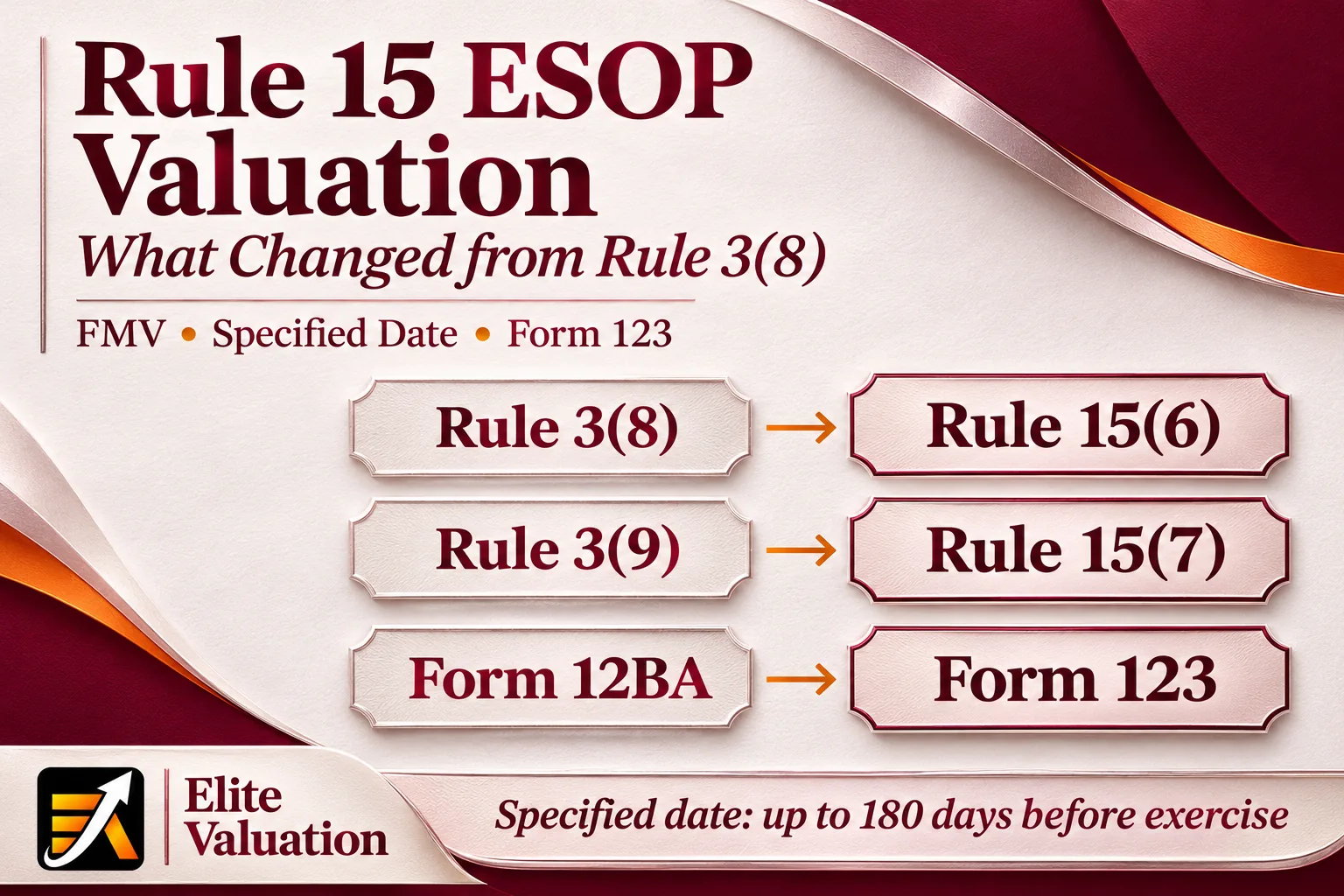
For current periods, Section 17(1)(d) of the Income-tax Act, 2025 covers employee securities, with the benefit measured under Section 17(4)(h). Rule 15 of the Income-tax Rules, 2026, effective from 1 April 2026, prescribes the share FMV. For unlisted equity shares, Rule 15(6)(d) requires a merchant banker’s determination; Rule 15(8)(g) specifies Category I SEBI registration, and Rule 15(8)(l) permits the exercise date or a specified valuation date up to 180 days earlier.
Listed and unlisted shares
For listed equity shares, Rule 15(6)(a)–(c) generally uses the exercise-date opening/closing average, selecting the highest-volume recognised exchange where applicable. If there is no trading that day, use the prescribed preceding closing-price rule. Unlisted equity uses the Category I merchant banker method on an eligible specified date; the deal price is not automatically the tax value. Registered-valuer status alone does not satisfy that merchant banker requirement.
Startup deferral and TDS
An eligible startup referred to in Section 140 may use Section 392(3), read with Section 289(3), of the Income-tax Act, 2025. Payment is due within 14 days of the earliest of: 60 months from the relevant tax year-end, sale of the shares, or cessation of employment with the allotting employer. Startup recognition alone does not establish eligibility. General salary TDS is governed by Section 392, so payroll needs the exercise and sale dates before closing.
Cash paid for options at closing
A buyer may pay the employee in cash for vested options, or for unvested options that accelerate. Such a payment is generally income for the employee, and the employer’s withholding depends on how the payment is structured and whether it is treated as salary. A payment documented as deal consideration for scheme options, and run through payroll with tax withheld, is simpler to defend than a payment made outside the scheme. Payroll teams in Pune and Delhi face the same question for any employee, wherever based.
Which Regulatory Approvals Apply to an Exit or Listing?
An exit or listing with ESOPs brings several approvals together. An unlisted company needs the scheme’s own consents, and FEMA pricing checks where a non-resident is involved. A listed company adds the SBEB Regulations, the SEBI Takeover Regulations and the rules on who may certify a Valuation.
Figure 3 maps the approvals to each event, so the checklist starts from the type of transaction. The same map serves a Bengaluru start-up preparing a sale, a Gurugram company preparing a listing and a Mumbai group that is already listed.
Approvals to check by event
Approvals, pricing and certifier checks
- Scheme amendments. Adding or changing acceleration after grant is a change to the scheme or the grant. Check the amendment clause in the scheme and whether shareholder approval is needed. For listed companies, the SBEB Regulations govern the approval route.
- FEMA. Where a non-resident buyer acquires shares, or a non-resident holds options or shares, check the NDI Rules, 2019 before cash moves. Rule 21 of those rules sets the pricing for transfers between residents and non-residents.
- Takeover. Subject to applicable exemptions, acquiring 25% or more voting rights (including persons acting in concert), or control, generally triggers an open offer under the SEBI Takeover Regulations. ESOP exercises during the offer period can affect the share base and offer-size calculation. For valuation under the relevant pricing provisions, apply the current independent registered valuer requirement; the nine-month transition for pre-amendment work was time-limited.
- Certifier. The SBEB Second Amendment Regulations, 2025 changed the definition of “valuer” to refer to Section 247 of the Companies Act, effective 2 January 2026. This applies where the regulations call for a valuer, not to every scheme/accounting valuation. The specific sweat-equity valuation transition was limited to nine months; it is not an open-ended exemption for ESOP work.
- Founder promoters. For an IPO, test Regulation 9A’s employee-benefit eligibility, including the grant date at least one year before draft offer-document filing. Check eligibility at grant and the employee’s identification as promoter or promoter-group member in that document.
How Do You Draft and Test an Acceleration Clause?
Draft the trigger, the window, the definition of good reason, the substitution route and the tax and payroll route together. Then test the clause against the one-year floor, the Ind AS 102 charge and the cash the buyer must fund at closing.
Set the floor
Confirm the grant date and the vesting dates for every grant. Mark any grant that would accelerate inside its first year.
Choose the trigger
Single, double or hybrid. For a double trigger, state the window, commonly 12 months after closing, and the share of the pool that accelerates.
Define the events
Write the change-of-control threshold, the qualifying termination, the good reason tests and the exclusions for group reorganisations.
Choose the substitution route
Decide whether the buyer assumes, replaces or cashes out each grant, and measure any modification under Ind AS 102.
Model the cash and the charge
Calculate the spread at the deal price on accelerating options, the expense still to be recognised at the event date, and the withholding or payroll cost.
Check the approvals
Confirm the scheme consents, FEMA pricing for non-residents, the takeover and SBEB rules for listed companies, and the certifier’s registration for the scheme Valuation.
Each card corresponds to a clause or a schedule in the transaction documents. If one of them cannot be answered from the scheme and the grant letters, the clause is not ready to sign, whether the deal team sits in Pune, Mumbai or elsewhere.
Want the Exit Cash and Payroll Route Settled Early?
Share the scheme, the grant register and the deal timetable. We will confirm the scope, the Valuation required and the documents we need before any fee is agreed.
Share Your Deal TimetableShare Valuation | ESOP Advisory | Deal Support
Where Do Acceleration Clauses Go Wrong? Common Mistakes and Fixes
Six errors cause most of the delays and repricing that arise when acceleration clauses are reviewed in diligence. They appear in start-up and mid-market deals across Mumbai, Bengaluru and Pune alike. Each ticket shows the cost of the error and the fix. The tickets are not ranked by legal weight.
Drafting acceleration that vests options inside the one-year floor
The clause is copied from a foreign term sheet without checking the one-year minimum under the Indian rules.
The vesting can be challenged, and buyer diligence flags the scheme as non-compliantApply the statutory minimum and any available exception to each grant. Obtain a written legal view on a compliant structure; an opinion does not itself waive the floor.
Leaving change of control undefined
The clause says “sale of the company” with no threshold, no reference to mergers and no exclusion for group restructurings.
Closing slips while the parties argue whether the trigger has fired, and the price movesDefine a voting threshold, list the qualifying transactions, exclude internal reorganisations and name the decision-maker.
Choosing single trigger without modelling the retention loss
Full single-trigger vesting is requested because it is simple to explain to the team.
The buyer pays for options that carry no retention, then renegotiates the price or the earn-outModel the spread and the retention gap, then offer double trigger with a 12-month window, or a split for senior grants.
Leaving good reason undefined
The second trigger includes resignation for good reason, but the term is never defined.
Employees claim good reason after integration, and the second trigger becomes a disputeDefine good reason with objective tests, such as a material cut in pay, role or reporting line, or a forced relocation beyond a stated distance.
Ignoring the Ind AS 102 charge at acceleration
The finance team learns of the charge after the year has closed, when the expense is already in the accounts.
A large one-time expense lands in the year of exit or listing, and the auditor queries the basisCalculate the expense still to be recognised at the event date under the applicable original-trigger, modification or cancellation requirements, record it and document the assumptions in writing.
Treating an IPO as a non-event for ESOP compliance
After listing, the company makes fresh grants under its pre-IPO scheme without the required post-IPO shareholder ratification.
Fresh grants made before ratification risk non-compliance with the SBEB RegulationsMap every scheme against ICDR Regulation 5(2) and the SBEB ratification rule, and list promoter-held options under Regulation 9A before filing.
Each error is avoidable with a file that sets out the trigger, the definition, the grant dates, the charge and the cash. A clause that can be traced from the grant letter to the accounts and the payroll is far easier to defend than one that is only described in a term sheet.
How Can Elite Valuation Help With an Acceleration Clause?
Elite Valuation is an IBBI Registered Valuer firm for Securities and Financial Assets, based in Ahmedabad with pan-India operations and founded in 2020 by Sagar Shah. Sagar is a Chartered Accountant, a Company Secretary and an IBBI Registered Valuer. He has 9 years of experience at Ernst & Young and 17 years of total experience serving MNCs, listed companies and funds across industries.
On an acceleration clause, the legal drafting sits with counsel. The Valuation, the accounting and the cash modelling are the firm’s part of the work, and they need to agree with the legal text. The table sets out the split.
| Need | What Elite Valuation delivers | Where it sits in this guide |
|---|---|---|
| ESOP scheme and grant review | Review of the scheme, grant letters and acceleration terms against Rule 12 and the SBEB Regulations, with points for counsel | Sections 2, 3 and 5 |
| Ind AS 102 charge at the event date | Grant-date fair value and the expense still to be recognised, with assumptions documented | Section 6 |
| Exit and cash-out Valuation | Share Valuation and the per-option value at the deal price, for the payroll and the price model | Sections 2, 7 and 9 |
| Pre-IPO scheme review | Check of the pre-IPO scheme, ratification steps and promoter-held options against the ICDR and SBEB requirements | Section 4 |
Where the acceleration sits inside a wider sale in Mumbai or a funding round in Gurugram, a company Valuation or a Share Valuation may also be needed. The services below cover those engagements.
Talk to Elite Valuation about your ESOP terms
- ESOP advisory: scheme design, grant terms and acceleration review
- Share Valuation: per-share value for a sale, a grant or a secondary transfer
- Company Valuation: enterprise value behind a sale, a merger or a funding round
- Contact us: share the scheme, the grant register and the deal date to get a scope in writing
What should founders and investors take from acceleration clauses?
Choose the trigger on purpose. Double trigger is the usual position in institutional deals, so founders in Bengaluru and Pune and investors in Mumbai should treat single trigger as a deliberate exception. Define the change of control and the good reason tests so that closing does not turn on an argument. Respect the one-year floor under Rule 12 and the SBEB Regulations, because a clause that breaks it can be challenged even when the deal itself is sound.
Price the charge and the cash before the term sheet is signed. The Ind AS 102 expense, the spread at the deal price and the payroll route for any cash-out all depend on the same clause. For IPO-bound companies, map promoter-held options before draft offer-document filing. After the IPO, obtain the required shareholder ratification before fresh grants under the pre-IPO scheme.
Make the Acceleration Clause Hold Up at Closing
Whether the trigger is single or double, the clause has to hold under the scheme, the rules and the accounts. Elite Valuation can review it before the term sheet is signed, or model it before the buyer’s diligence team does.
Contact Elite ValuationESOP Advisory | Ind AS 102 | Share Valuation | Listing Support
Frequently asked questions about accelerated vesting in ESOPs
What is accelerated vesting in an ESOP?
Accelerated vesting is a clause that brings forward the vesting of unvested options when a named event happens, usually a change of control, an IPO or the termination of the employee’s job. The event and its effect are set out in the ESOP scheme or the grant letter. Accelerated options still have to be exercised and paid for at the exercise price, within the exercise window. Acceleration changes the timing of vesting and of the accounting charge, but not the number of options or the exercise price.
What is the difference between single-trigger and double-trigger acceleration?
A single-trigger clause vests unvested options on the change of control alone. A double-trigger clause needs the change of control and a second event, usually a termination without cause or a resignation for good reason within a set window after closing, often 12 months. Double trigger is the usual position in institutional deals because it keeps the retention the buyer is paying for. A hybrid clause accelerates part of the unvested pool on the first trigger and the rest on the second.
Can ESOP options vest within one year of grant in India?
Generally not, except on death or permanent incapacity. Rule 12(6)(a) of the Companies (Share Capital and Debentures) Rules, 2014 requires at least one year between grant and vesting for unlisted companies. Regulation 18(1) of the SBEB Regulations, 2021 sets the same minimum for listed companies, and the merger adjustment applies in both. A change-of-control clause that could vest options in month six therefore needs a drafting answer: apply it only after the first anniversary, or identify an applicable statutory exception with counsel. A legal opinion does not itself waive the minimum.
Does accelerated vesting trigger tax for the employee in India?
Not by itself. The perquisite arises when the option is exercised and shares are allotted or transferred, measured as the fair market value on the Valuation date less the exercise price. Section 17 of the Income-tax Act, 2025 defines perquisites, and Rule 15 of the Income-tax Rules, 2026 sets the Valuation method for ESOP shares. Any cash paid for options at closing is a separate question and needs its own payroll route. For eligible startups, the separate payment deadline is within 14 days of the earliest of 60 months from the relevant tax year-end, share sale or cessation of employment with the allotting employer.
How does Ind AS 102 account for accelerated vesting?
For employee equity-settled awards, distinguish an original trigger from a later beneficial modification under paragraph 27/B43(c), or cancellation or settlement under paragraph 28. Remaining expense is accelerated when no further vesting condition remains. In the four-year full-cliff example, 1,00,000 options at ₹120 each have ₹60 lakh unrecognised after two years; that balance is recognised on acceleration under the stated assumptions. Replacement awards and any incremental value need a separate assessment.
Does an IPO automatically vest all ESOP options?
No. An IPO vests options only where the scheme or the grant letter says so. Many schemes instead align the exercise window with the IPO, so employees can exercise and sell at listing. A scheme framed before the IPO can continue after listing under the SEBI ICDR Regulations, but shareholders must ratify it after the IPO before any fresh grant is made. Under Regulation 9A of the SBEB Regulations, an employee identified as a promoter or promoter-group member in the draft offer document may continue holding or exercising qualifying benefits granted at least one year before filing, subject to their terms and applicable law.
How should a change of control be defined in an ESOP scheme?
Indian ESOP rules do not supply a change-of-control definition for acceleration, so the scheme or grant letter should define it. A workable definition sets a voting threshold, such as an acquisition of more than 50% of voting rights or the right to appoint a majority of the board. It states whether a merger or a sale of all or substantially all assets counts, excludes internal group reorganisations, and names the body that decides whether the trigger has occurred. Without those terms, the clause is open to dispute at closing.
Do listed companies have different rules for ESOP acceleration?
Yes. The SBEB Regulations apply, including minimum vesting, employee-event provisions, approvals and pre-IPO scheme conditions. The current definition of “valuer” refers to Section 247 where these regulations call for one; it does not replace every accounting or tax valuation rule. Subject to applicable exemptions, reaching 25% or more voting rights or acquiring control generally triggers an open offer. ESOP exercises can affect the relevant share base and offer-size calculation.
What does acceleration cost a buyer?
Acceleration affects the timing of employee entitlements and the buyer’s retention position. In an illustrative case, 30,000 unvested options with a spread of ₹280 each carry a value of ₹84 lakh. Single trigger vests that value at closing. Double trigger keeps the options on schedule, so an employee who stays for the remaining 12 months vests in full, and only a qualifying termination inside that window accelerates the pool. The buyer’s price model should show both outcomes before the term sheet is signed.
Which Valuation is needed for an acceleration clause?
Three Valuations usually matter, and they are not interchangeable. The first is the grant-date fair value under Ind AS 102, which sets the expense, and which is measured under that standard rather than Ind AS 113. The second is the fair market value on exercise for the employee’s perquisite. For unlisted equity shares, Rule 15(6)(d) requires a Category I SEBI-registered merchant banker’s determination on an eligible specified date; registered-valuer status alone does not replace it. The third is the deal price per share used to settle any cash-out. Each needs its own basis, documented separately.
Does a group restructuring trigger acceleration?
It should not, unless the scheme says so. A transfer of shares between group companies or an internal reorganisation usually leaves the same employer and the same ultimate control. Many clauses exclude these transactions expressly. Where they are not excluded, an employee may argue that the transaction is a change of control and seek acceleration. Define the exclusion before the reorganisation, and check whether a change to the grant letter counts as a modification for Ind AS 102 purposes.
What should a founder ask for in an acceleration term sheet?
Ask for a double-trigger clause on the unvested pool, a defined qualifying termination, a 12-month window, objective good reason tests and an assumption or replacement route for unvested options. Confirm that the acceleration respects the one-year floor, the tax and payroll route for any cash-out, and the Ind AS 102 charge and its timing under each trigger. Negotiate senior grants separately from broad-based grants, because the retention value of the two pools is different.
Sources
- Companies (Share Capital and Debentures) Rules, 2014: Rule 12 on ESOP approval, minimum vesting and employee events.
- SEBI SBEB and Sweat Equity Regulations, 2021: Regulations 9A, 11, 12 and 18 and the current valuer definition.
- ICAI: Ind AS 102, Share-based Payment, including modifications, cancellation and settlement.
- Income-tax Act, 2025, as amended in 2026: employee securities, salary withholding and eligible startup deferral.
- Notified Income-tax Rules, 2026: Rule 15 on listed and unlisted share FMV and specified valuation dates.

Disclaimer. This article is general information only. It is not legal, tax, accounting or investment advice, and it is not a Valuation of any company, grant or security. The figures are hypothetical. Treatment depends on the applicable law, scheme and transaction terms, award conditions and individual circumstances. Obtain advice from a qualified professional for your situation.