Tata Steel has agreed to buy a 26.38% stake in APL Apollo Tubes from its promoter group at ₹2,100 per share, about ₹15,510 crore. Because that crosses 25%, the takeover rules require a mandatory open offer for up to 26% more at ₹2,301.40 per share, a maximum of about ₹16,756 crore. Alongside, APL Apollo is to take over Tata Steel's steel tubes division and its Tata Steel Colors subsidiary for about ₹28,000 crore, which reporting says it will initially fund through acquisition financing.
The two halves of the deal are linked. Tata Steel is buying control of a listed company to which it is also selling part of its own downstream business. The transactions were disclosed in two stages, on Sunday and Monday, 22 and 23 November 2026, and the market reacted sharply. The Week reports APL Apollo shares fell 17.7% after the announcement, while Tata Steel fell 7.82%. Financial Express reporting, republished by INDIA IPO, puts the combined loss in market value at ₹30,707 crore in one session. The reaction suggests investors do not yet accept that the price of control is justified by the businesses being combined.
A control deal is priced once, but its risks stay on the balance sheet for years. The open offer price tells you what the takeover rules require the buyer to pay. It does not tell you what the business is worth to the shareholders who stay behind.
When debt moves from one balance sheet to another, the useful question is not whether the assets changed hands. It is who carries the leverage, and whether the earnings of the business that carries it can service it.
Tata Steel's Downstream Strategy Shift
The industrial logic is simple on paper. Before the deal, Tata Steel's tubes and coated-product operations had about 2.5 million tonnes of annual capacity, against APL Apollo's 5 million tonnes, according to The Week. The combined capacity would be about 7.5 million tonnes after the transaction. The merged business is targeted at 15.5 million tonnes by 2035, split roughly into 9 million tonnes of steel pipes and 6.5 million tonnes of colour-coated products, per the GMK Center report.
The tubes division has plants at Jamshedpur, Hosur, Khopoli and Sahibabad. Tata Steel Colors is a Pune-based company whose entire shareholding is being sold. Together, those two businesses form the value-added end of Tata Steel's India downstream chain, and they are the parts being moved.
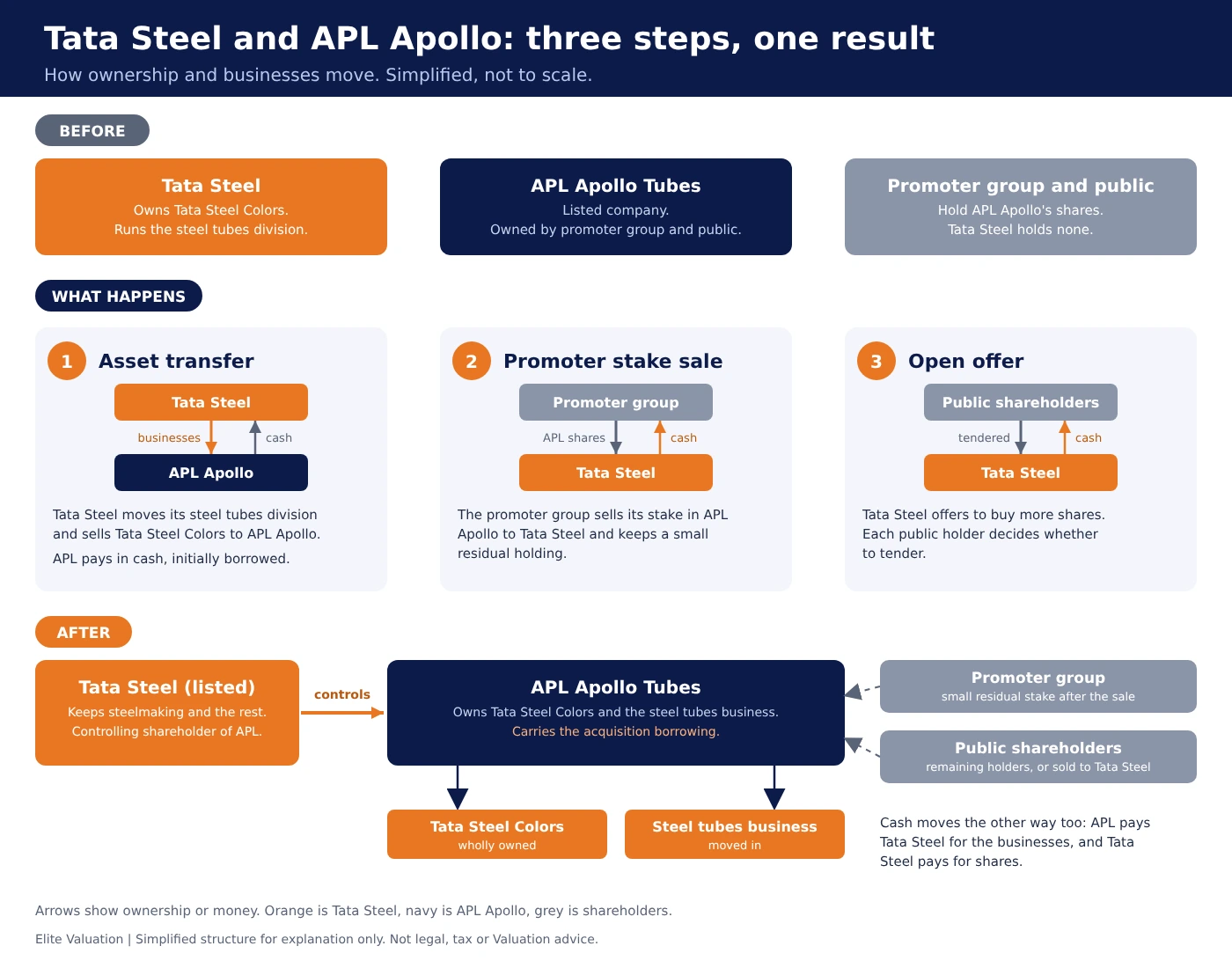
The structure before and after the deal, simplified for explanation and not to scale. The three numbered steps are the asset transfer, the promoter stake sale and the open offer.
The Numbers Behind the Structure
| Component | Buyer and seller | Amount (₹ crore) | Price basis |
|---|---|---|---|
| Stake purchase: 7.39 crore shares (26.38% of expanded capital) | Tata Steel from S Gupta Holding Private Limited, part of the promoter group | 15,510 | ₹2,100 per share |
| Mandatory open offer: up to 7.28 crore shares (26%) | Tata Steel from public shareholders | Up to 16,756 | ₹2,301.40 per share |
| Steel tubes division (Jamshedpur, Hosur, Khopoli, Sahibabad) | APL Apollo from Tata Steel | 11,700 | No separate basis in reports |
| Tata Steel Colors, 100% (86.6 million shares) | APL Apollo from Tata Steel | 16,300 | No separate basis in reports |
| Gross flow if the open offer is fully taken up | Sum of the four components | About 60,266 | Our calculation |
Sources: Genvest (open offer shares and price, Tata Steel Colors); Equitypandit (stake and asset split); IIFL (tubes and Colors split).
Two readings of the headline number need separating. Some wire-based summaries describe a total of "INR 280 billion (about $3.02 billion)". That figure matches the ₹28,000 crore asset consideration, not the whole structure. Quoting ₹28,000 crore as the deal size describes only one leg. Adding the share purchases gives gross flows of about ₹60,266 crore if the open offer is fully taken up.
The second point matters more for Tata Steel. The ₹28,000 crore comes back to it as sale proceeds, so its own net outlay is far smaller than its gross payments, as the balance sheet section below shows.
What the Open Offer Prices, and What It Does Not
The open offer is priced 9.6% above the promoter's ₹2,100 per share. It is about 38% above APL Apollo's ₹1,670 close on 24 November, and about 60% above the ₹1,438.40 quoted on the morning of 25 November, according to Business Upturn. Those spreads reflect the rules more than a fresh view of value. Under the SEBI (Substantial Acquisition of Shares and Takeovers) Regulations, 2011, the offer price is generally the highest of several benchmarks, which can include the negotiated price and recent trading averages. It can therefore sit well above the market price. The spread is partly a view on whether the offer completes at that price and on what the combined business will earn. It is not an independent measure of value.
| Price basis | Price (₹ per share) | Equity value (₹ crore) | P/E on FY26 earnings per share | EV/EBITDA on FY26 EBITDA |
|---|---|---|---|---|
| Promoter sale price | 2,100.00 | 58,805 | 48.9x | 31.8x |
| Open offer price | 2,301.40 | 64,445 | 53.6x | 34.9x |
| Close, 24 November 2026 | 1,670.00 | 46,764 | 38.9x | 25.1x |
Our calculations. Equity value uses about 28.0 crore shares, the count implied by the open offer. EV deducts net cash of about ₹1,530 crore at March 2026. FY26 is the latest full year, and the multiples exclude the businesses being transferred, whose earnings have not been disclosed.
APL Apollo's FY26 record is strong on its own terms. Revenue reached ₹23,079 crore, and EBITDA and net profit rose 50% and 59% on 3.49 million tonnes sold. The September quarter showed revenue of ₹7,002 crore and net profit of ₹382 crore, up about 27% year on year. Management has guided to 20% to 25% EBITDA growth for FY27, according to a summary of its earnings call. Even so, at the open offer price the company would trade at about 35 times FY26 EBITDA, against about 25 times at the 24 November close.
Capacity cross-checks point the same way. On the reported capacities, the tubes division's price works out to about ₹68,800 per tonne of annual capacity and Tata Steel Colors to about ₹2,03,750 per tonne. APL Apollo's own enterprise value at the 24 November close is about ₹90,500 per tonne. Capacity is a blunt measure, because utilisation and product mix drive earnings. The split of Tata Steel's 2.5 million tonnes between the two businesses comes from a single secondary source, so treat this as directional.
Where the Debt Lands
The market reaction is easiest to understand through the balance sheet. Reporting says APL Apollo will fund the acquisition initially through acquisition financing, to be replaced by longer-term capital later. Management has acknowledged that the deal needs "significant debt and equity funding" and that financing costs will dilute earnings per share in the near term. The table below treats the ₹28,000 crore as fully debt-funded, purely for illustration.
| Measure | Illustrative value | Basis |
|---|---|---|
| APL Apollo net cash, March 2026 | About ₹1,530 crore | Reported balance sheet |
| Acquisition debt if fully debt-funded | ₹28,000 crore | Reported asset consideration |
| Pro forma net debt, before any acquired earnings | About ₹26,470 crore | Our calculation |
| Net debt to FY26 standalone EBITDA | 14.7x | Our calculation |
| Annual interest at an assumed 9% cost of debt | About ₹2,520 crore | Assumed rate, not a quoted rate |
| Net debt to EBITDA if the ₹10,000 crore target is met with no change in debt | About 2.6x | Management target as reported, timeframe not stated |
The arithmetic leaves little room. At an assumed 9% cost of debt, interest alone would be about 1.4 times FY26 EBITDA. For net leverage to fall to 3x, combined EBITDA would need to reach about ₹8,800 crore, which means about ₹7,000 crore must come from the transferred businesses. None of the reports reviewed discloses their earnings. That is the central gap in the public information, and it is the number a valuer would need before forming any view on price.
Tata Steel's Side: Gross Outlay Against Liquidity
Tata Steel's group net debt rose to ₹91,423 crore at 30 September 2026, from ₹80,144 crore at FY26, even as its profit for the September quarter climbed 16.2% to ₹3,699 crore. The group reported liquidity of ₹40,076 crore and net debt of about 2.4 times EBITDA, per Investywise.
On full take-up, Tata Steel's gross payments of ₹32,266 crore would absorb about 80% of that liquidity. The ₹28,000 crore asset consideration offsets most of it, leaving a net outlay of about ₹4,266 crore. If the one-in-three acceptance estimate reported by Financial Express holds, applied to public holdings of about 19.9 crore shares, the open offer cash need falls to about ₹15,260 crore, and the net outlay to about ₹2,770 crore.
The offset is not a deleveraging at group level. Once APL Apollo is consolidated, the borrowing that funds its ₹28,000 crore payment becomes group debt. The sale moves debt into APL Apollo; it does not remove it. Tata Steel's leverage will therefore depend on how much APL Apollo borrows and how fast its earnings grow, which is why the stakeholder view below covers both companies.
Reconciling the Reported Figures
Reports disagree on several figures. We have used the version the share arithmetic supports, and flagged the rest.
| Item | What reports say | How this piece treats it |
|---|---|---|
| Stake size | 26.38% (Financial Express, Genvest, Equitypandit); 26.4% (Bloomberg, via GMK Center); 26.6% (The Week) | We use 26.38%. The 7.39 crore shares of S Gupta Holding at ₹2,100 give ₹15,510 crore, which is 26.38% of the expanded share base. On the current base the same shares are 26.6%. |
| Headline deal value | ₹28,000 crore (Indian reports); "INR 280 billion (about $3.02 billion)" in wire-based summaries | Treated as the asset consideration only. Gross flows including the share purchases are about ₹60,266 crore. |
| Stake value in dollars | $1.67 billion (The Week); $1.7 billion (Bloomberg, via GMK Center) | Consistent with ₹15,510 crore at about ₹93 per dollar. |
| APL Apollo share price fall | 17.7% (The Week); more than 21% (Financial Express) | Both shown. The measurement windows differ and the reports do not reconcile them. |
| Promoter residual stake | About 4.5% (Financial Express) | The March 2026 shareholding data puts the promoter group at 28.25%, which implies a residual of about 1.7% after the sale. Confirm against the takeover disclosure before relying on either figure. |
| Completion timing | Within FY2027 (The Week); by 31 March 2028 (GMK Center) | Unresolved. Take the date from the filings. |
| APL Apollo net cash, FY26 | ₹1,510 crore (Quartr); ₹1,530 crore (Investywise, Taxguru) | We use ₹1,530 crore. The difference does not change any multiple in this piece materially. |
| Tata Steel net debt, FY26 | ₹80,144 crore (The Week, Multibagg); ₹82,324 crore (a secondary blog) | We use ₹80,144 crore. |
Why This Matters
- Control is set by tenders, not by the signing. Tata Steel's stake sits at 26.38% on signing and could reach about 52.38% if the full open offer is taken up. The consolidation outcome depends on shareholders who have not yet decided.
- Asset sales move debt rather than retire it. The ₹28,000 crore flowing to Tata Steel is funded by APL Apollo. Once consolidated, that borrowing sits inside the group, so the transaction does not reduce group leverage on its own.
- The open offer price is a regulatory outcome, not a fair value. The ₹2,301.40 figure comes from the takeover framework. Testing what the acquired businesses and APL Apollo are worth needs earnings and net asset data that are not yet public. Pricing and fairness questions of this kind sit within our M&A advisory work.
- Minority shareholders hold the decisive vote. As Financial Express reports, management has said the promoter's share sale will proceed whether or not shareholders approve the business transfer. Tata Steel's chief executive has conceded that minority holders see the terms as unbalanced, partly because of the debt APL Apollo will carry, and has indicated the terms may be revised. The vote on the ₹28,000 crore transfer, not the open offer, is where minority terms can change.
Caveat: None of the reports reviewed discloses the EBITDA, profit or net assets of the tubes and Colors businesses. Every multiple in this piece is calculated on APL Apollo's standalone FY26 numbers. It shows how the price relates to the listed company today, not what the businesses being transferred will earn.
When Consolidation Works, and When It Doesn't
| Works when | Breaks down when |
|---|---|
| The acquired businesses have disclosed earnings that support the debt they bring | Their earnings are unknown and the buyer's leverage rises before they are proven |
| Minority holders see a fair price, and an independent committee gives a reasoned recommendation | The promoter exit is priced above market while the minority's terms are settled separately |
| Acquisition debt is refinanced with long-term capital, so leverage peaks and then falls | Acquisition debt stays in place and interest costs exceed the earnings that service it |
| Operating gains such as scale, product mix and procurement are quantified and tracked against a timetable | Synergies are described in the announcement but not measured |
| Related party dealings are approved by disinterested shareholders on full disclosure | The seller of the assets becomes the buyer's largest shareholder, with influence over it |
| Integration, people and supplier plans are settled before closing | Transferring teams, ESOP terms and supply contracts are left until after completion |
The Frameworks That Set the Terms
Three sets of rules will shape the outcome. Under the SEBI takeover regulations, crossing 25% triggers the open offer, and the target company's independent directors must issue a reasoned recommendation before tendering opens. The board has 11 directors, six of them independent, so the committee that will recommend on the offer carries real weight. Under the Companies Act, 2013, the transfer of an undertaking may require a special resolution of Tata Steel's shareholders, depending on the thresholds. A transaction between APL Apollo and a holder of about 26% may also be a related party transaction under Section 188 and the SEBI Listing Obligations and Disclosure Requirements, which would bring the disinterested shareholders' vote into play. Competition clearance from the Competition Commission of India is likely, and the companies have described approvals as expected in the coming months.
On the accounting side, Ind AS 110 will determine when control passes, and Ind AS 103 will then govern the purchase price allocation for the businesses acquired. Our purchase price allocation and Ind AS Valuation work covers that process in detail.
Our Take on the Stakeholders
Our view, drawn from the reported terms and the arithmetic above, is that the cash risk for Tata Steel is manageable. The leverage and strategic risk falls on APL Apollo's continuing shareholders and lenders, and on Tata Steel's shareholders through consolidation. The tables below set out where each group gains and where it carries the cost.
Tata Steel
| Stakeholder | What they gain | What they carry | Our take |
|---|---|---|---|
| Shareholders | Control of a larger downstream platform with a 15.5 million tonne target for 2035 | A net outlay of roughly ₹2,800 crore to ₹4,300 crore, consolidation of APL Apollo's debt, and a share price that fell by about 8% to 9% on announcement | The cash exposure is modest for a group of this scale. The real risk is strategic. The investment case shifts from a steel producer to the owner of a leveraged pipes and coated-products business, and the market will want earnings evidence before it credits the plan. |
| Lenders and rating agencies | Inflows of up to ₹28,000 crore that reduce standalone gross debt | Consolidation of APL Apollo's acquisition debt on a group net debt base already at ₹91,423 crore | Expect scrutiny of how far APL Apollo's borrowing is ring-fenced, and whether group leverage rises before it falls. |
| Employees in the transferred divisions | Continuity of work if roles transfer intact at Jamshedpur, Hosur, Khopoli and Sahibabad, and at Tata Steel Colors in Pune | For tubes division staff, a change of employer with service terms, retirement benefits and any retrenchment obligations to settle. For Colors staff, a change of owner with the employer unchanged. | This is the least disclosed stakeholder group. Transfer terms should be public before the minority vote. |
| Management and the Tata group | Strategic control of value-added steel, and a route to the 2035 capacity target | Integration risk, and the reputational cost of a deal that minority holders see as unbalanced | The chief executive has already signalled flexibility on terms. Whether the group uses it will shape how the market reads the rest of the plan. |
| Customers and channel partners | Continuity of supply under the new owner | Brand and channel changes as products move to a new owner | Low financial risk, but dealer and customer continuity should be communicated early. |
APL Apollo
| Stakeholder | What they gain | What they carry | Our take |
|---|---|---|---|
| Public minority shareholders, about 72% of shares | An exit at ₹2,301.40 for up to 26%, about 38% above the 24 November close | Leverage on the shares they keep, and a vote on the ₹28,000 crore transfer that will shape the terms | This is the most important group in the deal. Foreign institutional investors (37.5%) and mutual funds (11.9%), per March 2026 shareholding data, can shape the transfer vote. Their stance will matter more than the headline offer price. |
| Retail shareholders, about 18% | The same exit route as institutions | Less information and limited ability to shape terms individually | Read the independent committee's recommendation and the offer timetable before tendering. Do not decide on the spread alone. |
| Promoter family | About ₹15,510 crore at ₹2,100 per share, above the market price | Governance questions, a residual stake that is reported inconsistently, and an exit from the chief executive role | The price is above market, and the promoter says a higher open offer price was negotiated for minority holders. The sharper concern is that a selling promoter is co-signing a company-level transaction, and that the transfer does not depend on minority approval. The independent directors should test that directly. |
| Lenders to APL Apollo | Fees and a multi-year relationship on up to ₹28,000 crore of financing | Leverage that moves from net cash of about ₹1,530 crore to net debt of about ₹26,470 crore before acquired earnings | Financing terms will set the economic cost of the deal more than the headline price. |
| Employees and ESOP holders | Retention value if integration and leadership succession are handled well | Change-of-control terms in the ESOP plans, and the transition as the promoter steps back | Review the change-of-control clauses now. Acceleration or modification can change the Ind AS 102 accounting, and this is where our ESOP Valuation work comes in. |
| Suppliers and dealers | Stable supply and distribution contracts, if they carry over | A change in sourcing decisions under a steel producer's influence | APL Apollo's plants have sourced coils from JSW Steel for close to twenty years, according to the same report. Coil sourcing and contract continuity should be watched closely. |
| Promoter-linked contract manufacturers | Contract volumes for new colour-coated capacity, if the reported terms hold | Related party scrutiny | One secondary report says part of the new colour-coated capacity will come from contract manufacturing by promoter-linked entities. If confirmed, pricing should be disclosed as arm's length. |
Overall, the deal is coherent on strategy. It concentrates downstream capacity, gives APL Apollo the scale to pursue its 15.5 million tonne plan, and gives Tata Steel control of a listed vehicle for those assets. The cost of that coherence falls on APL Apollo's continuing shareholders and lenders, because the debt sits on their company and the earnings that would service it have not been disclosed. The most useful step either side can take before the vote is to publish the earnings of the transferred businesses.
Six Questions Before You Tender or Vote
- What EBITDA, profit and net assets sit in the tubes and Colors businesses, and where are they disclosed?
- Does the independent committee's recommendation test value, or only the offer price against the regulatory benchmark?
- What are APL Apollo's pro forma net debt and interest cover once the ₹28,000 crore is funded?
- Is the business transfer a related party transaction, and how will the disinterested shareholders' vote be counted?
- What control and free float result if tenders come in near the one-in-three estimate?
- How do the change-of-control terms in APL Apollo's ESOP plans affect option holders and their accounting under Ind AS 102?
Sources and Further Reading
- The Week, 23 November 2026: deal terms, capacity and share price moves
- GMK Center: transaction structure and 2035 capacity target
- Business Standard: Tata Steel's response to stakeholder concerns
- BusinessToday: possible revision of terms after shareholder feedback
- Financial Express, republished by INDIA IPO: minority concerns, open offer acceptance estimate, analyst ratings
- Business Upturn: share prices and open offer spread on 25 November
- Genvest: open offer share count and consideration
- Sovrenn: APL Apollo results for the September 2026 quarter
- Free Press Journal: APL Apollo FY26 revenue
- The Week, 7 November 2026: Tata Steel September quarter results and net debt
- Marketsmojo: APL Apollo shareholding pattern, March 2026
- SEBI: takeover and listing regulations
- Ministry of Corporate Affairs: Companies Act, 2013
The takeaway. The headline numbers describe a control purchase and an asset swap. The numbers that matter most to a valuer are the ones not yet disclosed: the earnings and net assets of the businesses changing hands, and the debt that will sit beside them. Until those appear in the filings, the open offer price is a regulatory reference point, not evidence of value.
For shareholders on both sides, the test is simple to state and hard to meet. Does the combined business earn enough, after financing, to justify the price each group is being asked to accept?
Planning a control transaction or open offer?
Elite Valuation provides independent Valuation reports and structuring support for fairness opinions, purchase price allocation and open offer price reviews, under the Companies Act, 2013, SEBI takeover regulations and Ind AS 103 and 110.

CA Sagar Shah, Founder
Mr Sagar Shah is the Founder of Elite Valuation and leads the firm’s Valuation and Advisory practice. With over 15+ years of professional experience.