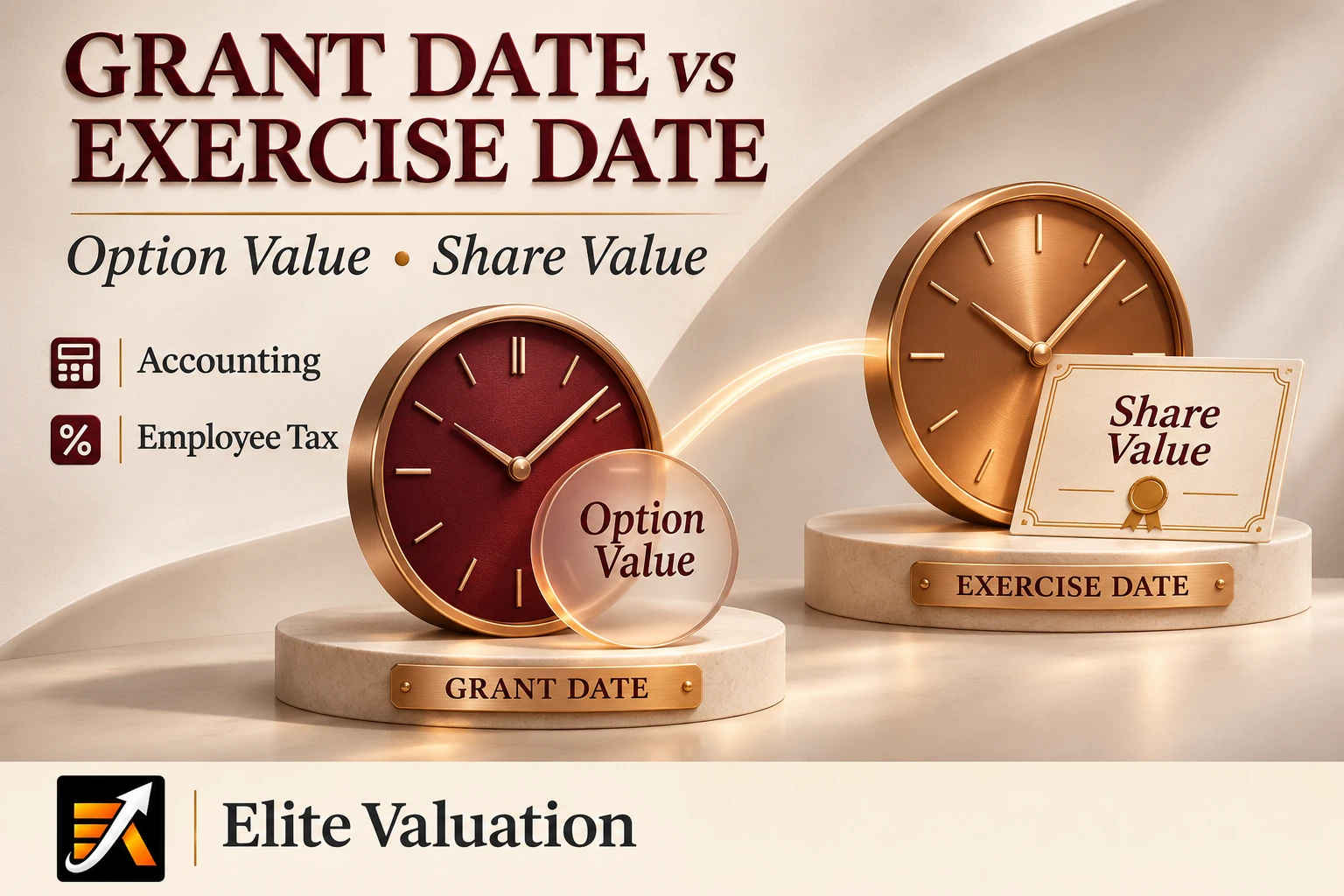
Most companies with an ESOP scheme need two Valuations, not one. Treating them as the same report causes problems in audit, in tax assessment and in funding due diligence.
The grant-date Valuation measures the fair value of each option at grant and drives the Ind AS 102 expense for equity-settled awards. The exercise-related Valuation determines the underlying share’s fair market value for the employee perquisite under the tax rules. They measure different things, for different purposes and dates; for unlisted equity, check the required merchant banker determination and the provider’s regulatory eligibility.
Key takeaways
- Grant-date Valuation values the option. Exercise-date Valuation values the share.
- The grant date drives the Ind AS 102 expense. The exercise date drives the perquisite and the TDS.
- For unlisted equity shares, Rule 15(6)(d) of the Income-tax Rules, 2026 requires a Category I merchant banker’s determination. Check the provider’s valuer registration in light of SEBI’s 16 November 2026 informal guidance.
- Rule 15(8)(l) permits a specified date on exercise or up to 180 days earlier. Confirm that the determination covers the relevant exercises.
Quick Comparison Table
The table sets out the differences that matter for accounting, tax and certification. The same distinctions apply to companies in Ahmedabad, Noida, Gurugram, Delhi and Pune.
| Feature | Grant-date Valuation | Exercise-date Valuation |
|---|---|---|
| Purpose | Ind AS 102 expense and disclosure | Perquisite tax and TDS on exercise |
| Timing | The grant date | The exercise date or a specified date no more than 180 days earlier under Rule 15(8)(l), Income-tax Rules, 2026 |
| What is valued | Fair value of one option | Fair market value of one share |
| Typical method | Option-pricing model (Black-Scholes or binomial) on an equity value | Merchant banker’s Valuation of the share on the specified date |
| Who certifies (unlisted) | Often an IBBI Registered Valuer | Category I merchant banker under Rule 15(6)(d); check regulatory eligibility and valuer registration |
| Recurs | Each grant date | As required to cover the exercises, applying the permitted specified-date window |
| Can one report serve both? | No | No |
A company in Pune that grants options in April and sees exercises in October has two events, even if the share price has not moved between them.
What Is Grant-Date Valuation?
The grant-date Valuation sets the fair value of each option on the date the company and the employee agree its terms, with any required approvals obtained. Ind AS 102 measures equity-settled awards at that grant-date fair value and recognises the expense over the vesting period. The figure is fixed at grant, so later movements in the share price do not restate it.
What is valued is the option, not the share. The equity value of the ordinary shares is set first, using a DCF or a comparable method. The option is then priced with Black-Scholes or a binomial model. Where preference shares rank ahead of the ordinary shares, that equity value must reflect them. The same steps apply to a company in Ahmedabad or Pune.
Many companies engage an IBBI Registered Valuer for this report. The reviewed text of Rule 12 of the Companies (Share Capital and Debentures) Rules, 2014 does not expressly require one for unlisted grants, so the choice rests on what the company’s auditor expects. The report supports the expense, the disclosures and the reasonableness of the exercise price the board sets. For what this work costs and what drives the fee, see our ESOP Valuation cost guide.
What Is Exercise-Date Valuation?
The exercise-related Valuation determines the underlying share’s fair market value for the employee’s perquisite. For tax years governed by the Income-tax Act, 2025, Section 17(1)(d) and Section 17(4)(h) provide for the taxable benefit based on the applicable fair market value less the amount paid by the employee. The historical provision was Section 17(2)(vi) of the Income-tax Act, 1961. Apply the legislation governing the relevant tax year.
For unlisted equity shares, Rule 15(6)(d), read with Rule 15(8)(g) of the Income-tax Rules, 2026, requires a Category I merchant banker’s determination. Rule 15(8)(l) permits a specified date on exercise or no more than 180 days earlier. For listed equity, Rule 15(6) uses the relevant exchange’s opening and closing prices, with provisions for multiple exchanges and non-trading dates. Apply the specific case rather than assuming one method fits every share.
The exercise value moves with the share, not with the option model. A funding round, a milestone or a change in the cap table can lift the share value between grant and exercise. That raises the perquisite but leaves the grant expense unchanged. Companies in Delhi and Gurugram that approve exercises after a round should expect this gap.
SEBI’s informal guidance of 16 November 2026 to Navigant Corporate Advisors states that merchant bankers undertaking valuation activity must obtain registration from the relevant regulatory authority, including valuer registration under Section 247. It is fact-specific departmental guidance, not a Board decision, and does not amend the separate income-tax valuation rule. Check the provider’s eligibility under both regimes before opening the exercise window.
Why You Cannot Use One Report for Both
The two reports answer different questions, on different dates, for different reviewers. An auditor tests the grant report against the Ind AS 102 inputs. An assessing officer tests the exercise certificate against the perquisite rule, its date and its certifier. A single document rarely satisfies both, whether the company is in Noida, Pune or any other city.
Illustration with hypothetical numbers (not a Valuation):
| Item | Hypothetical figure | What it measures |
|---|---|---|
| Exercise price per option | ₹100 | Price paid by the employee |
| Grant-date fair value per option | ₹120 | Option value, which drives the Ind AS 102 expense over vesting |
| Exercise-date fair market value per share | ₹400 | Share value, which drives the perquisite |
| Perquisite per share (₹400 less ₹100) | ₹300 | Taxed as salary, with TDS deducted by the employer |
Using the ₹120 option value for tax would understate the perquisite. Using the ₹400 share value for the accounting expense would mix a share value with an option measure. The two figures answer different questions.
Timing and Practical Workflow
Prepare grant-date workings in advance and finalise the measurement for the actual grant date. Plan exercise-related determinations before exercises occur, with a specified date inside the permitted window. Three grant dates and two exercise windows represent five events to plan for; they do not automatically require five separate report commissions. The required tax determinations depend on the exercises, documented scope and specified-date coverage.
- Prepare the grant-date workings before the approval meeting, then finalise the measurement for the actual grant date, with the input date and underlying share value recorded.
- Check or arrange the merchant banker determination covering each exercise window, and test its specified date against the permitted 180-day period.
- Where exercises fall outside one certificate’s window, commission a new certificate rather than stretch the old one.
- Reconcile the grant count, the fair value per option and the expense schedule once a year, against the reviewed accounts.
- Keep both reports, the certifiers’ registrations and the board resolutions in one file.
Companies in Noida and Pune with several exercise windows should map each window to the board calendar, so that no exercise runs without a current certificate.
Impact on Accounting and Employee Tax
The grant-date fair value drives the Ind AS 102 expense, which the company recognises over the vesting period and adjusts for awards expected to vest. For equity-settled awards, the fair value per option is not remeasured after grant.
The exercise-related share value drives the perquisite. For tax years governed by the Income-tax Act, 2025, salary withholding is addressed in Section 392. The employer reports the perquisite particulars in Form 123 where applicable under Rule 204(2)(b) of the Income-tax Rules, 2026. For earlier periods, the corresponding references were Section 192 and Form 12BA.
For an eligible startup referred to in Section 140, Section 392(3) of the Income-tax Act, 2025 links ESOP-related withholding to the deadline in Section 289(3). The deadline is within 14 days of the earliest of: expiry of 60 months from the end of the relevant tax year, sale of the security or share, or cessation of employment with the allotting employer. This is a timing benefit, not a tax exemption, and it does not apply to every startup. Check eligibility and the governing tax year before relying on it.
The two Valuations meet at the share value. A rising share price between grant and exercise increases the perquisite and leaves the expense unchanged. Track both in one assumptions table, so the reason for the gap is on file.
Common Confusions (and How to Avoid Them)
Five confusions tend to cause the errors in this area, whether the company is in Ahmedabad, Noida, Gurugram, Delhi or Pune. Each card gives the fix.
Assuming last year’s Valuation still covers this exercise
The exercise is taxed on a value that may sit outside the permitted window, so the perquisite is open to challenge.
Check that the merchant banker’s determination covers the exercise and has a specified date on exercise or no more than 180 days earlier. Obtain a fresh determination where the existing coverage does not apply.
Assuming the chartered accountant’s certificate is enough
The certifier may not be the professional the Income-tax Rules name for unlisted exercise values, so TDS and the perquisite can be challenged.
Confirm in writing who certifies the exercise-date value, and check that person’s registration before the window opens.
Treating a fixed exercise price as a fixed tax value
The perquisite is the exercise-date value less the price paid, so a higher share value raises the tax without anyone reviewing it.
Compute the perquisite from the exercise-date fair market value on every exercise, not from the scheme price.
Using the grant-date fair value for perquisite tax
An option measure becomes the tax base, so the TDS is computed on the wrong figure and the employer faces a correction.
Use the grant-date fair value only for Ind AS 102, and the exercise-date fair market value only for the perquisite.
Covering the whole scheme with one scheme-level report
A scheme-level option report does not by itself supply the exercise-related share determination or establish coverage of the permitted specified dates.
Map each grant date and exercise window to a named deliverable on the scheme calendar.
For the wider list of errors, including stale reports and Black-Scholes inputs, read our guide to common ESOP Valuation mistakes in India.
Frequently Asked Questions
These answers apply to companies in Ahmedabad, Noida, Gurugram, Delhi and Pune alike. Apply the requirements to the relevant grant, exercise, tax year and company circumstances.
Do I need both Valuations every year?
Not always. Grant-date option fair value is measured for each grant date, so a year with no new grants may need no new grant measurement. Exercise-related tax determinations must cover the exercises and permitted specified dates; several windows may fall within one determination’s coverage. A year with both events needs support for both purposes, plus a reconciliation of grant counts, option fair values and the expense schedule.
Can grant-date fair value be used for exercise?
No. Grant-date fair value measures an option, while the perquisite uses the underlying share’s fair market value under the tax rules. For unlisted equity, Rule 15 permits a merchant banker’s specified date on exercise or up to 180 days earlier. That permitted date window does not turn a grant-date option value into an exercise-related share value.
What if employees exercise in different months?
Check each exercise against the specified date and scope of the merchant banker’s determination. Under Rule 15(8)(l), the specified date may be the exercise date or no more than 180 days earlier. Obtain a fresh determination when the existing coverage does not apply. Where the scheme allows, grouping exercises can simplify administration without changing the valuation requirement.
How long is each report valid?
A grant-date measurement relates to its grant date. New grants need current inputs; an existing equity-settled award is not remeasured merely because the share price later changes. For unlisted-equity perquisite purposes, the merchant banker’s specified date may be on exercise or no more than 180 days earlier under Rule 15(8)(l). Check the determination’s documented coverage, not a general scheme-level validity period.
Does Ind AS 102 require a specific professional?
Ind AS 102 requires a fair value at grant date and does not name the professional who prepares it. The company can prepare the figure, but auditors often ask for independent evidence, and many companies engage an IBBI Registered Valuer for it. Ask the auditor which evidence it expects before the grant is approved.
Why can the exercise-date value differ from the grant-date value?
The share value can move between grant and exercise, for example after a funding round or a change in outlook. The grant-date fair value is not remeasured, so the expense does not change for share price moves, but the perquisite follows the share value at exercise. Record the reason for the difference in the reconciliation, so the auditor and the assessing officer see the same explanation.
Can the same firm prepare both reports?
Yes, where each assignment is carried out and signed by a professional with the required registrations and scope. Many companies engage an IBBI Registered Valuer for grant-date accounting support. For unlisted-equity perquisite value, Rule 15 requires the Category I merchant banker determination; SEBI’s November 2026 informal guidance also addresses the provider’s valuer registration under Section 247. Confirm eligibility before engaging one firm for both purposes.
Can an eligible startup defer the perquisite tax?
An eligible startup referred to in Section 140 may use Section 392(3), read with Section 289(3), of the Income-tax Act, 2025. The relevant deadline is within 14 days of the earliest of: 60 months from the end of the relevant tax year, sale of the security or share, or cessation of employment with the allotting employer. This defers timing rather than exempting the perquisite. Check eligibility and the law governing the relevant tax year; earlier periods have their own provisions.
Which form reports the perquisite to the employee?
For the current rules, Form 123 is the statement of perquisite and related particulars prescribed by Rule 204(2)(b) of the Income-tax Rules, 2026, where applicable. The earlier 1962 Rules used Form 12BA. Use the form for the relevant period and reconcile its perquisite figures and specified valuation dates with payroll records.
Who certifies each report?
Many companies engage an IBBI Registered Valuer for the grant-date report. The reviewed text of Rule 12 of the Companies (Share Capital and Debentures) Rules, 2014 does not expressly require one for unlisted grants. For unlisted shares, the exercise-date fair market value is determined by a Category I merchant banker under the Income-tax Rules, subject to SEBI’s guidance of 16 November 2026. Ask each certifier for its registration number before engagement, and check it on the public register.
Summary: two Valuations, two events
The grant-date Valuation drives the accounting expense, and the exercise-date Valuation drives the employee’s perquisite and TDS. Keep them as separate reports, with their applicable valuation dates and a reconciliation of date-specific inputs. Whether the company is in Ahmedabad, Noida, Gurugram, Delhi or Pune, appoint each certifier before the grant is approved or the exercise window opens.
Coordinate Your Grant and Exercise Valuations
Send us the grant dates, exercise windows and cap table. Elite Valuation will map the grant-date report and each exercise window, and confirm the certifier for each in writing.
Talk to Elite ValuationESOP Valuation | Ind AS 102 Expense Workings | ESOP Advisory
Related guides
Sources
- Income-tax Act, 2025, as amended by Finance Act 2026: perquisites, salary withholding and eligible-startup deferral.
- Income-tax Rules, 2026: Rule 15 valuation, Rule 204 and Form 123.
- SEBI informal guidance to Navigant Corporate Advisors, 16 November 2026: merchant banker valuation activity and valuer registration.
- Ind AS 102, Share-based Payment: ICAI compendium of Indian Accounting Standards.
- Ministry of Corporate Affairs: Companies Act and Share Capital and Debentures Rules, including Rule 12.

Disclaimer. This article provides general information, not legal, tax, accounting or investment advice, and is not a Valuation of a company, option or share. The illustration uses hypothetical figures. Requirements depend on the scheme, relevant date and applicable framework. Obtain advice appropriate to your circumstances.