An ESOP Valuation in India typically costs between ₹40,000 and ₹2,00,000 or more. The fee depends less on the headline and more on the scope: how many grant dates the scheme will use, whether the exercise-date tax certificate is included, and how complex the cap table is. Fix the purpose before you ask for a quote, and most surprises disappear.
Key takeaways
- Most schemes need two Valuations: a grant-date Valuation for accounting and company law, and an exercise-date Valuation for the perquisite tax on each exercise.
- Company stage, cap table complexity, the number of grants and the methods used set most of the fee.
- For unlisted shares, the exercise-date fair market value must come from a Category I merchant banker, so a grant-date report cannot be reused for it.
- Ask every provider to state in writing whether the merchant banker certificate is included.
- A low quote saves little if the report fails the statutory audit or a tax review.
This guide is for founders deciding when to launch an employee stock option plan, CFOs who must budget for the Valuation work, and HR heads who have to explain the cost to a board. It gives indicative fee ranges for 2026, sets out what drives each figure, and shows where a cheap quote becomes an expensive correction.
How Much Does ESOP Valuation Cost in India?
For most private companies in India, an ESOP Valuation costs between ₹40,000 and ₹2,00,000 or more in 2026. A simple grant-date report for an early-stage company sits at the lower end. A growth-stage grant with option-pricing workings, plus an exercise-date merchant banker certificate, sits at the upper end. Fees are indicative and depend on scope.
A company in Ahmedabad, Noida, Pune or Bengaluru will usually need one of the five engagements in Table 1, or a combination of them. The amounts are indicative for 2026 and are quoted before GST.
| Typical engagement | Indicative fee, 2026 | What it covers |
|---|---|---|
| Early-stage, simple grant-date Valuation (IBBI Registered Valuer) | ₹50,000 to ₹1,00,000 | One grant date, fair value per option and a short report |
| Growth-stage grant with Black-Scholes or binomial workings | ₹75,000 to ₹1,50,000 or more | Option-pricing model, assumption table and Ind AS 102 inputs |
| Exercise-date fair market value certificate (Category I merchant banker) | ₹50,000 to ₹1,00,000 per exercise date | Fair market value of unlisted shares on the exercise date, for the perquisite |
| Full scheme design with grant and exercise Valuations | ₹1,50,000 to ₹3,00,000 | Scheme terms input, explanatory statement support and both report types |
| Annual retainer for frequent grants | ₹1,00,000 to ₹2,50,000 a year | Repeat grant dates, an annual refresh and employee communication support |
Why Does an ESOP Scheme Need Two or More Valuations?
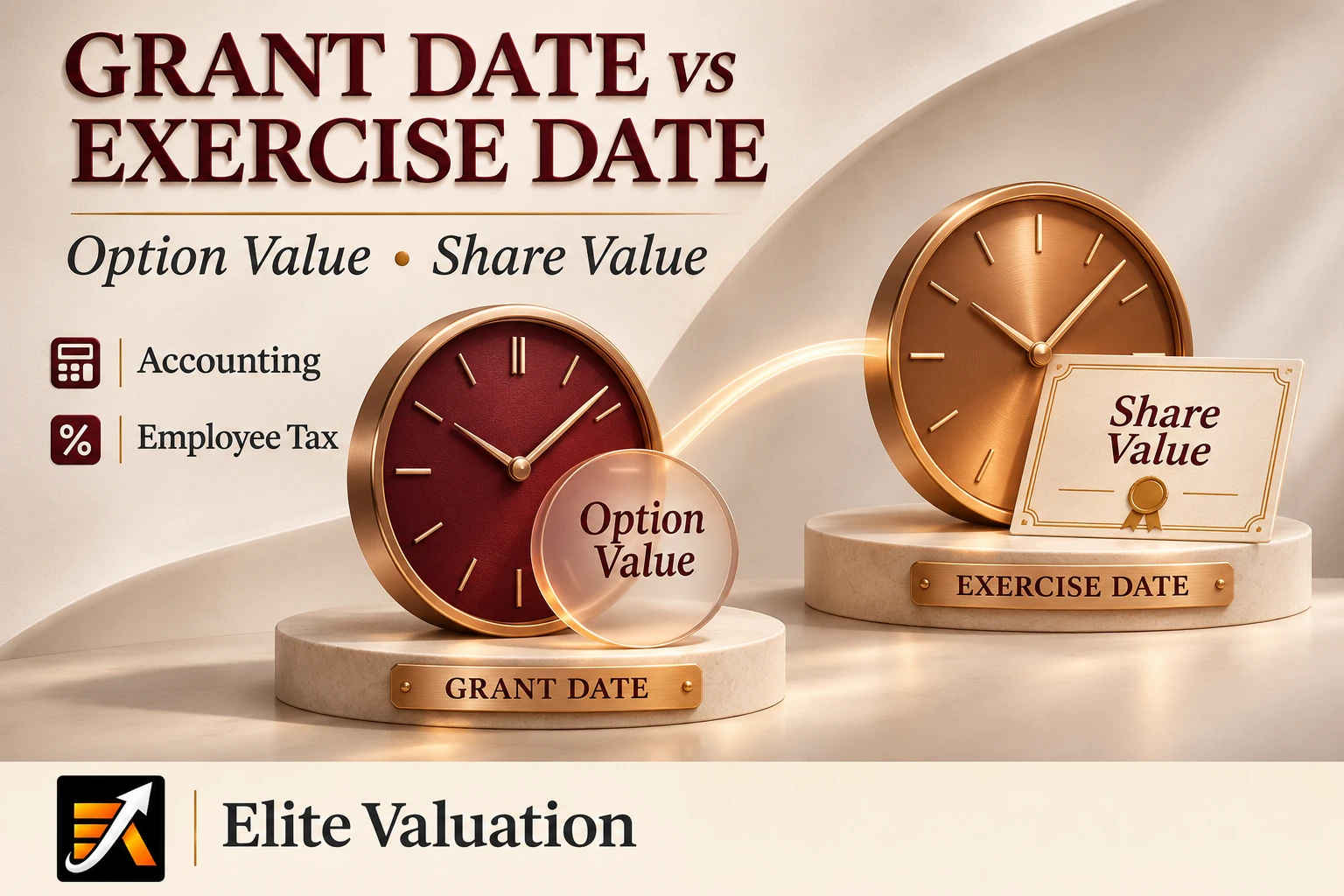
A scheme that grants options and later allows exercise usually needs at least two Valuations, because each answers a different question on a different date. The grant-date Valuation sets the fair value of an option when it is granted. That figure drives the expense recognised over the vesting period under Ind AS 102, and it supports the method disclosure that an unlisted company must make in its explanatory statement under Rule 12 of the Companies (Share Capital and Debentures) Rules, 2014.
The exercise-date Valuation supports the fair market value used for the employee’s taxable perquisite. The difference between that value and the exercise price is taxed as salary income. For unlisted equity shares, Rule 15(6)(d) of the Income-tax Rules, 2026 requires a Category I merchant banker’s determination. Under Rule 15(8)(l), the specified date may be the exercise date or an earlier date no more than 180 days before exercise. Agree which exercise windows the certificate covers; a fresh certificate is not automatically required for every exercise day.
The two reports cannot be combined or reused freely. A grant-date report measures the option at one date and for one purpose, so it cannot support tax on a later exercise. An exercise certificate cannot support the accounting expense either. A company in Chennai or Delhi that stretches one report across both dates usually discovers the gap during the statutory audit or a tax assessment, when the cost of fixing it exceeds the fee it tried to save.
What Drives the Cost of an ESOP Valuation?
Seven factors explain most of the difference between two quotes for the same company. Check each one against your situation before you compare prices.
- Company stage. A pre-Series A company with one class of shares is quicker to value than a growth company in Hyderabad or Gurugram that has raised several rounds.
- Cap table complexity. Preference shares, convertible instruments and several share classes need separate waterfall analysis before an option value can be set.
- Valuation methods. A single method costs less than a combination of discounted cash flow, comparable company analysis and an option-pricing model.
- Purpose. A grant-only report, a grant report with Ind AS 102 workings and an exercise-date fair market value each carry a different scope.
- Turnaround time. Standard timelines cost less than urgent ones, especially where the board date is already fixed.
- Merchant banker certificate. The exercise-date certificate for unlisted shares comes from a Category I merchant banker and is priced separately.
- Additional requirements. Cross-border grants may bring in foreign exchange rules under FEMA, and listed companies follow the SEBI share-based employee benefits framework instead.
A Pune start-up with a single class of shares grants 50,000 options at one board meeting. A simple grant-date Valuation fits the lower band. Later, after a Series A with preference shares, the company grants a second tranche. The second report needs waterfall analysis, and the quote moves into the growth-stage band. The figures are illustrative and are not a quote.
What Are the Indicative ESOP Valuation Fee Ranges in India (2026)?
The bands in Table 1 reflect the scope typical for each engagement. They assume a private limited company with reviewed accounts, a current cap table and one scheme. A quote for a company in Ahmedabad, Delhi or Kolkata should describe the deliverables in the same way, because two firms can price identical words very differently. Compare quotes by deliverable, not by total.
Use three checks to read any quote against the bands:
- Ask for one fixed fee for each report, with the Valuation date it covers.
- Confirm in writing whether the merchant banker certificate is included, and for how many exercise dates.
- Require the expected grant pipeline for the next three years, so the quote reflects the real scheme rather than a single grant.
Need a Fixed Quote for Your ESOP Scheme?
Send us the cap table, the draft scheme terms and the grant dates you expect. Elite Valuation will confirm the scope, the deliverables and the fee in writing.
Get a Fixed ESOP QuoteESOP Valuation | Ind AS 102 Workings | Exercise-Date Support | Scheme Design
Grant-Date vs Exercise-Date Valuation: Which Costs More?
The grant-date report is usually the first cost. The exercise-date certificate is often the recurring one, because it is needed each time employees exercise. Table 2 compares the two.
| Feature | Grant-date Valuation | Exercise-date Valuation |
|---|---|---|
| Valuation date | The date the options are granted | Exercise date for the perquisite, using the specified-date rules where permitted |
| What it supports | Ind AS 102 expense and the explanatory statement | Perquisite tax and TDS on the exercise |
| Usual preparer | IBBI Registered Valuer | Category I merchant banker |
| Recurs? | Once for each grant date | By exercise scope; the permitted specified-date window may cover multiple exercise dates |
| Main cost driver | Option-pricing inputs and the number of tranches | Number of exercise dates and changes to the cap table |
Exercise-date work is often priced separately because it needs a different professional and a different certificate, and the fee can recur for each exercise window. Companies in Pune, Hyderabad or Chennai that expect exercises in several windows should ask for an annual scope rather than buying one certificate at a time.
Reusing one report carries a specific risk. A report prepared for the grant cannot be relied on for an exercise two years later, because the share value on the exercise date may be materially different. The consequences are an understated perquisite, questions on TDS, or a grant expense challenged at audit. The fee saved on the first report is usually smaller than the cost of defending the second.
How Does ESOP Valuation Cost Differ for Startups and Established Companies?
Startups and established companies usually land in different parts of the range, for different reasons. A start-up has a short history and few shareholders, which keeps its cap table cheap to model. Its fee rises when it raises a round, because each round can change the share value and the waterfall. An established company may make fewer grants, but it has deeper financial history, more shareholders and more filings to reconcile, so the review takes longer.
Early-stage founders should expect a first grant report at the lower end of the band if the company has one class of shares and a short history. Budget for that report before the first offer letter goes out, not after. A founder in Bengaluru or Gurugram who waits until the first hire accepts will pay for urgency.
Funding rounds change future costs. A new round with preference shares or convertible instruments alters the waterfall and often reopens the grant assumptions. Budget for a refresh at each round, and ask the professional to price that refresh within the original scope. For an eligible start-up referred to in section 140 of the Income-tax Act, 2025, section 392(3), read with section 289(3), provides the special timing for ESOP-related tax deduction or payment. It does not reduce the Valuation fee.
Does ESOP Valuation Cost Differ Across Ahmedabad, Noida, Gurugram, Delhi and Pune?
The city does not set the fee on its own. The scope does. A grant-date report with the same share classes, methods and grant dates should be quoted on the same basis, wherever the company is based. What changes from one city to another is the context around the work, and that context affects how long the cap table review takes.
Ahmedabad is where Elite Valuation is based, so founders and CFOs there can meet the team in person as well as online. Companies with a GIFT City entity in nearby Gandhinagar may need the scheme read alongside that entity’s regulatory status, which can add scope to the quote.
In Noida and Gurugram, many software, fintech and consumer startups raise funds at short intervals. Each round can change the share value and the waterfall, so a company in the Delhi NCR should expect a grant refresh at every raise rather than one report for the life of the scheme. Delhi companies with foreign investors or non-resident employees should also check the FEMA pricing position for the scheme.
Pune has a large base of engineering, automotive component and software companies. Many of them combine a promoter or family shareholding with a newer employee pool, so the cap table review usually takes longer than for a single-class startup.
Whichever city the company is in, ask for a quote that lists the same deliverables and exclusions. If site visits or in-person meetings are needed, the quote should show them as a separate line.
How Can You Reduce ESOP Valuation Cost Without Compromising Quality?
- Bundle the grant-date report and the Ind AS 102 workings into one engagement, so the inputs are prepared once and used consistently.
- Plan grants in batches, so one report covers every tranche approved on the same board date.
- Keep the financial data clean, with reviewed accounts, a current cap table and signed board resolutions ready before you ask for a quote.
- Choose the right professional at the start, so the report is not rebuilt after an audit query.
- Agree an annual retainer where the company grants options more than once a year.
Companies in Delhi, Kolkata or Pune that plan three or four grant dates in a year should compare one batched engagement with separate reports for each date. The batched route is usually cheaper, but only if the grant dates are fixed in the scheme terms.
A Kolkata company plans three grant dates in one financial year. Quoted separately at ₹75,000 each, the three reports total ₹2,25,000. A batched engagement covering all three dates at ₹1,50,000 saves ₹75,000, provided the dates are fixed in the scheme terms before the engagement starts. The fee figures are illustrative and are not a quote.
What Should a Good ESOP Valuation Report Include?
A report that survives audit and tax review has a fixed set of contents. Check for these items before you accept the report and pay the invoice.
- The IBBI Registered Valuer’s registration details and signature for the grant-date report, and the merchant banker’s registration for the exercise-date certificate.
- A methodology note that names the method, explains why it suits the company and states the Valuation date.
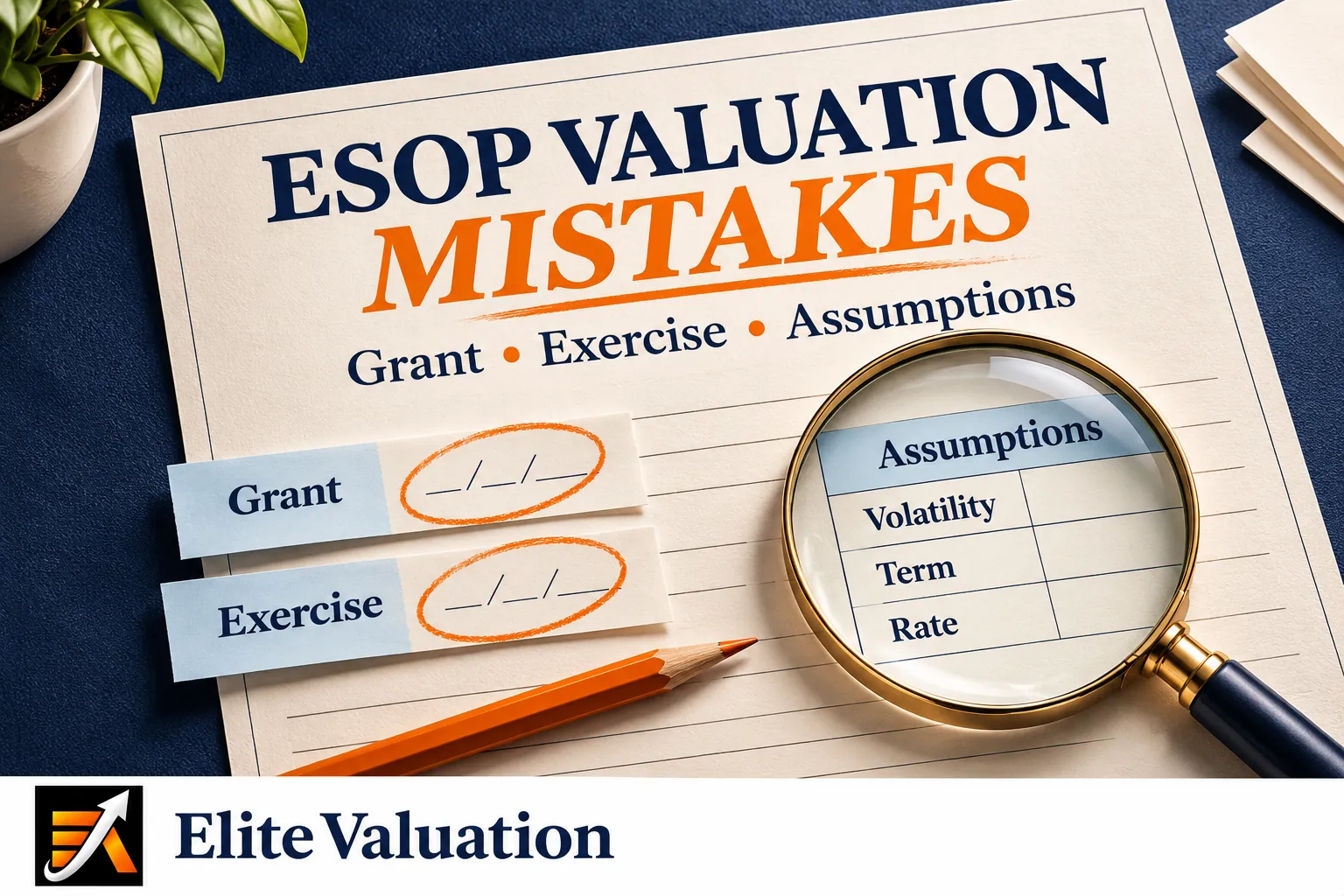
- Option-pricing workings with each input shown, including volatility, the risk-free rate, the expected term and the dividend yield.
- One assumptions table, with the source of every figure.
- A fair value per option, reconciled to the cap table and to the number of options granted.
- An audit-ready layout, with the same figures carried into the Ind AS 102 expense schedule.
The report should also show where each input came from. A Mumbai or Gurugram company that cannot document the source of its volatility or expected term will face questions from the auditor, and the Valuation may have to be redone.
Want a Report That Holds Up at Audit?
Elite Valuation prepares grant-date reports with the method note, the option-pricing workings and the assumptions table in one file, so the figures agree from the cap table to the expense schedule.
Talk to a Registered ValuerGrant-Date Valuation | Black-Scholes Workings | Ind AS 102 Support
Where Companies Go Wrong on ESOP Valuation Cost: Common Mistakes
These five errors appear most often when a scheme reaches audit or a tax assessment. The first two cost money at the quote stage, and the rest cost money later. An investor in Bengaluru, a tax officer in Hyderabad and an auditor in Delhi each test a different number, so the report has to hold up for all of them.
Choosing the cheapest quote
The lowest quote often leaves out the option-pricing workings or the merchant banker certificate.
Rework, a delayed grant, or a report that fails audit reviewCompare quotes line by line against the same deliverables, dates and exclusions.
Not confirming whether the merchant banker certificate is included
The exercise-date certificate is assumed to sit inside the grant quote, but it is scoped and priced separately.
Perquisite and TDS are unsupported when employees exerciseWrite the certificate, its exercise dates and its fee into the engagement letter before the grant.
Assuming one Valuation covers both grant and exercise
A single report sits on file and is used for both the accounting expense and the tax on exercise.
The tax figure or the expense figure fails review, and one may need restatingBudget for two deliverables and set a calendar for each exercise window.
Ignoring the Ind AS 102 requirement until audit
The company records no expense in the first year and produces the workings only when the auditor asks for them.
Prior-period expense has to be recalculated and the audit timetable slipsObtain the grant-date fair value and the expense schedule before the first set of accounts is closed.
Starting the Valuation after the grant date is set
The board approves the grant terms first, and the Valuation is commissioned afterwards in Chennai, Pune or elsewhere.
An urgent fee is charged, and the board has approved a price that is not yet supportedStart the Valuation during scheme design and send the draft report with the board papers.
Elite Valuation’s ESOP Valuation Services
Elite Valuation is an independent Valuation firm founded in 2020 by Sagar Shah, a Chartered Accountant, Company Secretary and IBBI Registered Valuer. Before founding the firm, he spent 9 years at Ernst & Young focused on cross-border structuring and transfer pricing. We support founders, CFOs and HR heads in Ahmedabad, Noida, Gurugram, Delhi, Pune and Mumbai, and across India, on grant-date reports, Ind AS 102 workings and exercise-date support for the scheme. Our wider practice covers business Valuation, purchase price allocation under Ind AS 103, FEMA and Income-tax Valuations, AIF registration and compliance, and M&A advisory.
Related Elite Valuation services
- ESOP advisory: scheme design, grant planning and Ind AS 102 expense support
- Share Valuation: share price support for a fundraise, a secondary transfer or an ESOP grant
- Company Valuation: enterprise value behind a funding round or a sale
- Contact us: share the cap table and the grant plan to receive a scope and fee in writing
Frequently Asked Questions About ESOP Valuation Cost in India
How much does ESOP Valuation cost in India?
For most private companies in India, an ESOP Valuation costs between ₹40,000 and ₹2,00,000 or more in 2026. A simple grant-date report for an early-stage company sits at the lower end of that band. A growth-stage grant with Black-Scholes or binomial workings, plus an exercise-date merchant banker certificate, sits at the upper end. The exact fee depends on the company’s stage, the number of grants, the complexity of the cap table and the turnaround time. Ask for a fixed quote that states the scope and each deliverable.
Is Merchant Banker Valuation more expensive than IBBI RV Valuation?
The two are not like for like, because they produce different deliverables. A merchant banker certificate is needed for the exercise-date fair market value of unlisted shares for perquisite tax, and its fee is set per exercise date. An IBBI Registered Valuer usually prepares the grant-date report that supports the Ind AS 102 expense. Compare quotes by the deliverable, the Valuation date and the exclusions, rather than by the professional’s title or the headline fee.
Do I need a fresh Valuation for every grant?
Usually, yes. The fair value of an option depends on the share value, the exercise price, the expected term and the volatility on the grant date. Those inputs change after a funding round, a major contract or a change in the cap table. A grant made shortly after a report, with no change in those inputs, may rely on a documented review rather than a full new report, but the decision should be recorded and discussed with the auditor before the grant is approved.
Can I use the same report for grant and exercise?
No. The grant-date report measures the fair value of options on the grant date. It supports the Ind AS 102 expense and the method disclosure in the explanatory statement. For unlisted equity shares, the perquisite value requires a Category I merchant banker’s determination using the permitted specified-date window under Rule 15. One report cannot support both, so the company needs a separate deliverable for each date.
What is the cost of Black-Scholes Valuation under Ind AS 102?
For a growth-stage company, a Black-Scholes or binomial report for Ind AS 102 typically falls in the range of ₹75,000 to ₹1,50,000 or more in 2026. The fee rises with the number of inputs that need evidence, such as volatility taken from comparable listed companies, the expected term, performance conditions and the number of tranches. A single simple grant costs less than a scheme with several grant dates and preference shares in the same cap table.
Does Elite Valuation handle ESOP Valuation for startups?
Yes. Elite Valuation prepares grant-date reports and Ind AS 102 workings for startups, and supports exercise-date work for the scheme. Early-stage companies usually need one clean report before the first offer letter, then a refresh at each funding round, because a new round can change the share value and the waterfall. The quote starts from the share classes, the number of grant dates and the methods required, so a startup knows its scope before it commits.
How is ESOP Valuation different for a listed company?
For a listed company, the share price is quoted on the exchange, so the grant-date work centres on the option-pricing model. Volatility comes from the listed price history, and the expected term and any performance conditions are documented in the same way as for unlisted companies. The exercise-date value also comes from the exchange quote, so the merchant banker certificate used for unlisted shares is not needed for that purpose. Pricing and exercise rules come from the SEBI Share Based Employee Benefits and Sweat Equity Regulations, 2021, which should be checked for each scheme.
Why choose a specialist Valuation firm over a Big-4 firm for ESOP work?
A specialist firm concentrates on Valuation, ESOP and related regulatory work, so the scope, the method note and the workings come from one team rather than a wider practice. Elite Valuation is led by a Chartered Accountant, Company Secretary and IBBI Registered Valuer, and the firm works to the level of rigour expected of a Big-4 firm. A Big-4 firm may still be the better choice when the ESOP work sits inside a larger transaction or audit that it already leads.
Can our statutory auditor also prepare the ESOP Valuation?
Check this before you appoint anyone. Section 144 of the Companies Act, 2013 restricts the non-audit services that a statutory auditor may provide to an audit client, and some of those restrictions, such as the one on management services, can overlap with Valuation work. Where independence is in doubt, a separate IBBI Registered Valuer avoids the question. Ask the auditor to confirm its position in writing, and record the answer in the board papers.
What credentials should an ESOP Valuation provider hold in India?
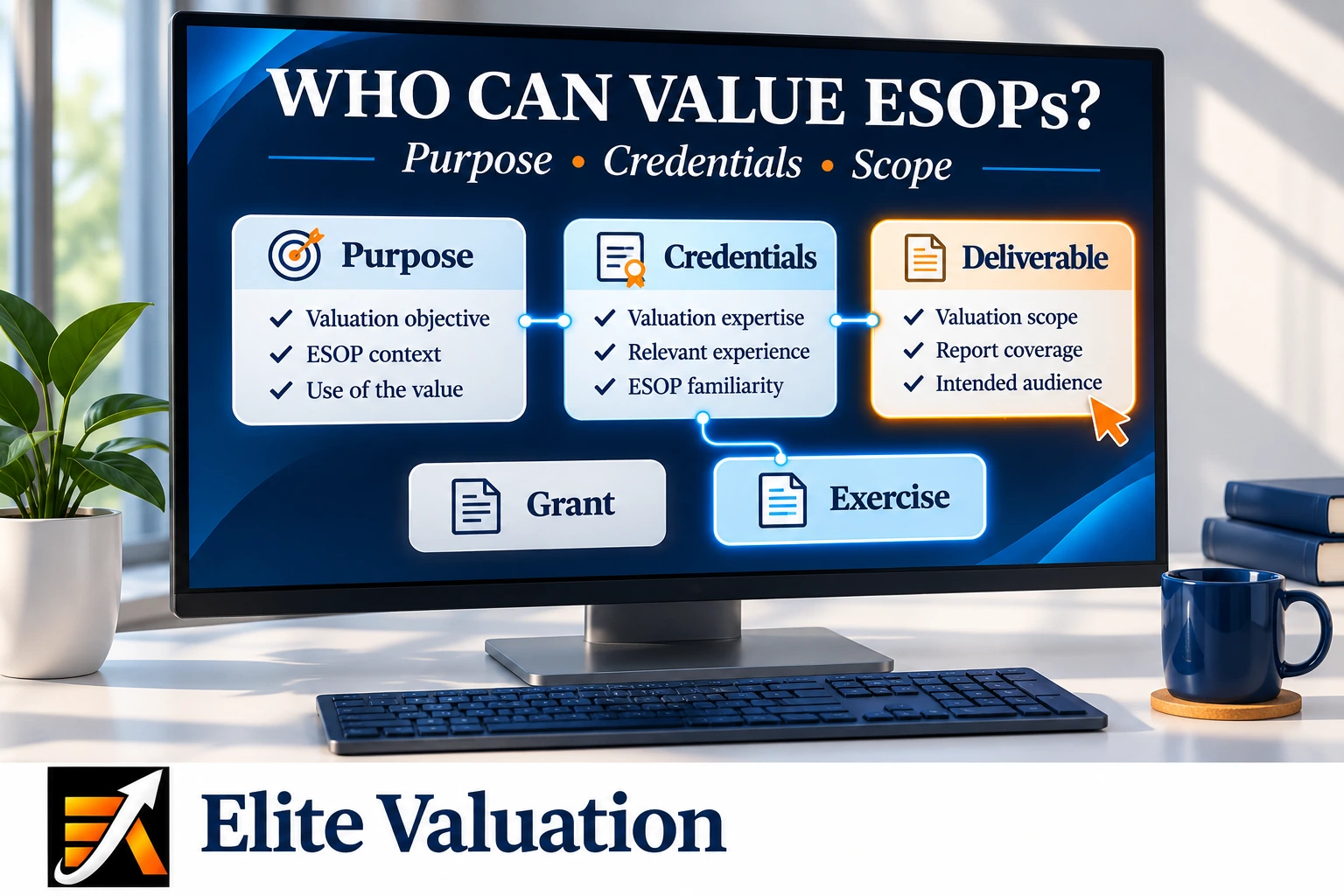
For the grant-date report, look for an IBBI Registered Valuer registered under Section 247 of the Companies Act, 2013, with the asset class stated on the report. For the exercise-date fair market value of unlisted shares, the perquisite rules require a Category I merchant banker registered with SEBI. A Chartered Accountant or Company Secretary adds the accounting and company law background needed for the Ind AS 102 expense and the explanatory statement. Ask for the registration numbers before you sign the engagement letter.
Who leads ESOP Valuation work at Elite Valuation, and what is their background?
Sagar Shah, the founder, leads the firm’s Valuation and advisory practice. He is a Chartered Accountant, Company Secretary and IBBI Registered Valuer registered under Securities or Financial Assets, and he is a CA All India Rank holder. He spent 9 years at Ernst & Young focused on cross-border structuring and transfer pricing, then founded Elite Valuation in 2020. The firm is based in Ahmedabad and operates pan-India.
What other Valuation services does Elite Valuation cover besides ESOP work?
Elite Valuation covers business and share Valuation, purchase price allocation under Ind AS 103, impairment testing under Ind AS 36, and intangible and patent Valuation. It also prepares Valuation reports for FEMA, SEBI and Income-tax purposes, under the applicable valuation provisions. The wider practice includes M&A advisory, financial modelling, DCF analysis, and AIF registration and compliance for Category I, II and III funds, so a company can often cover its ESOP, accounting and fund needs with one advisor.
Does ESOP Valuation cost more in Delhi, Gurugram or Noida than in Ahmedabad or Pune?
Not because of the city alone. The fee follows the scope: the grant dates, the share classes, the methods and whether the merchant banker certificate is included. A company in Ahmedabad, Noida, Gurugram, Delhi or Pune with the same scope should receive a quote built on the same deliverables. Elite Valuation is based in Ahmedabad and operates pan-India, so location rarely changes the engagement, but any site visit or in-person meeting should appear as a separate line in the quote.
What should you budget for an ESOP Valuation?
Budget for at least two deliverables: a grant-date report that supports the Ind AS 102 expense and the explanatory statement, and an exercise-date fair market value that supports perquisite tax on unlisted shares. For 2026, a simple grant-date report starts near ₹50,000, and a growth-stage package with option-pricing workings rises towards ₹1,50,000 or more. Add the merchant banker certificate, any batch planning and an annual refresh, and the budget becomes clear before the first grant.
Ask for the scope in writing, start the Valuation during scheme design and keep the cap table clean. Those three steps control most of the cost.
Sources
Fee ranges are indicative for 2026, are not market data or a quotation, and depend on the agreed scope. Historical references to the Income-tax Act, 1961 apply to the relevant earlier periods.
- Companies Act, 2013 and Companies (Share Capital and Debentures) Rules, 2014: sections 62, 144 and 247, and Rule 12.
- Ind AS 102, Share-based Payment: grant-date accounting and option-pricing principles.
- SEBI Share Based Employee Benefits and Sweat Equity Regulations, 2021, as amended: listed-company framework.
- Income-tax Act, 2025, as amended: sections 17(1)(d), 17(4)(h), 140 and 392(3), read with section 289(3).
- Income-tax Rules, 2026: Rule 15(6)(d) and Rule 15(8), including the merchant banker and specified-date definitions.
Ready to Price Your ESOP Scheme?
Tell us the number of grant dates you expect, the share classes in the cap table and the exercise windows in the scheme. Elite Valuation will respond with the scope, the deliverables and a fee in writing.
Request an ESOP Valuation QuoteESOP Valuation | Ind AS 102 Workings | Exercise-Date Support | Scheme Design

Disclaimer. This article provides general information, not legal, tax, accounting or investment advice, and is not a Valuation of a company, option or share. Fee ranges are indicative for 2026, are not a quotation and depend on scope. Apply the relevant law, accounting framework and professional requirements to the company’s circumstances.