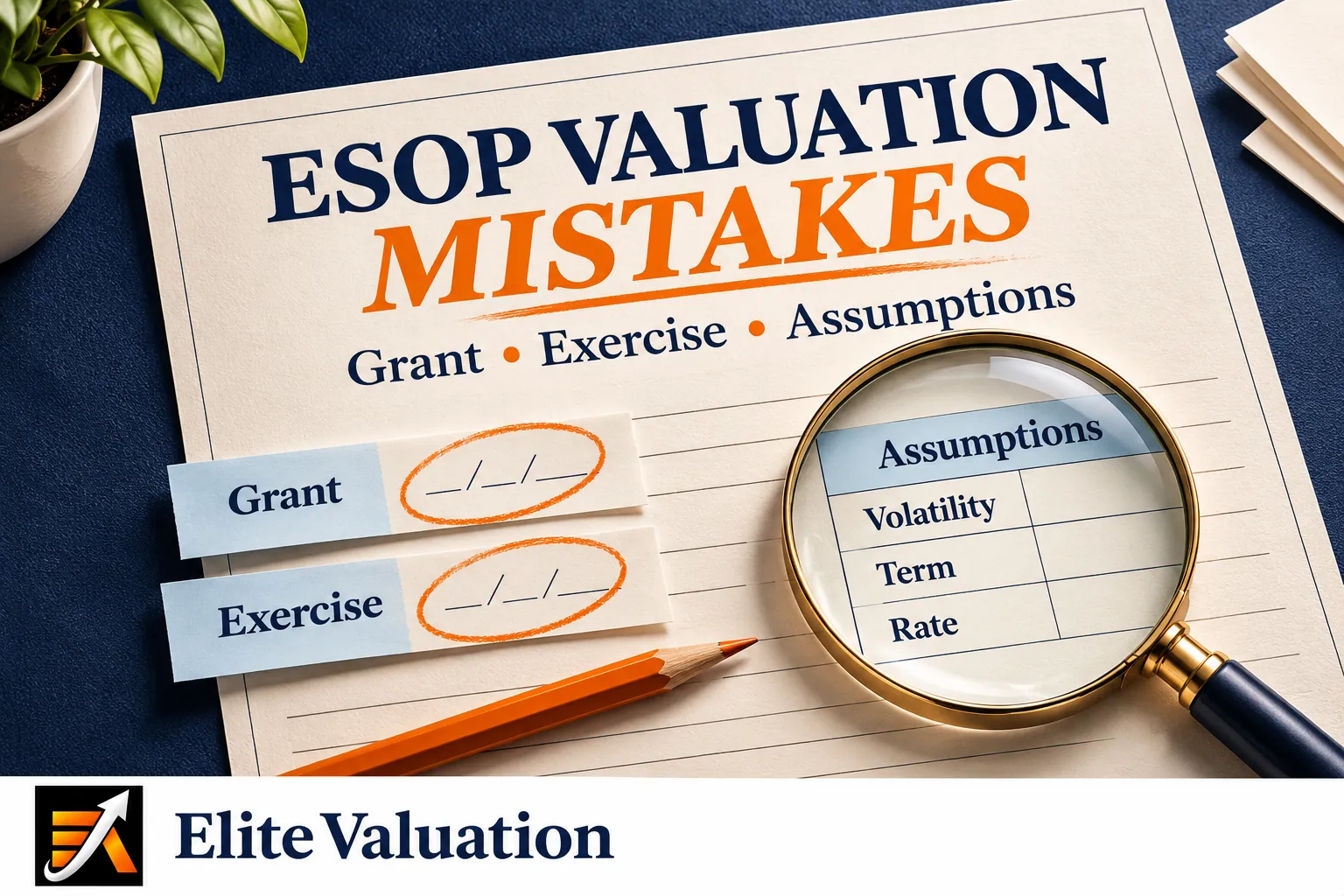
Most ESOP problems surface during a statutory audit, a tax assessment or funding due diligence, long after the scheme was approved. The causes are rarely technical. They are usually the wrong professional, one report used for two purposes, or assumptions nobody wrote down.
The most common ESOP Valuation mistake in India is using one report for two purposes. The grant-date Valuation supports the Ind AS 102 expense. The exercise-date fair market value supports the perquisite tax on each exercise, and for unlisted shares a Category I merchant banker must determine it. A grant report cannot support the tax, and a chartered accountant’s certificate cannot replace the merchant banker’s determination.
Key takeaways
- Grant-date and exercise-date Valuations answer different questions, on different dates, and cannot replace each other.
- For unlisted shares, the exercise-date fair market value is determined by a Category I merchant banker under the Income-tax Rules.
- Confirm the certifier, the registration number and the deliverable for every engagement in writing.
- Black-Scholes inputs need a documented source, and at-the-money options still carry a fair value.
- Reconcile the Companies Act, Ind AS 102 and tax figures to one assumptions table.
This guide is for founders, CFOs and HR heads who run or budget an ESOP scheme. It explains the regulatory split, shows which professional certifies each figure, and sets out seven mistakes that recur in ESOP schemes, with the fix for each. The same rules apply whether the company is in Ahmedabad, Noida, Gurugram, Delhi or Pune.
Grant-Date and Exercise-Date Valuations: What Each Is For
A scheme that grants options and later allows exercise needs two Valuations, because each answers a different question on a different date. The grant-date Valuation sets the fair value of each option on the grant date. Under Ind AS 102, that figure drives the expense recognised over the vesting period, and it supports the method the company discloses for its scheme.
The exercise-date Valuation supports the fair market value used for the employee’s taxable perquisite. For unlisted equity shares, Rule 15(6)(d) of the Income-tax Rules, 2026 requires a Category I merchant banker’s determination. Rule 15(8)(l) permits the exercise date or an earlier specified date no more than 180 days before exercise. Agree coverage with the merchant banker: a fresh certificate is not automatically required for every exercise window. Grant-date option fair value and the exercise-related perquisite value remain different measurements.
| Feature | Grant-date Valuation | Exercise-date Valuation |
|---|---|---|
| Valuation date | The date the options are granted | Exercise-related value, applying the specified-date rules where permitted |
| What it supports | Ind AS 102 expense and scheme disclosures | Perquisite tax and TDS on the exercise |
| Usual certifier | IBBI Registered Valuer | Category I merchant banker (unlisted shares) |
| Recurs? | Once for each grant date | By exercise scope, applying the permitted specified-date window |
A report prepared for one date cannot be relied on for the other. Companies in Pune or Gurugram that expect exercises in several windows should plan the exercise certificates when the scheme is designed, not when the first employee exercises.
Which Professional Must Certify Each ESOP Valuation?
Two professionals appear in ESOP work, and they are not interchangeable. An IBBI Registered Valuer, registered under Section 247 of the Companies Act, 2013, prepares the grant-date report for company law and accounting purposes. A Category I merchant banker, registered with SEBI, determines the fair market value of unlisted shares on exercise for the perquisite.
The risk is substitution. A chartered accountant’s certificate does not replace the merchant banker’s determination where the perquisite rules require one. The figure can be sound and still fail if the wrong professional signed it.
For listed companies, the SEBI Second Amendment Regulations, 2025 substitute an independent registered valuer for the merchant banker in Regulation 34(1). The amendment takes effect on the thirtieth day from its publication in the Official Gazette and includes a transition provision for ongoing assignments. Apply that provision to the relevant valuation work; it does not replace the separate income-tax rules for an employee’s perquisite.
A single quote can cover both professionals. For companies in Ahmedabad, Noida or Delhi, ask who signs each deliverable and which registration number appears on it.
Common ESOP Valuation Mistakes: Where Companies Go Wrong and How to Fix Them
Accepting a CA certificate for exercise-date value
The perquisite value is unsupported under the Income-tax Rules, and TDS and the employee’s tax return are open to challenge.
Engage a Category I merchant banker to determine the exercise-date fair market value of unlisted shares under Rule 15(6) of the Income-tax Rules, 2026.
Using one report for both grant and exercise
The exercise-date perquisite or the Ind AS 102 expense fails review, and the audited accounts may need correction.
Obtain the exercise-related merchant banker determination separately from the grant-date accounting work, and agree which exercise dates fall within its scope and the Rule 15 specified-date window.
Reusing a grant report after a funding round
For a new grant, the option value may no longer reflect the current inputs. Reusing stale inputs can misstate that grant’s expense; existing equity-settled awards are not remeasured merely because a later funding round occurs.
Commission a new grant-date report before any grant that follows a funding round, secondary sale or change in preference rights.
Skipping the equity value step for unlisted shares
The option fair value rests on the wrong base, so the expense and the exercise price can both be challenged at audit.
Determine the equity value of the ordinary shares first, then run the option-pricing model on that value.
Treating at-the-money options as zero expense
The Ind AS 102 expense is understated for every vesting year, and the gap surfaces during the statutory audit.
Run the option-pricing model on every grant, including at-the-money options, and record the resulting fair value.
Setting the exercise price without a documented fair value
The price cannot be defended if challenged, and an exercise price below fair market value on exercise creates a taxable perquisite for the employee.
Record the grant-date fair value and the basis for the exercise price in the same board resolution that approves the grant.
Leaving Companies Act, Ind AS 102 and tax figures unreconciled
The audit timetable slips, and the company must explain differences that one reconciled file would have avoided.
Tie the grant count, the fair value per option and the expense schedule to one assumptions table before the accounts close.
Black-Scholes Inputs Under Ind AS 102: What Auditors Test
Ind AS 102 measures equity-settled awards at grant-date fair value, and the expense follows the number of awards expected to vest. The option-pricing model takes inputs that an auditor can test one at a time. Each input needs a source and a date, as the table below shows.
| Input | Common error | Evidence that holds up |
|---|---|---|
| Expected term | Contractual life used without reasoning | Exercise history, exit timelines and vesting terms, set out in a short note |
| Volatility | A guessed figure, or the company’s own short price history | Historical volatility of named comparable listed companies, over a period matching the expected term |
| Risk-free rate | A rate whose tenor does not match the expected term | Government securities yield for the same tenor, with its source and date |
| Dividend yield | Dividends assumed with no policy behind them | The stated dividend policy, with zero where no dividend is declared |
| Forfeiture | Forfeiture built into the option price | A reduction in the number of awards expected to vest, reviewed over the vesting period |
Two points cause most of the confusion. The expected term is the period over which the company expects exercise, which is usually shorter than the contractual life. Forfeitures do not belong in the option price, because they change the number of awards expected to vest.
For an unlisted company, two steps come before the expense. First, determine the equity value of the ordinary shares. Second, calculate the option fair value from that value. A growth-stage company in Gurugram or Pune that uses listed peers should name each peer, the volatility period and the data source inside the report.
How Long an ESOP Valuation Stays Usable
The rules we reviewed do not set a fixed validity period for a grant-date report. The test is whether the inputs still hold on the new grant date. A report stays usable only while the share value, the cap table, the preference rights, the expected term and the volatility still match the grant.
Exercise-related certificates have a permitted specified-date window under Rule 15. Confirm that the certificate covers the relevant exercises rather than assuming either unlimited reuse or a mandatory new report for every window. For new grants, treat the following changes as triggers to reassess the inputs:
- a funding round or a secondary sale that sets a new price
- a change in preference rights or in the cap table
- a material contract or a change in outlook that moves the value
- a change in the expected term or the volatility evidence
Where nothing has changed, record a documented review and discuss it with the auditor before the grant is approved. Companies in Delhi and Noida that approve several grants in one year should time each review to the board meeting that approves the grant.
One Set of Numbers Across the Companies Act, Ind AS 102 and Tax
Company law, accounting and tax each set their own requirements. A single report rarely satisfies all three without adjustment, and each reviewer tests something different.
| Regime | Purpose | What the reviewer tests |
|---|---|---|
| Companies Act, 2013 and the Share Capital and Debentures Rules, 2014 | Scheme approval and disclosure | Scheme terms, pricing conditions and the method disclosed |
| Ind AS 102 | Accounting expense | Grant-date fair value, vesting and the expense schedule |
| Income-tax Act and Rules | Perquisite on exercise | Exercise-date fair market value, the certifier and TDS |
Documentation holds the three together. A methodology note, an assumptions table with sources, a reconciliation of options to the cap table, and the board resolution for each grant do most of the work. Investors reviewing a funding round in Noida or Gurugram will read this file during due diligence, and a missing note becomes an open point.
ESOP Valuation Red Flags to Check Before Your Audit
Any one of these items justifies a review before the board approves the grant, whether the company is in Ahmedabad, Noida, Gurugram, Delhi or Pune.
Red flags
- The grant report predates the latest funding round or secondary sale.
- The certifier is not named, or no registration number appears on the report.
- The engagement letter leaves out the merchant banker certificate for unlisted exercise dates.
- The expected term equals the contractual life, with no reasoning given.
- Volatility is stated with no peer list, data source or period.
- Forfeiture is built into the option price, not the number of awards expected to vest.
- The exercise price has no board resolution or documented fair value behind it.
- The exercise price is below the face value of the share.
How to Get ESOP Valuation Right From the Start
- Map the scheme: grant dates, share classes, exercise windows and the next funding round.
- Appoint the professionals before the board approves the scheme: an IBBI Registered Valuer for the grant report and a Category I merchant banker for each exercise date.
- Assemble the file: the cap table, reviewed accounts, board resolutions, the latest funding documents and the peer data for volatility.
- Review the draft report against the red flags above before the board pack goes out.
- Diary the exercise windows and review dates, so no exercise runs without a current certificate.
Founders and CFOs in Ahmedabad, Noida, Gurugram, Delhi and Pune can send the cap table and draft scheme terms, then receive the scope and fee in writing. Elite Valuation prepares the grant-date report as an IBBI Registered Valuer and coordinates the exercise-date certificate with a Category I merchant banker, so both deliverables use one set of inputs.
Need Grant and Exercise Reports That Hold Up?
Send us the cap table, the draft scheme terms and the expected grant dates. We will confirm the certifier, the deliverables and the fee in writing.
Talk to an IBBI Registered ValuerGrant-Date Valuation | Exercise-Date Support | Ind AS 102 Workings
Do These Mistakes Differ Across Ahmedabad, Noida, Gurugram, Delhi and Pune?
The mistakes do not change with the city. The regulatory tests are the same wherever the company is registered. What changes is the funding and ownership context that creates the risk.
In Ahmedabad, a company that combines a promoter shareholding with a new employee pool needs the cap table reviewed before any option is priced. Elite Valuation is based in Ahmedabad and operates pan-India, so the same review standard applies to companies in every city on this list.
In Noida and Gurugram, startups that raise rounds frequently are exposed to stale reports, because each round can change the share value. Delhi companies with foreign investors or non-resident employees should also check the FEMA pricing position alongside the ESOP Valuation. Pune’s engineering and software companies often run a promoter shareholding alongside an employee pool, which lengthens the cap table review.
Frequently Asked Questions About ESOP Valuation Mistakes
What is the most common ESOP Valuation mistake in India?
Using one report for both grant and exercise. The grant-date Valuation supports the Ind AS 102 expense, while the exercise-date fair market value supports the perquisite tax. One report cannot support both, and for unlisted shares the exercise-date value must be determined by a Category I merchant banker. Check that the certifier named for each date matches the rule that applies to that date.
Can I use the same Valuation for grant and exercise?
Grant-date option fair value and exercise-related share fair market value serve different purposes and cannot be treated as interchangeable. For unlisted equity shares, use the Category I merchant banker’s determination required by Rule 15. Its specified date may be the exercise date or no more than 180 days earlier, so review the certificate’s scope before deciding whether a later exercise window needs a fresh determination.
Who should do ESOP Valuation for an unlisted company?
An IBBI Registered Valuer under Section 247 of the Companies Act, 2013 usually prepares the grant-date report, and a Category I merchant banker determines the exercise-date fair market value for the perquisite. A chartered accountant’s certificate cannot replace the merchant banker where that rule applies. Ask for the registration numbers of both professionals before the engagement starts.
What happens if Black-Scholes inputs are wrong?
The option fair value and the Ind AS 102 expense are misstated. Auditors may ask for the evidence behind each input, and a material error in an earlier year can require correction of the accounts. Keep a source and a date for the expected term, volatility, risk-free rate and dividend yield.
How often should we get a fresh ESOP Valuation?
Whenever an input changes materially, such as a funding round, a secondary sale, a change in preference rights or a major contract. Where nothing has changed, record a documented review. For exercises, check whether the merchant banker’s certificate covers the relevant date under the permitted specified-date window. Build the review into the board calendar, so that each grant date has a current support file.
Does an at-the-money option carry any expense?
Yes. An option whose exercise price equals the current share value still has time value, so its fair value on the grant date is above zero. Recording nothing is a common error. The expense follows that fair value over the vesting period, adjusted for the awards expected to vest. The same logic applies to every grant date in the scheme.
Does Elite Valuation handle ESOP Valuation for startups?
Yes. Elite Valuation prepares grant-date reports and Ind AS 102 workings for startups, and supports exercise-date work for the scheme. Early-stage companies usually need a clean first report before the first offer letter, then a refresh at each funding round, since a new round can change the share value. The engagement letter sets the scope in writing before work begins.
How is ESOP Valuation different for a listed company?
The quoted share price informs the grant-date option-pricing work, alongside documented volatility, expected term and other assumptions. The December 2025 SEBI amendment changes the certifier to an independent registered valuer for Regulation 34(1) valuations, subject to its commencement and transition provisions. Assess that scope separately from the tax valuation of an employee’s perquisite.
Why choose a specialist Valuation firm over a Big-4 firm for ESOP work?
A specialist firm concentrates on Valuation, ESOP and related regulatory work, so the scope, the method note and the workings come from one team. Elite Valuation is led by a Chartered Accountant, Company Secretary and IBBI Registered Valuer, and the firm works to Big-4 levels of rigour. A Big-4 firm can still be the better choice when the ESOP work sits inside a larger transaction or audit that it already leads.
Can our statutory auditor also prepare the ESOP Valuation?
Check first. Section 144 of the Companies Act, 2013 restricts the non-audit services a statutory auditor may provide to an audit client, and some restrictions, such as the one on management services, can overlap with Valuation work. Ask the auditor to confirm its position in writing before the engagement starts.
What credentials should an ESOP Valuation provider hold in India?
Look for an IBBI Registered Valuer registered under Section 247 of the Companies Act, 2013, with the asset class stated on the report. For exercise-date values on unlisted shares, look for a Category I merchant banker registered with SEBI. A Chartered Accountant or Company Secretary adds the accounting and company law background. Ask for the registration numbers before you sign.
Who leads ESOP Valuation work at Elite Valuation?
Sagar Shah, the founder, leads the firm’s Valuation and advisory practice. He is a Chartered Accountant, Company Secretary and IBBI Registered Valuer registered under Securities or Financial Assets, and a CA All India Rank holder. He spent 9 years at Ernst & Young focused on cross-border structuring and transfer pricing, and founded Elite Valuation in 2020.
Can the exercise price be below the face value of the share?
For an ordinary ESOP share issue, do not set a price below face value: section 53 of the Companies Act, 2013 generally prohibits issuing shares at a discount, subject to its statutory exceptions. Rule 12 governs the ESOP scheme and pricing disclosures; it is not the source of that general prohibition. Document the exercise-price basis and apply the company’s accounting policies.
What should you fix first?
Most ESOP Valuation mistakes are process and professional-selection errors, not technical complexity. Whether the company is in Ahmedabad, Noida or Pune, name the certifier for each deliverable, keep the grant and exercise reports separate, and document every input before the first grant. Those three steps close off the errors covered in this guide.
Get an Audit-Ready ESOP Valuation
Speak to an IBBI Registered Valuer about the grant report, the exercise-date certificate and the Ind AS 102 workings for your scheme.
Speak to an IBBI Registered ValuerESOP Valuation | Ind AS 102 Workings | Exercise-Date Support | Scheme Design
Sources
- Companies Act, 2013: sections 53, 62, 144 and 247.
- Companies (Share Capital and Debentures) Rules, 2014: Rule 12 on employee stock option schemes.
- Ind AS 102, Share-based Payment: option-pricing and equity-settled award accounting.
- Income-tax Rules, 2026: Rule 15(6)(d), 15(8)(g) and 15(8)(l).
- SEBI Share Based Employee Benefits and Sweat Equity (Second Amendment) Regulations, 2025.
- Black, F. and Scholes, M. (1973), The Pricing of Options and Corporate Liabilities, Journal of Political Economy.
Ready to Get Your ESOP Valuation Right?
Tell us the number of grant dates you expect, the share classes in the cap table and the exercise windows in the scheme. Elite Valuation will respond with the scope, the deliverables and a fee in writing.
Request an ESOP Valuation QuoteESOP Valuation | Ind AS 102 Workings | Exercise-Date Support | Scheme Design

Disclaimer. This article provides general information, not legal, tax, accounting or investment advice, and is not a Valuation of a company, option or share. Requirements depend on the company, scheme and applicable framework. Obtain advice appropriate to your circumstances.