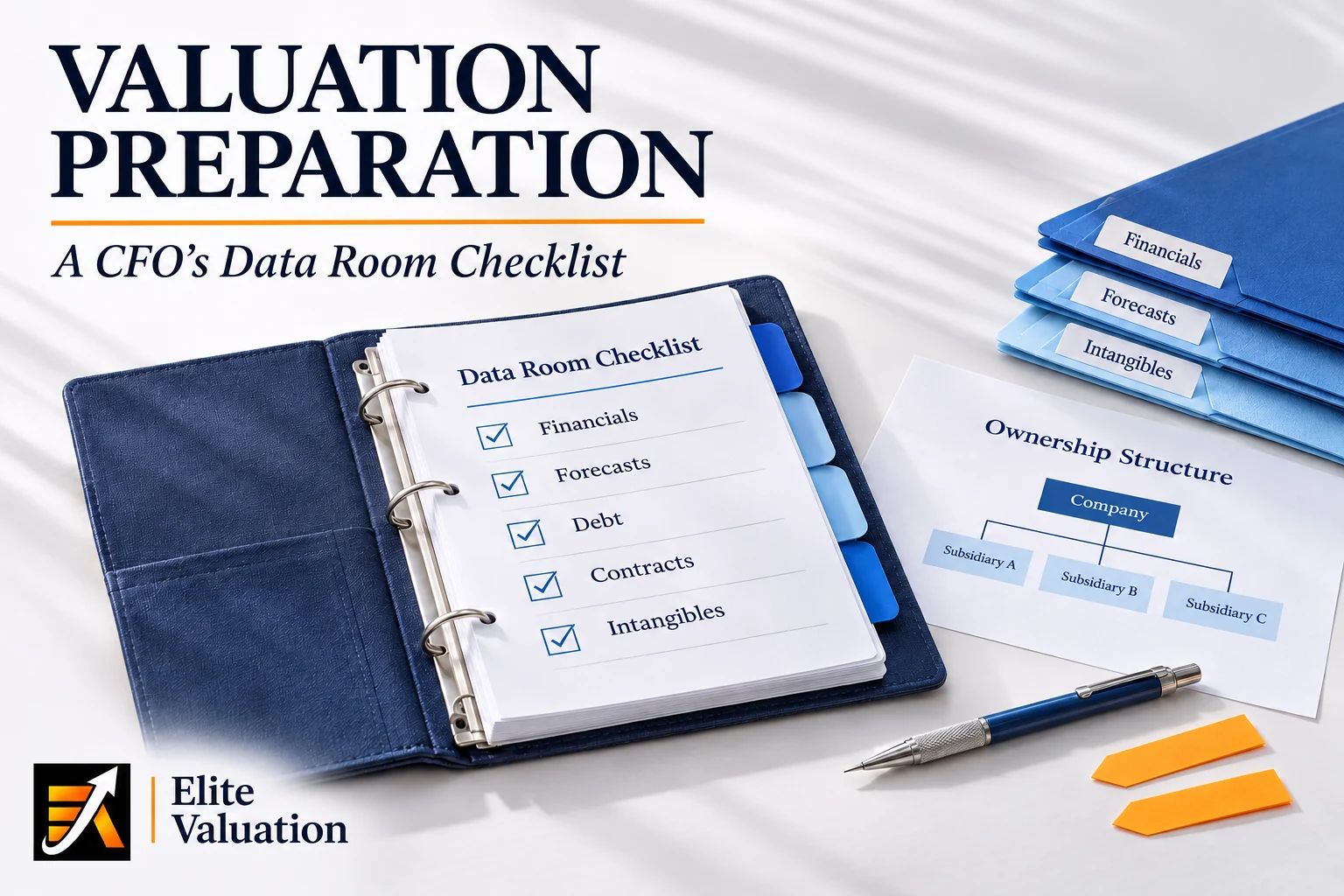
A Corporate Valuation rarely fails on arithmetic. It fails on inputs: accounts that do not reconcile, a cap table that does not match the register of members, or projections the data room cannot support. This checklist sets out what a CFO should assemble before the valuer is instructed.
Key takeaways
- Preparation sets the timeline and the range. Investors and regulators test the inputs before they test the number.
- Reconcile before you engage. Tie audited accounts, management accounts and the cap table together first.
- Normalize earnings with evidence. Document every one-off item and related party adjustment.
- Build projections from drivers. Support each revenue line with contracts or pipeline, and show a downside case.
- Tie the cap table to statutory records, including every outstanding option.
- Map the triggers early. Confirm FEMA pricing, FC-GPR and Rule 57 requirements before any share moves.
Most CFOs meet a Corporate Valuation in a funding round. The investor’s advisers ask for the basis within days of a term sheet. If the cap table cannot be tied to filed returns, the lawyers stop. If the projections outrun the pipeline, the discount rate becomes the negotiation. The same gaps create regulatory exposure: a share issue to a foreign investor below the FEMA pricing floor can cause reporting failures long after the deal closes.
Why Is Advance Preparation Critical for a Corporate Valuation?
Preparation shortens the time between a term sheet and a signed report, and narrows the range an investor or regulator can justify. The same inputs should serve the fundraising, the accounts and the tax filings.
Streamlining the Fundraising Process with Institutional Investors
Institutional investors expect three years of audited accounts, monthly management accounts, a fully diluted cap table, the ESOP register, shareholder agreements and the Valuation supporting the price, all in a data room. When these exist on the day the mandate is signed, the valuer starts at once. When they do not, each request becomes a separate exchange, and the round moves at the speed of the slowest document.
Mitigating Tax and Regulatory Risks (FEMA, Income Tax)
Under Rule 21 of the Foreign Exchange Management (Non-debt Instruments) Rules, 2019, shares issued to a non-resident must be priced at or above fair value under an internationally accepted methodology, on an arm’s length basis. Form FC-GPR must be filed through the RBI’s FIRMS portal within 30 days of allotment.
For a preferential issue, Rule 13 of the Companies (Share Capital and Debentures) Rules, 2014 requires the price to rest on a registered valuer’s report under Section 62(1)(c) of the Companies Act, 2013.
Under the Income-tax Rules, 2026, effective 1 April 2026, Rule 57 governs the fair market value of unquoted equity shares. It consolidates the former Rule 11UA and keeps net asset value as the principal approach. Section 56(2)(x) of the Income-tax Act, 1961 taxes shares received for inadequate consideration; its successor under the Income-tax Act, 2025 must be confirmed.
Phase 1: Financial Data and Historical Records
Phase 1 is the reconciliation stage. Audited accounts, management accounts tied to them, and a documented list of adjustments form the base of every Corporate Valuation.
Audited Financial Statements and Normalized Earnings
Start with three years of audited Ind AS financial statements. Tie every management account to the audited figures, and record any emphasis of matter or restated prior period. Then normalize earnings, so the valuer sees the profit under ordinary ownership.
| Adjustment | Typical example | Evidence to keep |
|---|---|---|
| One-off income | Land sale, one-time insurance receipt | Sale deed, settlement letter |
| Non-recurring costs | Litigation settlement, restructuring | Legal opinion, board minutes |
| Owner expenses | Personal vehicles, above-market salaries | Payroll records, board approvals |
| Related party pricing | Management fees not at arm’s length | Transfer pricing file |
An adjustment without evidence is removed in diligence, and the range widens to cover it.
Reconciling Off-Balance Sheet Items and Contingent Liabilities
Most leases now sit on the balance sheet under Ind AS 116. What remains off it is mainly guarantees, letters of comfort, capital commitments and contingent liabilities disclosed under Ind AS 37. List each item with its amount, forum and counsel’s view, and reconcile the totals to the notes to the accounts.
Phase 2: Building Defensible Financial Projections
A projection is defensible when each revenue line traces to evidence such as contracts, a weighted pipeline, pricing and retention data, and when a downside case shows the Value under slower growth.
Aligning Revenue Forecasts with Market Realities
Build revenue from drivers: customers, contract value, conversion, retention and price. Compare growth with the company’s history and with credible sector data. If growth accelerates, explain what changed, such as a new product, licence or geography, because the valuer will otherwise discount the later years heavily.
A Bengaluru software company with ₹18 crore of FY26 revenue projects ₹60 crore for FY28. Contracts and a weighted pipeline support ₹22 crore of the ₹42 crore increase. The CFO should present a base case of ₹40 crore and a separate new-product case for the remaining ₹20 crore, so the valuer can weight each one.
Substantiating CapEx and Working Capital Assumptions
Split capital expenditure into maintenance and growth. Maintenance capex should track depreciation and the fixed asset register, and capex well below depreciation needs an explanation. Calculate debtor, inventory and creditor days for three years, and project them within that range unless a contract changes the terms.
Need the Checklist Reviewed Before a Funding Round?
Share your data room index and cap table. We will flag the missing items and the reconciliations most likely to draw questions.
Book a Pre-Valuation ReviewCorporate Valuation | Due Diligence Readiness | Share Valuation
Phase 3: Legal, IP, and Corporate Governance Documentation
Legal records must show who owns the company and what rights each class of shares carries. Investors and valuers test the cap table, the shareholder agreements and IP ownership before they accept any Value.
Cap Table, Shareholder Agreements, and ESOP Details
Tie every allotment to its board resolution, its PAS-3 return filed within 30 days, and the register of members. A gap of a few shares can halt a round. Summarize liquidation preference, anti-dilution, pre-emption, tag-along and drag-along terms in a one-page schedule.
For ESOPs, confirm the scheme was approved under Section 62(1)(b) and Rule 12 of the Companies (Share Capital and Debentures) Rules, 2014, that each grant has a board resolution, and that the vesting, lapse and exercise history is complete. Include the Ind AS 102 expense for each tranche.
Identifying and Documenting Intangible Assets and Patents
List patents, trademarks, software, domain names, customer contracts and know-how, each with its owner, filing number and chain of title. Where a founder or contractor created an asset, obtain a signed assignment, because a missing assignment is a common reason an IP asset is excluded from a Valuation. Our Patent Valuation guide covers how each stage is treated.
Phase 4: Regulatory Compliance Triggers
Regulatory triggers decide which Valuation standard applies. Identify each one before the first term sheet is signed.
Navigating FEMA Guidelines for Cross-Border Capital
Cross-border subscriptions and transfers must meet the pricing rules in Rule 21 of the FEMA NDI Rules, 2019. The RBI does not mandate a single method, so the valuer should justify the approach chosen. Secondary guidance indicates that a DCF-based fair value needs a SEBI-registered Merchant Banker’s certificate, no more than 90 days old at allotment. Confirm both points against the current RBI master direction. File FC-GPR within 30 days, and check the FC-TRS requirement for any transfer. Our FEMA Valuation service covers pricing certificates and reporting.
Aligning with Rule 57 Income Tax Requirements
Rule 57 of the Income-tax Rules, 2026 sets the fair market value of unquoted equity shares, with net asset value as the principal approach. Where shares are issued or received below fair market value, the recipient may be taxed on the difference above the threshold in the relevant provision. Commentary differs on whether a DCF method is available for unquoted shares, so rely on the notified text. Keep the Rule 57 computation in the same file as the FEMA and Companies Act reports, so the figures agree.
Is a FEMA or Rule 57 Report Required?
Tell us the transaction, and we will confirm which regulatory triggers apply and the report each one requires.
Confirm Your TriggersFEMA Valuation | Rule 57 Valuation | ESOP Advisory
What Does the CFO’s Pre-Valuation Checklist Include?
Use this table as the working list. Save or print the page to keep a copy.
Use your browser’s Print command to save this checklist.
| Area | Document or data to assemble | Test before sharing |
|---|---|---|
| Financial records | Three years of audited and monthly management accounts | Management accounts tie to audited totals |
| Earnings | Normalization schedule with evidence | Every adjustment has a document |
| Off-balance sheet | Register of guarantees, commitments and contingencies | Totals agree to notes and legal register |
| Projections | Driver-based model with base and downside cases | Revenue traces to contracts or pipeline |
| Working capital | Debtor, inventory and creditor days for three years | Days sit in range, or the change is explained |
| Cap table | Fully diluted cap table with allotment history | Matches register of members and PAS-3 filings |
| Shareholder agreements | One-page schedule of rights for each class | Preference and protective rights summarized correctly |
| ESOP | Scheme approval, grant register, vesting and lapses | Options tie to board resolutions and Ind AS 102 expense |
| Intangibles | Register of patents, trademarks, software and assignments | Every creator has a signed assignment |
| FEMA | Pricing certificate and FC-GPR or FC-TRS filings | Certificate is current and filing dates are met |
| Income tax | Rule 57 computation and section 56(2)(x) successor review | Figures agree to accounts and cap table |
Close each row with a named owner and a date before the valuer is engaged.
How Do You Choose the Right Valuation Expert for a Corporate Valuation?
Choose a registered valuer under the Insolvency and Bankruptcy Board of India with FEMA, Companies Act and Income-tax experience at your stage, who reconciles the report to your accounts and cap table.
Ask whether the valuer is registered for the purpose the report must serve, has prepared that type of report before, and will set out its assumptions in writing for an investor’s diligence team. Sagar Shah, who founded Elite Valuation in 2020, is a Chartered Accountant, Company Secretary and IBBI Registered Valuer, with 9 years at Ernst & Young before that.
Valuation services from Elite Valuation
- Company Valuation for a round, a sale or a merger
- Share Valuation for issues, transfers and tax purposes
- ESOP advisory for scheme design and Ind AS 102 support
Where Do CFOs Go Wrong in a Corporate Valuation? Common Mistakes
| No. | Mistake | Consequence | Fix |
|---|---|---|---|
| 01 | Using unaudited accounts as the Valuation base | Errors that the audit later corrects force the valuer to restate, leading to restated earnings and a changed price. | Start from audited accounts and reconcile management accounts line by line. |
| 02 | Presenting a single projected number | The investor applies its own discount to a forecast with no drivers behind it, and the negotiation shifts to the discount rate. | Present base, downside and upside cases, each with its drivers. |
| 03 | Leaving outstanding options out of the share count | Granted but unexercised options are ignored in the diluted count, so the price per share and the dilution are both misstated. | Show every outstanding option and the unallocated pool. |
| 04 | Issuing shares to a non-resident below the FEMA floor | The term sheet price is not checked against the pricing rule, leading to a pricing breach and late FC-GPR reporting. | Obtain a current fair value certificate before allotment, and file FC-GPR within 30 days. |
| 05 | Ignoring Rule 57 on a premium or discount | Shares issued at a premium, or transferred below fair market value, go untested, and the recipient may face tax above the threshold. | Compute Rule 57 fair market value on each issue or transfer date, and keep it on file. |
| 06 | Listing contingencies in the notes but not in the diligence schedule | The buyer finds the claims in diligence and reprices after the price has been agreed. | Maintain one contingency register, reconciled to the notes. |
What Should a CFO Do Before a Corporate Valuation Begins?
Start with reconciled numbers, not a model. Confirm the cap table against the statutory records, normalize earnings with evidence, and identify the FEMA, Companies Act and Rule 57 triggers before the term sheet. One well-prepared file serves the round, the regulator and the tax file.
Frequently Asked Questions About Corporate Valuation Preparation
What documents does a CFO need before a Corporate Valuation?
Prepare three years of audited accounts, management accounts reconciled to them, a fully diluted cap table with allotment records, shareholder agreements, the ESOP grant register, a contingent liabilities register, the intangible asset register and driver-based projections. Complete files let the valuer start without repeated requests.
How long does Corporate Valuation preparation take?
The timeline depends on the records. Audited accounts, a reconciled cap table and documented projections allow a quick start, while incomplete ESOP records, an unclear chain of title or restatements add time. Begin the reconciliation before the term sheet is signed, so it does not delay the round.
What is normalized earnings?
Normalized earnings are the profits a business would make under ordinary ownership. The valuer removes one-off gains, non-recurring costs, owner expenses and related party pricing that is not at arm’s length. Each adjustment needs evidence, such as a sale deed, board approval, payroll record or transfer pricing study.
Does FEMA apply to a share issue to a foreign investor?
Yes. Shares issued to a non-resident must be priced at or above fair value under an internationally accepted methodology, as required by Rule 21 of the FEMA NDI Rules, 2019. The fair value must be certified by a Chartered Accountant, a SEBI-registered Category I Merchant Banker or a practising Cost Accountant. File Form FC-GPR through the FIRMS portal within 30 days of allotment.
What is Rule 57 of the Income-tax Rules, 2026?
Rule 57 consolidates the former Rule 11UA and sets the fair market value of unquoted equity shares for tax purposes from 1 April 2026. Net asset value is the principal approach. Shares issued or received below fair market value can create a tax liability for the recipient above the threshold in the relevant provision, so keep the computation on file for each transaction.
Is a DCF Valuation acceptable for unquoted equity shares under Rule 57?
Confirm this against the notified text of Rule 57 before relying on it, because commentary differs on whether DCF is available for unquoted equity shares. For FEMA pricing, the RBI does not mandate one method, but secondary guidance says a DCF-based fair value needs a SEBI-registered Merchant Banker’s certification.
Who can issue a Valuation report in India?
A registered valuer under the Insolvency and Bankruptcy Board of India must prepare the report for a preferential issue priced on a Valuation, or for shares issued for non-cash consideration, under Section 62(1)(c) and Rule 13 of the Companies (Share Capital and Debentures) Rules, 2014. For FEMA pricing, a Chartered Accountant, SEBI-registered Category I Merchant Banker or practising Cost Accountant certifies fair value.
What is the difference between a Corporate Valuation and a Share Valuation?
A Corporate Valuation estimates the value of the whole business for a funding round, acquisition, merger or strategic decision. A Share Valuation estimates a specific class of shares for a transaction, a tax purpose or an ESOP grant, and reflects the rights attached to that class. Both rely on the same financial inputs.
How should ESOPs be treated in a Corporate Valuation?
Include every outstanding option and the unallocated pool in the fully diluted share count. Confirm the scheme was approved under Section 62(1)(b) of the Companies Act, 2013 and Rule 12 of the Companies (Share Capital and Debentures) Rules, 2014, and that grants, vesting and lapses are documented. Reconcile the Ind AS 102 expense for each tranche before the report is issued.
What is the biggest mistake in Corporate Valuation preparation?
Presenting unreconciled numbers is the costliest error. When audited accounts, management accounts, the cap table and projections disagree, the valuer must restate or caveat the report, and the investor reprices during diligence.
Sources
- Companies Act, 2013, Sections 62(1)(b), 62(1)(c), 139 and 247, Ministry of Corporate Affairs: mca.gov.in
- Companies (Share Capital and Debentures) Rules, 2014, Rules 12 and 13: mca.gov.in
- Foreign Exchange Management (Non-debt Instruments) Rules, 2019, Rule 21, and the RBI Master Direction on Foreign Investment in India, with FC-GPR and FC-TRS reporting: rbi.org.in
- Income-tax Act, 2025 (effective 1 April 2026), Income-tax Rules, 2026, Rule 57; Income-tax Act, 1961, Sections 56(2)(x) and 56(2)(viib), the latter not applicable from assessment year 2025-26: incometaxindia.gov.in
- Ind AS 37, 38, 102, 103, 113 and 116, Ministry of Corporate Affairs.

Make the Corporate Valuation Ready for Review
Elite Valuation prepares the reconciliations, regulatory checks and Valuation report, end to end, so your team can focus on the investor conversation.
Contact Elite ValuationCorporate Valuation | FEMA Valuation | Share Valuation | ESOP Advisory | Purchase Price Allocation
Disclaimer. General information only, not legal, tax, accounting or investment advice, and not a Valuation of any company or security. The illustration is hypothetical. Rule 57, the Income-tax Act, 2025 successor provisions, the FEMA certificate conditions and the FC-TRS period must be confirmed against the notified text. Research date: 9 November 2026.