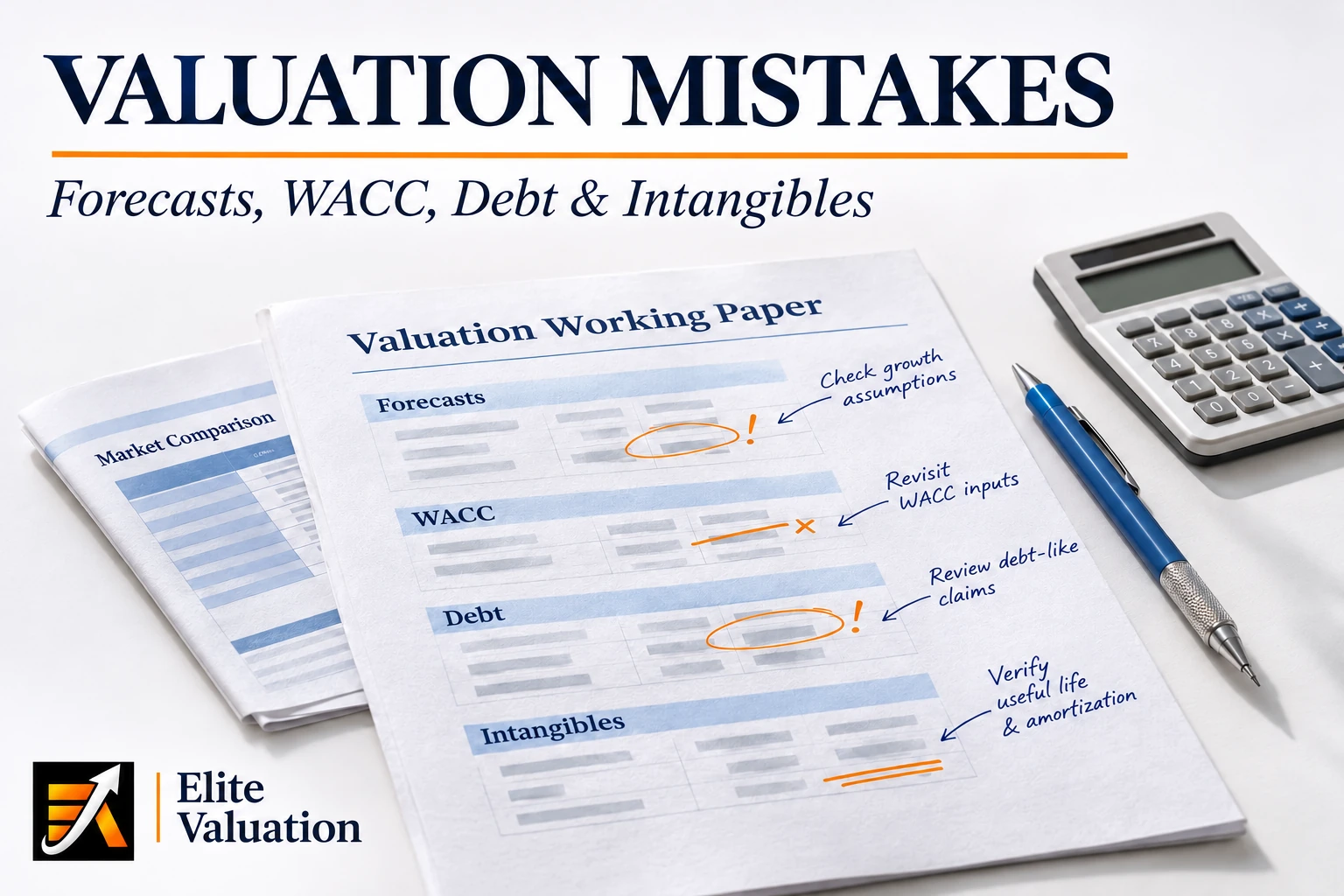
5 common Valuation mistakes quietly dilute shareholder value in a sale, a fundraising or a merger. Most of the loss happens before negotiation begins: an optimistic forecast, a single method, an unsupported discount rate, debts left out of the bridge, or intangibles that were never documented. Each error is avoidable, and each is visible to a buyer’s advisers within days of the data room opening. This guide shows how to avoid every one of them.
Key takeaways
- Anchor forecasts in evidence. Tie growth to history, the order book and sector data, and show a downside case.
- Use more than one method. Reconcile the income, market and asset approaches rather than choosing the most flattering one.
- Build the discount rate from documented parts. Each component of the cost of equity needs a stated source.
- Deduct every debt-like claim. Guarantees, leases, deferred payments and disputed demands all reduce equity value.
- Document intangibles. Value that cannot be shown to a buyer is value the buyer will not pay for.
- Review before the buyer does. Run an internal due diligence well before any process is launched.
Mistake 1: Relying on Unrealistic Growth Projections
A forecast that departs sharply from the company’s own history, without a documented reason, will be discounted by any experienced buyer or valuer. The number that survives diligence is the one the order book and the market can explain.
The Danger of Overly Optimistic Assumptions
Owners often present the growth they expect rather than the growth they can evidence. A projection that moves from 22% a year to 60% in one step raises the obvious question of what changed. Buyers in Mumbai, Bengaluru and Gurugram test every forecast against three checks: the historical growth rate, the sector growth reported by credible sources, and the revenue already contracted for the next twelve months.
A forecast that fails those checks does not raise the value. It lowers credibility, and the valuer applies a higher discount rate or a lower terminal growth rate to compensate. The premium the optimistic number was meant to create is lost, and the owner ends up with less than a realistic case would have produced.
Mistake 2: Fixating on a Single Valuation Method
No single method captures every driver of value. Income, market and asset approaches answer different questions, and a defensible Valuation reconciles them rather than choosing the most favourable one.
Why One Method Never Tells the Whole Story
A discounted cash flow can move sharply on a small change in the terminal assumption. Market multiples reflect what buyers paid for other companies, often at a different stage or scale. A net asset approach may ignore the earning power of the business altogether. Ind AS 113 requires fair value from the perspective of a market participant, and the IBBI Valuation Standards expect the valuer to consider the approaches that are appropriate and to explain the choice.
Combining methods gives a balanced view. Figure 2 shows a hypothetical range for an engineering company in Pune. Each bar is the range from one method, and the shaded band is the range the valuer can reconcile. A seller who presents only the highest bar invites a buyer to show the lowest one, and the negotiation starts from the buyer’s number.
The cross-method illustration assumes nil net debt solely to make its enterprise-value and NAV figures comparable.
Mistake 3: Miscalculating the Discount Rate (WACC)
The weighted average cost of capital is only as sound as its components. Most errors sit in the beta, the equity risk premium, the size or company-specific premium and the target capital structure, and each one changes the Value materially.
Errors in Assessing Risk and the Cost of Equity
The cost of equity is usually built as the risk-free rate plus beta multiplied by the equity risk premium, plus any size or company-specific premium. The common errors are using a short-term rate in place of the long-term government bond yield, taking a beta from peers whose business mix differs materially, applying a premium without a stated reason, and weighting debt at today’s ratio when the company plans a different capital structure, as is common for a business in Gurugram or Delhi raising growth capital.
Table 1 sets out a hypothetical build-up. The inputs are illustrative, but they show how a single choice moves the answer.
| Component | Hypothetical input | What to document |
|---|---|---|
| Risk-free rate | 7.0% | Long-term government bond yield at the Valuation date |
| Beta (relevered) | 1.3 | Peer set matched to the business mix, at the target debt level |
| Equity risk premium | 7.0% | Documented market premium, applied consistently |
| Size or specific premium | 3.0% | A stated reason, such as customer concentration |
| Cost of equity | 19.1% | 7.0% + (1.3 × 7.0%) + 3.0% |
If the owner used a beta of 1.0 without a supporting peer set, the cost of equity would fall to 17.0% and the Value would rise. A buyer who sees an unexplained beta will apply the higher figure, and the gap becomes the negotiation.
Need Your Discount Rate Tested Before a Buyer Does?
We document each component of the cost of equity and the target capital structure, so the rate can be defended line by line in a transaction.
Review Your Discount RateCompany Valuation | Transaction Advisory | Share Valuation
Mistake 4: Overlooking Hidden Liabilities and Debt
Equity value is enterprise value less every debt-like claim. Guarantees, lease liabilities, disputed tax demands and deferred payments that sit outside the headline debt figure reduce what shareholders receive, and buyers will find them.
How Unrecorded Debt Skews the Value and Harms Investor Trust
A Valuation bridge that deducts only bank borrowings overstates the equity. Buyers and investors look for personal guarantees given for group companies, lease liabilities under Ind AS 116, deferred consideration on past acquisitions, customer advances that may need refunding, and disputed tax or GST demands. Each one is a claim on the value shareholders would otherwise receive. Figure 3 shows how these items move a hypothetical equity value.
Omitting items does more than lower the number. It damages trust. Once a buyer finds one undisclosed guarantee, every other figure in the data room is re-tested, and the price is reset with a wider discount.
A reporting nuance matters here. Secondary commentary indicates that the net asset value formula under Rule 57 of the Income-tax Rules, 2026 excludes contingent and unascertained liabilities for tax purposes. That should be confirmed against the notified text. A transaction Valuation prepared for a buyer or investor must still reflect the expected cost of those claims, and the two figures should be reconciled in writing.
Mistake 5: Failing to Properly Document Intangible Assets
Intellectual property, brand, customer relationships and software often drive much of a technology or consumer business’s value, yet they are largely absent from the balance sheet. If they are not documented, a buyer assigns them little or no worth.
The Cost of Ignoring Intellectual Property and Brand Equity
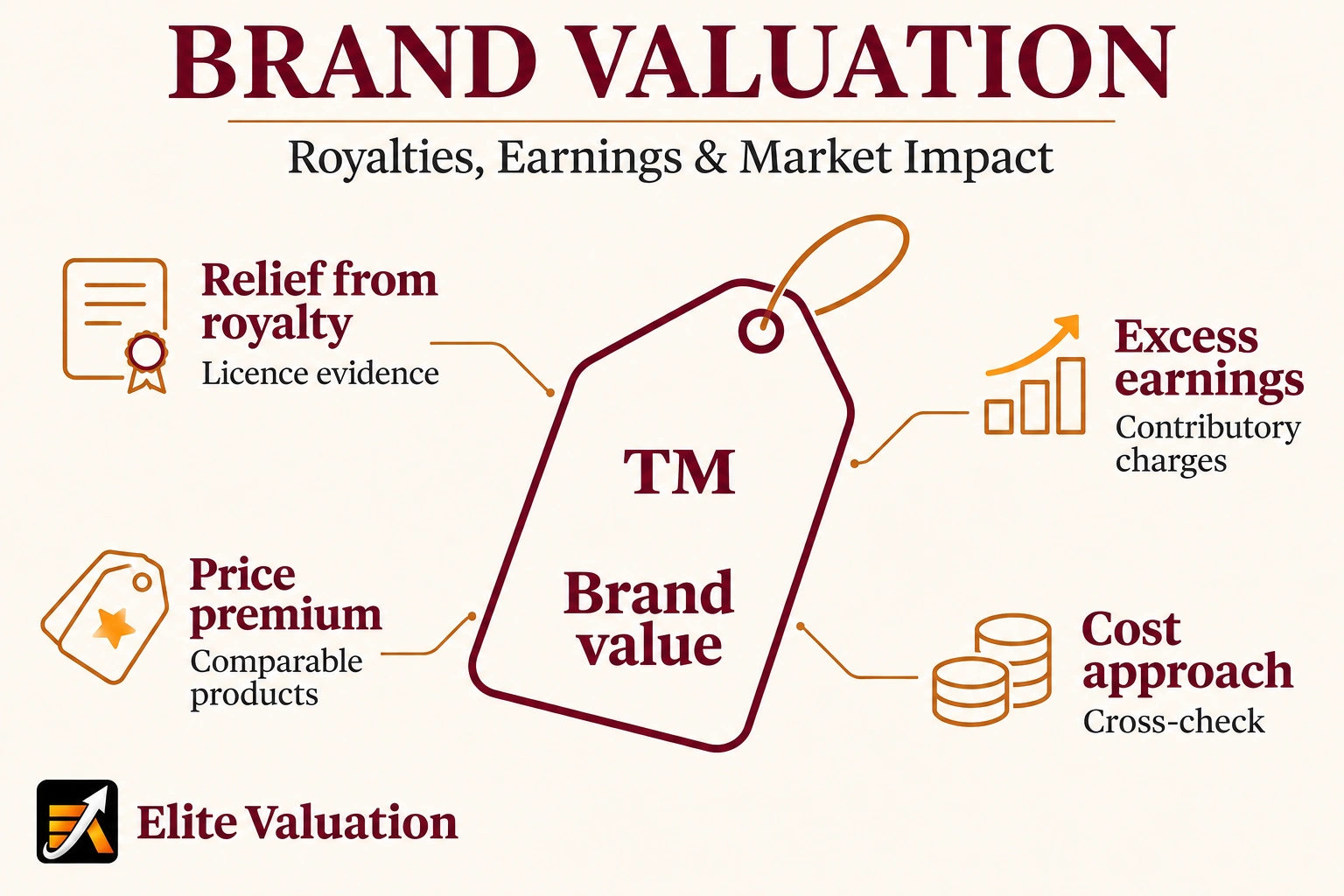
Internally generated brands and most self-developed intangibles are not recognised on the balance sheet under Ind AS 38, so the accounts understate them. In an acquisition, Ind AS 103 requires identifiable intangibles to be recognised at fair value. The documentation therefore decides how much of the price is allocated to brands, technology and customer relationships, and how much falls into goodwill. Companies in Bengaluru, Pune and Ahmedabad that cannot show ownership of their platform or brand often find the buyer’s valuer allocating very little to either.
A Hyderabad software company is offered a price based on its tangible assets and recent earnings. Its platform code, a registered trademark and a customer base with renewal history are not documented. Once the owner assembles the assignments, the trademark registration and renewal data, the valuer attributes a separate fair value to the platform and customer relationships. The buyer’s range moves up because the uncertainty that discounted those assets has been removed.
For each asset, record the owner, the registration or filing number, the contracts that support it and the chain of title. Where a founder, employee or contractor created it, obtain a signed assignment. Our patent Valuation guide explains how patents are valued at each stage.
How to Safeguard Shareholder Value During M&A
Protect value before a transaction begins. Reconcile the numbers, test the assumptions and run an internal due diligence that a buyer would run, so that price is decided on evidence rather than on questions raised late in the process.
Internal due diligence gives the owner the chance to find these errors before the buyer does. A practical sequence is set out below.
- Reconcile the accounts. Tie audited, management and tax figures together before any adviser is engaged.
- Stress-test the projections. Build a downside case and identify the assumptions that move the value most.
- Review the discount rate. Document each component of the cost of equity and the target capital structure.
- Schedule debt-like items. List guarantees, leases, deferred payments, advances and disputed claims with amounts.
- Map intangibles. Record ownership, registrations, contracts and assignments for each asset.
- Run a mock buyer review. Ask an adviser outside the deal team to test the data room as a buyer in Mumbai or Delhi would, and record every question.
A file prepared this way narrows the range a buyer can argue and removes the surprises that reset the price late in a process.
Secure an Accurate, Defensible Valuation
A defensible Valuation is one that another adviser can follow from the forecast to the equity value, with every assumption sourced and every debt-like item deducted. Elite Valuation provides transaction advisory and Valuation services for M&A, fundraising and regulatory purposes, prepared under the registered valuer framework, so the owner can enter a negotiation with a range that holds up under review.
Protect Shareholder Value Before the Deal Starts
Share your projections, debt schedule and intangibles register. We will test the assumptions, reconcile the methods and identify where a buyer is likely to push back.
Discuss Your TransactionTransaction Advisory | M&A Buy-Side Advisory | Company Valuation | Share Valuation
Frequently Asked Questions About Valuation Mistakes
What are the most common Valuation mistakes that dilute shareholder value?
The most damaging errors are unrealistic growth projections, reliance on a single Valuation method, an unsupported discount rate, omitted debt-like liabilities and undocumented intangible assets. Each one lowers the credible value or forces a wider discount during a transaction, and each is visible to a buyer’s advisers during due diligence.
How do growth projections reduce company value?
A projection that departs sharply from historical growth, without a documented reason, is discounted by the buyer or valuer. The result is a lower value and a loss of credibility. Forecasts should be tied to the order book, the pipeline, sector data and a downside case, so the number survives diligence.
Why should more than one Valuation method be used?
Each method answers a different question. Discounted cash flow captures future earnings, market multiples reflect comparable pricing, and asset approaches show net worth. Reconciling two or more methods shows where the Value sits and exposes the assumptions that drive a single answer. Relying on one method leaves the figure open to challenge.
What is WACC and why does it matter in a Valuation?
The weighted average cost of capital is the rate used to discount cash flows to the firm. It combines the cost of equity and the after-tax cost of debt in the target capital structure. A small error in beta, the equity risk premium or a company-specific premium changes the Value materially, so each component should be documented.
Which hidden liabilities should be deducted from enterprise value?
Deduct bank and non-bank borrowings, lease liabilities under Ind AS 116, guarantees given for group companies, deferred consideration on past acquisitions, customer advances that may be refunded, and disputed tax or statutory demands. Contingent claims should be assessed for probability and reflected in the transaction Valuation.
Are contingent liabilities deducted under Rule 57 of the Income-tax Rules, 2026?
Secondary commentary indicates that the net asset value formula under Rule 57 excludes contingent and unascertained liabilities for tax purposes. Confirm this against the notified text. A transaction Valuation prepared for a buyer or investor should still reflect the expected cost of those claims, and the two figures should be reconciled in writing.
How should intangible assets be documented for an acquisition?
Record each asset’s owner, registration or filing number, supporting contracts and chain of title. Obtain signed assignments from founders and contractors. Under Ind AS 103, identifiable intangibles are recognised at fair value in a business combination, so documented ownership and separable cash flows determine how much of the price is allocated to them rather than to goodwill.
What does internal due diligence involve before a sale?
Internal due diligence reconciles the accounts, stress-tests projections, documents each discount rate input, schedules debt-like items, maps intangibles and reviews the data room as a buyer would. The aim is to find and fix errors before the buyer’s advisers do, which protects both the price and the timetable.
Can an owner rely on an informal estimate of value before selling?
An informal estimate is useful for planning, but it should not set a price, a share exchange ratio or a regulatory filing. A registered valuer’s report sets out the method, the assumptions and the sources, which a buyer, investor or regulator can test. Where the Companies Act or FEMA rules require a registered or certified valuer, an informal estimate does not satisfy them.
How can family owners protect value when selling a business?
Separate personal expenses and related party transactions from the earnings, document each adjustment, and align the shareholder agreement with the method that will be used. Family owners should also agree the rights attached to each class of shares before the process begins, because preference rights change how the proceeds are shared.
Sources
- Ind AS 37, 38, 103, 113 and 116, Ministry of Corporate Affairs.
- Income-tax Act, 2025 and Income-tax Rules, 2026, Rule 57 (previously Rule 11UA), with the notified text to be confirmed for the treatment of contingent liabilities in the net asset value formula.
- Insolvency and Bankruptcy Board of India, Registered Valuers Regulations and the IBBI Valuation Standards: ibbi.gov.in

Disclaimer. General information only, not legal, tax, accounting or investment advice, and not a Valuation of any company or security. All figures, scenarios and the Table 1 build-up are hypothetical. The treatment of contingent liabilities under Rule 57 must be confirmed against the notified text. Research date: 9 November 2026.