📌 For Founders and Promoters — What You Must Know
You do not need to give up a single share to reward the people who make your company valuable. Phantom stock and cash-settled Stock Appreciation Rights (SARs) — collectively known as synthetic equity or non-dilutive equity compensation — pay employees in cash, tied entirely to the company's share value, without transferring ownership, voting rights, or a single line on the cap table.
- Employees get real, meaningful upside tied to the company's growth — comparable to actual equity
- Promoters keep 100% of voting control and cap table ownership
- No shareholder special resolution under Section 62(1)(b) of the Companies Act, 2013
- No SEBI (SBEB & SE) Regulations, 2021 scheme filing — even for listed companies, if cash-settled
- Taxed simply as salary income for the employee; deductible as a business expense for the company
Every growing Indian company eventually hits the same wall: the people you most need to retain — a CFO who understands the business cold, a plant head who has run operations for a decade, a sales leader who owns every key client relationship — expect to be paid like stakeholders, not just employees. The instinctive answer is an ESOP. But for family businesses protecting a multi-generational shareholding, bootstrapped founders guarding a tight cap table before their first institutional round, or promoters who simply do not want a minority shareholder register with exit rights attached to it, an ESOP is not always the right instrument — even though it is the default one everyone reaches for.
The good news is that real equity is not the only way to give an employee "skin in the game." Synthetic equity instruments — phantom stock and cash-settled SARs — replicate the exact financial upside of owning shares, without a single share ever changing hands. At Elite Valuation, we design, value, and help structure both real equity plans through our ESOP advisory practice and non-dilutive synthetic equity plans for promoters who want the retention power of equity without the cap table consequences. This guide walks through exactly how phantom stock and cash-settled SARs work, how they are taxed and regulated in India, and how to structure one without creating a cash-flow problem for your business three years from now.
Key Takeaways:
- Synthetic equity (phantom stock and cash-settled SARs) pays employees cash linked to share value — with zero shares issued and zero cap table impact
- Phantom stock is typically a Full Value plan (employee gets the entire share value at payout); cash-settled SARs are typically an Appreciation-Only plan (employee gets only the growth in value)
- Because no shares are issued, these plans fall outside Section 62(1)(b) of the Companies Act, 2013 and the Companies (Share Capital and Debentures) Rules, 2014
- Cash-settled SAR schemes are explicitly excluded from the SEBI (Share Based Employee Benefits and Sweat Equity) Regulations, 2021 — even for listed companies
- Payouts are taxed as ordinary salary income for the employee — no perquisite valuation, no capital gains — and are deductible business expenses for the company
- Even without share issuance, the liability must be fair-valued and booked under Ind AS 102 as a cash-settled share-based payment
- Best suited to family businesses, cash-generative mature companies, bootstrapped startups, and companies with an exhausted ESOP pool
- The primary structuring risk is cash-flow strain at payout — solved by linking payouts to liquidity events and staggered vesting, not fixed calendar dates
- A defensible baseline "mock share" valuation is the foundation the entire plan is built on — get this wrong and every future payout is disputable
What Is Non-Dilutive Equity Compensation? Synthetic Equity Explained
Non-dilutive equity compensation — also called synthetic equity or shadow stock — is a category of employee reward plans that mimic the financial experience of owning company shares without ever transferring actual ownership. The two instruments used almost universally in India for this purpose are phantom stock and cash-settled Stock Appreciation Rights (SARs). Both are purely contractual: the company promises to pay the employee a cash amount, calculated by reference to a notional number of "mock shares" and the company's per-share value, at a defined future date or trigger event.
Nothing about the company's actual share capital changes. No shares are allotted, no entry is made in the register of members, no voting rights are created, and no minority shareholder is added to the cap table. The employee's right exists only as a contractual entitlement to a future cash payment — legally closer to a deferred cash bonus scheme than to an equity grant, even though it is deliberately designed to feel and perform like one.
📌 The Core Definition — Directly Quotable
Phantom stock and cash-settled SARs give an employee the economic upside of share ownership — calculated against a notional number of shares and an independently valued "mock share" price — settled entirely in cash, with no shares issued, no voting rights created, and no change to the company's cap table.
This distinction matters because it directly determines which law applies. A real ESOP is, legally, a form of share capital issuance — governed by Section 62(1)(b) of the Companies Act, 2013. Phantom stock and cash-settled SARs are not share issuances at all — they are compensation contracts, governed primarily by the Indian Contract Act, 1872, and the company's own board-approved scheme rules. This one structural difference is what unlocks nearly every advantage discussed in this guide: no special resolution, no ROC filing, no SEBI scheme approval, and no minority shareholder complications.
The Founder's Dilemma: Why Promoters Hesitate to Offer Real Equity
Almost every founder or promoter we advise arrives at the same crossroads. A key employee — often one the business genuinely cannot afford to lose — wants to be compensated in a way that reflects the value they are creating, not just a salary hike. The instinctive, well-worn answer is an ESOP. But real equity comes with consequences that go well beyond the percentage number on a cap table spreadsheet.
Cap Table Dilution Compounds With Every Grant
Reduces Founder Ownership %
Every ESOP pool — typically 5–10% of fully diluted equity — permanently reduces promoter ownership, before a single rupee of external investment has even been raised. For family businesses planning succession across generations, or founders anticipating multiple future funding rounds, this dilution stacks up fast.
Minority Shareholder Complications on Employee Exit
Buyback & Exit Friction
When an ESOP holder resigns, is terminated, or simply wants liquidity, the company typically needs a buyback mechanism, a valuation exercise, and often board and shareholder approvals under Sections 68–70 of the Companies Act, 2013. Left unmanaged, departed employees can remain minority shareholders indefinitely — with statutory protection against oppression and mismanagement under Sections 241–242.
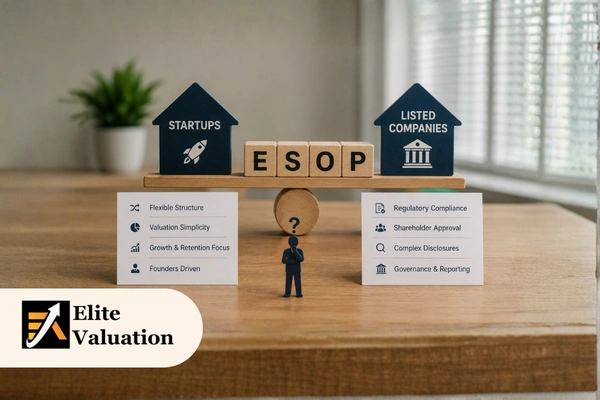
None of this makes ESOPs the wrong choice — for venture-backed startups competing for talent against well-funded platforms, a real ESOP pool is often non-negotiable, and our ESOP advisory practice exists precisely to help such companies structure one correctly. But for a very large segment of Indian businesses — family-run manufacturing groups, professional services firms, cash-generative mid-market companies, and founders who are simply not ready to formalise a minority shareholder base — the dilemma is real: how do you compensate a key employee like a stakeholder, without actually making them one?
Phantom Stock vs Cash-Settled SARs vs Traditional ESOPs — How Are They Different?
Phantom Stock — Full Value, Cash-Settled
Full Value Plan
Zero Dilution
- Employee is granted a notional number of "phantom units" mirroring real shares
- At payout, the employee receives cash equal to the entire current value of those notional units — as if they actually owned and sold the shares
- Often includes phantom "dividend equivalents" — periodic cash payments mirroring what a real shareholder would receive as dividends
- No shares are ever issued; the employee's right exists only on paper as a contractual entitlement
Cash-Settled Stock Appreciation Rights (SARs) — Appreciation Only
Appreciation-Only Plan
Zero Dilution
- Employee is granted a right to the increase in value of a notional number of shares between the grant date and the exercise/payout date
- Structurally mirrors a stock option's economics, but settled entirely in cash instead of shares
- No cash outlay at grant for either party — the employee "exercises" the right and is simply paid the appreciation in cash
- The baseline ("strike") value is fixed at grant and excluded from the payout calculation
Traditional ESOP — Real Equity
Dilutive
Section 62(1)(b) Applies
- Employee receives an actual option to acquire real shares at a pre-fixed exercise price
- On exercise, shares are allotted, the employee becomes a shareholder, and the cap table changes permanently
- Governed by Section 62(1)(b) of the Companies Act, 2013 and the Companies (Share Capital and Debentures) Rules, 2014
- Requires a shareholder resolution, a board-approved scheme, and — for listed companies — compliance with the SEBI (SBEB & SE) Regulations, 2021
| Parameter | Traditional ESOP | Phantom Stock (Full Value) | Cash-Settled SARs (Appreciation-Only) |
|---|---|---|---|
| Ownership Transferred | Yes — real shares | No — notional units only | No — notional units only |
| Cap Table Impact | Diluted permanently | None | None |
| Voting Rights | Yes, on exercise | None | None |
| Settlement | Shares (equity) | Cash | Cash |
| Payout Basis | Full share value on sale | Full share value at payout | Appreciation only |
| Section 62(1)(b) Applicable | Yes | No | No |
| SEBI SBEB & SE Regs, 2021 (Listed Cos.) | Yes | No (cash-settled) | No (cash-settled) |
| Employee Tax Treatment | Perquisite + capital gains | Salary income only | Salary income only |
| Company Cash Outflow | None (dilution instead) | Yes, at payout | Yes, at payout |
Appreciation-Only vs Full Value: Which Model Fits Your Business?
Plan Design Phase
The choice between an Appreciation-Only structure (typical of SARs) and a Full Value structure (typical of phantom stock) is the single most consequential design decision in the entire plan — it determines both how motivating the grant feels to the employee and how large a cash liability the company is signing up for.
📌 Worked Example — Same Grant, Two Outcomes
Assume: 1,000 notional units granted, baseline "mock share" value at grant = ₹1,000 per unit. Four years later, an independent valuation puts the mock share value at ₹2,500 per unit.
- Full Value (Phantom Stock): Payout = 1,000 × ₹2,500 = ₹25,00,000
- Appreciation-Only (SAR): Payout = 1,000 × (₹2,500 − ₹1,000) = ₹15,00,000
The Full Value structure pays out 67% more for an identical grant size — because it also compensates the employee for the value that already existed on day one, not just the growth achieved afterward.
Appreciation-only SARs are generally the better fit when the objective is to reward future growth specifically attributable to the employee's tenure — which is why they are the closer economic cousin of a stock option. Full-value phantom stock is generally preferred when the intent is closer to a genuine ownership substitute — for example, rewarding a long-serving family-business executive who is, in substance, being treated as a near-equal stakeholder, just without the share certificate. Many Elite Valuation clients use a blended approach: appreciation-only SARs for broader senior management, and full-value phantom stock reserved for one or two truly irreplaceable individuals.
Not Sure Whether Phantom Stock or a Real ESOP Fits Your Cap Table?
The right instrument depends on your growth stage, fundraising plans, and how much of the cap table you can afford to hold in reserve. We benchmark both paths against your specific ownership and hiring goals before you commit to either.
Strategic Advantages for Promoters: Zero Dilution, Full Control
Zero Cap Table Dilution
0% Equity Diluted
Cap Table Unchanged
Because no shares are ever allotted, the promoter's percentage ownership on the day the plan is signed is mathematically identical to their percentage ownership on the day the last payout is made — regardless of how many employees participate or how large the plan grows.
Full Voting Control Retained
No New Shareholders
Promoters retain complete decision-making authority — no employee acquires a vote on board composition, dividend declarations, related-party transactions, or any other matter reserved for shareholders under the Companies Act, 2013.
No Minority Shareholder Interference
No Oppression & Mismanagement Exposure
Because the employee is a creditor of a contractual promise, not a shareholder, the statutory minority protections under Sections 241–242 of the Companies Act, 2013 simply do not arise. There is no register-of-members entry to unwind and no ongoing shareholder relationship to manage after the employee exits.
Equity Fully Preserved for Future Fundraising
Cap Table Stays Clean for Investors
Startups planning an institutional round benefit particularly here: the entire pre-money cap table remains available for the incoming investor's ownership calculation, rather than being pre-diluted by an ESOP pool carved out years earlier for reasons unrelated to the fundraise.
Is Phantom Stock Regulated Under the Companies Act, 2013?
Regulatory & Compliance Phase
This is the question every promoter's company secretary eventually asks — and the answer is what makes synthetic equity administratively lighter than a real ESOP. A traditional ESOP is a share issuance event, so it must run through Section 62(1)(b) of the Companies Act, 2013 and the Companies (Share Capital and Debentures) Rules, 2014 — for private companies this is relaxed by MCA notification to permit an ordinary rather than special resolution, but a shareholder resolution, a formal scheme document, a minimum one-year vesting cliff, and specific disclosure requirements remain mandatory either way.
Phantom stock and cash-settled SARs bypass this entire framework, because they never result in the allotment of a single share.
✔ What a Non-Dilutive Synthetic Equity Plan Requires (Unlisted Company)
- A board resolution approving the scheme rules
- A properly drafted plan document and individual grant letters
- An independently determined baseline "mock share" valuation
- Ind AS 102-compliant liability accounting (see Section 8 below)
- TDS compliance on payout, since the amount is taxed as salary income
⚠️ For Listed Companies — SEBI Treatment. The SEBI (Share Based Employee Benefits and Sweat Equity) Regulations, 2021 apply only to schemes that involve dealing in, subscribing to, or purchasing securities of the company. A cash-only settled SAR scheme is explicitly excluded from this scope, meaning even a listed company can implement one without SEBI's scheme filing or in-principle stock exchange approval. However, the plan document must be drafted so it is unambiguously and irrevocably cash-settled — any optionality to settle in shares pulls the entire scheme back under SEBI's regulatory framework. Listed-company promoters must also assess the plan against the SEBI (Prohibition of Insider Trading) Regulations, 2015 where payout triggers are linked to unpublished price-sensitive information.
How Are Phantom Stock and SAR Payouts Taxed in India?
Tax Structuring Phase
The tax treatment of synthetic equity is, deliberately, far simpler than the two-stage taxation that applies to real ESOPs — and this simplicity is itself a meaningful advantage for both the company's payroll function and the employee's personal tax planning.
| Event | Traditional ESOP | Phantom Stock / Cash-Settled SAR |
|---|---|---|
| At Grant | No tax event | No tax event |
| At Vesting | No tax event | No tax event |
| At Exercise / Payout | Perquisite tax on (FMV − exercise price) under the salary provisions of the Income-tax Act, 2025 (successor to Section 17(2), 1961 Act) | Entire cash payout taxed as ordinary salary/bonus income under Sections 15–16 and the successor to Section 17 |
| At Sale of Shares | Capital gains tax under the Income-tax Act, 2025 (successor to Section 45, 1961 Act) — LTCG/STCG depending on holding period | Not applicable — no shares exist to sell |
| TDS Obligation | Employer withholds on perquisite value | Employer withholds on full payout as salary |
| Employer Deduction | ESOP cost generally not a cash-tax-deductible expense in the same way | ESOP cost generally not a cash-tax-deductible expense in the same way |
📌 The Key Tax Distinction — Directly Quotable
Real ESOP payouts are taxed in two stages — a perquisite tax at exercise and a capital gains tax at eventual share sale. Phantom stock and cash-settled SAR payouts are taxed in a single stage — entirely as ordinary salary income in the year the cash is received — with no perquisite valuation exercise and no capital gains component at all.
For the employee, this means no risk of being taxed on paper gains before any liquidity exists, and no separate long-term capital gains planning years down the line. For the employer, structuring payouts to align with the actual-payment-basis requirement is important where amounts are characterised as bonus or commission — the deduction is available only once the cash actually leaves the company's account before the return filing due date, not merely when the liability is booked.
Need a Legally Airtight Phantom Stock or SAR Scheme?
From the plan document and grant agreements to board resolutions and Ind AS 102-compliant valuation, we build the full structure so it holds up under scrutiny — from employees, auditors, and future investors alike.
Accounting Treatment: Why Synthetic Equity Still Needs Ind AS 102
A common misconception among founders is that because no shares are involved, phantom stock and cash-settled SARs sit entirely outside formal accounting standards. They do not. Under Ind AS 102 (Share-based Payment), any arrangement whose value is linked to the company's equity — regardless of whether it is settled in shares or cash — falls within scope. Phantom stock and cash-settled SARs are specifically classified as cash-settled share-based payment transactions.
The practical consequence: the company must recognise a liability — not an equity reserve — on its balance sheet for the fair value of the obligation, and that liability must be re-measured at every reporting date until the final payout, with the change in fair value flowing through the profit and loss statement. This is a meaningfully different accounting treatment from an equity-settled ESOP, where the cost is recognised once against an equity reserve and never re-measured. It also means auditors will expect a defensible, updated valuation of the underlying mock share price at every year-end — not just at grant — which is where independent valuation support becomes a recurring, not one-time, requirement.
Who Should Use Synthetic Equity Instead of ESOPs?
Family-Owned and Multi-Generational Businesses
Succession-Sensitive
Where ownership is deliberately being kept within the family across generations, phantom stock lets the business reward a non-family CFO, plant head, or sales leader competitively — without introducing an outside name onto the shareholder register.
Cash-Rich, Mature, Profitable Companies
Can Fund Payouts From Cash Flow
Established companies generating consistent free cash flow are well positioned to absorb periodic phantom stock or SAR payouts without needing to raise capital or sell equity to fund them.
Bootstrapped Startups Protecting Early Founder Equity
Pre-Institutional Round
Founders who have not yet raised institutional capital and want to avoid carving out an ESOP pool before their cap table is even finalised can use synthetic equity to retain early hires competitively, then introduce a real ESOP pool once the company is fundraising and the pool can be sized properly.
Companies With an Exhausted ESOP Pool
Pool Fully Allocated
When the approved ESOP pool has already been fully granted and a shareholder resolution to expand it is not feasible or desirable in the near term, phantom stock provides a way to keep making competitive offers to new key hires without reopening the cap table conversation.
Need an Independent Baseline Valuation for Your Synthetic Equity Plan?
As an IBBI Registered Valuer, we establish the defensible "mock share" price your plan runs on — the number every future payout, audit, and dispute will be measured against.
Steps to Structure a Phantom Stock or SAR Plan
Implementation Phase
1. Independent Baseline Valuation — Establish the "Mock Share" Price
Every phantom stock or SAR plan is only as credible as the baseline valuation it is anchored to. An independent, defensible valuation at grant — and at each subsequent reporting date — protects both the employee (who needs to trust the number) and the company (which needs it to survive an audit or a dispute).
2. Choose the Model — Appreciation-Only or Full Value
Decide whether the plan rewards growth from the grant date (SAR-style, appreciation-only) or the entire share value at payout (phantom stock-style, full value) — see the worked example in Section 4 above.
3. Draft the Plan Document and Grant Agreements
The scheme rules and individual grant letters must clearly state that the arrangement is purely contractual and cash-settled, define the notional unit mechanism, and set out forfeiture, termination, and dispute-resolution provisions in unambiguous language.
Define the Vesting Schedule and Trigger Events
Set a multi-year vesting schedule (commonly 3–4 years, often with a one-year cliff, mirroring ESOP market practice) and specify whether payout occurs on a fixed date or only on a defined trigger — acquisition, IPO, or a revenue/EBITDA milestone.
Model the Future Cash-Flow Liability
Project the potential payout obligation across multiple growth scenarios so the company's finance team can plan for it well in advance, rather than discovering the liability only when it comes due.
Communicate Clearly — Set Employee Expectations From Day One
Employees must understand, in writing and in conversation, that this is a cash bonus plan linked to share value — not equity ownership. Ambiguity here is the single most common source of disputes when payout time arrives.
Managing the Cash Flow Challenge: Linking Payouts to Liquidity Events
The one genuine trade-off of non-dilutive equity compensation is that the company takes on a future cash obligation instead of a future dilution obligation. Unlike an ESOP, where the "cost" to the company is a smaller ownership percentage, a phantom stock or SAR payout is a real cash outflow — and if it is not planned for, it can land at exactly the wrong moment for the business's liquidity position.
⚠️ The Cash Flow Risk Is Real — Plan for It Structurally, Not Reactively. A large payout falling due during a working-capital-intensive quarter, or immediately before a planned capital expenditure, can force a company into a difficult choice between honouring the plan and funding operations. This is avoidable with the right structural design from day one.
📌 Structural Safeguards Against Payout-Driven Cash Strain
- Trigger-linked payouts: Tie the payout to a defined liquidity event — an acquisition, an IPO, or a specific revenue/EBITDA milestone — rather than a fixed calendar date, so the cash to fund it is often generated by the very event that triggers it
- Staggered, multi-year vesting: Spread payout obligations across several years rather than a single cliff date
- Payout caps: Set a maximum cash ceiling per employee or per plan year, with any excess deferred or converted to a follow-on grant
- Periodic liability modelling: Re-forecast the accumulated liability at each valuation date so finance teams see the number coming, not arriving
- Reserve or sinking fund: Larger, cash-generative companies often set aside a portion of annual free cash flow specifically against the modelled liability
Companies pursuing an eventual sale, acquisition, or IPO frequently find that tying phantom stock or SAR payouts to that exact event is the cleanest structure of all — the liquidity event itself generates the cash to fund the payout, aligning the timing of the obligation with the timing of the company's own cash inflow. This is a common structure we build for clients preparing for an eventual M&A exit, where the synthetic equity payout is explicitly modelled as part of the transaction waterfall.
Case Study: Retaining a CFO and Two Regional Heads Without Diluting a Third-Generation Family Business
Sector: Family-Owned Manufacturing
Structure: Cash-Settled SARs — Appreciation-Only
Team Covered: 3 Senior Executives
A third-generation, family-owned engineering manufacturing group based in Gujarat, with revenue of approximately ₹140 crore, faced a retention risk on three critical non-family executives — its CFO and two regional sales heads — during an active succession planning process among family shareholders. An ESOP was considered and rejected: the promoter family was unwilling to introduce outside shareholders or voting rights while ownership transition among family members was still being finalised.
Elite Valuation established an independent baseline "mock share" valuation for the group, then structured a four-year, cliff-vested, appreciation-only cash-settled SAR plan for the three executives, with payout additionally triggered on a change-of-control event. The plan document, board resolution, and individual grant letters were drafted to be unambiguously cash-settled, and a five-year cash-liability model was built for the family's finance office.
All three executives remained through a subsequent strategic acquisition of a controlling stake in the group, at which point their SAR payouts were funded directly from transaction proceeds — without drawing on the company's working capital at any point in the process.
Where Promoters Go Wrong — Common Synthetic Equity Mistakes
❌ Setting the baseline mock share price without an independent valuation
An internally guessed or founder-assigned baseline value has no defensibility — with the employee, with auditors under Ind AS 102, or in the event of a dispute at payout.
Fix: Commission an independent baseline valuation at grant, and re-value at every subsequent reporting date.
❌Treating the plan as an informal understanding instead of a drafted legal agreement
Verbal or loosely worded commitments create ambiguity over vesting, forfeiture on termination, and exactly what counts as a "liquidity event" — precisely the terms most likely to be disputed when real money is on the table.
Fix: Draft a formal plan document and individual grant letters that are unambiguous on every trigger, forfeiture, and payout mechanic.
❌ Ignoring Ind AS 102 liability accounting
Some companies book nothing until the cash is actually paid, understating liabilities on the balance sheet in the interim and creating an unpleasant audit finding later.
Fix: Recognise and re-measure the liability at fair value at every reporting date, from grant onward.
❌ Fixing payout to a calendar date with no link to liquidity
A plan that matures on a fixed date regardless of the company's cash position can force a payout during a working-capital crunch, unrelated to whether the company has the cash on hand.
Fix:Link payout triggers to liquidity events or model the obligation years in advance and build reserves against it.
❌Letting employees believe they hold real equity
If an employee walks away from a conversation believing they own shares, will get a vote, or will get capital gains tax treatment, the mismatch surfaces — badly — at payout or exit.
Fix: Communicate explicitly, in writing, that the plan is a cash bonus arrangement linked to share value, not an equity grant.
❌ Missing TDS withholding obligations on payout
Because the entire payout is taxed as salary income, it is subject to the same withholding discipline as any other salary component — an area some companies overlook because the payment "feels" different from regular payroll.
Fix: Route the payout through payroll with correct TDS deduction under the salary provisions of the Income-tax Act, 2025.
❌ Drafting an equity-settled optionality "just in case" into a listed-company SAR scheme
Any optionality to settle in shares — even if never exercised — pulls the entire scheme back within the scope of the SEBI (SBEB & SE) Regulations, 2021, defeating the purpose of choosing a cash-settled structure.
Fix:Draft the scheme to be unambiguously and irrevocably cash-settled from the outset.
Closing Summary: Retention Without Dilution Is a Design Choice, Not a Compromise
The choice between real equity and synthetic equity is not a choice between a "proper" reward and a lesser substitute — it is a structuring decision that should follow directly from the promoter's actual objectives. For a startup racing to compete for talent ahead of its next funding round, an ESOP pool remains the right tool. For a family business protecting a multi-generational shareholding, a bootstrapped founder guarding a tight cap table, or a company whose ESOP pool is already exhausted, phantom stock and cash-settled SARs deliver the same retention power — real, meaningful, share-value-linked upside — without giving up a single vote or a single line on the cap table. At Elite Valuation, we design both paths: full ESOP structuring through our dedicated ESOP advisory practice, and non-dilutive synthetic equity plans anchored by an independent baseline valuation, an airtight plan document, Ind AS 102-compliant accounting support, and a cash-flow model that keeps the promise to your employees from ever becoming a liquidity crisis for your business.
Reward Key Employees Without Giving Up an Inch of Your Cap Table
Baseline valuation → Plan design → Legal drafting → Ind AS 102 accounting support → Ongoing cash-flow modelling. One team, one engagement — zero dilution.
Frequently Asked Questions —Non-Dilutive Equity Compensation in India

CA Sagar Shah, Founder
Mr Sagar Shah is the Founder of Elite Valuation and leads the firm’s Valuation and Advisory practice. With over 15+ years of professional experience.