Business Valuation · Insight
TVS Succession Dispute: Running a Business Is Not Owning Its Value
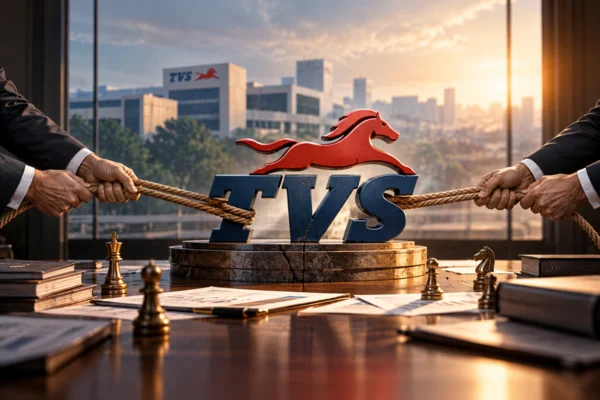
Differences have reportedly emerged within Venu Srinivasan's family over how the TVS group is to be divided between the next generation, involving TVS Motor, TVS Holdings and Sundaram-Clayton. According to Business Today, citing The Economic Times, mediation has failed after nearly 18 months and the camps are weighing a legal route. At the centre is a 21 March 2024 family MoU.
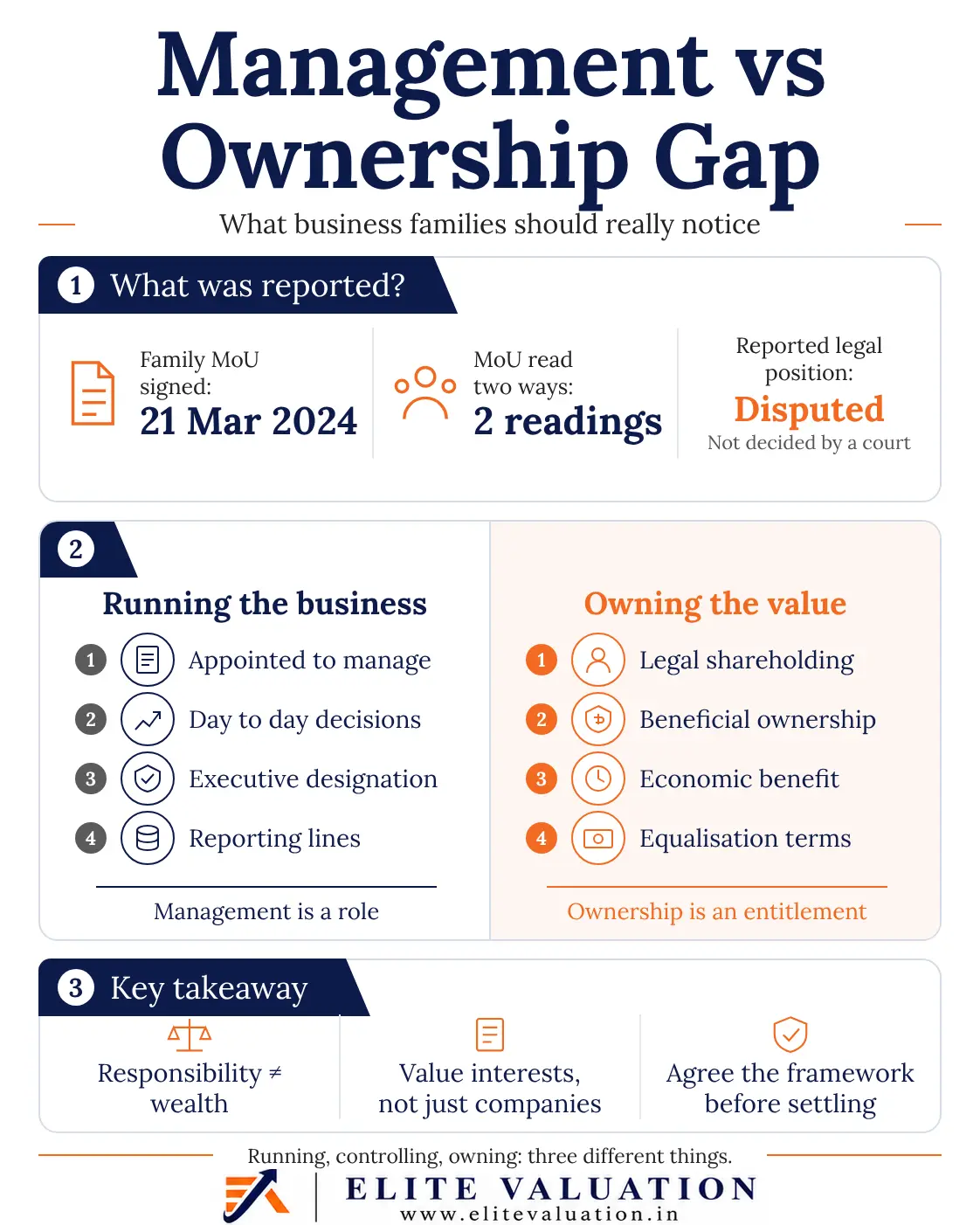
One side reportedly treats the MoU as the formal division of family assets, with TVS Motor going to Sudarshan Venu and Sundaram-Clayton to Lakshmi Venu. The other side reportedly maintains that it addressed brand usage and non-compete arrangements, not the economic division of family wealth. The legal position remains disputed, and nothing here has been decided by a court. The lesson reaches well beyond one family: running a company, controlling it and owning its economic value are three different things, and every business Valuation in a succession depends on keeping them apart.
A family member can be appointed to run a business worth thousands of crores. That designation, by itself, does not establish how much of it they own, or who is entitled to its economic benefit.
Valuation cannot determine legal rights or dictate what is fair. What it can do is make the economic consequences of different settlement structures transparent, so that families negotiate over numbers they can see instead of assumptions each side holds privately.
What the TVS MoU Reportedly Covers
Why This Matters
- Establish ownership before discussing succession. Map direct and indirect shareholdings, family trusts, voting rights and existing legal entitlements. Indian rules on significant beneficial ownership already require declarations of interests held through others, which shows how often the registered holder is not the full picture.
- Value the economic interests, not merely the companies. Two successors each receiving management of a different business have not necessarily received equivalent wealth. Enterprise value, net debt, holding structures, minority interests and transfer restrictions can all change the comparison, as set out in our M&A Valuation framework.
- Separate management responsibility from wealth allocation. One successor can keep running the flagship while another receives economic interests elsewhere. The two arrangements need not be identical, but they must be recorded separately. Courts have given weight to family settlements, and the Supreme Court has held that a document merely recording an earlier family arrangement need not be registered, which makes clear records all the more important.
- Agree the Valuation framework before negotiating settlement. A common Valuation date, consistent assumptions, treatment of control rights and an agreed equalisation mechanism reduce later disagreement. The ICAI Valuation Standards 2018 are a useful common reference, as is our Valuation approach for unlisted companies.
When a Family Settlement Is Clear, and When It Isn't
| Signals Clear Succession Design | Signals Ambiguity |
|---|---|
| Ownership mapped, including trusts and indirect holdings | Ownership assumed from who manages which business |
| Management and wealth allocation recorded separately | One document expected to settle both |
| Common Valuation date and agreed assumptions | Each side relying on its own numbers |
| Equalisation mechanism for differences in value | Unequal businesses treated as equivalent |
| Control rights valued explicitly | Control and economic benefit left undefined |
| Written, signed and consistently understood by all parties | MoU read differently by each signatory |
Six Questions Before You Settle a Family Business
- Who manages the business?
A management appointment answers who runs it, nothing more. - Who legally owns the shares?
Check registered holdings, trusts and beneficial ownership, because the name on a board seat is not a shareholding. - Who exercises control?
Voting rights, board nominations and protective provisions can sit apart from economic ownership. - Who receives the economic benefit?
Dividends, exit proceeds and growth in value must be traced to a person, not a business. - How will differences in value be settled?
If one successor receives a larger asset, the equalisation mechanism should be agreed in advance. - Do all parties accept the same Valuation date and assumptions?
A settlement negotiated on mismatched numbers is a dispute waiting for a trigger.
THE TAKEAWAY. A business empire can survive generations of competition. What it may struggle to survive is generations of ambiguity over ownership. A family settlement should not end with "who gets which business". It should state who manages, who legally owns, who controls, who benefits and how differences in value are settled.
For promoters and family-business owners, succession planning must address more than leadership. Allocating responsibility is not the same as allocating wealth, and a transparent Valuation framework agreed early is the cheapest way to keep the two from being confused.
Does your family settlement allocate wealth, or only responsibility?
Planning a succession, a family settlement or a holding restructure? Elite Valuation provides independent Valuation reports, equalisation analysis and structuring support for family business transactions, under Rule 11UA, Ind AS 113, SEBI and FEMA NDI Rules.

Founder - Elite Valuation
CA Sagar Shah
IBBI Registered Valuer & Business Valuation Expert in India
Chartered Accountant (All India Rank) · Company Secretary · Ex-Ernst & Young.
15+ years advising Promoters, Investors, and MNCs on Valuation, ESOP, M&A, FEMA, AIF, Transfer Pricing, and Cross-Border Transactions across India.
- CA — All India Rank
- Company Secretary
- IBBI Registered Valuer
- Ex-Ernst & Young
- 500+ Clients