Goodwill Valuation Services in India
Determine the Value That Exists Beyond Identifiable Assets
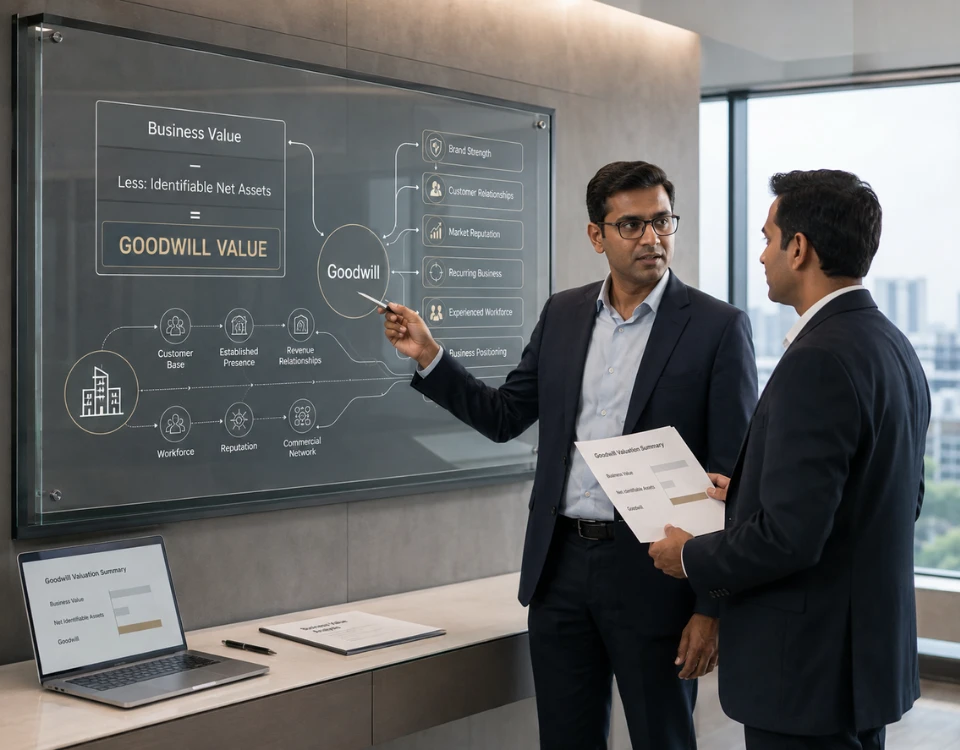
For an established business, Goodwill is more than an accounting residual; it represents the economic value created by reputation, customer relationships, operating systems, workforce continuity and expected synergies beyond identifiable net assets. Elite Valuation provides independent, purpose-specific Goodwill Valuation reports for M&A, Purchase Price Allocation (PPA), business transfers, disputes, tax analysis and financial reporting, with each assignment aligned to the transaction, Valuation date and applicable framework.
Goodwill Valuation Experts in India
Elite Valuation is a specialist Valuation and financial advisory firm serving clients across India on Goodwill Valuation at the intersection of transactions, accounting and regulation. We work with promoters, CFOs, acquirers, investors, auditors, and legal teams that need a clear view of Goodwill within an operating business.
Led by CA Sagar Shah (Ex-EY and IBBI Registered Valuer), we bring the independence, technical rigor and documentation discipline of a Big-4 Valuation practice to Goodwill Valuations used in acquisitions, financial reporting, disputes and business transfers.
Goodwill cannot be valued through a standard percentage of revenue. It requires analysis of sustainable earning capacity, identifiable intangible assets, customer and key-person dependence, transferability and the economic benefits that remain with the business.
Our Specialized Goodwill Valuation Solutions
Types of Goodwill Considered in a Valuation
- Purchased Goodwill: The residual recognized when acquisition consideration exceeds the value assigned to identifiable net assets. It is commonly addressed in PPA.
- Business Goodwill: Value created by processes, location advantages, recurring demand, reputation, systems and organizational capability.
- Enterprise Goodwill: Value expected to remain if a promoter, partner or professional leaves, supported by institutional relationships, systems and team-based delivery.
- Personal Goodwill: Value linked mainly to a specific individual's reputation, skill, relationships or continued involvement. Treatment depends on the transaction and contractual protections.
This distinction matters for professional practices and promoter-led businesses. The analysis tests customer ownership, non-compete terms, succession depth, brand independence and management continuity.
Goodwill vs Identifiable Intangible Assets
Goodwill should not become a catch-all for every non-physical source of value. The analysis must first test whether an asset is separable or arises from contractual or legal rights. This affects PPA, amortization, and impairment testing.
- Customer Relationships: Contracts, recurring relationships, and order backlog may be identifiable when their economic benefit can be measured separately.
- Brands and Trade Names: These may be valued separately where ownership, recognition and attributable revenue can be established.
- Technology and Software: Patents, software, databases and know-how may require separate recognition when identifiability criteria are met.
- Contracts and Rights: Agreements, licenses, permits, distribution rights and non-compete terms may carry standalone value.
- Assembled Workforce: Its value is generally included in Goodwill because the workforce is not usually separable as a group.
- Future Synergies and New Opportunities: Cross-selling, combined operations and benefits not meeting recognition criteria commonly remain in Goodwill.
A robust allocation avoids overstating Goodwill or forcing value into separate intangibles without a sound legal or economic basis.
Key Factors That Affect Goodwill Value
- Sustainable Earning Capacity: Normalized profits and cash flows remove one-off, promoter-specific and non-operating items.
- Customer Quality and Retention: Recurring revenue, contract duration, concentration, churn and transferability shape continuing value.
- Brand and Market Position: Reputation, pricing power, recognition and differentiation can support excess earnings.
- Dependence on Key Individuals: Value may reduce where sales, delivery or customer confidence depends on one person.
- Workforce and Operating Systems: Documented processes, trained teams and management continuity can increase transferable Goodwill.
- Expected Synergies: Cost savings, cross-selling and combined capabilities may explain acquisition Goodwill without replacing identifiable assets.
- Industry Risk and Competitive Alternatives: Entry barriers, technology change, regulation and substitutes affect excess-return durability.
- Transaction Terms and Valuation Date: Earn-outs, deferred consideration, non-compete terms and market conditions can change the conclusion.
What Is Goodwill Valuation?
Goodwill Valuation determines the economic value of business advantages that cannot be recognized as separate identifiable assets. These may include customer preference, organized operations, workforce continuity, synergies and returns above a normal return on identifiable assets.
Under Ind AS 103, Goodwill is generally the residual after comparing the relevant consideration and ownership components with the acquisition-date value of identifiable assets and liabilities. In commercial or dispute contexts, it may also be analyzed through excess earnings, super profits, with-and-without scenarios or residual reconciliation.
Goodwill Valuation is not the same as valuing an entire company. Business Valuation establishes enterprise or equity value; Goodwill Valuation explains the portion remaining after tangible and identifiable intangible assets are considered.

Get Expert Goodwill Valuation Support
When Do You Need Goodwill Valuation Services?
Free Goodwill Valuation Guide for Founders, CFOs & Transaction Teams (2026)
Learn Goodwill Valuation for PPA, impairment testing, business transfers, partner exits and disputes, with practical Ind AS 103 and Ind AS 36 guidance.
Includes practical cases, residual goodwill frameworks, super-profit and capitalisation methods, CGU impairment testing, tax considerations, and defensible reporting checklists.
Who Needs Goodwill Valuation Services?

CFOs and Finance Heads

M&A and Corporate Development Teams

Promoters and Family Businesses

Private Equity and Strategic Investors

Legal and Dispute Resolution Teams

Statutory Auditors and Accounting Teams
Benefits of Professional Goodwill Valuation
Goodwill Valuation Methods We Use
We apply established Valuation approaches based on the purpose, nature of the business and availability of reliable financial data.
- Residual Method: Determines Goodwill as the residual value after deducting identifiable net assets from the overall business or transaction value.
- Excess Earnings Method: Values Goodwill based on sustainable earnings remaining after providing appropriate returns on identifiable assets.
- Capitalization of Super Profits: Estimates Goodwill by capitalizing maintainable profits earned above a normal return on the capital employed.
- With-and-Without Method: Measures Goodwill by comparing the business value or earnings with and without the relevant business advantage.
Regulatory Compliance (Ind AS, Tax, Companies Act, FEMA, etc.)
We align Goodwill Valuation with applicable accounting, tax, and regulatory requirements:
- Financial Reporting for Business Combinations (Ind AS 103)
Requires acquisition-date recognition and measurement of identifiable assets and liabilities separately from residual Goodwill. - Ind AS 38 & Ind AS 36
Compliance with accounting standards governing the recognition of Intangible Assets and the Goodwill impairment. - Income-tax Act, 2025
Governs the tax treatment and Valuation considerations applicable to Goodwill in business transfers, acquisitions and restructurings. - FEMA Regulations
Ensuring cross-border acquisitions, transfers and restructurings involving Goodwill comply with applicable FEMA pricing and reporting requirements. - SEBI Regulations
Relevant where Goodwill Valuation forms part of listed-company acquisitions, mergers, schemes of arrangement or other SEBI-regulated transactions.
Our Goodwill Valuation Process
We follow a structured 5-step process to deliver clear and defensible Goodwill Valuation reports:
Requirement Analysis
We understand the Valuation purpose, transaction structure, reporting requirements and applicable regulatory framework.
Business & Data Assessment
We review financial statements, forecasts, transaction documents and key business drivers contributing to Goodwill.
Valuation Analysis
We apply the appropriate Goodwill Valuation methodology and assess sustainable earnings, identifiable assets and relevant assumptions.
Management Discussion
We discuss key assumptions, business dependencies and Valuation findings with management before finalizing the analysis.
Final Reporting
We issue a signed Goodwill Valuation Report documenting the methodology, assumptions, workings and concluded value.
What You Receive: Goodwill Valuation Deliverables
Goodwill Valuation vs Goodwill Impairment Testing
The services answer different questions. Goodwill Valuation determines value at a transaction, transfer or dispute date. Impairment testing assesses later recoverability.
| Parameter | Goodwill Valuation | Goodwill Impairment Testing |
|---|---|---|
| Primary question | What Goodwill value exists at the Valuation date? | Does the CGU carrying amount exceed recoverable amount? |
| Typical trigger | Acquisition, PPA, transfer, partnership change, sale or dispute. | Annual Ind AS 36 test, plus earlier indicator-based testing. |
| Starting point | Business value, consideration, identifiable net assets and transferable earnings. | CGU carrying amount and recoverable amount using VIU or FVLCD. |
| Core output | Goodwill value or range with method rationale. | Headroom or loss with CGU, forecasts, rates and sensitivities. |
| Valuation date | Transaction, transfer, dispute or agreed Valuation date. | Consistent annual date, plus any indicator-based date. |
| Related service | Often linked to PPA, business, dispute or slump sale Valuation. | Covered through the dedicated impairment testing service. |
Why Choose Elite Valuation?
- Ex-Big 4 Pedigree
Founder Sagar RV Shah’s background at EY ensures global best practices in documentation and ethics. - Tripartite Qualification
We combine CA, CS, and Registered Valuer expertise to address tax, legal, and financial angles simultaneously.
- Speed & Agility
We offer the quickest response times (5–7 business days) without compromising on technical depth. - Defensive Reporting
Our reports are engineered to withstand strict scrutiny from the Income Tax Department and the NCLT.
Our Clients





































































































































Where Our Goodwill Valuation Expertise Is Applied







Trusted by Leaders.
Proven by Results.
What founders, CFOs, and investors say about working with Elite Valuation.
"The team at Elite Valuation was very helpful in our multiple Valuations. CA Sagar Shah personally ensured the Valuation was objective and clearly explained to us, which helped fix the gap during negotiations. They are responsive, professional, and truly understand the complexities of M&A. Highly recommend their expertise for any deal."

"We've been working with Elite Valuation for our ESOPs for a few years now, and they've been great. They handle the complex regulatory side of things very smoothly, making sure our reports are always audit-ready and easy to understand. The team is professional and always help us meet a deadline, and they really know how to manage equity Valuations for larger companies. Highly recommended if you need a reliable partner for compliance."

"Elite Valuation has been our go-to firm for our all type of Valuations be ie Merger, ESOP, Preferential Valuation of listed companies. They understand the nuances of different regulations, complex Valuation modelling and always ensure the assumptions are well-supported and defensible during audits. Their consistency and reliability make them a trusted partner for all of our Valuation requirements ."

"We engaged Elite Valuation for a merger Valuation involving more than 12 group companies, and the experience was seamless. Mr Sagar Shah and his team built a robust model that satisfied all stakeholders. Their understanding of regulatory requirements and Valuation complexities made them an invaluable partner throughout the process."

"Sagar and his team understand ESOP and Business Valuation and compliance very well. What we like most is that they take the time to explain the numbers and the logic behind them, which has been very useful for us internally. It feels like working with a team that genuinely knows the space well."

"We issued compulsorily convertible debentures as part of a funding round, and Elite Valuation provided a robust Valuation that addressed all regulatory and stakeholder requirements. Their familiarity with instrument-specific Valuation methodologies and SEBI requirements was very evident."
"As a first-time fundraiser, we had no idea where to begin. Elite Valuation built an investor-grade financial model and a detailed Investor Memorandum for us, while guiding us on exactly what institutional investors look for. Mr. was patient, responsive, and made the entire process approachable. We walked into every investor meeting fully confident. Truly a reliable partner for anyone navigating fundraising for the first time."

"We have engaged Elite Valuation across a range of assignments, including share issuances, transfers, ESOPs, preferential allotments, rights issues, and merger Valuations. Their execution has consistently reflected strong technical depth and a clear understanding of regulatory frameworks. The team delivers well-structured, defensible Valuation reports with a high level of precision and professionalism. Their ability to manage complex mandates within tight timelines, without compromising on analytical rigor, is particularly noteworthy. Elite Valuation combines technical expertise with commercial insight, making them a dependable partner for Valuation engagements. We highly recommend their services.""

"Over the last few years, we've engaged Elite Valuation for multiple Valuation projects for multiple of our clients. Their reports are always comprehensive, well-documented, and fully aligned with regulatory requirements under Income-tax and FEMA. CA Sagar Shah's insights were instrumental in ensuring a smooth process and his expertise added tremendous value throughout. Highly recommended for multinational enterprises and large firms."
Published Insights
Read Our Latest Blogs





















Request a Call Back
15+ years
500+ clients
Frequently Asked Questions (FAQs)
Related Services
- Impairment Testing