Merger Valuation Services in India
Independent, Court & NCLT-Ready Merger Valuation Reports — Backed by India's Leading IBBI Registered Valuer
Mergers involve complex Valuation questions, from determining fair exchange ratios to satisfying multiple regulators. Ensure your merger stands up to regulatory, tax, and stakeholder scrutiny with an independent Valuation report trusted by over 500 clients across India.
We deliver fair value opinions and exchange ratio reports for mergers and amalgamations, fully compliant with Companies Act Section 230–232, SEBI, RBI, and NCLT requirements. Every assignment is structured around the scheme terms, Valuation date, capital structure, applicable regulations, and the questions likely to arise from boards, shareholders, auditors, stock exchanges, and regulators.

Merger Valuation Experts in India
Elite Valuation is a specialist Valuation and financial advisory firm headquartered in Ahmedabad and serving companies across India, including Mumbai, Delhi, Bengaluru, Hyderabad, Pune, Chennai, and other commercial centers.
Led by CA Sagar Shah (Ex-EY and IBBI Registered Valuer), assignments are backed by transparent workings, where method selection, key assumptions, and value conclusions must withstand challenge from auditors, boards, and regulators. Merger Valuation is not an independent exercise for each entity, it demands cross-company consistency in forecasts, discount rates, market multiples, net debt adjustments, non-operating assets, and security rights. We treat this consistency as non-negotiable, since even a small mismatch can materially shift the relative value per share and the resulting ownership of the combined company.
Our Specialized Merger Valuation Solutions
We provide end-to-end Valuation support across every stage of a merger transaction:
Complex Merger Structures & Special Situations
While standard scheme valuations cover most transactions, certain merger structures involve unique valuation and regulatory challenges. We bring specialized expertise to these high-complexity situations.
- Cross-Border Mergers: Valuation of Indian and foreign entities under Section 234 of the Companies Act and FEMA Cross Border Merger Regulations, including currency and DTAA considerations.
- Reverse Mergers: Determining fair value and exchange ratios where a smaller or unlisted entity absorbs a larger operating business, with careful treatment of accounting acquirer versus legal acquirer.
- Listed Company Mergers: Valuation compliant with SEBI's Master Circular on Scheme of Arrangement, including volume-weighted average price (VWAP) benchmarking for listed entities.
- Slump Exchange & Business Transfers: Valuing undertakings transferred as a going concern for lump-sum consideration, distinct from itemized asset sales under Income Tax Act provisions.
- Treasury Shares & Cross-Holdings: Assessing the impact of inter-company shareholdings on the exchange ratio to prevent double-counting or dilution distortions.
Enterprise Value, Equity Value and Relative Value in a Merger
- Enterprise Value: Enterprise value reflects the operating business value available to all capital providers, generally derived from cash flows, earnings multiples, or adjusted assets.
- Equity Value: Equity value adjusts enterprise value for cash, debt, preference capital, non-operating assets, investments, and relevant contingencies. The same adjustment logic is applied to each company.
- Relative Value Per Share: Equity value is allocated across the relevant security classes and divided by fully diluted shares after considering the rights attached to each instrument.

Merger Valuation & Scheme Support
In a merger, Valuation is the anchor that determines ownership in the combined entity. We provide independent, defensible merger Valuation services to support scheme drafting, regulatory filings, and shareholder approval.
- Fair Value & Exchange Ratio Determination: Robust Valuation of transferor and transferee companies using globally accepted methodologies, tailored to each entity's structure.
- Swap Ratio Certification: Independent Valuation support for mergers, amalgamations, and schemes of arrangement to determine fair & defensible exchange ratios.
- Board & Shareholder Decision Support: Valuations designed to support Board approval, shareholder resolutions, and merchant banker fairness opinions.
- Regulatory & Court-Facing Valuations: Audit-ready Valuation reports aligned with Ind AS, IVS, SEBI, Companies Act, and NCLT requirements — built to withstand regulatory and judicial scrutiny.
- Deal Scenario & Sensitivity Analysis: Merger-linked models to assess synergies, control premiums, and Valuation impact across alternative exchange ratio scenarios.
What Is Merger Valuation?
Merger Valuation is the process of determining the relative economic value of the companies participating in a merger and using those values to recommend a fair share exchange or swap ratio. It is commonly documented in a Valuation report for merger proceedings, board consideration, shareholder communication, regulatory review, and scheme filings.
A standalone business Valuation estimates one company’s value. Merger Valuation compares participating companies to determine the ownership each shareholder group should receive in the combined entity.
The assignment covers enterprise value, equity value, value per share, security rights, capital structure adjustments, and the rationale for weighting different methods.

Get Expert Merger Valuation Support
When Do You Need Merger Valuation Services?
Merger transactions require Valuation at specific trigger points to ensure regulatory compliance, shareholder protection, and NCLT approval.
Free M&A Valuation Playbook for Founders, CFOs & Investors (2026)
Learn step-by-step M&A Valuation techniques including DCF, CCM, LBO Modeling, Synergy Valuation & Deal Structuring used by Top professionals.
Includes illustrations, Valuation models, and practical frameworks used in Mergers & Acquisitions, Deal Making, and Strategic Transactions. see less
Who Needs Merger Valuation Services?

Boards & Audit Committee

Lenders & Secured Creditors

Statutory Auditors & Tax Advisors

Promoters & Corporate Groups

CFOs & Finance
Teams

Legal & Secretarial Teams

Investors & Minority Shareholders

Listed Companies & Merchant Bankers
Benefits of Professional Merger Valuation
A rigorous, independent Valuation delivers advantages that go well beyond regulatory checkbox compliance:
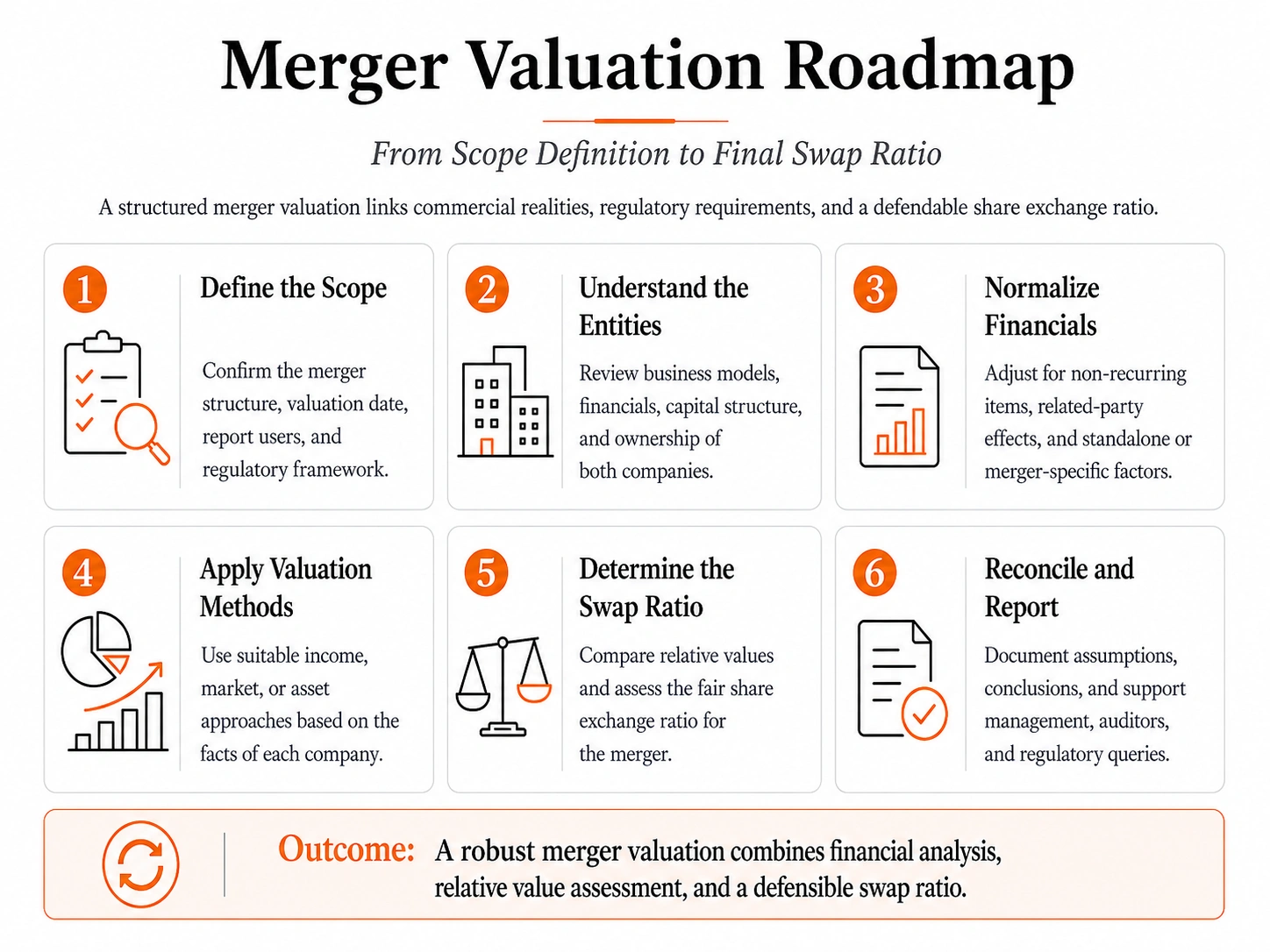
Merger Valuation Roadmap (From Scope Definition to Final Ratio)
Follow a structured merger valuation process from scope definition and financial normalization to relative value assessment, swap ratio determination and final reporting.
How Is a Merger Share Exchange Ratio Determined?
A share exchange ratio compares the equity value per share of the transferor and transferee companies on a common Valuation date. The final recommendation also reflects share denominations, security rights, dilution, and scheme mechanics.
- Value Each Company on a Consistent Basis: All companies are assessed using a common date, aligned financial periods, and consistent treatment of debt, cash, investments, and contingencies. Any methodological difference must be justified.
- Determine Equity Value Per Share: Enterprise value is bridged to equity value and allocated across security classes after reviewing options, convertibles, preference rights, treasury shares, and cross-holdings.
- Assign Reasoned Weights to the Methods: Method values are not mechanically averaged. Weight depends on business maturity, forecast reliability, trading liquidity, asset intensity, and comparable data.
- Translate Relative Value into Share Entitlement: Relative value per share is converted into a practicable entitlement ratio. Rounding and fractional treatment should not materially distort the economic result.
- Test the Post-Merger Ownership Outcome: The ratio is tested against post-scheme ownership, dilution, promoter and public holdings, and shareholder-group participation. Synergies should not be selectively assigned to one pre-merger entity.
Key Factors That Affect Merger Valuation
- Valuation Date and Information Cut-Off: Financial performance, market prices, capital structure, and significant events must be assessed as of a clearly defined date.
- Business Model and Earnings Quality: Recurring revenue, margins, customer concentration, cyclicality, and normalized earnings influence sustainable value.
- Forecast Reliability: Growth, margins, capital expenditure, working capital, and terminal assumptions are tested against history and industry conditions.
- Capital Structure and Security Rights: Debt, surplus cash, preference shares, convertibles, options, and liquidation or conversion rights affect equity allocation.
- Listed Share Liquidity: Market price evidence depends on trading frequency, volume, unusual price movements, and whether the observed price reflects a reliable market.
- Non-Operating Assets and Liabilities: Investments, surplus property, tax assets, guarantees, litigation, and contingent liabilities are assessed separately where relevant.
- Subsidiaries and Cross-Holdings: Consolidated value, minority interests, associates, inter-company balances, and circular holdings require careful adjustment.
- Related-Party Context and Minority Impact: Common control or promoter overlap increases the need for transparent assumptions and balanced treatment across shareholder groups.
Merger Valuation Methods and Weighting
We employ globally accepted Valuation approaches tailored to the specific dynamics of the deal:
Discounted Cash Flow (Income Approach)
Comparable Companies (Market Approach)
Replacement Cost (Cost Approach)
Control Premium & Discounts
Regulatory, Accounting and Tax Framework for Merger Valuation
We navigate the complex web of Indian regulations to ensure your Valuation is compliant across all jurisdictions:
- Companies Act, 2013
Compliance with Sections 230–232 for schemes, arrangements, and amalgamations requiring NCLT approval. - SEBI Regulations
Adherence to LODR Regulation 37 and the Master Circular on Schemes of Arrangement for listed entities. - Ind AS Accounting
Compliance with Ind AS 103 for business combinations and Appendix C for common-control mergers. - Income Tax Act
Alignment with Rule 57 for fair market value of unquoted shares and scheme conditions under the Income Tax Act - FEMA Regulations
Compliance with Section 234 of the Companies Act and FEMA regulations for cross-border mergers.
Documents and Information Required for Merger Valuation
- Management Projections: Revenue, margins, working capital, capital expenditure, tax, and cash-flow forecasts with documented assumptions.
- Draft Scheme or Transaction Note: Proposed structure, transferor and transferee entities, appointed date, consideration, and intended share exchange mechanics.
- Corporate and Capital Structure: Memorandum and Articles, cap table, security classes, promoter holdings, options, convertibles, and cross-holdings.
- Historical Financial Statements: Audited financial statements, recent management accounts, segment information, and normalization details for each company.
- Debt, Cash and Investment Details: Borrowings, cash balances, guarantees, surplus investments, preference capital, and off-balance-sheet obligations.
- Business and Operational Information: Products, customers, contracts, market position, capacity, key risks, and operational dependencies.
- Subsidiary and Associate Data: Financial and ownership details of subsidiaries, joint ventures, associates, special purpose vehicles, and minority interests.
- Tax, Litigation and Contingency Schedule: Pending disputes, tax exposures, indemnities, guarantees, regulatory matters, and other potential value adjustments.
- Board and Advisor Inputs: Commercial rationale, accounting treatment, legal structure, fairness opinion requirements, and expected regulatory timetable.
- Market and Comparable Information: Listed trading history, peer set, relevant transactions, industry data, recent market trends, and any prior Valuation reports or supporting analysis.
Our Merger Valuation Process
We follow a rigorous five-step workflow to deliver high-quality, defensible reports:
Understand the Requirement
We clarify the Valuation objective, transaction context, and scope of work to align with deal requirements.
Discovery & Data Collection
We collect financial statements, projections, operational data, and deal terms to gain a complete understanding of the business.
Financial Modeling & Analysis
We develop robust Valuation models (DCF, CCM) and assess key drivers and sensitivity factors impacting value.
Management Review & Validation
We discuss assumptions and findings with management to ensure the Valuation reflects real-world business dynamics.
Final Valuation Report
We deliver a signed, audit-ready Valuation report compliant with IBBI and International Valuation Standards.
What You Receive: Merger Valuation Report Deliverables
Why Choose Elite Valuation for Merger Valuation?
We are uniquely positioned to handle high-stakes Valuations in PAN India, offering a combination of technical rigor and operational speed.
- Ex-Big 4 Pedigree
Our founder’s background at Ernst & Young ensures global best practices in documentation and ethics. - Tripartite Qualification
We combine CA, CS, and Registered Valuer expertise to address tax, legal, and financial angles simultaneously.
- Defensive Reporting
Our reports are written to withstand regulatory scrutiny, minimizing queries from tax officers or NCLT. - Speed & Agility
We offer the quickest response times without compromising on the depth of analysis, unlike bureaucratic firms.
Our Clients














































































































Industries We Serve






Trusted by Leaders.
Proven by Results.
What founders, CFOs, and investors say about working with Elite Valuation.
"The team at Elite Valuation was very helpful in our multiple Valuations. CA Sagar Shah personally ensured the Valuation was objective and clearly explained to us, which helped fix the gap during negotiations. They are responsive, professional, and truly understand the complexities of M&A. Highly recommend their expertise for any deal."

"We've been working with Elite Valuation for our ESOPs for a few years now, and they've been great. They handle the complex regulatory side of things very smoothly, making sure our reports are always audit-ready and easy to understand. The team is professional and always help us meet a deadline, and they really know how to manage equity Valuations for larger companies. Highly recommended if you need a reliable partner for compliance."

"Elite Valuation has been our go-to firm for our all type of Valuations be ie Merger, ESOP, Preferential Valuation of listed companies. They understand the nuances of different regulations, complex Valuation modelling and always ensure the assumptions are well-supported and defensible during audits. Their consistency and reliability make them a trusted partner for all of our Valuation requirements ."

"We engaged Elite Valuation for a merger Valuation involving more than 12 group companies, and the experience was seamless. Mr Sagar Shah and his team built a robust model that satisfied all stakeholders. Their understanding of regulatory requirements and Valuation complexities made them an invaluable partner throughout the process."

"Sagar and his team understand ESOP and Business Valuation and compliance very well. What we like most is that they take the time to explain the numbers and the logic behind them, which has been very useful for us internally. It feels like working with a team that genuinely knows the space well."

"We issued compulsorily convertible debentures as part of a funding round, and Elite Valuation provided a robust Valuation that addressed all regulatory and stakeholder requirements. Their familiarity with instrument-specific Valuation methodologies and SEBI requirements was very evident."
"As a first-time fundraiser, we had no idea where to begin. Elite Valuation built an investor-grade financial model and a detailed Investor Memorandum for us, while guiding us on exactly what institutional investors look for. Mr. was patient, responsive, and made the entire process approachable. We walked into every investor meeting fully confident. Truly a reliable partner for anyone navigating fundraising for the first time."

"We have engaged Elite Valuation across a range of assignments, including share issuances, transfers, ESOPs, preferential allotments, rights issues, and merger Valuations. Their execution has consistently reflected strong technical depth and a clear understanding of regulatory frameworks. The team delivers well-structured, defensible Valuation reports with a high level of precision and professionalism. Their ability to manage complex mandates within tight timelines, without compromising on analytical rigor, is particularly noteworthy. Elite Valuation combines technical expertise with commercial insight, making them a dependable partner for Valuation engagements. We highly recommend their services.""

"Over the last few years, we've engaged Elite Valuation for multiple Valuation projects for multiple of our clients. Their reports are always comprehensive, well-documented, and fully aligned with regulatory requirements under Income-tax and FEMA. CA Sagar Shah's insights were instrumental in ensuring a smooth process and his expertise added tremendous value throughout. Highly recommended for multinational enterprises and large firms."
Published Insights
Read Our Latest Blogs


























Request a Call Back
15+ years
500+ clients
Frequently Asked Questions About Merger Valuation
Related Services
- Swap Ratio Valuation
- Fairness Opinion Support
- Demerger Valuation
- Scheme of Arrangement Valuation