Slump Sale Valuation Services in India
Defensible, Transaction-Ready Valuation Reports for Slump Sales, Business Transfers and Corporate Restructuring
Execute your Slump Sale transaction with an independent, well-supported Valuation report prepared by an experienced IBBI Registered Valuer. Elite Valuation provides professional Valuation support for the transfer of an undertaking or business division for a lump-sum consideration.
We assist with commercial business Valuation, identification of the transaction perimeter, prescribed fair market value computations, and reconciliation of business value with transaction consideration, supporting compliance under the Income-tax Act, Companies Act, accounting requirements and stakeholder review.

Slump Sale Valuation Experts in India
Elite Valuation is a specialist Valuation and financial advisory firm headquartered in Ahmedabad, advising businesses on independent Slump Sale Valuations and serving clients throughout India, including Mumbai, Delhi, Bengaluru, Hyderabad, Pune and Chennai.
A Valuation for Slump Sale requires a coordinated view of the operating undertaking, transferred assets and liabilities, transaction consideration and prescribed tax computation. Separate workstreams can create inconsistencies between the report, tax working, board papers, and business transfer agreements.
Led by CA Sagar Shah (Ex-EY and IBBI Registered Valuer for Securities or Financial Assets), our firm brings Big-4-grade discipline, independence and technical rigor to every engagement. We apply recognized methods, document key assumptions, and coordinate with the client’s legal, tax and accounting advisers where specialist input is required.
Our Specialized Slump Sale Valuation Solutions
Valuation Across Business Transfer Scenarios
Slump Sale Valuation may be required for strategic divestments, internal restructuring, business separations and transfers of operating divisions. Our Valuation approach is aligned with the commercial purpose and specific facts of each transaction:
- Transfer of a Business Division: Valuation of a complete operating division transferred as a going concern for lump-sum consideration.
- Strategic Divestment: Valuation support where a company sells a non-core, underperforming or independently scalable business undertaking to a strategic or financial buyer.
- Group Restructuring: Valuation of businesses transferred between group entities as part of legal entity simplification, consolidation or operational restructuring.
- Hive-Off and Business Separation: Valuation of an undertaking being separated into another entity before an investment, joint venture, sale or independent operation.
- Promoter or Investor-Led Transactions: Valuation support for transfers involving promoters, private equity investors, strategic partners or related parties.
- Asset Sale versus Slump Sale Assessment: Evaluating the commercial & Valuation implications of transferring an undertaking as a whole vs assets seperately.
Slump Sale vs Itemized Asset Sale
The two structures can transfer similar operating resources, but the unit of transfer, pricing mechanics and tax treatment are different. The final structure should be selected with legal and tax advice, not only on Valuation convenience.
| Parameter | Slump Sale | Itemized Asset Sale |
|---|---|---|
| Subject of transfer | An undertaking or business division transferred as a whole. | Selected assets and liabilities transferred individually. |
| Consideration | A lump-sum amount for the undertaking, subject to permitted statutory allocations. | Separate values or prices are generally assigned to individual items. |
| Business continuity | Typically structured to preserve the operating continuity of the transferred unit. | Buyer may acquire only selected resources and rebuild operating arrangements. |
| Valuation focus | Standalone business value, prescribed Slump Sale FMV and enterprise-to-price bridge. | Asset-by-asset fair value, condition, title and specific tax consequences. |
| Tax computation | Current rules use the Slump Sale capital-gains framework and prescribed FMV. | Tax treatment is analysed separately for each asset or liability category. |
| Contracts and employees | Transfer commonly includes operational contracts, people and licences required by the undertaking. | Only specifically assigned contracts, employees or rights move. |
| Buyer accounting | Requires assessment of whether a business or only assets have been acquired. | Commonly analysed as an asset acquisition unless the transferred set meets the business definition. |
Transaction Support Beyond the Valuation Report
A Slump Sale Valuation often involves coordination with management, auditors, tax advisors, legal teams and transaction stakeholders. We support the process beyond the core Valuation analysis to help maintain consistency across the transaction.
- Document Alignment: Ensuring key Valuation assumptions are consistent with the business transfer agreement and supporting schedules.
- Stakeholder Coordination: Working with management, auditors, tax advisors and legal teams on Valuation-related matters.
- Query Resolution: Addressing questions on methodology, assumptions, projections, adjustments and value conclusions.
- Transaction Revisions: Updating the Valuation for changes in financial information, transfer terms or the agreed business scope.
What Is Slump Sale Valuation?
Slump Sale Valuation is the process of determining the value of an undertaking or business division transferred as a whole for a lump sum of consideration. It combines commercial business Valuation with the prescribed tax fair market value computation applicable to the transfer.
The subject is undertaking, not a random collection of assets. The analysis considers whether the unit can continue operations with the assets, liabilities, people, contracts, and rights assigned to it, while identifying shared resources and exclusions that affect value.

Get Expert Slump Sale Valuation Support
When Do You Need Slump Sale Valuation Services?
Formal Slump Sale Valuation is typically triggered by specific transaction milestones, and strategic business considerations:
Who Needs a Slump Sale Valuation Report?

Promoters and Boards

CFOs and Finance Teams

Tax and Legal Advisers

Corporate Development and M&A Teams

Private Equity and Strategic Investors

Statutory Auditors and Audit Committees
FMV1 vs FMV2 Under the Current Slump Sale Rules
From Tax Year 2026-27, Section 77 and Rule 53 prescribe the higher of FMV1 and FMV2 as the deemed consideration for a Slump Sale.
| Measure | What It Represents | Core Components | Valuation Focus |
|---|---|---|---|
| FMV1 | Fair market value of the capital assets transferred as part of the undertaking. | Book value of specified assets with prescribed adjustments for jewellery or artistic work, shares and securities, immovable property, less eligible book liabilities. | Accuracy of the carve-out balance sheet, asset classification, prescribed adjustments and liability perimeter. |
| FMV2 | Fair market value of the consideration received or accruing to the seller. | Monetary consideration plus prescribed value of shares, securities, property and other non-monetary consideration. | Completeness and Valuation of every form of consideration, including deferred or non-cash components where applicable. |
| Tax FMV | Higher of FMV1 and FMV2. | The higher figure is used as the deemed full value of consideration for the statutory capital-gains computation. | A transparent reconciliation showing both calculations and why the higher amount applies. |
Enterprise Value, Equity Value and Transaction Consideration
A Slump Sale price may be discussed as enterprise value, but final consideration depends on what moves with the business. The report should bridge operating value to the payable amount.
- Enterprise Value: Value of the undertaking’s operating business before considering the final treatment of cash, debt and other financing items.
- Debt and Debt-Like Items: Borrowings, overdue liabilities, unpaid statutory obligations or other items treated as financing or value adjustments under the deal.
- Cash and Surplus Assets: Cash, investments or non-operating assets included in or excluded from the undertaking.
- Normalized Working Capital: The level of receivables, inventory and payables required to operate the business in the ordinary course.
- Contingent and Off-Balance-Sheet Items: Claims, guarantees, litigation, onerous contracts and other exposures that may affect price or indemnity provisions.
- Final Consideration: The amount payable after applying the agreed bridge, completion accounts, locked-box terms or other transaction mechanics.This reconciliation prevents double counting, omissions and inconsistent treatment between the Valuation and agreement.
Benefits of Professional Slump Sale Valuation
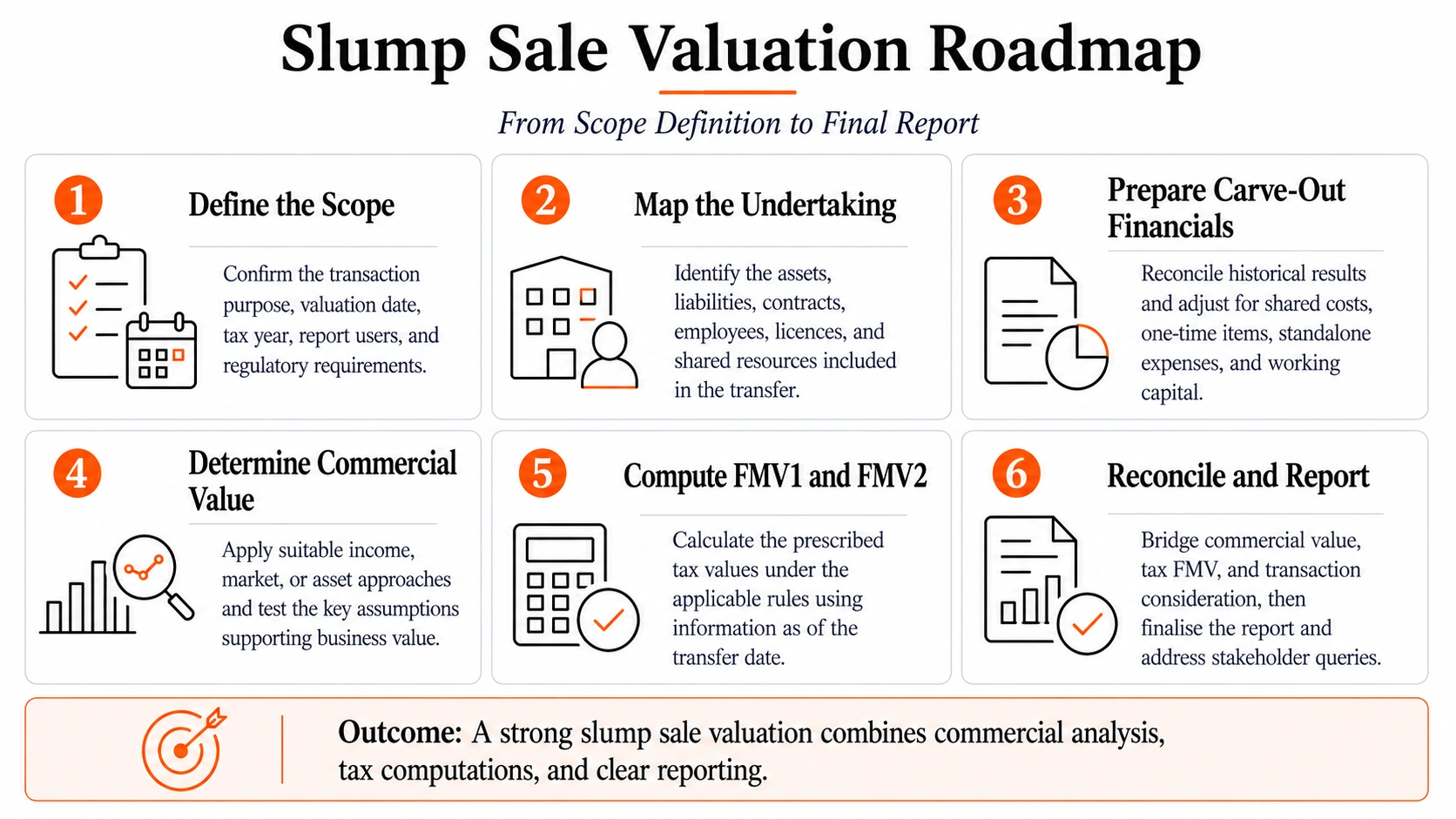
Slump Sale Valuation Roadmap (From Scope Definition to Final Report)
Follow a structured valuation process from scope definition and financial analysis to FMV computation, reconciliation and final reporting for a clear, defensible slump sale valuation.
Valuation Methodologies Used
We apply suitable commercial and statutory approaches based on the undertaking and transaction purpose.
Discounted Cash Flow (Income Approach)
Comparable Companies (Market Approach)
Prescribed Tax Valuation
Adjusted Net Asset Value (Asset Approach)
Regulatory Framework for Slump Sale Valuation – Income Tax, Companies Act, GST, SEBI & IBC
We align the Valuation, tax computations and transaction documentation with the applicable statutory and financial reporting requirements.
- Income-tax Framework
Compliance with Section 77 and Rule 53 for computing FMV1, FMV2, net worth and the deemed full value of consideration. - Legacy Tax Provisions
Application of Section 50B and Rule 11UAE for transactions governed by the earlier income-tax framework. - Companies Act, 2013
Compliance with Section 180(1)(a) and Section 188, related-party requirements and applicable Valuation provisions. - GST Framework
Assessment of going-concern transfer considerations and supporting documentation in coordination with the transaction’s tax advisors. - SEBI Regulations
Compliance with applicable LODR disclosures, related-party requirements and shareholder approvals where a listed entity is involved. - Accounting and IBC Framework
Alignment with applicable financial reporting requirements and, where relevant, CIRP, liquidation or going-concern sale provisions.
Our Slump Sale Valuation Process
We follow a rigorous five-step workflow to deliver high-quality, defensible reports that align with your transaction timeline:
Scope Review
Confirm the Valuation purpose, transaction date, tax year, report users, signatories and assets, liabilities, contracts and employees included in the undertaking.
Carve-Out Financial Analysis
Reconcile the undertaking’s financials with the seller’s accounts and adjust for shared costs, allocations, one-off items and standalone expenses.
Commercial Valuation
Apply appropriate income, market and asset approaches, and reconcile enterprise value with the proposed transaction consideration.
FMV1 and FMV2 Computation
Calculate both prescribed fair market values under the applicable tax rules using information available as of the transfer date.
Review, Reporting and Support
Discuss key assumptions and transaction schedules with management and advisers, issue the final report and provide clarification support
What You Receive
Why Choose Elite Valuation?
We are uniquely positioned to handle high-stakes Valuations in PAN India, offering a combination of technical rigor and operational speed.
- Ex-Big 4 Pedigree
Our founder’s background at Ernst & Young ensures global best practices in documentation and ethics. - Tripartite Qualification
We combine CA, CS, and Registered Valuer expertise to address tax, legal, and financial angles simultaneously.
- Defensive Reporting
Our reports are written to withstand regulatory scrutiny, minimizing queries from regulatory authorities. - Speed & Agility
We offer the quickest response times without compromising on the depth of analysis, providing quality of Big 4.
Our Clients




































































































































Industries We Serve
Our Valuation expertise spans across complex, asset-heavy, and high-growth sectors:








Trusted by Leaders.
Proven by Results.
What founders, CFOs, and investors say about working with Elite Valuation.
"The team at Elite Valuation was very helpful in our multiple Valuations. CA Sagar Shah personally ensured the Valuation was objective and clearly explained to us, which helped fix the gap during negotiations. They are responsive, professional, and truly understand the complexities of M&A. Highly recommend their expertise for any deal."

"We've been working with Elite Valuation for our ESOPs for a few years now, and they've been great. They handle the complex regulatory side of things very smoothly, making sure our reports are always audit-ready and easy to understand. The team is professional and always help us meet a deadline, and they really know how to manage equity Valuations for larger companies. Highly recommended if you need a reliable partner for compliance."

"Elite Valuation has been our go-to firm for our all type of Valuations be ie Merger, ESOP, Preferential Valuation of listed companies. They understand the nuances of different regulations, complex Valuation modelling and always ensure the assumptions are well-supported and defensible during audits. Their consistency and reliability make them a trusted partner for all of our Valuation requirements ."

"We engaged Elite Valuation for a merger Valuation involving more than 12 group companies, and the experience was seamless. Mr Sagar Shah and his team built a robust model that satisfied all stakeholders. Their understanding of regulatory requirements and Valuation complexities made them an invaluable partner throughout the process."

"Sagar and his team understand ESOP and Business Valuation and compliance very well. What we like most is that they take the time to explain the numbers and the logic behind them, which has been very useful for us internally. It feels like working with a team that genuinely knows the space well."

"We issued compulsorily convertible debentures as part of a funding round, and Elite Valuation provided a robust Valuation that addressed all regulatory and stakeholder requirements. Their familiarity with instrument-specific Valuation methodologies and SEBI requirements was very evident."
"As a first-time fundraiser, we had no idea where to begin. Elite Valuation built an investor-grade financial model and a detailed Investor Memorandum for us, while guiding us on exactly what institutional investors look for. Mr. was patient, responsive, and made the entire process approachable. We walked into every investor meeting fully confident. Truly a reliable partner for anyone navigating fundraising for the first time."

"We have engaged Elite Valuation across a range of assignments, including share issuances, transfers, ESOPs, preferential allotments, rights issues, and merger Valuations. Their execution has consistently reflected strong technical depth and a clear understanding of regulatory frameworks. The team delivers well-structured, defensible Valuation reports with a high level of precision and professionalism. Their ability to manage complex mandates within tight timelines, without compromising on analytical rigor, is particularly noteworthy. Elite Valuation combines technical expertise with commercial insight, making them a dependable partner for Valuation engagements. We highly recommend their services.""

"Over the last few years, we've engaged Elite Valuation for multiple Valuation projects for multiple of our clients. Their reports are always comprehensive, well-documented, and fully aligned with regulatory requirements under Income-tax and FEMA. CA Sagar Shah's insights were instrumental in ensuring a smooth process and his expertise added tremendous value throughout. Highly recommended for multinational enterprises and large firms."
Published Insights