Business Valuation · Insight
Zepto’s IPO Valuation Reset: From $7 Billion to $3 Billion
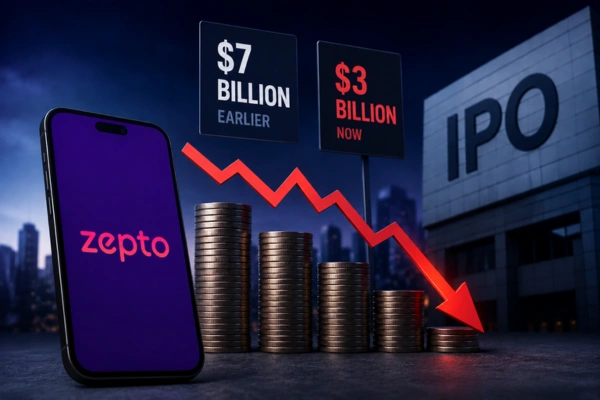
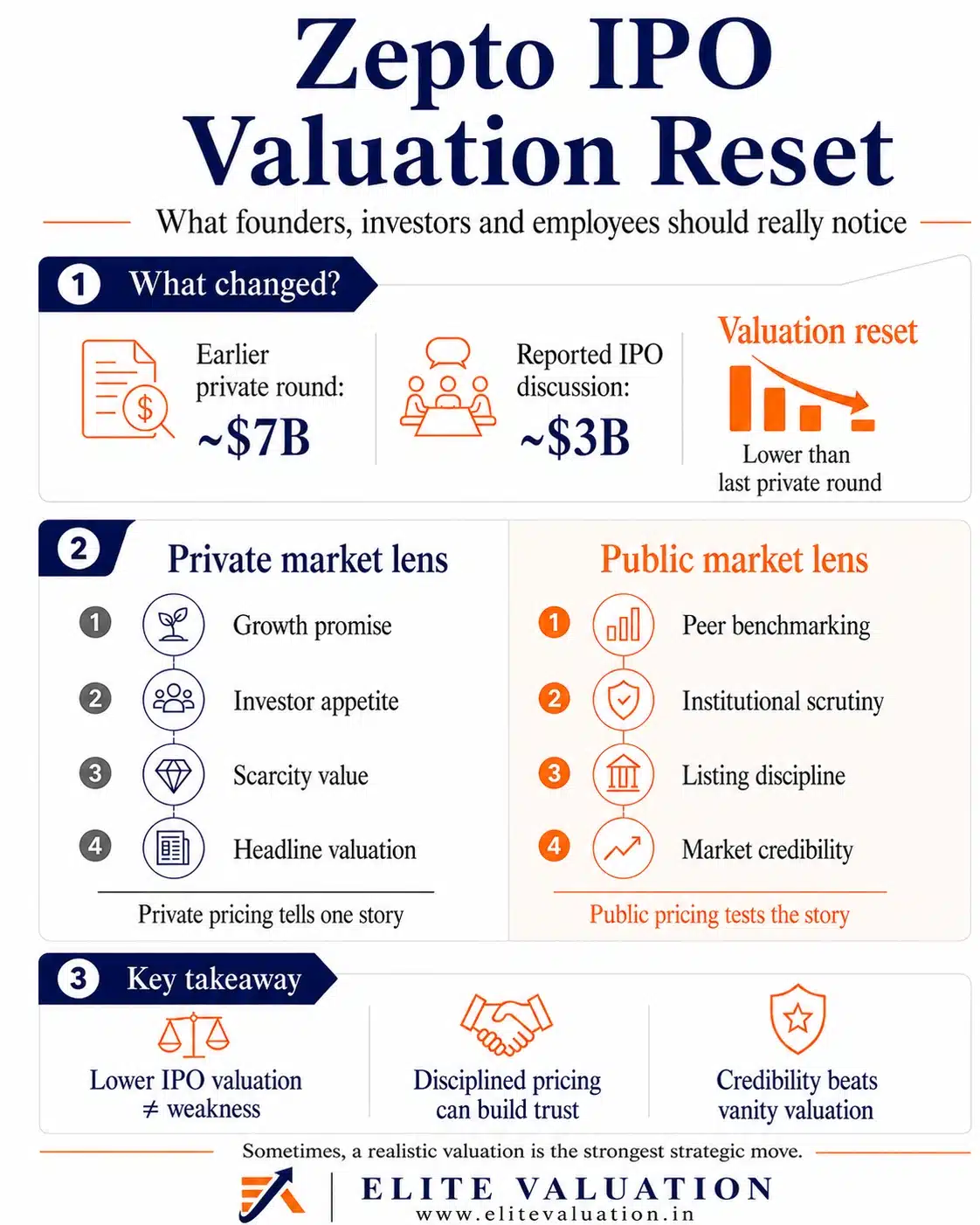
Zepto is reportedly in talks with anchor investors at a post-money IPO valuation of around $3 billion (₹29,000 crore), against its October 2025 private round of $7 billion. That is a markdown of approximately 57%. The proposed fresh issue has been trimmed from ₹8,010 crore to about ₹5,000 crore, with a small offer for sale of roughly ₹106 crore.
The reset is not a story about a broken business. FY2026 revenue reportedly doubled to ₹22,624 crore and per-order losses narrowed. It is a story about the gap between the price a handful of private investors pay in a preference-share round and the price a broad public market is willing to underwrite for ordinary equity. That gap sits at the heart of every startup valuation exercise in India today.
The number that gets quoted in the press, "valued at $7 billion", is a transaction price paid by a small group of investors for instruments that usually carry liquidation preference, ratchets and information rights. It is not, in a technical sense, fair market value.
An IPO strips those protections away. What the market is doing to Zepto now is not punishment. It is genuine price discovery. Every promoter raising at a headline valuation should assume this discount will eventually be applied, whether by an acquirer, by a public market, or by the tax officer.
Zepto's Quick-Commerce Strategy Shift
Why This Matters
- Private round price is not FMV. A preference-share round with contractual protections cannot be transplanted directly into an Ind AS 113 fair value or a Rule 11UA valuation, as detailed in our startup valuation framework.
- Public markets demand a margin of safety. Ordinary equity, no ratchets, no preference. Investors price the risk they cannot contract away.
- Unit economics matter more than growth. Adjusted EBITDA loss per order improved from ~₹136 to ~₹79. The direction, not the multiple, is what public investors are underwriting.
- Every future ESOP grant is repriced. A markdown of this scale changes the Ind AS 102 fair value used for stock-based compensation and the Rule 3(1)(d) perquisite for employees. See our ESOP valuation service for how grant-date fair value flows into both the P&L expense and the employee perquisite tax.
A necessary caveat. The valuation at which shares change hands in a funding round is a transaction price under specific commercial terms. It is not automatically the fair market value under Rule 11UA, nor is it the Ind AS 113 fair value for accounting, nor the Rule 3(1)(d) perquisite value for ESOP taxation. Each of these requires an independent, method-driven valuation by a registered valuer.
When a Private Round Price Reflects Fair Value, and When It Doesn't
| Suitable Where | Premature Where |
|---|---|
| Ordinary equity, no preference stack | Preference shares with 1x+ liquidation preference |
| Broad investor participation, competitive book | Single strategic or anchor investor |
| Cash-generating, profitable business | Business dependent on next funding round |
| Meaningful stake changing hands | Small tranche priced off headline valuation |
| Comparable listed peers available | Peer set contested or unproven category |
| Recent, arm's-length transaction | Round more than 12 months old, market re-rated |
Six Questions Before You Cite Your Last Round Valuation
- Would the same investor pay the same price for plain equity today? If the answer needs a preference stack, ratchet or anti-dilution to hold, the headline number is a term-sheet outcome, not a fair value.
- What percentage of the fully diluted cap table actually changed hands? A 2% primary tranche priced at a marquee valuation does not calibrate the remaining 98%, and no acquirer or listed-market investor will treat it as if it did.
- How have your listed peers re-rated since the round closed? If comparable EV/Revenue or EV/EBITDA multiples have compressed 20% to 40%, your last round price has silently gone stale on the cap table.
- Can the business fund its next 18 months without a fresh raise? A valuation supported by the runway you already have is defensible. A valuation supported by capital you still need to raise is a hypothesis.
- Does the story rely on peer set that regulators or bankers will accept? If your comparables include diversified platforms while you operate a single, capital-hungry segment, expect the peer set to be challenged, and the multiple with it.
- Would this valuation survive independent review under Rule 11UA, Ind AS 113 and a fairness opinion, on the same day? These three frameworks approach value differently. A number that clears all three is defensible. A number that clears only one is exposed.
THE TAKEAWAY. A markdown from $7 billion to $3 billion is not the failure of a company. It is the difference between venture pricing and public-market pricing being made visible in one transaction. Every unlisted company in India carrying a headline valuation on its cap table is carrying the same latent gap.
The discipline is to know the gap before someone else prices it for you, whether that someone is an acquirer negotiating a share swap, a tax officer applying Rule 11UA, or a public market pricing an IPO book.
Is your last-round valuation still defensible?
Planning an IPO, secondary sale, ESOP grant or fundraise? Elite Valuation provides independent valuation reports, fairness opinions and structuring support for equity issuances, ESOP fair value and secondary transactions, under Rule 11UA, Ind AS 102, Ind AS 113, SEBI SBEB and FEMA NDI Rules.

Founder - Elite Valuation
CA Sagar Shah
IBBI Registered Valuer & Business Valuation Expert in India
Chartered Accountant (All India Rank) · Company Secretary · Ex-Ernst & Young.
15+ years advising Promoters, Investors, and MNCs on Valuation, ESOP, M&A, FEMA, AIF, Transfer Pricing, and Cross-Border Transactions across India.
- CA — All India Rank
- Company Secretary
- IBBI Registered Valuer
- Ex-Ernst & Young
- 500+ Clients