IPO Valuation · Insight
Shiprocket’s IPO Valuation Reset: What the 30% Markdown Means
Shiprocket is reportedly targeting a ₹7,000 crore Valuation for its upcoming initial public offering, nearly 30% below the almost ₹10,000 crore Valuation implied by its December 2024 private funding round. The ₹2,342 crore issue follows a year in which the company cut its net loss by 88% and turned cash EBITDA positive for the first time. A markdown of this size on the way to listing is not automatically a verdict on the business. It usually says more about how public investors price risk than about what changed inside the company.
For a founder or CFO watching this closely, the more useful question is not why the number fell but what changed in the underwriting assumptions behind it. Shiprocket's structure, a fresh issue of ₹1,100 crore alongside an offer for sale of over ₹1,242 crore, means existing investors are also accepting the lower entry point rather than holding out for the private mark. That detail matters. It suggests the discount is being treated as the price of a successful listing, in line with a broader pattern this year in which logistics tech peers such as Shadowfax and Delhivery have also traded below their last private Valuations once public markets got to vote.
A private round prices conviction. A public market prices consensus. When those two numbers differ, Valuation has not failed: the assumptions are simply being repriced in front of a wider audience.
The bridge between a private mark and a public value is built on growth quality, profitability visibility and investor confidence, not on headline revenue alone. A business seeking an independent business Valuation before a listing or a large capital event should expect that bridge to be tested, not assumed.
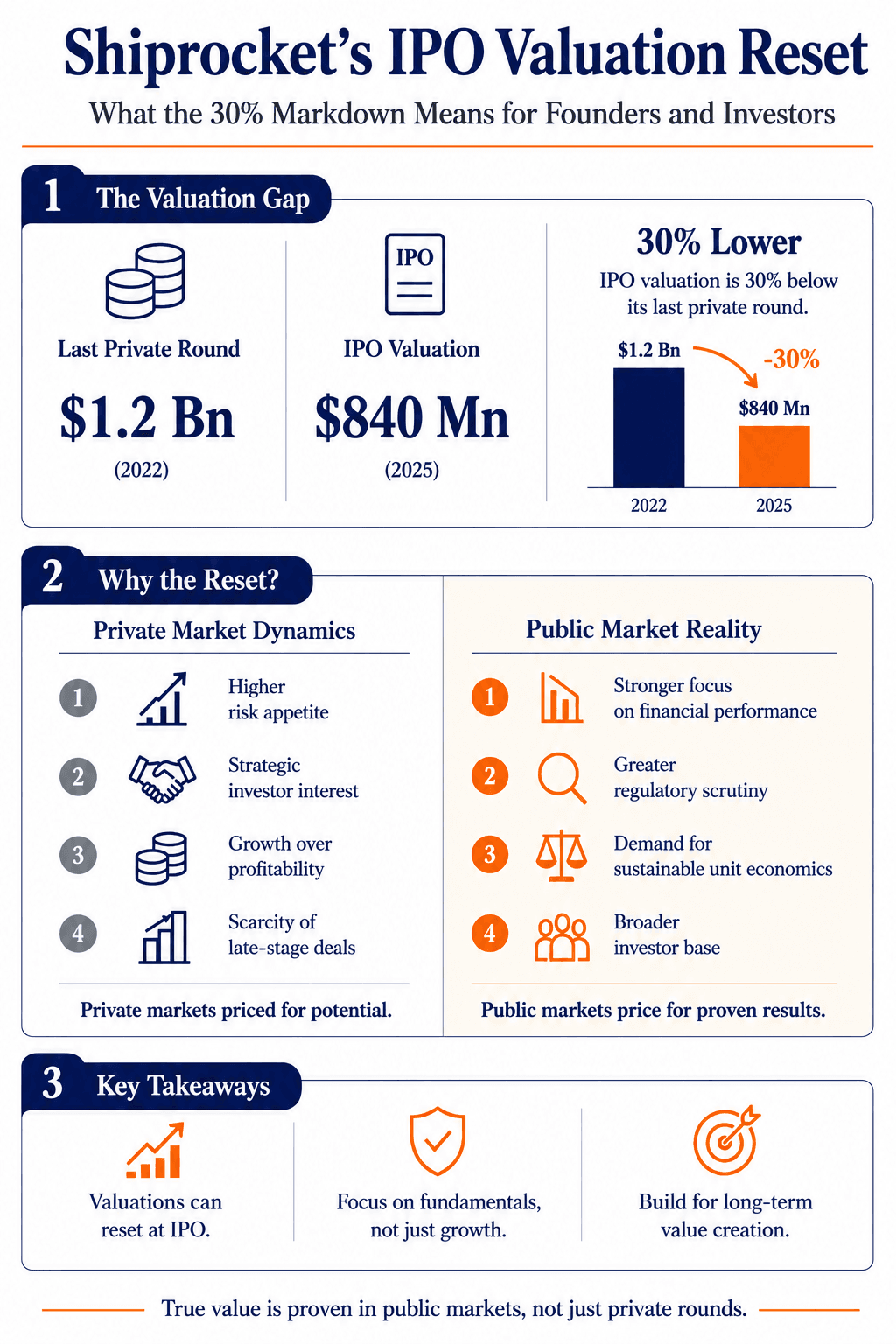
Shiprocket's IPO Valuation Reset Strategy
Shiprocket's approach reflects a four variable model that governs every gap between a private mark and a public Valuation: growth expectations, profitability, liquidity and the discount rate investors apply. When growth slows, revenue multiples usually compress. When margins improve, as they appear to have done here with the sharp cut in losses, the multiple can hold up better than the headline number suggests. Liquidity matters too. A listing lets existing backers such as Temasek, Bertelsmann and Tribe Capital begin exiting at all, something a private mark can never offer regardless of its size. And when perceived risk rises, even an operationally improving business can see its required return, and therefore its Valuation, adjusted downward. Two investors looking at identical numbers can reasonably land on different values depending on which of these four levers they weigh most heavily.
Illustrative summary of the valuation gap and the private-to-public market dynamics behind it. Figures are rounded for visual presentation; see the reported rupee figures above for the primary numbers.
Why This Matters
- Growth quality outweighs growth size. A slower but more durable revenue trajectory can justify a lower multiple without signalling business weakness.
- Margin improvement can offset multiple compression. Cutting losses by 88% and turning cash EBITDA positive gives Shiprocket a specific counterargument to the markdown.
- Liquidity is priced differently in public markets. A listing solves an exit problem that a private mark, however high, cannot address on its own.
- Discount rates move independently of operations. Investor sentiment toward an entire sector can lower a Valuation even when the underlying company is improving.
One caveat: a markdown of this scale can also mask real deterioration if it is not backed by verified financials. Founders and boards should insist on updated, audited numbers before accepting any narrative, optimistic or cautious, about why a Valuation moved.
When a Valuation Reset Signals Discipline, and When It Doesn't
| Signals Discipline | Signals a Deeper Problem |
|---|---|
| Losses narrowing while revenue holds up | Revenue growth decelerating alongside losses |
| Cash EBITDA turning positive | Cash burn accelerating despite the discount |
| Existing investors participating in the OFS | Existing investors exiting entirely at the lower price |
| Discount matches sector wide repricing | Discount is company specific with no peer comparison |
| Management can explain the four variable shift | Management attributes the gap only to "market conditions" |
| Structure supports long term capital needs | Fresh issue proceeds mostly cover debt or prior obligations |
Six Questions Before You Read Into a Down Round IPO
- Which of the four variables, growth, margin, liquidity or discount rate, actually changed?
- Did revenue growth decelerate, or did the market simply reprice risk across the sector?
- Have margins improved enough to offset any multiple compression?
- Are existing investors participating in the offer for sale, or exiting outright?
- Does the capital structure support the next phase of growth, not just the listing itself?
- Would this Valuation survive the same scrutiny two years from now?
THE TAKEAWAY. Shiprocket's IPO discount is less a story about a company losing value and more about a private mark meeting public consensus for the first time. On the numbers reported so far, an 88% cut in losses and a first time positive cash EBITDA, this looks closer to disciplined repricing than distress.
The lesson for anyone building or backing a private company is that a Valuation earned in a term sheet is only provisional. Its real test comes later, in front of investors who were never in the room when it was negotiated.
Preparing for an IPO, a large funding round, or a share transfer that will face public or regulatory scrutiny?
Elite Valuation provides independent Valuation reports and structuring support for IPO readiness and fairness opinions and Rule 11UA compliant Valuations under Ind AS and Income Tax Valuation norms.

Founder - Elite Valuation
CA Sagar Shah
IBBI Registered Valuer & Business Valuation Expert in India
Chartered Accountant (All India Rank) · Company Secretary · Ex-Ernst & Young.
15+ years advising Promoters, Investors, and MNCs on Valuation, ESOP, M&A, FEMA, AIF, Transfer Pricing, and Cross-Border Transactions across India.
- CA — All India Rank
- Company Secretary
- IBBI Registered Valuer
- Ex-Ernst & Young
- 500+ Clients