📚Part of the ESOP in India Knowledge Series - This is a supporting blog in Elite Valuation's comprehensive ESOP knowledge cluster. For the complete overview of ESOP design, tax, Valuation, and strategy for Indian companies, read our pillar guide: ESOP in India: The Complete Guide → | Also read: Founder's Guide to ESOP Valuation →
When a private company grants stock options to employees, it faces a challenge that listed companies never encounter: there is no market price. No stock exchange quotes the company's shares daily. No analyst consensus tells a board what the equity is worth. Yet the obligation to determine a defensible, methodology-backed fair market value (FMV) is every bit as real - and legally mandatory - as it is for a Nifty 50 company.
ESOP valuation for private companies in India is not a single event or a single document. It is a multi-layered regulatory compliance exercise that simultaneously touches the Companies Act 2013 (Section 62(1)(b) - grant-date FMV by an IBBI-registered valuer), Ind AS 102 (fair value recognition of all options as P&L expense over vesting), Income Tax Act 2025 (perquisite computation and TDS at exercise under Rule 15 of IT Rules 2026), FEMA (cross-border valuation and RBI reporting when non-resident employees participate), and SEBI SBEB Regulations 2021 (for listed companies, or companies preparing for a listing). Each framework requires a different analysis, a different professional certifier, and operates at a different point in the ESOP lifecycle.
At the heart of all of these obligations sits one foundational professional judgment: what is the fair market value of a common share in this private company on this specific date? Getting that number right - and getting it documented correctly by the right professional - is the difference between a clean compliance record and a liability that compounds invisibly until it surfaces during a Series C due diligence, a Registrar of Companies inspection, or an income tax scrutiny notice.
At Elite Valuation, our IBBI-registered valuers work exclusively on securities and financial asset valuations for Indian private companies, VC-backed startups, and growing corporates. This guide distils that experience into a practical, regulation-accurate resource on how FMV is determined for ESOP purposes, how to navigate the preferred-vs-common stock distinction that confuses most founders, and the documentation best practices that separate a defensible valuation from one that collapses under scrutiny.
Key Takeaways: ESOP Valuation for Private Companies
- FMV for ESOP purposes is not the last funding round valuation. The per-share FMV of common stock is derived through a liquidation-waterfall allocation across share classes - it is almost always lower than the per-share price at which the last investor round was priced.
- An IBBI-registered valuer (Securities & Financial Assets) is the only prescribed certifier for grant-date FMV under Section 62(1)(b) of the Companies Act 2013. A Chartered Accountant alone is not prescribed for this purpose.
- Three distinct option pricing models are used depending on plan design: Black-Scholes for standard time-based options, Binomial (Lattice) model for complex vesting or early-exercise patterns, and Monte Carlo simulation for market-condition-based vesting.
- FEMA compliance is triggered separately whenever ESOPs are allotted to non-resident employees - requiring a fresh valuation report (not older than 90 days), exercise prices meeting FEMA pricing norms, and Form FC-GPR filing within 30 days of allotment.
- A fresh IBBI Regd Valuer's report is required for every grant cycle. Post-funding round, post-restructuring, or 3+ months after the last report - each of these conditions makes the prior certificate factually inapplicable, regardless of what the report states.
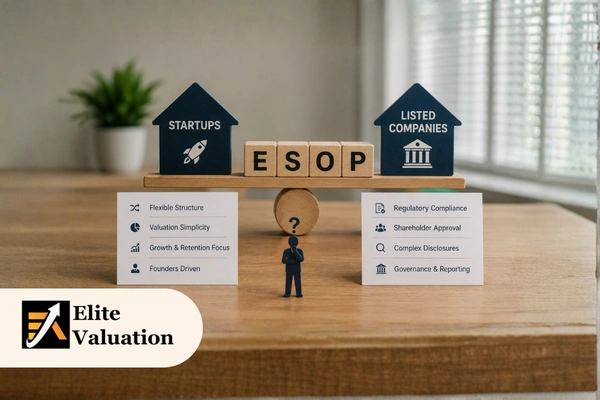
ESOP Valuation for Private Companies vs. Listed Companies: Why FMV Is Harder to Determine
Listed companies have an observable market price for their shares at every moment of the trading day. For ESOP purposes, the grant-date FMV of a listed company's shares is simply the volume-weighted average price (VWAP) on the grant date - a figure anyone can look up. The Ind AS 102 computation follows mechanically from there.
Private companies have none of this. The challenge of ESOP valuation for an unlisted Indian company is that the very thing being valued - a common share - has no market, no observable price, and no consensus benchmark. The valuer must construct the value entirely from inputs: financial projections, comparable company multiples, capital structure details, funding round data, and market-derived parameters like volatility. Each of these inputs involves professional judgment, each can be contested, and the aggregate output - the per-share FMV - directly affects three separate regulatory obligations simultaneously.
The private company ESOP valuation problem is also structurally harder because most Indian startups have complex capital structures. Investors hold convertible preference shares (CCPS) or compulsorily convertible debentures (CCDs) with liquidation preferences, anti-dilution protection, and participation rights. These instruments are senior to the common shares that employees receive via ESOPs. This means the simple question "what is the company worth?" is not the same as "what is a common share worth?" - and the difference can be substantial, as the detailed waterfall discussion in Section 3 below explains.
Quick Reference - What Makes Private Company ESOP Valuation Unique?
Two structural features make private company ESOP valuation more complex than listed company valuation: (1) No observable market price - FMV must be derived from financial modelling, not market data. (2) Complex capital structures - multiple preference share classes with liquidation preferences mean common share FMV is not simply total equity value divided by total shares. Both factors must be addressed in a properly constructed IBBI Regd Valuer's report..
How FMV Is Determined for ESOP Valuation: The Two-Stage Process
Determining the fair market value of common shares for ESOP purposes in an Indian private company requires two sequential analytical steps. Skipping or compressing either of them produces a FMV that is either non-compliant, commercially unreasonable, or both.
Stage 1 - Enterprise Valuation
The first step is computing the total enterprise value of the company. The IBBI-registered valuer selects the most appropriate methodology from three primary approaches, or a weighted blend:
1.Income Approach - DCF Method: The most commonly used methodology for growth-stage Indian startups with a reasonable revenue trajectory. The valuer projects free cash flows (FCFF) over a 5-10 year horizon, applies a terminal value assumption, and discounts the entire stream to present value using the Weighted Average Cost of Capital (WACC). The WACC incorporates the cost of equity (estimated via CAPM using a risk-free rate, equity risk premium, and company-specific beta) and the after-tax cost of debt. For early-stage companies with minimal revenue history, the DCF model is heavily dependent on management projections - making the quality and documentation of those projections critical to a defensible valuation report.
2.Market Approach - Comparable Company Analysis (CCA): The valuer identifies a set of publicly listed companies in the same sector and growth profile as the subject company and applies their median trading multiples (EV/Revenue, EV/EBITDA, or EV/EBIT) to the subject company's financial metrics. For Indian startups, this often involves combining domestic listed comparables with international peers, particularly in sectors where the Indian listed peer set is thin. The resulting enterprise value from CCA cross-checks the DCF output.
3.Asset Approach - Net Asset Value (NAV): Appropriate primarily for very early-stage companies (pre-revenue, asset-heavy), holding companies, real-estate or infrastructure businesses, or companies in financial distress. NAV computes enterprise value as total assets minus liabilities at fair value. For most growth-oriented startups, NAV typically understates value significantly because it ignores the going-concern and intangible value embedded in the business, and it is therefore used only as a floor check rather than a primary methodology.
Valuer's Insight - Choosing the Right Primary Methodology
The choice of primary valuation methodology is not discretionary - it must be justified in the valuation report based on the company's stage, data availability, and industry characteristics. For a pre-profit SaaS startup at Series A, DCF is typically primary and CCA provides a cross-check. For a mature, cash-generating private business, CCA may be primary. The IBBI-registered valuer documents the methodology selection rationale, and auditors and investors will scrutinise it. A report that uses NAV for a growth-stage startup, or that uses a single comparable company, will not withstand professional scrutiny.
Stage 2 - Equity Allocation: The Liquidation Waterfall
Stage 1 produces a total enterprise value. Stage 2 allocates that enterprise value to the different share classes in the cap table. This is where private company ESOP valuation diverges most sharply from listed company valuation - and where most founders discover that the common share FMV is materially lower than the per-share price their investors paid.
The standard waterfall approach models how the enterprise value would be distributed if the company were sold or liquidated on the valuation date. The sequence is:
Net debt: Deduct outstanding loans, convertible notes (to the extent not yet converted), and other financial liabilities to arrive at total equity value.
Preference share liquidation preferences: Allocate each preference share class its liquidation preference in seniority order (most-recent round first, in a typical non-participating preferred structure). For a company that has raised Series A at 1x liquidation preference and Series B at 1x, the Series B investors receive their invested capital first, then Series A, before any residual flows to common.
Participation rights: If preference shares are participating (as opposed to non-participating), the remaining value after liquidation preferences is shared pro-rata between preference and common shareholders. If non-participating, preference shareholders must choose between their liquidation preference and converting to common.
Residual to common: The remaining enterprise value after satisfying all preference claims flows to common shareholders and any converted preference shareholders. Dividing by fully diluted common shares (including the ESOP pool) gives.
Note - Fixed Conversion Ratio: Add to Diluted Shares, Don’t Deduct from Value
The deduction treatment above applies where a preference instrument is expected to exercise its liquidation preference (a non-participating downside or unconverted scenario). Where a CCPS or CCD carries a fixed conversion ratio - so that it will compulsorily convert into a known, fixed number of equity shares - it is not deducted from enterprise value as a preference claim. Instead, on an as-converted basis, those resulting shares are included in the fully diluted common share count, and the total equity value is divided across the enlarged share base. The valuer applies the higher of the two outcomes (as-converted value vs. liquidation preference) for each class, consistent with how a rational holder would elect at exit.
Illustrative Waterfall - Common Share FMV Derivation
Common Share FMV = (Total Equity Value − All Preference Claims) ÷ Fully Diluted Common Shares
Example - Series A Funded Startup:
Total Enterprise Value (from DCF / CCA blend) = Rs. 150 crore
Less: Net Debt = Rs. 5 crore
Total Equity Value = Rs. 145 crore
Less: Series A CCPS Liquidation Preference (1x on Rs. 20 crore invested) = Rs. 20 crore
Residual to Common Shareholders = Rs. 125 crore
Fully Diluted Common Shares = 1,00,00,000 (including 10% ESOP pool)
Per-Share FMV of Common Stock = Rs. 125 crore ÷ 1,00,00,000 = Rs. 125 per share
Note: The Series A investor priced their round at Rs. 145 crore ÷ total preference shares = a higher per-share price reflecting preference rights. The common share FMV of Rs. 125 is lower - and this is the correct exercise price basis for ESOP grants, not the Series A per-preference-share price.
Preferred vs Common Stock FMV for ESOP Valuation: The Discount Founders Miss
The single most common misconception in private company ESOP valuation is the assumption that the per-share price paid by the last investor round is the FMV to use for ESOP grants. This conflates the economics of preference shares with the economics of common shares - and the error can run in either direction, creating regulatory risk whichever way it goes.
Why investor price per share exceeds common share FMV: Investors in private rounds typically purchase Compulsorily Convertible Preference Shares (CCPS) or equivalent instruments that carry liquidation preferences - the right to receive their invested capital back first, before any proceeds flow to common shareholders. In a downside or flat exit scenario, this preference provides investors with meaningful downside protection that common shareholders do not have. This superior economic position justifies a higher price per preference share compared to a common share with equivalent economic participation rights but no downside protection. Treating the investor's per-share price as the ESOP exercise price systematically over-prices ESOP grants and creates a windfall for investors at employee expense.
Why ESOP FMV can sometimes be very low post-funding: Conversely, in a scenario where total enterprise value is close to or below the aggregate liquidation preference of all preference rounds, the residual equity for common shareholders approaches zero - even as the last round implies a headline "post-money valuation" that looks impressive. This is most common for companies that have raised large preference rounds relative to their current enterprise value. In such cases, the IBBI-registered valuer's waterfall computation correctly produces a very low common share FMV, which translates into a very low ESOP exercise price - which is economically beneficial for employees but may create perception challenges when communicating with employees about their potential upside.
ESOP Option Pricing Models Under Ind AS 102: Black-Scholes, Binomial, and Monte Carlo
Once the per-share equity FMV (post-waterfall) is established as the underlying asset value (S), the second analytical layer of ESOP valuation is computing the fair value of the stock option itself. This is distinct from the share FMV - an option has time value, uncertainty value, and asymmetric payoff characteristics that make it worth more than simply (S − K) on the grant date. The choice of option pricing model depends on the design of the ESOP scheme.
Black-Scholes Model - Standard Time-Based Options
The Black-Scholes model is the industry-standard tool for valuing ESOP options with standard time-based vesting (cliff + graded vesting with no performance conditions). Under Ind AS 102, it remains the most widely applied model and is accepted by auditors, the ICAI, and Indian regulatory bodies for standard ESOP schemes.
Black-Scholes - ESOP Option Fair Value
C = S × N(d₁) − K × e−rT × N(d₂)
Six Model Inputs and Their Sources:
S = Per-share common stock FMV (IBBI-certified, post-waterfall)
K = Exercise price (set by board in ESOP scheme - must be ≥ face value under Section 53)
T = Expected term (vesting period + expected post-vest holding period before exit event)
r = Risk-free rate (10-year Government of India securities yield on grant date)
σ = Annualised volatility (derived from historical volatility of listed comparable peer set)
q = Dividend yield (typically 0% for Indian startups with no declared dividend)
- Critical Professional Judgment Areas:
- Volatility (σ): Most judgment-intensive input. Since unlisted shares have no price history, σ must be proxy-derived from the historical daily return volatility of a curated comparable listed peer set over a period equal to T. Peer selection, size adjustment, and outlier exclusion criteria must be documented and defensible.
- Expected Term (T): Not the contractual option life. It must reflect the realistic exercise timing - vesting period plus expected post-vest holding - calibrated against the company's projected IPO or M&A timeline and historical forfeiture patterns if available.
Output: Fair value per option = Black-Scholes output × (1 − expected forfeiture rate adjustment)
Binomial (Lattice) Model - Complex Vesting Structures
The Binomial or Lattice model builds a multi-period decision tree of possible share price paths from grant date to option expiry, evaluating the optimal exercise decision at each node. It is more computationally intensive than Black-Scholes but is better suited for situations involving: graded vesting with different exercise windows per tranche, early exercise behaviour by employees (particularly relevant when options are deeply in-the-money post a funding round), non-standard vesting triggers such as performance or revenue milestones, or option repricing events where the model must capture the economic effect of the revised strike price.
Monte Carlo Simulation - Market-Condition Vesting
When ESOP vesting is contingent on a market-based performance condition - such as the company achieving a minimum enterprise value, or total shareholder return (TSR) exceeding a benchmark by the vesting date - neither Black-Scholes nor Binomial models can adequately capture the probability-weighted outcomes. Monte Carlo simulation runs tens of thousands of stochastic simulations of future share price paths, computing the fraction of scenarios in which the vesting condition is satisfied, and weights the option payoff accordingly. The result is a grant-date fair value that properly reflects the market risk embedded in the performance condition, as required by Ind AS 102 for market-condition vesting.
Key Takeaway - Model Selection Drives Compliance
Ind AS 102 requires the valuation model to "reflect the terms and conditions under which the instruments were granted." Using Black-Scholes for a scheme with TSR-based market conditions would produce a non-compliant Ind AS 102 valuation because it cannot incorporate the vesting condition probability. Similarly, using a simplified model for a graded-vesting scheme without adjusting for the different expected terms of each vesting tranche understates the Ind AS 102 expense. The IBBI-registered valuer must select and document the model that matches the plan design - not simply the most convenient model.
Private Company ESOP Valuation Needs Specialist Experience
Waterfall modelling and option model selection for unlisted startups require professional judgment that goes beyond template-based reports. Our IBBI-registered valuers bring sector-specific expertise and audit-ready documentation.
ESOP Compliance Framework for Private Companies: The Five Regulatory Touchpoints
Private company ESOP valuation does not exist in a single regulatory context. Every grant creates obligations under five separate frameworks, each of which must be tracked independently and cannot be satisfied by a single document or a single professional.
| Framework | Trigger Event | Valuation Requirement | Prescribed Certifier | Key Filing |
|---|---|---|---|---|
| Companies Act 2013 - Section 62(1)(b) | Every ESOP grant date | FMV of common shares (grant date) | IBBI Registered Valuer (Securities & Financial Assets) | Board resolution; MGT-14 within 30 days of special resolution |
| Ind AS 102 (Share-Based Payment) | Grant date | Black-Scholes / Binomial / Monte Carlo fair value of option | IBBI Registered Valuer (or internal team with documented methodology) | Notes to financial statements; mandatory disclosures of model, inputs, and expense |
| Income Tax Act 2025 - Rule 15 of IT Rules 2026 | Exercise date (allotment of shares) | FMV of common shares (exercise date) | SEBI-registered Category I Merchant Banker (not CA alone for unlisted shares) | TDS under Section 392(1); TDS return; Form 130 to employee |
| FEMA - NDI Rules 2019 | Exercise date - non-resident employees only | FMV at allotment (not older than 90 days) | SEBI-registered Category I Merchant Banker or Chartered Accountant | Form FC-GPR on RBI FIRMS portal within 30 days of allotment |
| SEBI SBEB Regulations 2021 | Grant date - listed companies only | Market price (listed) or FMV (unlisted, pre-IPO) | As per SEBI regulations; compensation committee oversight required | Shareholder special resolution; BSE/NSE disclosures; annual report |
Warning - The Two Most Common Multi-Framework Errors
Error 1 - Using the grant-date IBBI Regd Valuer's report for TDS computation at exercise:The IBBI Regd Valuer's report certifies the FMV on the grant date, which may be 3-5 years before the exercise event. Using this stale FMV instead of a fresh exercise-date Merchant Banker certification creates an income tax exposure for the employer (TDS default under Section 201 of the IT Act) and potential under-deduction for the employee. The two reports serve different regulatory purposes and must both exist independently.
Error 2 - Assuming DPIIT recognition triggers the startup TDS deferral: The deferred TDS mechanism under Section 392(3) of the Income Tax Act 2025 (old: Section 192(1C)) requires the startup to hold a valid certificate from the Inter-Ministerial Board of Certification (IMB) under Section 140 of the IT Act 2025 (old: Section 80-IAC). DPIIT recognition alone - which many founders assume is sufficient - does not satisfy this condition. Companies relying on TDS deferral without valid IMB certification face potential back-tax liability and interest for all prior exercise events where deferral was applied.
ESOP Compliance Checklist for Unlisted Companies in India
A valuation is only one component of a compliant ESOP issuance. For an unlisted (private or public) company, the grant and subsequent exercise of options trigger a sequence of corporate, accounting, tax, and (where non-residents are involved) exchange-control compliances. The checklist below sets out, in execution order, what an unlisted company issuing ESOPs must complete.
1. Companies Act 2013 - Corporate Compliance
ESOPs are issued under Section 62(1)(b) read with Rule 12 of the Companies (Share Capital and Debentures) Rules, 2014. The procedural compliance sequence is:
- Grant-date FMV valuation: Obtain the FMV of equity shares from an IBBI-registered valuer (Securities & Financial Assets) - the prescribed certifier for Companies Act governance. A valuation report should be in hand before the Board approves the grant.
- Board resolution: The Board approves the ESOP scheme, the quantum of the pool, the exercise price, and the terms of vesting.
- Shareholders' special resolution: The scheme is approved by members through a special resolution (a private company can pass it as an ordinary resolution only where its articles so permit; a separate resolution is required if options are granted to identified employees exceeding the prescribed thresholds, or to a holding/subsidiary company's employees).
- MGT-14 filing: File the special resolution with the RoC in Form MGT-14 within 30 days of passing. Scheme document & disclosures: Maintain a Rule 12-compliant ESOP scheme, and make the prescribed disclosures (number of options granted, exercise price, vesting, options vested/exercised/lapsed, etc.) in the Board's Report each year.
- Register of ESOP: Maintain the register of employee stock options in Form SH-6. On exercise - allotment: Allot shares and file Form PAS-3 (return of allotment) with the RoC within 30 days of allotment; issue share certificates in Form SH-1 within 2 months of allotment; pay applicable stamp duty on issue.
2. Ind AS 102 - Accounting Compliance
Recognise the grant-date fair value of the options (computed via Black-Scholes / Binomial / Monte Carlo, as the plan design requires) as an employee compensation expense, amortised over the vesting period, with the prescribed model inputs and methodology disclosed in the notes to the financial statements.
3. Income Tax - Perquisite & TDS Compliance
At exercise, the difference between the exercise-date FMV and the exercise price is a perquisite taxable in the employee's hands. For unlisted shares, the exercise-date FMV must be certified by a SEBI-registered Category I Merchant Banker. The employer deducts TDS on the perquisite and issues the TDS certificate (Form 130) to the employee. Eligible start-ups holding a valid IMB certificate may defer TDS under the start-up deferral mechanism.
4. FEMA - Cross-Border Compliance (where non-residents participate)
Where options are granted to non-resident employees, Form-ESOP must be filed with the RBI through the AD Bank on the FIRMS portal within 30 days of grant, and Form FC-GPR within 30 days of allotment on exercise. The exercise price must satisfy the FEMA NDI Rules pricing norms.
Issuance Compliance Checklist - Unlisted Company ESOPs
- IBBI-registered valuer report obtained before the grant-date Board approval (Section 62(1)(b))
- Board resolution and shareholders' special resolution passed; MGT-14 filed within 30 days
- Rule 12-compliant ESOP scheme in place; Board's Report disclosures maintained annually
- Register of ESOP maintained in Form SH-6
- On exercise: PAS-3 filed within 30 days; share certificates (SH-1) issued within 2 months; stamp duty paid
- Ind AS 102 compensation expense computed and booked with note disclosures each reporting period
- Exercise-date Merchant Banker FMV obtained; perquisite TDS deducted and Form 130 issued to the employee
- For non-resident employees: Form-ESOP filed (via AD Bank on FIRMS) within 30 days of grant; FC-GPR within 30 days of allotment
ESOP Valuation Best Practices for Private Companies in India
The gap between technically compliant and genuinely defensible ESOP valuation documentation is significant. Based on our experience working with Indian private companies at seed through pre-IPO stage, these are the practices that consistently separate clean compliance records from those that create avoidable liability.
1. Synchronise Legal and Valuation Timelines
The IBBI Regd Valuer's report, ESOP scheme document, board resolution, and shareholder special resolution must all be aligned to the same grant date. A valuation report prepared well before the board resolution, or a grant letter issued before the valuation report is delivered, creates a sequencing gap that an ROC inspector or auditor will flag. The correct workflow is: commission the valuation concurrent with legal drafting → receive the report → obtain board approval citing the specific valuation report → issue grant letters on the board-approved date.
2. Refresh the Valuation Report After Every Material Event
The single most common compliance failure in ESOP valuation is the assumption that a valuation report remains valid across multiple grant cycles. A single IBBI Regd Valuer's report certifies the FMV on one specific date. Any of the following events requires a fresh report before the next grant cycle: completion of a new funding round, revenue growth that materially changes the DCF valuation, addition of a new preference share class, a strategic acquisition or divestiture, or the passage of more than approximately three months since the last report was issued (as a practical convention based on ROC inspection norms, though no precise statutory expiry period is prescribed).
3. Maintain a Clean, Contemporaneous Cap Table
The accuracy of the waterfall computation in Stage 2 is entirely dependent on a precise, up-to-date capitalisation table. If the cap table understates preference share liquidation preferences, fails to include all convertible instruments, or uses incorrect conversion ratios, the resulting common share FMV is arithmetically wrong regardless of how rigorous the enterprise valuation in Stage 1 was. Maintain a cap table that records every share class, conversion ratio, liquidation preference amount, anti-dilution provisions, and ESOP pool allocation - and share this with the IBBI-registered valuer as a primary input document, not as an afterthought.
4. Book the Ind AS 102 Expense Consistently
Many private Indian companies that are technically compliant with the Section 62(1)(b) grant-date valuation obligation nonetheless fail to p>properly recognise the Ind AS 102 employee compensation expense in their financial statements. This creates a risk of audit qualification and misstatement that must be restated if the company subsequently seeks funding, conducts an IPO, or is acquired. The compensation expense must be computed using the Black-Scholes option fair value at grant date, allocated over the vesting period on a proportionate basis for each vesting tranche, and disclosed in the notes with the full set of model inputs and methodology.
ESOP Valuation Best Practices Checklist - Private Companies
- Commission IBBI Regd Valuer's report before - not after - each grant date
- Refresh the report after every funding round, and at minimum annually if grants are made across the year
- Document all DCF projections and comparable peer selection in the valuation report - a report without documented methodology cannot be defended
- Maintain a fully updated cap table (all share classes, preferences, convertibles, ESOP pool) and provide it to the IBBI valuer as a primary document
- Ensure the Ind AS 102 option fair value computation is prepared at each grant date and the compensation expense is booked consistently across each reporting period
- Obtain a separate exercise-date Merchant Banker FMV certificate (within 180 days) for each exercise event under IT Rule 15 - this is a distinct document from the IBBI grant-date report
- For non-resident employees: obtain FEMA-compliant valuation (≤ 90 days), comply with NDI Rules pricing norms, and file FC-GPR within 30 days of allotment
- Verify IMB certification is current if relying on startup TDS deferral under Section 392(3) - DPIIT recognition alone is not sufficient
Common ESOP Valuation Mistakes in Private Companies (and How to Avoid Them)
⚠ Four Critical ESOP Valuation Mistakes - Private Companies
❌ Setting exercise price equal to the last round's per-share price:
Investor CCPS carries liquidation preferences and other rights that justify a premium over common stock. The IBBI-registered valuer must model the waterfall to derive the common share FMV, which will almost always be lower than the investor round price. Setting exercise prices equal to the investor round price inflates the apparent option value and may result in employees holding underwater options immediately after a flat or modest-growth exit - damaging retention value and creating employee relations problems.
❌ ⚠ Using NAV/book value as a shortcut for FMV:
Book value or net asset value per share is the accounting value of assets less liabilities on the balance sheet - it is not the fair market value for ESOP purposes. For growth-stage companies, FMV (which captures going-concern value, brand, IP, and future cash flows) can be many multiples of NAV. Conversely, for distressed companies, NAV may overstate FMV. For ESOPs under Section 62(1)(b), using an arbitrary book-value FMV without an appropriate valuation (e.g., IBBI RV for Companies Act governance and a Merchant Banker for tax) is poor compliance and can be challenged by RoC / tax authorities.
❌ Applying one valuation report to multiple grant batches across different dates:
This is the most frequently observed compliance gap in ROC inspections of private company ESOP programmes. Every grant date requires a contemporaneous FMV report. If a company grants to 10 employees in April and another batch in September of the same year, both grant dates require a separate IBBI Regd Valuer's report - even if no material change in equity value has occurred.
❌ Ignoring FEMA compliance for foreign employee grants:
Companies with global workforces, particularly those with Singapore, US, or UK-based employees receiving options from the Indian entity, routinely overlook FEMA compliance at the exercise stage. The FC-GPR filing requirement and the 90-day valuation currency requirement are hard deadlines - a missed FC-GPR filing creates a FEMA contravention that must be compounded through the RBI's regularisation process, typically with a penalty calculation applied to the cross-border transaction value.
Conclusion: FMV Determination Is the Foundation of ESOP Compliance
ESOP valuation for private companies is not a checkbox exercise - it is the structural foundation on which every downstream compliance obligation rests. The grant-date FMV certified by an IBBI-registered valuer under Section 62(1)(b) is simultaneously the basis for the ESOP exercise price that determines employee economics, the input S in the Black-Scholes model for Ind AS 102 accounting, and the reference for the exercise-date perquisite computation under Income Tax Rule 15. A gap or error in the FMV determination - whether from using the wrong methodology, skipping the waterfall computation, or relying on a stale prior report - propagates through all three regulatory frameworks at once. Private companies that invest in rigorous, methodology-backed, contemporaneous IBBI Regd Valuer's reports for every grant cycle build a compliance record that holds up under the scrutiny of investors, auditors, tax authorities, and regulators alike. Those that cut corners typically discover the cost during a due diligence process or a regulatory notice - moments when clean documentation cannot be retrospectively created.
ESOP Valuation for Your Private Company
IBBI-registered valuer reports with full waterfall modelling, Black-Scholes computation, and Ind AS 102 compliance documentation. Delivered in 7-10 business days.
Frequently Asked Questions: ESOP Valuation for Private Companies

CA Sagar Shah, Founder
Mr Sagar Shah is the Founder of Elite Valuation and leads the firm’s Valuation and Advisory practice. With over 15+ years of professional experience.