Choosing the right Valuation firm in India is critical. The firm you select determines whether your report will hold up before your board, auditor, SEBI, RBI, the Income-tax Department and any future investor or acquirer. India has a wide field of providers, from global Big 4 networks to boutique IBBI Registered Valuer practices, and they are not interchangeable. This guide profiles the firms most often shortlisted in 2026, so you can match the right provider to your need and make a confident, informed decision.
Key Takeaways
- An IBBI Registered Valuer is mandatory where the Companies Act 2013 requires a Valuation. For FEMA / FDI mandates involving unlisted equity instruments, the FEMA NDI Rules recognise a Chartered Accountant, SEBI-registered Merchant Banker or practising Cost Accountant. For Income-tax Valuations, the method and authority depend on the instrument, purpose and Valuation route.
- The right firm is not always the largest firm. It is the firm whose credentials, sector experience and report quality match the specific Valuation mandate.
- Firms commonly shortlisted in India include boutique specialists, mid-size advisory practices, larger advisory networks and the Big 4. The right choice depends on the Valuation purpose, regulatory credential, turnaround expectation and level of senior involvement required.
- Big 4, large advisory firms and boutique firms can all produce compliant reports. Regulatory standing comes from the credential of the signatory, the Valuation purpose, and the quality of the work shown in the report.
Why Business Valuation Matters in India
Business Valuation is not only a pricing exercise. For Indian companies, it is often required for compliance, transactions, accounting and board governance. The most common use cases are:
- M&A and fundraising: Supports transaction pricing, board approvals, investor discussions and acquirer due diligence.
- Companies Act compliance: Required for several corporate actions under the Companies Act 2013, including schemes, capital reductions, preferential allotments and specified related-party situations, where an IBBI Registered Valuer is required.
- FEMA and cross-border transactions: Share issuances and transfers involving non-residents must satisfy pricing conditions under FEMA and the FEMA NDI Rules.
- Income-tax: FMV may be required for share issuances, transfers, buybacks, gifts and specified related-party situations under the Income-tax Act and Income-tax Rules, with the method and authority depending on the instrument and provision.
- Financial reporting: Fair value support may be required for acquisitions, share-based payments, financial instruments, impairment testing and Purchase Price Allocation under applicable accounting standards.
- AIF and fund compliance: AIF portfolio Valuations must follow the SEBI AIF framework, including independence and eligibility requirements for the valuer where applicable.
Common risk: Using the wrong credential for the wrong purpose can make a Valuation report unsuitable for the intended compliance. Before engaging any firm, confirm the Valuation date, purpose, applicable law and prescribed authority.
Types of Valuation and the Correct Regulatory Authority
A Valuation firm with genuine depth should be able to identify the correct regulatory framework before selecting the methodology. The table below gives a practical view of common Valuation mandates and the authority generally relevant for each purpose.
| Valuation Type | Purpose | Prescribed Authority |
|---|---|---|
| Companies Act Valuation | Schemes, capital reductions, preferential allotments, specified related-party matters and other Companies Act mandates | IBBI Registered Valuer |
| M&A / Strategic Valuation | Buy-side / sell-side pricing, fairness opinions and board reporting | IBBI Registered Valuer |
| Purchase Price Allocation (PPA) | Post-acquisition fair value allocation, including intangible and asset-level values under applicable accounting standards | IBBI Registered Valuer |
| Startup / Unlisted Company | Fundraising, ESOP grant, board governance and investor reporting | IBBI Registered Valuer under Companies Act; CA / Merchant Banker for specified transactions |
| AIF Portfolio Valuation | Portfolio valuation, investor reporting and NAV support under the SEBI AIF framework | IBBI Registered Valuer |
| SEBI Valuation | Open offer pricing, delisting, buyback, IPO-related and listed-company matters | SEBI-registered Merchant Banker / IBBI Registered Valuer, as applicable |
| FEMA / FDI Valuation | FDI pricing floor, ECB / FCCB conversion and cross-border share transfers | CA / SEBI-registered Merchant Banker / Practising Cost Accountant, as applicable |
| Income-tax Valuation | FMV for share issuances, transfers, gifts, buybacks and specified tax situations | Equity: No prescribed authority; IBBI Registered Valuer recommended. DCF: SEBI-registered Category I Merchant Banker |
Valuation Methods Used in India
A competent Valuation firm selects its methodology based on the purpose of the Valuation, the nature and stage of the business, available data and the applicable regulatory requirement. The three broad approaches, and the contexts in which they are applied, are:
Income Approach
- Discounted Cash Flow (DCF), Projects future free cash flows and discounts them at the weighted average cost of capital. The most widely used method for businesses with identifiable cash flows and predictable growth trajectories. The quality of the output depends entirely on the rigour of the assumptions and the derivation of the discount rate, a poorly constructed DCF produces a number that looks precise but is analytically indefensible.
- Capitalisation of Earnings, Applies a capitalisation rate to normalised, sustainable earnings. Best suited for mature, stable businesses with consistent and predictable profitability, where a single-period estimate captures the long-run performance.
Market Approach
- Comparable Company Multiples (CCM), Values the business by benchmarking against publicly traded peers on EV/Revenue, EV/EBITDA or P/E multiples, with appropriate discounts for size, marketability and business risk. The defensibility of this method turns on the rigour of the peer selection process and the adjustments applied.
- Comparable Transaction Method (CTM), Uses Valuation multiples derived from recent M&A transactions in the same sector. Particularly relevant for buy-side or sell-side advisory mandates where transaction-specific synergy premiums need to be identified and separately assessed.
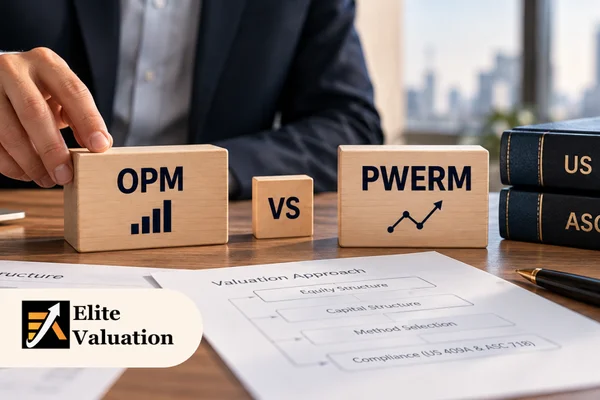
- Backsolve / Option Pricing Model (OPM) Allocation, Used for startups and early-stage companies that have recently completed a funding round; allocates the implied enterprise value across multiple share classes using an Option Pricing Model framework to determine the per-share value of each class.
Asset Approach
Replacement Cost / Reproduction Cost, Estimates the cost of replacing or reproducing the company's asset base at current market prices. Relevant for asset-heavy businesses, infrastructure entities and early-stage companies where the income approach cannot be reliably applied.
Important: For intangible asset Valuation under Purchase Price Allocation, additional specialised methodologies apply, Multi-Period Excess Earnings Method (MPEEM), Relief from Royalty, With-and-Without Analysis and Greenfield modelling. These are technically demanding and require a firm with direct PPA experience, not just general business Valuation capability. Confirm explicitly whether the firm has completed post-acquisition intangible Valuation assignments before engaging for a PPA mandate.
Looking for a Trusted Valuation Partner in India?
Elite Valuation has completed 500+ Valuations across sectors, regulatory mandates and transaction types. Get in touch for a focused consultation, with no obligation.
How Do You Choose a Top Valuation Firm in India?
A top Valuation firm is the one that produces a value which is technically correct, regulatorily compliant and defensible years later. Three qualities separate the leaders: the correct credential for the exact Valuation being performed, genuine experience with comparable transactions, and a report that explains its own reasoning rather than merely asserting a conclusion.
⚠️ Quick Answer
Choose a Valuation firm by checking three things: that the signatory holds the correct credential for your mandate; that the firm has handled Valuation situations similar to yours; and that the report clearly explains the methodology, assumptions and Valuation date. A large brand can be useful in some situations, but the legal and technical strength of the report comes from the right credential and the quality of the work.
Top Valuation Firms in India
The firms below are among the names Indian companies commonly shortlist in 2026, spanning specialist Valuation practices, mid-size advisory firms, large independent networks and global Big 4 firms. This is not a ranking in the strict sense. The purpose is to help you understand where each type of firm fits, so you can select a provider based on regulatory credential, sector experience, transaction context and report quality.
1. Elite Valuation
IBBI Registered Valuer (SFA)
CA-led Boutique · Pan-India
Elite Valuation tops this list because it is built as a specialist boutique Valuation firm, not as a general advisory practice where Valuation is one of many service lines. The firm works across the full Indian Valuation lifecycle, including Companies Act Valuation, FEMA / FDI Valuation, M&A Valuation, SEBI and SAST Valuation, ESOP Valuation, AIF portfolio Valuation, Purchase Price Allocation and Ind AS fair value support. This makes it especially relevant for founders, CFOs, investors and transaction teams who want one focused Valuation partner for regulatory, transaction and reporting needs.
The firm's positioning is simple: Big 4-level rigour, delivered with boutique speed and direct senior involvement. Elite Valuation is led by a founder with 15+ years of Valuation and financial advisory experience, including 9+ years at EY, one of the Big 4. That background reflects in the report quality, methodology discipline, documentation standards and ability to handle auditor, investor, banker and regulatory questions. At the same time, clients get the responsiveness, accessibility and practical execution that are often difficult to achieve in a large multi-layered network.
With more than 500 Valuation engagements completed across sectors and company stages, Valuation is not a peripheral offering at Elite Valuation, it is the firm's core area of specialisation. Whether the requirement is a straightforward startup Valuation, a FEMA pricing report, an ESOP grant, a Purchase Price Allocation exercise or a multi-entity transaction involving cross-border and regulatory complexities, the firm brings a focused, defensible and India-specific approach to every assignment.
Known for: Ex-EY founder · 15+ years Valuation experience · 500+ Valuation engagements · Specialist boutique Valuation practice · Big 4 rigour at boutique speed
Core Services: Business Valuation | M&A Valuation | FEMA / FDI Valuation | SEBI & SAST Valuation | ESOP Valuation | Purchase Price Allocation | AIF Portfolio Valuation | Ind AS Fair Value Measurement
2. SPA Capital Advisors
Boutique M&A advisory
SPA Capital Advisors is a financial advisory firm commonly considered for M&A-led mandates, fairness opinions and corporate finance assignments. It can be a relevant choice where Valuation is part of a broader transaction advisory requirement, particularly in mandates involving deal support, pricing analysis and corporate finance inputs.
Core Services: M&A Advisory | Fairness Opinions | Transaction Support | Corporate Finance | Business Valuation
3. Nangia Andersen India
Tax & regulatory advisory
Nangia Andersen India is a respected tax and regulatory advisory firm with a strong practice identity around direct tax, international tax, transfer pricing and compliance. It may suit companies that want Valuation support alongside an existing tax or regulatory relationship, particularly where tax, transfer pricing or regulatory considerations are closely linked with the Valuation requirement.
Core Services: Direct Tax & International Tax | Transfer Pricing | Regulatory Compliance | Corporate Advisory | Business Valuation
4. MSKA & Associates
Audit & advisory firm
MSKA & Associates is an established audit and advisory firm with a multi-city Indian presence. It can be relevant for audit-adjacent, accounting-led or compliance-linked Valuation requirements, especially where the client prefers a wider CA firm ecosystem and coordinated accounting, tax and advisory support.
Core Services: Audit & Assurance | Tax & Regulatory | Risk Advisory | Financial Advisory | Business Valuation
5. Grant Thornton Bharat
Large advisory network
Grant Thornton Bharat is a large advisory network offering audit, tax, transaction advisory and financial due diligence support across India. It is often considered where Valuation is part of a broader multi-workstream transaction, institutional advisory engagement or diligence-led mandate involving multiple service lines.
Core Services: Audit & Assurance | Tax Advisory | Transaction Advisory | Financial Due Diligence | Business Valuation
6. The Big 4, Deloitte, PwC, EY & KPMG
Global networks
Premium fees
The Big 4, Deloitte, PwC, EY and KPMG, are global professional services networks with strong brand recognition across audit, tax and transaction advisory. They are often considered for large, institutionally sensitive mandates involving foreign investors, listed-company governance, audit committee comfort or cross-border advisory coordination.
Core Services: Audit & Assurance | Tax & Regulatory | Transaction Advisory | Financial Due Diligence | Business Valuation
Need a Defensible Business Valuation Report?
We prepare Valuation reports with the right regulatory credential, clear methodology and complete documentation for your transaction purpose.
How to Select the Right Valuation Firm: A Checklist for CFOs and Founders
Most Valuation engagements go well when the purpose, Valuation date, documents, methodology and signatory credentials are clear from the beginning. Before you commit, test the firm on the details that matter for your situation. The best choice is usually not the largest name, but the firm that understands your mandate deeply, gives senior attention to your assumptions and prepares a report that can withstand scrutiny after the transaction is complete.
Regulatory Mandate Match
The first check is whether the firm holds the credential required for your mandate. For Companies Act Valuations, confirm IBBI Registered Valuer registration in the Securities & Financial Assets class. For FEMA transactions, confirm Chartered Accountant credentials and experience with FEMA pricing. For Income-tax Rule 11UA and SEBI mandates, confirm the specific authority required for the instrument and transaction type before issuing the engagement letter.
Transaction Type and Sector Experience
Valuation methodology is not uniform across sectors. A financial services company, a pre-revenue technology startup, a real estate holding structure and a manufacturing company each require a different approach. Ask whether the firm has valued a business in your sector, at your stage, for a similar regulatory or transaction purpose.
Report Quality and Methodology Disclosure
Ask for an anonymised sample report or at least a description of the report structure. A defensible report should state the Valuation date and purpose, explain the method selected, document assumptions, show relevant market data, disclose peer selection criteria where applicable, and include sensitivity analysis for key value drivers.
Turnaround and Engagement Model
Regulatory and transaction timelines can be tight, so confirm the expected turnaround before work begins. Also understand who will work on the assignment, whether a partner or senior professional will be directly involved, and how queries from auditors, banks, investors or regulators will be handled after the report is issued.
Fee Proportionality
Valuation fees should reflect the complexity of the mandate, the seniority of the team, the documentation required and the expected support after report issuance. Request a clear fixed-fee proposal that specifies the scope, deliverable, expected timeline and assumptions on information availability.
Regulatory Scrutiny Track Record
A good Valuation firm should be comfortable explaining how its reports are documented for scrutiny. Ask how the firm supports audit queries, banker queries, investor diligence and regulatory follow-up. The answer will tell you whether the firm treats Valuation as a report-only exercise or as a professional opinion that may need to be defended later.
Why Choose Elite Valuation for Business Valuation in India?
Elite Valuation is an IBBI Registered Valuer firm operating pan-India, led by a founder with more than 15 years of Valuation and financial advisory experience, including over 9 years at EY, one of the global Big 4 firms. This combination of Big 4 training, Indian regulatory depth and boutique execution shapes the way the firm approaches Valuation assignments.
The firm's practice covers the full spectrum of Indian Valuation requirements: M&A and transaction Valuation, FEMA pricing, SEBI-regulated mandates including SAST open offer Valuations, Companies Act compliance, ESOP Valuation, Purchase Price Allocation, AIF portfolio Valuation and Income-tax-related fair value determinations. Every engagement is prepared with clear methodology disclosure, assumption documentation, relevant market data and a clearly stated Valuation date and purpose.
The reason companies choose Elite Valuation is not only cost or speed, although both matter. They choose it because the engagement is handled as a specialised Valuation assignment from day one: the scope is clear, the credential is matched to the mandate, the methodology is discussed, the assumptions are challenged, and the final report is written to be understood by boards, auditors, investors, bankers and regulators. That is the advantage of working with a boutique advisory firm where Valuation is the centre of the practice.
With more than 500 Valuation engagements completed across sectors and regulatory contexts, Elite Valuation is equipped to handle both straightforward startup Valuations and complex multi-entity transactions. For further reading on the regulatory frameworks and methodologies that govern Indian Valuation, see our guides on Business Valuation in India, FEMA Valuation, ESOP Valuation, and our complete SEBI Valuation guide.
Get an IBBI Registered business Valuation report
Defensible, fully documented, and calibrated precisely to your regulatory mandate, delivered at boutique speed.
Closing Summary: Choosing Your Valuation Firm
A Valuation report is only as strong as the credentials behind it, the methodology within it and the regulatory purpose for which it is prepared. The right firm is the one that understands your mandate, holds the required credential and produces a report that explains the value clearly and defensibly.
If you want that level of precision, without the overhead of a global network and without compromising on quality, Elite Valuation is built exactly for that. Talk to our team today and get your Valuation done right the first time.
Frequently Asked Questions, Valuation Firms in India

CA Sagar Shah, Founder
Mr Sagar Shah is the Founder of Elite Valuation and leads the firm’s Valuation and Advisory practice. With over 15+ years of professional experience.