Table of contents
- Key Takeaways
- What Is Intangible Asset Valuation in India?
- What Types of Intangible Assets Need to Be Valued?
- Why Is Intangible Asset Valuation Important in India?
- What Methods Are Used for Intangible Asset Valuation?
- How Does the Intangible Asset Valuation Process Work?
- Brand, Patent and Transfer Pricing Valuation in India
- Who Can Perform Intangible Asset Valuation in India?
- Common Mistakes in Intangible Asset Valuation India
- Dealing With a Complex Intangible Asset Valuation?
- Need Expert Intangible Asset Valuation in India?
- Closing Summary: Intangible Asset Valuation Strategy
- Frequently Asked Questions — Intangible Asset Valuation
In India, intangible asset valuation has become one of the most critical — and technically demanding — areas of valuation practice. As the Indian economy transitions toward knowledge-intensive industries, intangible assets now represent the dominant component of enterprise value for technology companies, pharmaceutical firms, media enterprises, consumer brands and fintech platforms. A startup may have negligible tangible assets but possess patents, software and brand recognition worth hundreds of crores. A pharmaceutical company's most valuable asset may be its drug patents and regulatory approvals, not its manufacturing plant.
Yet intangibles are uniquely difficult to value. They lack physical substance, have no active secondary markets, and their value is entirely contingent on future economic benefits that are inherently uncertain — and on legal rights that must be verified, not assumed. The valuer must simultaneously master financial modelling, intellectual property law, industry dynamics and the specific regulatory frameworks — Ind AS 38, Ind AS 113, the Income Tax Act, the Companies Act, and FEMA — that each govern a different aspect of recognition, measurement and disclosure.
This guide covers everything required for a rigorous, defensible intangible asset valuation in India — the types of assets, the three valuation approaches and their specific application to each asset class, the seven-step valuation process, the regulatory framework across accounting standards, tax and corporate law, special considerations for brands, patents, software and transfer pricing, and the common mistakes that undermine even technically sophisticated valuations.
Key Takeaways
- Intangible asset valuation in India operates across four distinct regulatory frameworks simultaneously — Ind AS (financial reporting), Companies Act (corporate transactions), Income Tax Act (capital gains and transfer pricing), and FEMA (cross-border IP transfers)
- The income approach — specifically the relief from royalty method and MPEEM — is the dominant methodology; cost approach is used as a floor or for specific asset types like software and assembled workforce
- Royalty rate selection is the single most consequential and most frequently challenged variable in brand and patent valuation; it must be benchmarked against actual comparable licensing transactions, not industry averages
- Under Ind AS 103, all identifiable intangible assets acquired in a business combination must be separately valued and recognised — not absorbed into goodwill
- Economic life, not legal life, drives the valuation period — a patent's 20-year term is irrelevant if the technology becomes obsolete in five years
- Contributory asset charges in MPEEM must reflect fair market returns on all supporting assets — using book values or omitting asset classes materially distorts the excess earnings conclusion
- For cross-border IP transfers, transfer pricing documentation must be contemporaneous and arm's length — the absence of a robust valuation report is the primary trigger for tax authority adjustments
What Is Intangible Asset Valuation in India?
📌 Definition — Intangible Asset Valuation
- Intangible asset valuation is the process of determining the economic value of non-physical assets — patents, trademarks, brands, copyrights, customer relationships, software, trade secrets and licensed technology — that generate future economic benefits for their owner. Unlike tangible assets with observable market prices, intangibles are often unique to the owning entity, lack active secondary markets, and derive their value entirely from legal rights and the future cash flows those rights enable.
In India, intangible asset valuation operates within multiple regulatory frameworks, each with distinct requirements:
| Framework | Governing Standard | Purpose of Valuation | Professional Required |
|---|---|---|---|
| Financial Reporting | Ind AS 38, Ind AS 113, Ind AS 103 | Recognition, PPA, impairment testing | IBBI Registered Valuer / Ind AS specialist |
| Companies Act | Sections 230–232, Section 247 | Mergers, demergers, capital reduction | IBBI Registered Valuer |
| Income Tax — Capital Gains | Section 55, Section 45, Rule 11UA | FMV for transfer, capital gains computation | CA / Merchant Banker |
| Transfer Pricing | Rule 10TA, OECD guidelines | Arm's length pricing for cross-border IP | CA / Transfer Pricing Specialist |
| FEMA | NDI Rules 2019, RBI circulars | FMV for cross-border IP transfer or licensing | CA / Merchant Banker |
| IP Litigation | Indian Patents Act, Trademarks Act, Copyright Act | Damages quantification, infringement claims | Specialised IP Valuer |
A company transferring a trademark to a foreign subsidiary, for example, simultaneously needs an income approach valuation for Ind AS 38 derecognition, a transfer pricing analysis for the arm's length royalty rate, a FEMA FMV certificate for RBI compliance, and potentially a Companies Act registered valuer report if the transaction forms part of a scheme. Each requires a different professional, standard of value and format — they cannot be consolidated into a single report.
What Types of Intangible Assets Need to Be Valued?
The IBBI Valuation Standards and Ind AS 38 identify intangible assets across five broad categories. In a business combination under Ind AS 103, all identifiable intangibles must be separated from goodwill and individually valued — even if they are not recorded on the target's balance sheet.
| Category | Examples | Typical Valuation Trigger | Primary Method |
|---|---|---|---|
| Marketing-related | Trademarks, brands, trade names, domain names, non-compete agreements | M&A, PPA, licensing, transfer pricing | Relief from Royalty |
| Customer-related | Customer relationships, order backlog, customer lists, subscription bases | M&A, PPA, fundraising | MPEEM |
| Technology-based | Patents, trade secrets, proprietary processes, unpatented technology, software | M&A, transfer pricing, licensing, litigation | Relief from Royalty / MPEEM |
| Artistic / Content | Copyrights, literary works, music, films, databases | M&A, transfer pricing, licensing | Relief from Royalty |
| Contract-based | Franchise agreements, licences, supply contracts, service agreements | M&A, PPA, dispute resolution | MPEEM / Incremental Cash Flow |
| Workforce / Know-how | Assembled workforce, specialised training, institutional knowledge | M&A (contributory asset charge only under Ind AS 103) | Replacement Cost |
📋 Ind AS 103 — What Must Be Separately Recognised in a Business Combination:
- All identifiable intangible assets that meet the separability or contractual-legal criterion — even if not on the target's balance sheet
- Internally generated brands, customer relationships and order backlogs must be identified and valued even though they cannot be recognised on the target's own books under Ind AS 38
- Assembled workforce is valued as a contributory asset charge in MPEEM but not recognised separately in the purchase price allocation
- Goodwill is the residual after allocating fair value to all identifiable assets and liabilities — over-broad goodwill recognition signals incomplete intangible identification
Why Is Intangible Asset Valuation Important in India?
1. Financial Reporting — Ind AS Compliance
Under Ind AS, companies acquiring businesses must allocate the purchase consideration to all identifiable intangible assets at fair value — separately from goodwill. Ind AS 103 (Business Combinations) requires this purchase price allocation (PPA) at acquisition date. Post-acquisition, finite-lived intangibles are amortised over their economic lives, and goodwill plus indefinite-lived intangibles must be tested annually for impairment under Ind AS 36. Both the initial PPA and annual impairment testing require a formal valuation. An incorrect PPA — under-identifying intangibles and over-stating goodwill — will be challenged by auditors and creates a distorted depreciation and impairment profile for years post-acquisition.
2. Mergers, Acquisitions and Corporate Restructuring
In M&A transactions involving IP-rich companies, intangible assets are frequently the primary value drivers — and the primary source of valuation disagreement. In a pharmaceutical acquisition, the value of drug patents and regulatory approvals may represent 80%+ of the enterprise value. In a technology deal, proprietary software and customer relationships may be worth more than all tangible assets combined. The exchange ratio in a merger scheme filed with the NCLT is directly affected by how completely and accurately the intangible assets of both merging companies are identified and valued. Undervaluation of the target's intangibles suppresses the exchange ratio and is a ground for shareholder objection. For detailed merger valuation methodology, see our guide on M&A Valuation in India.
3. Tax Planning and Transfer Pricing
Intangible asset valuation has direct, high-stakes income tax consequences. For capital gains on IP transfers, the valuation determines the full value of consideration and the cost of acquisition — both inputs to the gains computation. For cross-border IP transactions within group structures, transfer pricing regulations require arm's length pricing, and the OECD's BEPS framework has significantly tightened the documentation standard. A company licensing its brand to a foreign subsidiary at below arm's length royalty rates may face a transfer pricing adjustment adding years of royalties to its Indian taxable income — plus penalties.
4. Fundraising and IP-Backed Financing
For IP-rich companies — particularly startups — intangible assets drive fundraising valuations. An early-stage pharma company with a patent portfolio and no revenues is valued almost entirely on the expected economic life and commercial potential of its IP. Venture capital and private equity investors evaluate IP portfolios as key value drivers, and a rigorous intangible asset valuation provides the analytical foundation for investment negotiation. Banks and NBFCs increasingly accept IP collateral for secured lending — requiring an independent valuation to establish the asset's realisable value.
5. IP Portfolio Management and Litigation
Beyond compliance, intangible asset valuation supports strategic IP decision-making — identifying high-value patents for continued maintenance versus abandonment, setting appropriate royalty rates in licensing negotiations, quantifying damages in IP infringement litigation, and informing R&D investment priorities. In IP infringement disputes, the damages calculation is essentially an intangible asset valuation exercise — computing the lost profits, reasonable royalty, or market value attributable to the infringed IP.
What Methods Are Used for Intangible Asset Valuation?
Three valuation approaches are applied to intangible assets — each with specific methods suited to different asset types and purposes. Unlike company-level DCF valuation, intangible asset valuation requires additional analytical steps to isolate the value attributable specifically to the subject intangible, separate from the broader business.
📌 Three Approaches to Intangible Asset Valuation — Quick Reference
- Income Approach: Values the intangible based on the future economic benefits it generates — either as hypothetical royalty savings (relief from royalty) or as isolated excess earnings (MPEEM). Dominant for brands, patents, customer relationships and technology.
- Market Approach: Values based on prices paid in comparable transactions for similar intangible assets. Limited by scarcity of truly comparable deals and non-disclosure of terms — typically used as cross-check.
- Cost Approach: Values based on the cost to recreate or reproduce the asset. Used for software, assembled workforce and early-stage technology where income-based evidence is unavailable.
Income Approach Methods
📌 Relief from Royalty Method — How It Works
The relief from royalty method values an intangible asset based on the hypothetical royalty a company would pay to license the asset if it did not own it. By owning the asset, the company is "relieved" of paying that royalty — and the present value of those avoided royalty payments is the asset's value.
Value = Σ [ (Revenue × Royalty Rate × (1 − Tax Rate)) ÷ (1 + Discount Rate)ⁿ ]
Key inputs: Revenue attributable to the asset · Royalty rate from comparable licensing transactions · Asset-specific discount rate · Remaining economic life · Tax amortisation benefit (where applicable)
Relief from Royalty Method (RfR)
Best For: Trademarks, brands, licensed technology, patents with established licensing markets
The royalty rate is the most critical and most frequently challenged input. It must be benchmarked against actual comparable licensing transactions in the same industry and geography — not generic industry averages. Key adjustments include exclusivity premiums, geographic coverage, field-of-use restrictions, and the relative bargaining position of licensor and licensee. The after-tax royalty savings are discounted at an intangible-specific rate that is higher than the company's WACC, reflecting the asset's higher risk profile relative to the overall business.
- Project revenues attributable to the branded / patented category over the asset's economic life
- Apply appropriate royalty rate benchmarked to comparable licensing transactions
- Tax-affect the annual royalty savings at the applicable corporate tax rate
- Discount to present value at an asset-specific rate reflecting technology, market and legal risk
- Add tax amortisation benefit where the asset is separately amortisable for tax purposes
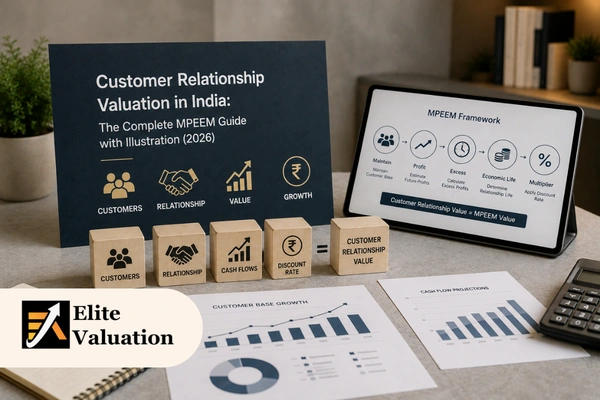
📌 MPEEM — Multi-Period Excess Earnings Method Explained
MPEEM values a specific intangible asset by isolating the portion of a business's cash flows that is attributable to that asset alone, after deducting the required returns on all other assets (tangible and intangible) that also contribute to generating those cash flows. Those other assets are called contributory assets, and the charges deducted for them are contributory asset charges (CACs).
Excess Earnings = Asset Revenue − Operating Costs − Taxes − Working Capital Return − Fixed Asset Return − Other Intangible Returns − Workforce Return
Multi-Period Excess Earnings Method (MPEEM)
Best For: Customer relationships, order backlog, core technology with identifiable cash flows, non-compete agreements
MPEEM is the standard method for valuing assets where a specific, identifiable revenue stream can be attributed to the intangible. The core challenge — and the most common source of error — is the contributory asset charge. CACs must be computed at fair market rates of return on the fair values of all supporting assets, not at book values. Using book values for working capital or fixed assets, omitting the assembled workforce charge, or applying the wrong required return rate on other intangibles will materially overstate or understate the excess earnings attributable to the subject intangible.
- Project cash flows from the asset-specific revenue stream over remaining economic life
- Deduct operating expenses, taxes and working capital requirements
- Deduct contributory asset charges at fair market required returns on fair values of: working capital, fixed assets, assembled workforce, other intangibles
- Remaining excess earnings are attributable to the subject intangible
- Discount to present value at an intangible-specific discount rate
⚠️ Key Risk: Customer attrition rates in customer relationship valuations and technology obsolescence assumptions in patent/software valuations are the most sensitive inputs — small changes in attrition or obsolescence assumptions produce large value swings. These must be benchmarked against industry data, not management estimates alone.
With-and-Without Method
Best For: Non-compete agreements, exclusivity clauses, key contracts — assets whose value is best measured by the difference they make
The with-and-without method is a variant of the income approach that values an intangible asset by comparing two scenarios: the business with the asset in place versus the business without it. The difference in present value between the two scenarios represents the value of the intangible. It is particularly well-suited for assets whose primary function is to prevent a negative outcome — a non-compete agreement, an exclusivity clause or a key distribution contract — rather than to generate incremental revenue directly.
- Project cash flows under the "with" scenario — business operating normally with the asset in place
- Project cash flows under the "without" scenario — reflecting lost revenues, increased costs or competitive erosion over the transition period
- The difference in discounted cash flows represents the value of the intangible's protective function
- The valuation period ends when the business could theoretically recover through other means — for a non-compete, typically the agreement's contractual term
Key Consideration: The "without" scenario must be realistic and defensible — overly pessimistic assumptions about competitive harm overstate value; overly optimistic assumptions understate it. The valuer must assess the actual competitive threat posed, the speed at which a replacement relationship could be established, and the market share genuinely at risk.
Market Approach
Best For: Pharmaceutical patents, music copyrights, franchise rights — industries with active IP markets The comparable transaction method analyses recent sales or licensing of similar intangible assets, adjusts for differences in technology maturity, market size, geographic coverage, exclusivity and remaining economic life, and applies the adjusted metrics to the subject asset. In practice, truly comparable transactions are rare — each intangible is unique, and transaction terms are rarely fully disclosed. This method is primarily used as a cross-check on income approach conclusions, or as the primary method where income-based data is unavailable.
Cost Approach
Replacement Cost Method
Best For: Software, internally developed technology, assembled workforce, databases
The replacement cost method estimates the cost to develop an equivalent asset with the same utility using current methods and technology. It includes direct costs (labour, materials, testing), indirect costs (overhead, management time) and developer's profit. Critically, the cost must then be reduced for functional obsolescence (the asset does less than what current technology would deliver), technological obsolescence (newer approaches exist) and economic obsolescence (market conditions have reduced demand for the asset's output). Cost to create is not equal to value — this method is a floor, not a primary indication of worth, for most intangible asset types.
Method Selection by Asset Type
| Intangible Asset Type | Primary Method | Cross-Check Method |
|---|---|---|
| Trademarks / Brands | Relief from Royalty | Comparable transactions, MPEEM |
| Patents — licensed | Relief from Royalty | Comparable licensing deals |
| Patents — unlicensed | MPEEM / Incremental cash flow | Cost approach |
| Customer relationships | MPEEM | Cost to recreate |
| Software / technology | Relief from Royalty / MPEEM | Replacement cost |
| Copyrights / content | Relief from Royalty | Comparable transactions |
| Non-compete agreements | With-and-without method | Cost approach |
| Assembled workforce | Replacement cost | MPEEM (as CAC only) |
| Order backlog | MPEEM | Comparable margins |
| Franchise rights | MPEEM / Incremental cash flow | Comparable transactions |
How Does the Intangible Asset Valuation Process Work?
A rigorous intangible asset valuation follows a seven-step process that combines legal due diligence, financial analysis, methodology application and documented reporting. Skipping or shortcutting any step is the primary cause of valuations that fail under audit or regulatory scrutiny.
1. Engagement Scoping and Asset Identification
Define the valuation purpose (financial reporting, M&A, tax, litigation, fundraising), the applicable standard of value (fair value under Ind AS, FMV under Income Tax, arm's length under transfer pricing), the valuation date, and the professional requirement. Comprehensively identify all intangible assets — many that are absent from the balance sheet (internally generated brands, customer relationships, assembled workforce) must still be identified and valued for transaction and reporting purposes. Incomplete identification is the most consequential error a valuation team can make at this stage.
2. Legal and IP Due Diligence
Intangible asset valuation is only as reliable as the legal rights it is based on. Verify ownership through registration certificates, assignment deeds and employment agreements. Confirm protection status — patent grant versus application, trademark registration classes, copyright registration, trade secret protection measures. Identify remaining economic life accounting for patent expiration, renewal history and technology trends. Map all encumbrances — licensing arrangements, liens, co-ownership, pending oppositions, infringement claims. Legal defects can impair value to zero — the valuation must reflect actual enforceable rights, not claimed rights.
3. Economic and Market Analysis
Establish the economic context in which the asset generates value: market size and growth, competitive landscape, barriers to entry, industry royalty rate benchmarks, comparable IP transactions, technology obsolescence trends and regulatory environment. This analysis sets the framework for royalty rate selection, revenue projections and discount rate construction — the three most sensitive inputs in the valuation model. Weak market analysis is the most common reason royalty rates are challenged by tax authorities and auditors.
4. Financial Analysis and Benefit Quantification
Quantify the economic benefits attributable to the specific intangible: identify revenues driven by the brand or patent, determine excess profits versus generic/unbranded alternatives, estimate the hypothetical royalty for the relief from royalty method, or isolate the specific revenue stream for MPEEM. The core analytical challenge is attribution — separating the intangible's contribution from the contributions of tangible assets, working capital, workforce and other intangibles that operate alongside it.
5. Methodology Application
Apply the selected primary method and cross-check method. For relief from royalty: project revenues, apply benchmarked royalty rate, tax-affect, discount to present value. For MPEEM: project asset-specific cash flows, deduct all contributory asset charges at fair market required returns, discount excess earnings. Document the analytical basis for each key input — royalty rate source, attrition rate data, discount rate build-up, useful life determination. The methodology section of the report must be self-contained and independently reviewable.
6. Discount Rate and Risk Adjustment
Intangible assets carry higher risk than overall business cash flows and must be discounted at rates above the company's WACC. The discount rate build-up starts with WACC or cost of equity and adds premiums for technology risk, market risk, legal risk (patent validity, trademark enforceability) and obsolescence risk. For MPEEM, each contributory asset class (working capital, fixed assets, customer relationships, technology) has a distinct required return reflecting its risk profile. Applying a single WACC to all intangible asset types is a material error.
7. Value Reconciliation and Reporting
Reconcile results from primary and cross-check methods, weight based on reliability and data quality, and state the final value conclusion — as a point estimate or a range where appropriate. The report must contain: executive summary with purpose, date, standard and conclusion; asset description and legal status; industry and market analysis; methodology explanation with full calculations; key assumptions and their basis; limiting conditions and disclosures; and professional independence declaration. For regulatory valuations, the format must comply with the specific requirements of the applicable standard — IBBI Valuation Standards, Ind AS 113, or OECD Transfer Pricing Guidelines.
Brand, Patent and Transfer Pricing Valuation in India
Brand Valuation in India
Brand valuation is most commonly performed using the relief from royalty method — projecting brand-driven revenues, applying a market-benchmarked royalty rate and discounting to present value. The royalty rate selection is the dominant analytical challenge. It must reflect the specific brand's strength, market position, geographic reach and consumer loyalty — not an industry average. The 25% rule of thumb (allocating 25% of operating profit as royalty) has been widely rejected by tax authorities and courts internationally and should not be used as a primary reference.
For Indian brands, royalty rate benchmarks are drawn from comparable licensing transactions in RoyaltySource, RoyaltyStat, ktMINE and publicly available licensing disclosures. Relevant comparability factors include the brand's awareness level, geographic coverage, product category, exclusivity of the licence, and the competitive intensity of the market. For Ind AS 103 PPA purposes, the brand is valued at fair value reflecting market participant assumptions — not entity-specific synergies. The resulting value is amortised over its economic life or tested annually for impairment if deemed indefinite-lived.
Patent Valuation in India
Patent valuation methodology depends on whether the patent is licensed or unlicensed. For licensed patents with established royalty rates — common in pharmaceuticals, electronics and software — the relief from royalty method is directly applicable. For unlicensed patents — proprietary process technologies, manufacturing innovations — MPEEM is applied, projecting the incremental cash flows enabled by the patent relative to the next-best alternative. The remaining economic life of a patent is determined by the earlier of its expiry date and the date by which a competing technology renders it economically obsolete.
For early-stage patents — particularly biotech and pharmaceutical patents awaiting clinical trial outcomes — a probability-weighted scenario analysis is applied, adjusting the base cash flows by the probability of successfully completing each development stage. This risk-adjustment is applied to cash flows rather than the discount rate, to avoid double-counting. Indian patent valuation must also account for the Indian Patents Act 1970 provisions on compulsory licensing, parallel imports and patentability restrictions under Section 3(d), all of which can materially impair patent value relative to equivalent Western jurisdictions.
Software and Technology Valuation
Software and technology assets are valued using relief from royalty (where the technology is licensed to others or comparable licences exist) or replacement cost (where the technology is embedded in operations and no licensing market exists). The replacement cost approach must be carefully adjusted for functional obsolescence — current technology may achieve the same output with less code, fewer resources or faster processing. The economic life of software is typically 3–7 years, significantly shorter than many companies assume, reflecting rapid technological change. Proprietary algorithms, machine learning models and data assets increasingly form the core of technology company valuations and require bespoke valuation approaches that combine the income and cost approaches.
Intangible Asset Valuation for Transfer Pricing
Transfer pricing valuation for intangibles has become one of the highest-risk areas of tax compliance for Indian multinationals following India's adoption of OECD BEPS recommendations. Under the profit split method and TNMM (transactional net margin method), the arm's length return attributable to intangibles must be carefully analysed. The OECD's guidance on "hard-to-value intangibles" — including patents and brands whose value at the time of transfer is highly uncertain — imposes a look-back obligation on tax authorities, allowing them to re-price transfers based on actual post-transfer outcomes even years after the transaction. Contemporaneous, robust documentation using the comparable uncontrolled transaction (CUT) method or a residual profit split is the primary defence.
Who Can Perform Intangible Asset Valuation in India?
The professional requirement for intangible asset valuation varies by the regulatory framework triggering the engagement. Using the wrong professional category produces a non-compliant report that is invalid for its intended purpose — regardless of the analytical quality of the underlying work.
| Purpose / Framework | Required Professional | Key Consideration |
|---|---|---|
| Companies Act — mergers, demergers, capital reduction | IBBI Registered Valuer | Must hold 'Securities or Financial Assets' asset class registration |
| Ind AS 103 — purchase price allocation | IBBI Registered Valuer / Ind AS specialist | Must understand fair value hierarchy under Ind AS 113 and market participant assumptions |
| Income Tax — capital gains on IP transfer | CA / Merchant Banker | FMV under Section 55 / Rule 11UA; report must be contemporaneous with transfer |
| Transfer Pricing — cross-border IP transactions | CA / Transfer Pricing Specialist | OECD BEPS-aligned documentation; benchmarking database access essential |
| FEMA — cross-border IP transfer / licensing | CA / Merchant Banker | FMV certification for AD bank and FC-TRS / FC-GPR compliance |
| IP litigation — damages quantification | Specialised IP Valuer / Expert Witness | Must combine IP law understanding with financial modelling expertise; court-acceptable format |
📋 A Note for Chartered Accountants and Merchant Bankers
While CAs and merchant bankers are the prescribed professionals for income tax FMV certifications and FEMA compliance, intangible asset valuation — particularly for brands, patents, customer relationships and technology portfolios — requires specialised financial modelling expertise that goes well beyond standard practice. The relief from royalty method demands access to licensed royalty benchmarking databases (RoyaltySource, RoyaltyStat, ktMINE), detailed comparable transaction analysis and asset-specific discount rate construction. MPEEM requires a full contributory asset charge framework built on fair-value returns across every supporting asset class.
- Many CAs and merchant bankers rely on experienced IBBI-registered valuers with a proven intangible asset track record to conduct the substantive valuation analysis, with the CA or MB issuing the final regulatory certificate based on that expert work
- At Elite Valuation, we regularly support CAs and merchant bankers as the expert registered valuer behind their intangible asset certifications — providing the full valuation model, royalty rate benchmarking, methodology documentation and working papers
- Our team has completed intangible asset valuations across brand portfolios, pharmaceutical patents, software and technology assets, customer relationships, and cross-border IP transfers — with reports accepted by the Income Tax Department, NCLT, statutory auditors and SEBI
- If you are a CA or merchant banker handling a transaction that involves intangible asset valuation, reach out to us — we work seamlessly as your expert valuation partner
Dealing With a Complex Intangible Asset Valuation?
Our team combines IBBI-registered valuation expertise, Ind AS 103 PPA experience, transfer pricing documentation and IP litigation support — covering brands, patents, customer relationships, software and technology assets across all regulatory frameworks.
Common Mistakes in Intangible Asset Valuation India
- Failure to identify all intangible assets — Overlooking material intangibles — internally generated brands, customer relationships not on the balance sheet, non-contractual relationships, embedded software, assembled workforce — is the most consequential identification error. In a PPA, each unidentified intangible is collapsed into goodwill, distorting the amortisation profile, impairing impairment testing accuracy, and creating potential audit qualifications.
- Consequence: Understatement of total intangible value; goodwill misstatement; incorrect PPA; audit qualification.
- Inadequate legal due diligence on IP ownership — Valuing assets the entity does not legally own — by assuming rather than verifying ownership, overlooking co-ownership or licensing encumbrances, ignoring pending oppositions or infringement claims, or failing to check lapsed maintenance payments — produces a fundamentally unreliable report. A brand with a disputed trademark registration or a patent with a pending invalidity challenge is worth materially less than the same asset with clean title.
- Consequence: Overvaluation of legally impaired assets; significant post-transaction disputes; professional liability exposure.
- Inappropriate royalty rate selection — Using industry average royalty rates without analysing specific asset characteristics — brand strength, geographic coverage, exclusivity, competitive position — produces royalty rates that are indefensible under scrutiny. Equally, using list rates from licensing directories without verifying that they reflect actual negotiated transactions (which are typically lower) overstates royalty income. The royalty rate is the single most scrutinised input in a brand or patent valuation — by tax authorities, auditors, transaction counterparties and courts alike.
- Consequence: Material misstatement of brand or technology value; tax authority challenge; audit qualification.
- Incorrect contributory asset charges in MPEEM — Computing CACs on book values rather than fair values of supporting assets, applying inappropriate required return rates, double-counting or omitting specific asset classes (particularly assembled workforce), or failing to reflect economic depreciation of contributory assets — all produce material errors in the excess earnings attributed to the subject intangible. MPEEM errors are directionally uncertain: overestimating CACs understates the intangible's value; underestimating them overstates it.
- Consequence: Overstatement or understatement of intangible value; PPA errors; impairment testing misstatement.
- Using legal life instead of economic life — A patent's 20-year statutory term is irrelevant to valuation if the underlying technology is commercially obsolete in five years. A trademark registered for 10 years may have an indefinite economic life if the brand is actively maintained. Valuation must use economic life — the period over which the asset actually generates economic benefits. This requires an assessment of technology substitution risk, competitive dynamics, market trends and obsolescence — not a mechanical read of registration certificates.
- Consequence: Material overvaluation of short-lived assets; future impairment charges; failed synergy expectations.
- Applying company WACC to intangible asset discount rates — Intangible assets carry higher risk than overall business cash flows — technology risk, market adoption risk, legal enforceability risk, and obsolescence risk all add premium above WACC. Applying the company's WACC to intangible-specific cash flows systematically understates the discount rate and overstates the present value. Each intangible category requires a distinct discount rate reflecting its specific risk profile — customer relationships (relatively low risk), early-stage patents (high risk), assembled workforce (moderate risk).
- Consequence: Systematic overvaluation; regulatory rejection; litigation vulnerability.
- Poor documentation and assumption transparency — A technically correct valuation that is poorly documented — insufficient explanation of royalty rate selection, missing data sources, unexplained growth rates, no sensitivity analysis — is indistinguishable from a weak valuation under audit or regulatory review. The report must be self-contained and independently verifiable. Any reviewer — tax officer, NCLT, auditor, arbitrator — must be able to follow the analysis from inputs to conclusions without additional explanation from the valuer.
- Consequence: Valuation appears arbitrary under scrutiny; difficulty defending in disputes; professional liability exposure.
Need Expert Intangible Asset Valuation in India?
From purchase price allocation and brand valuation to patent portfolios, transfer pricing documentation and IP litigation support — our IBBI-registered valuers deliver compliant, defensible reports across all regulatory frameworks.
Closing Summary: Intangible Asset Valuation Strategy
Intangible asset valuation in India is no longer a peripheral technical exercise — it sits at the intersection of financial reporting, M&A execution, tax compliance, transfer pricing documentation and strategic IP management. As knowledge-intensive industries continue to grow as a proportion of Indian GDP, the proportion of enterprise value attributable to intangibles will only increase — making rigorous, defensible intangible asset valuation an increasingly non-negotiable capability. The complexity stems not just from the methodologies — relief from royalty, MPEEM, contributory asset charges — but from the multi-framework regulatory environment in which any single intangible asset transaction must simultaneously satisfy Ind AS, Companies Act, Income Tax, transfer pricing and FEMA requirements, each with its own standard, methodology and professional. Getting one framework wrong while getting the others right is not a partial success — it is a failed engagement. At Elite Valuation, our IBBI-registered valuers and chartered accountants bring the technical depth and regulatory breadth required to navigate all five frameworks in a single, coordinated engagement.
Frequently Asked Questions — Intangible Asset Valuation

CA Sagar Shah, Founder
Mr Sagar Shah is the Founder of Elite Valuation and leads the firm’s Valuation and Advisory practice. With over 15+ years of professional experience.